Tuberculosis in Special
Situations
Dr. K.Deepak Kanna MD
Assistant Professor , Dept of Respiratory
Medicine
Govt Medical College Hospital , Virudhunagar
TREATMENT OF TB IN SPECIAL SITUATIONS
• TB in COVID
• TB in PREGNANCY / LACTATION
• TB in ELDERLY
• TB in Pts with HEPATIC DISEASES
• TB in Pts with RENAL DISEASES
• TB in HIV/AIDS
• TB in Children
TB in COVID Patients
• No interaction between ATT drugs and drugs
used during Covid .
• The dose of Steroids had to be adjusted while
treating Covid and tapered.
• ATT can be started along with Covid Positive
status and Diagnosed TB at same time.
• Vaccination to be avoided to patients on ATT
before determining the cause of acquiring the
infection ( Immuno suppression, DM, Drugs,etc)
TB IN PREGNANT AND LACTATING WOMEN
• Before starting ATT, women of childbearing age
group should be asked about current
pregnancy status / planned pregnancy and
counselled appropriately.
• Safe ATT drugs in Pregnancy & Lacatation –
CAT- I - H R Z E
• ATT contra indicated –Cat II - Inj Streptomycin
( ototoxic to foetus )
• No modification in ATT and can continue full course .
• Breast feeding has to be continued.
• After ruling out active TB , the baby should be given
6 months of Isoniazid preventive therapy for 6
months followed by BCG vaccination. Breast feeding
should not be discouraged.
• Mother must be advised cough hygiene measures
such as covering the nose and mouth while coughing
, sneezing or any act which produces sputum
production droplets.
• Mothers receiving INH and their breastfed infants
should be supplemented with vitamin B6
(pyridoxine)(5mg/day)
MDR TB in Pregnancy
• Teratogenicity is demonstrated with drugs used to
treat MDR – TB
• Women diagnosed MDR TB should be counselled
intensively to use birth control measures and the
risk of taking MDR drugs for the mother and the
foetus
• Duration of pregnancy is less than 20 weeks –
advise – MTP (Medical Termination)
• If Duration more than 20 weeks – Modified MDR
ATT drugs should be given to her.
TB in Patients on OCP
• Rifampicin and Rifapentine interacts with
oral and hormonal contraceptive
medications – CYP450 and reduces the
efficacy of OCP and hence should be
advised to use alternative anti
contraception methods ( Condoms /
diaphragm) , IUDs, or depot –
metroxyprogesterone.
TB in Liver disorders
• Pts with Hepatitis virus carriage, past history of acute
hepatitis, current excessive alcohol consumption can
receive -H R Z E but hepatotoxicity to be anticipated.
• Liver function test has to be taken at beginning of ATT and
periodically during the course.
• If the Serum ALT –is raised 3 times the normal then
modification of the drugs is needed.
The normal range of values for ALT (SGPT) is about 7 to 56
units per liters of serum – eg. 50 U– then more than 150U is
at upper limit
• Elderly , alcoholics and pre existing liver diseases patients
are prone to develop Hepatotoxicity.
• Hepatatoxic drugs in ATT first line – H R Z
second line ATT- PAS granules, Ethionamide
• Hepato safe drugs – E , Streptomycin , Fluoro
quinolones ( Levofloxacin , Ofloxacin ) .
• In patients with hepatotoxicity – SEO
regimen – streptomycin , ethambutol ,
Ofloxacin .
• ATT challenging test to find the causative
drug in H R Z. ( in special situations only)
TB in Renal diseases.
• Patients suffering from Chronic kidney disease are at increased risk
of developing TB.
• Post renal transplant and other renal diseases pts are to be
counselled to avoid all risk factors in acquiring TB infections.
• Renal safe ATT drugs – HRZ
• Renal toxicity drug- most - Ethambutol
- in moderate renal impairment – FQs, PAS, Cycloserine
• Creatinine Clearance test have to be calculated and determine.
• Dialysis and ATT drugs – can be gven 4-6 hrs after E and Z.
• Post renal transplant – Rifampicin interacts with
immunosuppressive drugs, hence corticosteriods dose should be
doubled in pts receiving Rifampicin.
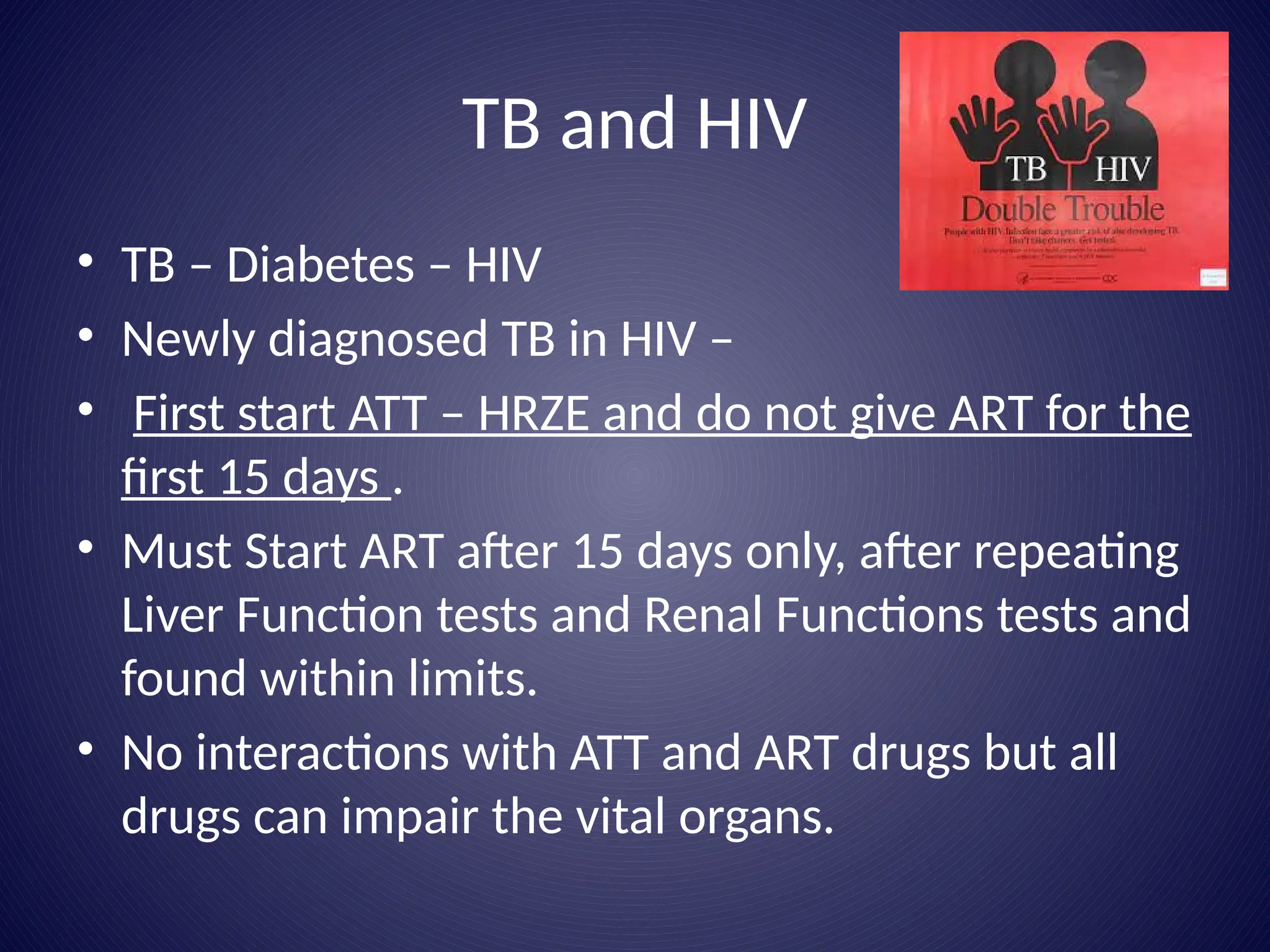
TB and HIV
• TB – Diabetes – HIV
• Newly diagnosed TB in HIV –
• First start ATT – HRZE and do not give ART for the
first 15 days .
• Must Start ART after 15 days only, after repeating
Liver Function tests and Renal Functions tests and
found within limits.
• No interactions with ATT and ART drugs but all
drugs can impair the vital organs.
TB and HIV
• Previously TLE regimen was used for patients
with HIV and TB co existing
• Recent Guidelines – changed from TLE
regimen (FDC) to T L D regimen
• T – Tenofovir 300mg ; L-Lamivudine 300mg;
E- Efavirenz 600mg
• D- (DRV) Darunavir
Darunavir is given 50mg BD till Rifamycin is given
in ATT and changed to 50mg OD ( as Rif
decreases the conc. of Darunavir )
TB in Children
Achieving successful treatment of TB in children depends on a
number of different factors including-
• The child must be promptly diagnosed
• TB treatment must be started promptly
• The correct TB drugs must be provided
• The dosage of the TB drugs must be adjusted according to the
child’s weight
• Support must be provided to ensure that the TB drugs are
taken correctly
• There must be a continuous supply of quality assured TB
drugs.
TB in Children
• There are no drugs that are absolutely
contraindicated in children
• Children generally tolerate well for the second-line
anti-TB drugs.
• Weight based Fixed dose regimen to started for
children
TB and Seizures
• Rifampicin and Phenytoin
• CYP450
• Rifampicin dose has to be increased in Pts on
Phenytoin
• MDR TB - – Cyclocerine , Ethionamide, FQs
are associated with seizures and psychosis.
THANK YOU

TB in Special situations and management

  • 1.
    Tuberculosis in Special Situations Dr.K.Deepak Kanna MD Assistant Professor , Dept of Respiratory Medicine Govt Medical College Hospital , Virudhunagar
  • 2.
    TREATMENT OF TBIN SPECIAL SITUATIONS • TB in COVID • TB in PREGNANCY / LACTATION • TB in ELDERLY • TB in Pts with HEPATIC DISEASES • TB in Pts with RENAL DISEASES • TB in HIV/AIDS • TB in Children
  • 3.
    TB in COVIDPatients • No interaction between ATT drugs and drugs used during Covid . • The dose of Steroids had to be adjusted while treating Covid and tapered. • ATT can be started along with Covid Positive status and Diagnosed TB at same time. • Vaccination to be avoided to patients on ATT before determining the cause of acquiring the infection ( Immuno suppression, DM, Drugs,etc)
  • 4.
    TB IN PREGNANTAND LACTATING WOMEN • Before starting ATT, women of childbearing age group should be asked about current pregnancy status / planned pregnancy and counselled appropriately. • Safe ATT drugs in Pregnancy & Lacatation – CAT- I - H R Z E • ATT contra indicated –Cat II - Inj Streptomycin ( ototoxic to foetus )
  • 5.
    • No modificationin ATT and can continue full course . • Breast feeding has to be continued. • After ruling out active TB , the baby should be given 6 months of Isoniazid preventive therapy for 6 months followed by BCG vaccination. Breast feeding should not be discouraged. • Mother must be advised cough hygiene measures such as covering the nose and mouth while coughing , sneezing or any act which produces sputum production droplets. • Mothers receiving INH and their breastfed infants should be supplemented with vitamin B6 (pyridoxine)(5mg/day)
  • 6.
    MDR TB inPregnancy • Teratogenicity is demonstrated with drugs used to treat MDR – TB • Women diagnosed MDR TB should be counselled intensively to use birth control measures and the risk of taking MDR drugs for the mother and the foetus • Duration of pregnancy is less than 20 weeks – advise – MTP (Medical Termination) • If Duration more than 20 weeks – Modified MDR ATT drugs should be given to her.
  • 7.
    TB in Patientson OCP • Rifampicin and Rifapentine interacts with oral and hormonal contraceptive medications – CYP450 and reduces the efficacy of OCP and hence should be advised to use alternative anti contraception methods ( Condoms / diaphragm) , IUDs, or depot – metroxyprogesterone.
  • 8.
    TB in Liverdisorders • Pts with Hepatitis virus carriage, past history of acute hepatitis, current excessive alcohol consumption can receive -H R Z E but hepatotoxicity to be anticipated. • Liver function test has to be taken at beginning of ATT and periodically during the course. • If the Serum ALT –is raised 3 times the normal then modification of the drugs is needed. The normal range of values for ALT (SGPT) is about 7 to 56 units per liters of serum – eg. 50 U– then more than 150U is at upper limit • Elderly , alcoholics and pre existing liver diseases patients are prone to develop Hepatotoxicity.
  • 9.
    • Hepatatoxic drugsin ATT first line – H R Z second line ATT- PAS granules, Ethionamide • Hepato safe drugs – E , Streptomycin , Fluoro quinolones ( Levofloxacin , Ofloxacin ) . • In patients with hepatotoxicity – SEO regimen – streptomycin , ethambutol , Ofloxacin . • ATT challenging test to find the causative drug in H R Z. ( in special situations only)
  • 10.
    TB in Renaldiseases. • Patients suffering from Chronic kidney disease are at increased risk of developing TB. • Post renal transplant and other renal diseases pts are to be counselled to avoid all risk factors in acquiring TB infections. • Renal safe ATT drugs – HRZ • Renal toxicity drug- most - Ethambutol - in moderate renal impairment – FQs, PAS, Cycloserine • Creatinine Clearance test have to be calculated and determine. • Dialysis and ATT drugs – can be gven 4-6 hrs after E and Z. • Post renal transplant – Rifampicin interacts with immunosuppressive drugs, hence corticosteriods dose should be doubled in pts receiving Rifampicin.
  • 11.
    TB and HIV •TB – Diabetes – HIV • Newly diagnosed TB in HIV – • First start ATT – HRZE and do not give ART for the first 15 days . • Must Start ART after 15 days only, after repeating Liver Function tests and Renal Functions tests and found within limits. • No interactions with ATT and ART drugs but all drugs can impair the vital organs.
  • 12.
    TB and HIV •Previously TLE regimen was used for patients with HIV and TB co existing • Recent Guidelines – changed from TLE regimen (FDC) to T L D regimen • T – Tenofovir 300mg ; L-Lamivudine 300mg; E- Efavirenz 600mg • D- (DRV) Darunavir Darunavir is given 50mg BD till Rifamycin is given in ATT and changed to 50mg OD ( as Rif decreases the conc. of Darunavir )
  • 13.
    TB in Children Achievingsuccessful treatment of TB in children depends on a number of different factors including- • The child must be promptly diagnosed • TB treatment must be started promptly • The correct TB drugs must be provided • The dosage of the TB drugs must be adjusted according to the child’s weight • Support must be provided to ensure that the TB drugs are taken correctly • There must be a continuous supply of quality assured TB drugs.
  • 15.
    TB in Children •There are no drugs that are absolutely contraindicated in children • Children generally tolerate well for the second-line anti-TB drugs. • Weight based Fixed dose regimen to started for children
  • 16.
    TB and Seizures •Rifampicin and Phenytoin • CYP450 • Rifampicin dose has to be increased in Pts on Phenytoin • MDR TB - – Cyclocerine , Ethionamide, FQs are associated with seizures and psychosis.
  • 17.