Management of Tuberculosis Dr. Uttam Kumar Dasgupta MBBS (Cal)  MD (Cal, Chest)
Introduction Commonest cause of death due to a single inf. agent. 1882 – Discovery of TB bacilli. 1944 – First Anti – TB drug, Streptomycin discovered. 1963 – Efficacy of domiciliary treatment established. 1993 – WHO declares TB a global emergency.
Statistics Total no. of pts. infected with TB = 2 bi. (0.3 bi.) Total no. of active TB pts. = 20 mi. (12 mi.) Total no. of pts. dying of TB / year = 3 mi. (5 lakhs) Total no. of NSSP pts. / year = 8 mi. (1.5 mi.)
Principle of standard short course therapy Mycobacterial population divided into 4 groups (Mitchison’s Theory) Grp. A – EC Bacilli in liq. caseous material (H, R) Grp. B – Slow growing in macrophage (Z) Grp. C – Small no. of EC Bacilli in solid caseations  exhibiting brief spurts of metabolism ( R) Grp. D – Dormant bacilli (nil)
Aims of treatment To cure pts. with least interference to their lives. To prevent death from active TB or its effects. To avoid relapse / recurrence. To prevent development of drug resistance. To decrease transmission to others.
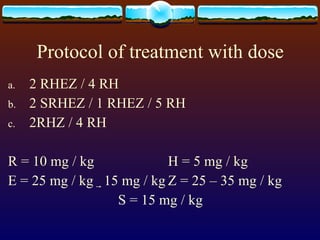
Protocol of treatment with dose 2 RHEZ / 4 RH 2 SRHEZ / 1 RHEZ / 5 RH 2RHZ / 4 RH R = 10 mg / kg H = 5 mg / kg E = 25 mg / kg 15 mg / kg Z = 25 – 35 mg / kg S = 15 mg / kg
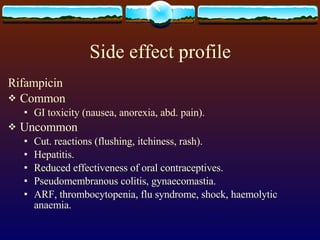
Side effect profile Rifampicin Common GI toxicity (nausea, anorexia, abd. pain). Uncommon Cut. reactions (flushing, itchiness, rash). Hepatitis. Reduced effectiveness of oral contraceptives. Pseudomembranous colitis, gynaecomastia. ARF, thrombocytopenia, flu syndrome, shock, haemolytic anaemia.
Contd… INH Peripheral neuropathy. Hepatitis. Rarely, giddiness, convulsion, optic neuritis, psychosis.
Contd… Ethambutol Progressive loss of vision due to retrobulbar neuritis. Rarely peripheral neuropathy, joint pain, skin rash.
Contd… Pyrazinamide Hepatitis (Bilirubin,  SGPT x3 – stop) Arthralgia – mild but common. Gout. Rarely – GI symptoms, rash, sideroblastic anemia.
Contd… Streptomycin Auditory & vestibular nerve damage. Renal damage. Rarely skin rash & anaphylaxis.
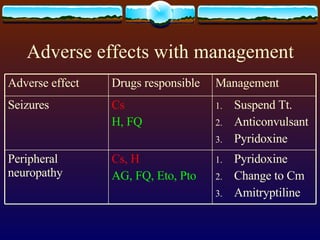
Adverse effects with management Pyridoxine Change to Cm Amitryptiline Cs, H AG, FQ, Eto, Pto Peripheral neuropathy Suspend Tt. Anticonvulsant Pyridoxine Cs H, FQ Seizures Management Drugs responsible Adverse effect
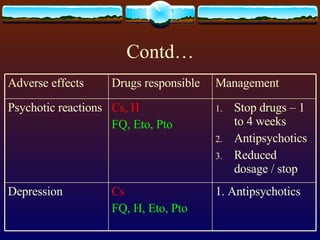
Contd… 1. Antipsychotics Cs FQ, H, Eto, Pto Depression Stop drugs – 1 to 4 weeks Antipsychotics Reduced dosage / stop Cs, H FQ, Eto, Pto Psychotic reactions Management Drugs responsible Adverse effects
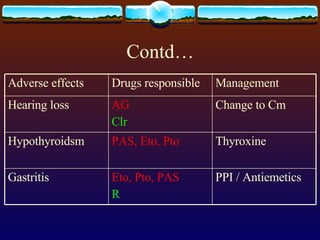
Contd… PPI / Antiemetics Eto, Pto, PAS R Gastritis Thyroxine PAS, Eto, Pto Hypothyroidsm Change to Cm AG Clr Hearing loss Management Drugs responsible Adverse effects
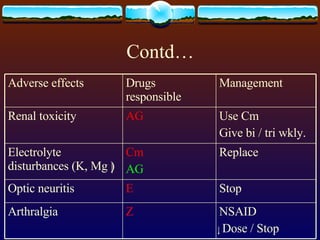
Contd… Stop E Optic neuritis NSAID Dose / Stop Z Arthralgia Replace Cm AG Electrolyte disturbances (K, Mg ) Use Cm Give bi / tri wkly. AG Renal toxicity Management Drugs responsible Adverse effects
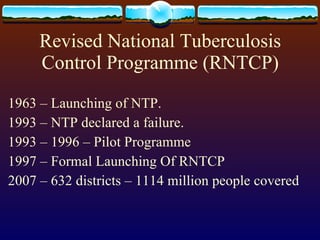
Revised National Tuberculosis Control Programme (RNTCP) 1963 – Launching of NTP. 1993 – NTP declared a failure. 1993 – 1996 – Pilot Programme 1997 – Formal Launching Of RNTCP 2007 – 632 districts – 1114 million people covered
Setup
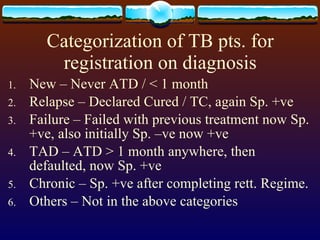
Categorization of TB pts. for registration on diagnosis New – Never ATD / < 1 month Relapse – Declared Cured / TC, again Sp. +ve Failure – Failed with previous treatment now Sp. +ve, also initially Sp. –ve now +ve TAD – ATD > 1 month anywhere, then defaulted, now Sp. +ve  Chronic – Sp. +ve after completing rett. Regime. Others – Not in the above categories
Standardized treatment protocol Cat I – [2 (RHEZ) 3  / 4 (RH) 3 ] Cat II – [2 (SRHEZ) 3  / 1 (RHEZ) 3  / 5 (RHE) 3 ] Cat III – [2 (RHZ) 3  / 4 (RH) 3 ] Cat IV - Individualised
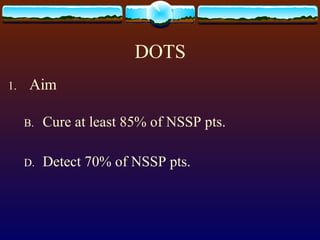
DOTS Aim Cure at least 85% of NSSP pts. Detect 70% of NSSP pts.
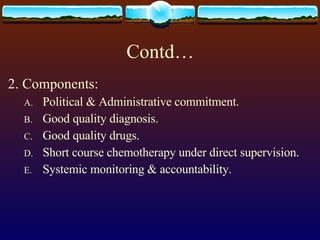
Contd… 2. Components: Political & Administrative commitment. Good quality diagnosis. Good quality drugs. Short course chemotherapy under direct supervision. Systemic monitoring & accountability.
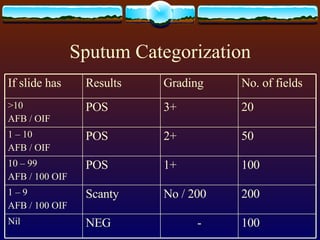
Sputum Categorization 100 - NEG Nil 200 No / 200 Scanty 1 – 9 AFB / 100 OIF 100 1+ POS 10 – 99 AFB / 100 OIF 50 2+ POS 1 – 10 AFB / OIF 20 3+ POS >10 AFB / OIF No. of fields Grading Results If slide has
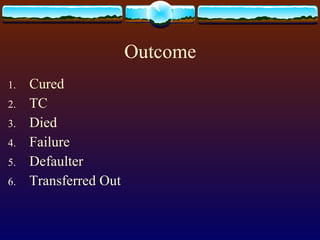
Outcome Cured TC Died Failure Defaulter Transferred Out
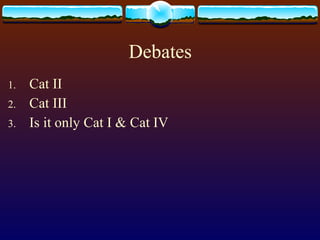
Debates Cat II Cat III Is it only Cat I & Cat IV
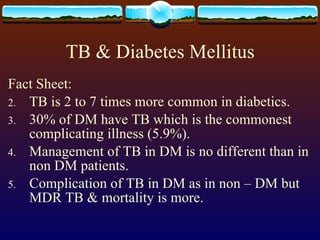
TB & Diabetes Mellitus Fact Sheet: TB is 2 to 7 times more common in diabetics. 30% of DM have TB which is the commonest complicating illness (5.9%). Management of TB in DM is no different than in non DM patients. Complication of TB in DM as in non – DM but MDR TB & mortality is more.
Points to remember in TB + DM Prompt initiation of Pharmacotherapy. Adequate diet prescription. Possible failure of sulphonylureas with Rifampicin co-administration. Augmentation of hepatotoxicity of ATT (esp. with Thiazolidindiones but less with biguanides). Insulin is always a good option.
TB & HIV ( The Deadly Duo ) Estimates in 2000: Globally no. of people with TB + HIV = 11.4 mi. (2 mi.). 8.3 million new cases of TB (3.7 mi. is Sp. +ve). Most live in SSA, WP & S.E. Asia where 34 mi. (85%) of estimated 40 mi. people with HIV also live. 9% of 8.3 mi. new TB cases were due to HIV.
Contd… 4. 12% of 1.84 mi. deaths due to TB were due to HIV. 5. 11 % of all adult AIDS deaths were due to TB. 6. HIV infected pts. has a five time risk of developing TB than non – HIV pts. 7. TB & HIV interaction is bi-directional.
Issues in HAART – ATD When to start HAART ‘ Virologic, immunologic & clinical responses to HAART of HIV – 1 TB patients treated concurrently with antitubercular therapy & HAART was similar to those of non TB patients’ Hung C. C. et. al AIDS 2003; 17: 2615 - 2622
Contd… Proposal: CD 4 < 100 / µ L or in advanced AIDS – concurrent HAART as early as possible. CD 4 100 – 200 / µL – Start HAART 4 – 8 weeks after ATD initiation. CD 4 > 200 / µ L – initiation of HAART based on Further AIDS defining condition. CD 4 counts & rate of decline. Drug toxicity & interactions.
Contd… 2.  Optimal duration of therapy 6 months but prolonged to 9 months in delayed clinical (sym.) / microbiologic response (culture +ve at 2 months) Treatment failure & relapse is related to: Advanced immuno deficiency. Acquired Rifamycin resistance (common in intt. ATD). So daily ATD.
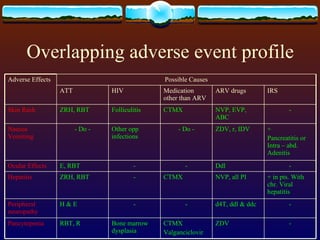
Overlapping adverse event profile - ZDV CTMX Valganciclovir Bone marrow dysplasia RBT, R Pancytopenia - d4T, ddl & ddc - - H & E Peripheral neuropathy + in pts. With chr. Viral hepatitis NVP, all PI CTMX - ZRH, RBT Hepatitis - Ddl - - E, RBT Ocular Effects + Pancreatitis or Intra – abd. Adenitis ZDV, r, IDV - Do - Other opp infections - Do - Nausea Vomiting - NVP, EVP, ABC CTMX Folliculitis ZRH, RBT Skin Rash IRS ARV drugs Medication other than ARV HIV ATT Possible Causes Adverse Effects
Drug – drug interaction R reduces PI & NNRTI by increasing CYP3A which metabolises PI & NNRTI. So R never with PI & NNRTI. RBT also increases CYP3A but less so, so can be used with PI. PI & NNRTI alters R level by increasing or decreasing CYP3A. PI can increase levels of RBT & it’s metabolites. So when using NNRTI with RBT, increase dose of RBT & while using PI reduce dose of RBT H inhibits CYP3A thus increasing levels of PI & NNRTI.
IRS Definition : Restoration of immunity by ARV therapy leading to increased inflammation in TB resulting in significant worsening of S / S (Paradoxical reactions) Onset  – Within days of ARV therapy or months after ARV initiation. Symptoms : Fever, adenopathy, increased pulmonary infiltrates, serositis. Less common features are worsening of meningitis, increased CNS tuberculomas, soft tissue & bone abscess & diffuse skin lesions. Diagnosis : Difficult.
BCG & HIV Role of BCG in preventing TB in HIV +ve pts. is not known. Conversion to +ve MT after BCG is less frequent but significant BCG is safe in HIV WHO recommendation: In high prevalence – BCG except in children with S / S of HIV / AIDS In low prevalence – no BCG
MDR TB Definition : Resistance to H + R + / - other drugs. Causes : Inadequate & inappropiate previous treatment with ATD. Patients with extensive cavitary disease. Addition syndrome Ineffectual & irrational drug schedule. Contact with a known MDR patient.
Basic principles of Tt. Of MDR TB Tt. should be in a specialised centre with C / S facilities. Careful analysis of past drug history. Never to add a single to a failing regimen. Never combine two drugs of the same group or a drug with known cross resistance. (eg. Thioamides / TZN, Km or Am / Sm, R / RBT) Intt. therapy is not effective in MDR TB
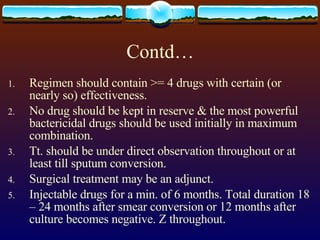
Contd… Regimen should contain >= 4 drugs with certain (or nearly so) effectiveness. No drug should be kept in reserve & the most powerful bactericidal drugs should be used initially in maximum combination. Tt. should be under direct observation throughout or at least till sputum conversion. Surgical treatment may be an adjunct. Injectable drugs for a min. of 6 months. Total duration 18 – 24 months after smear conversion or 12 months after culture becomes negative. Z throughout.
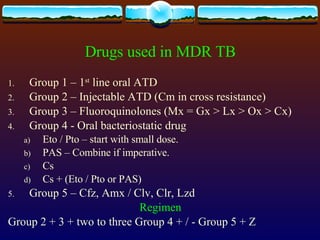
Drugs used in MDR TB Group 1 – 1 st  line oral ATD Group 2 – Injectable ATD (Cm in cross resistance) Group 3 – Fluoroquinolones (Mx = Gx > Lx > Ox > Cx) Group 4 - Oral bacteriostatic drug Eto / Pto – start with small dose. PAS – Combine if imperative. Cs Cs + (Eto / Pto or PAS) Group 5 – Cfz, Amx / Clv, Clr, Lzd Regimen Group 2 + 3 + two to three Group 4 + / - Group 5 + Z
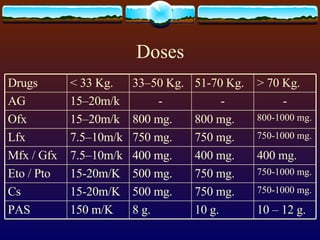
Doses 10 – 12 g. 10 g. 8 g. 150 m/K PAS 750-1000 mg. 750 mg. 500 mg. 15-20m/K Cs 750-1000 mg. 750 mg. 500 mg. 15-20m/K Eto / Pto 400 mg. 400 mg. 400 mg. 7.5–10m/k Mfx / Gfx 750-1000 mg. 750 mg. 750 mg. 7.5–10m/k Lfx 800-1000 mg. 800 mg. 800 mg. 15–20m/k Ofx - - - 15–20m/k AG > 70 Kg. 51-70 Kg. 33–50 Kg. < 33 Kg. Drugs
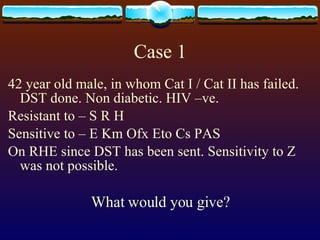
Case 1 42 year old male, in whom Cat I / Cat II has failed. DST done. Non diabetic. HIV –ve. Resistant to – S R H Sensitive to – E Km Ofx Eto Cs PAS On RHE since DST has been sent. Sensitivity to Z was not possible. What would you give?
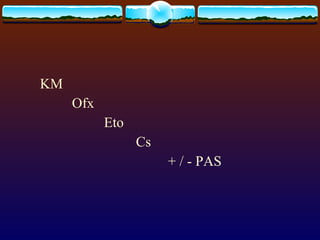
KM Ofx Eto Cs + / - PAS
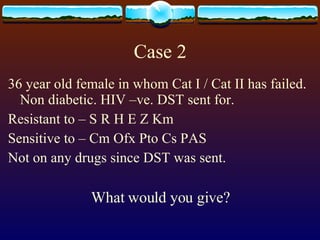
Case 2 36 year old female in whom Cat I / Cat II has failed. Non diabetic. HIV –ve. DST sent for. Resistant to – S R H E Z Km Sensitive to – Cm Ofx Pto Cs PAS Not on any drugs since DST was sent. What would you give?
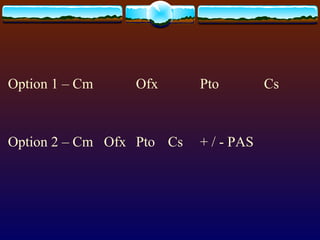
Option 1 – Cm Ofx Pto Cs Option 2 – Cm Ofx Pto Cs + / - PAS
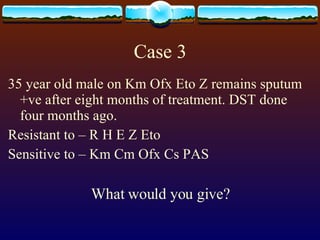
Case 3 35 year old male on Km Ofx Eto Z remains sputum +ve after eight months of treatment. DST done four months ago. Resistant to – R H E Z Eto Sensitive to – Km Cm Ofx Cs PAS What would you give?
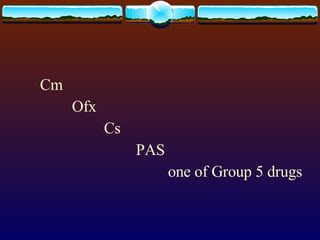
Cm Ofx Cs PAS one of Group 5 drugs
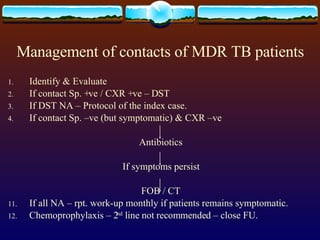
Management of contacts of MDR TB patients Identify & Evaluate If contact Sp. +ve / CXR +ve – DST If DST NA – Protocol of the index case. If contact Sp. –ve (but symptomatic) & CXR –ve  Antibiotics If symptoms persist FOB / CT If all NA – rpt. work-up monthly if patients remains symptomatic. Chemoprophylaxis – 2 nd  line not recommended – close FU.
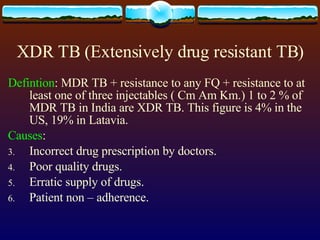
XDR TB (Extensively drug resistant TB) Defintion : MDR TB + resistance to any FQ + resistance to at least one of three injectables ( Cm Am Km.) 1 to 2 % of MDR TB in India are XDR TB. This figure is 4% in the US, 19% in Latavia. Causes : Incorrect drug prescription by doctors. Poor quality drugs. Erratic supply of drugs. Patient non – adherence.
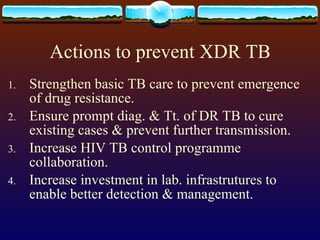
Actions to prevent XDR TB Strengthen basic TB care to prevent emergence of drug resistance. Ensure prompt diag. & Tt. of DR TB to cure existing cases & prevent further transmission. Increase HIV TB control programme collaboration. Increase investment in lab. infrastrutures to enable better detection & management.
DOTS PLUS & Green Light Committee DOTS PLUS is a comprehensive management strategy that includes five tenets of DOTS strategy. It considers specific issues (eg. use of reserve drugs) that needs to be addressed in high MDR TB areas. Green Light Committee is a working group that has made arrangement with the pharmaceutical industry to provide concessionally - priced 2 nd  line anti TB drugs to DOTS PLUS pilot projects for management of MDR TB.
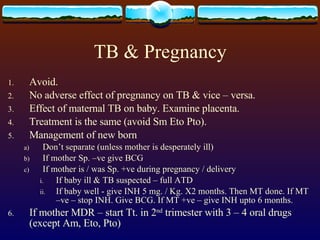
TB & Pregnancy Avoid. No adverse effect of pregnancy on TB & vice – versa. Effect of maternal TB on baby. Examine placenta. Treatment is the same (avoid Sm Eto Pto). Management of new born Don’t separate (unless mother is desperately ill) If mother Sp. –ve give BCG If mother is / was Sp. +ve during pregnancy / delivery If baby ill & TB suspected – full ATD If baby well - give INH 5 mg. / Kg. X2 months. Then MT done. If MT –ve – stop INH. Give BCG. If MT +ve – give INH upto 6 months. If mother MDR – start Tt. in 2 nd  trimester with 3 – 4 oral drugs (except Am, Eto, Pto)
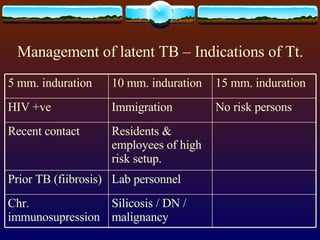
Management of latent TB – Indications of Tt. Silicosis / DN / malignancy Chr. immunosupression Lab personnel Prior TB (fiibrosis) Residents & employees of high risk setup. Recent contact No risk persons Immigration HIV +ve 15 mm. induration 10 mm. induration 5 mm. induration
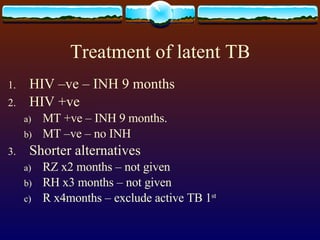
Treatment of latent TB HIV –ve – INH 9 months HIV +ve MT +ve – INH 9 months. MT –ve – no INH Shorter alternatives RZ x2 months – not given RH x3 months – not given R x4months – exclude active TB 1 st
Toxicity with Tt. of latent TB HIV -ve – Low risk. Hepatitis (fatal), PN (use B 6 ) HIV +ve – Toxicity > that of HIV –ve pts.
Problems with treatment of latent TB Low rate of Tt. inititation. Low Tt. completion rates. Monitoring for toxicity is a must. Logistic difficulties. Future protocol RPT + INH x3 months Mx Special situations Pregnant / breast feeding females – INH  Children – INH Contacts with MDR – Z + E / Z + FQ x6 – 12 months
Newer drugs in TB Why is it required? To improve current Tt. Of active TB by Shortening duration of treatment Providing more widely spaced intt. therapy. To improve MDR TB Tt. To provide more effective Tt. of latent TB.
The Drugs Rifabutine First used in MAC prophylaxis. Now, used as a substitute for R & for patients who can’t be given R for drug drug interaction. Given twice weekly, it increases acquired drug resistance. Rifalazin Acts by reducing enzyme induction. Reduces drug drug interaction Flu like syndrome
Rifapentine It is not indicated in advanced TB & HIV infection (acquired Rifamycin resistance) It’s chief indication is LTBI where it is combined with H. Dose is 900 mg. / day. Moxifloxacin It’s bactericidal activity is better than R but = H
Contd… 5. Diarylquinoline (R 207910) Effective against drug sensitive bacilli & strains resistant to SRHEZFQ. It is effective against other myco bacteria. It may be combined with any standard ATD (RHZ). It’s ability to shorten duration is under trial. Pyrrole (LL 3858) – It’s a good steriliser. Dihydroimidazo – oxazoles (OPC – 67683) No cross resistance or antagonistic action against other ATD. Better than the first line drugs.
Contd… Nitroimidazopyrans (PA – 824) Effective against sensitive & resistant TB. It is highly selective. Active against non replicating bacilli (cf ‘H’). Active against MDR TB. Does not demonstrate mutagenicity. Min. effective dose is 12.5 mg. / day. It is not genotoxic. SQ 109 – Active against MDR TB
Contd… Oxazolidinones It is very active against MDR TB May rarely cause peripheral & optic neuropathy.
Where youth grows pale, and spectre-thin, and dies;          Where but to think is to be full of sorrow                  And leaden-eyed despairs,      Where Beauty cannot keep her lustrous eyes,          Or new Love pine at them beyond to-morrow. - John Keats (Ode To A Nightingale)
Thank You!

MOT

  • 1.
    Management of TuberculosisDr. Uttam Kumar Dasgupta MBBS (Cal) MD (Cal, Chest)
  • 2.
    Introduction Commonest causeof death due to a single inf. agent. 1882 – Discovery of TB bacilli. 1944 – First Anti – TB drug, Streptomycin discovered. 1963 – Efficacy of domiciliary treatment established. 1993 – WHO declares TB a global emergency.
  • 3.
    Statistics Total no.of pts. infected with TB = 2 bi. (0.3 bi.) Total no. of active TB pts. = 20 mi. (12 mi.) Total no. of pts. dying of TB / year = 3 mi. (5 lakhs) Total no. of NSSP pts. / year = 8 mi. (1.5 mi.)
  • 4.
    Principle of standardshort course therapy Mycobacterial population divided into 4 groups (Mitchison’s Theory) Grp. A – EC Bacilli in liq. caseous material (H, R) Grp. B – Slow growing in macrophage (Z) Grp. C – Small no. of EC Bacilli in solid caseations exhibiting brief spurts of metabolism ( R) Grp. D – Dormant bacilli (nil)
  • 5.
    Aims of treatmentTo cure pts. with least interference to their lives. To prevent death from active TB or its effects. To avoid relapse / recurrence. To prevent development of drug resistance. To decrease transmission to others.
  • 6.
    Protocol of treatmentwith dose 2 RHEZ / 4 RH 2 SRHEZ / 1 RHEZ / 5 RH 2RHZ / 4 RH R = 10 mg / kg H = 5 mg / kg E = 25 mg / kg 15 mg / kg Z = 25 – 35 mg / kg S = 15 mg / kg
  • 7.
    Side effect profileRifampicin Common GI toxicity (nausea, anorexia, abd. pain). Uncommon Cut. reactions (flushing, itchiness, rash). Hepatitis. Reduced effectiveness of oral contraceptives. Pseudomembranous colitis, gynaecomastia. ARF, thrombocytopenia, flu syndrome, shock, haemolytic anaemia.
  • 8.
    Contd… INH Peripheralneuropathy. Hepatitis. Rarely, giddiness, convulsion, optic neuritis, psychosis.
  • 9.
    Contd… Ethambutol Progressiveloss of vision due to retrobulbar neuritis. Rarely peripheral neuropathy, joint pain, skin rash.
  • 10.
    Contd… Pyrazinamide Hepatitis(Bilirubin, SGPT x3 – stop) Arthralgia – mild but common. Gout. Rarely – GI symptoms, rash, sideroblastic anemia.
  • 11.
    Contd… Streptomycin Auditory& vestibular nerve damage. Renal damage. Rarely skin rash & anaphylaxis.
  • 12.
    Adverse effects withmanagement Pyridoxine Change to Cm Amitryptiline Cs, H AG, FQ, Eto, Pto Peripheral neuropathy Suspend Tt. Anticonvulsant Pyridoxine Cs H, FQ Seizures Management Drugs responsible Adverse effect
  • 13.
    Contd… 1. AntipsychoticsCs FQ, H, Eto, Pto Depression Stop drugs – 1 to 4 weeks Antipsychotics Reduced dosage / stop Cs, H FQ, Eto, Pto Psychotic reactions Management Drugs responsible Adverse effects
  • 14.
    Contd… PPI /Antiemetics Eto, Pto, PAS R Gastritis Thyroxine PAS, Eto, Pto Hypothyroidsm Change to Cm AG Clr Hearing loss Management Drugs responsible Adverse effects
  • 15.
    Contd… Stop EOptic neuritis NSAID Dose / Stop Z Arthralgia Replace Cm AG Electrolyte disturbances (K, Mg ) Use Cm Give bi / tri wkly. AG Renal toxicity Management Drugs responsible Adverse effects
  • 16.
    Revised National TuberculosisControl Programme (RNTCP) 1963 – Launching of NTP. 1993 – NTP declared a failure. 1993 – 1996 – Pilot Programme 1997 – Formal Launching Of RNTCP 2007 – 632 districts – 1114 million people covered
  • 17.
  • 18.
    Categorization of TBpts. for registration on diagnosis New – Never ATD / < 1 month Relapse – Declared Cured / TC, again Sp. +ve Failure – Failed with previous treatment now Sp. +ve, also initially Sp. –ve now +ve TAD – ATD > 1 month anywhere, then defaulted, now Sp. +ve Chronic – Sp. +ve after completing rett. Regime. Others – Not in the above categories
  • 19.
    Standardized treatment protocolCat I – [2 (RHEZ) 3 / 4 (RH) 3 ] Cat II – [2 (SRHEZ) 3 / 1 (RHEZ) 3 / 5 (RHE) 3 ] Cat III – [2 (RHZ) 3 / 4 (RH) 3 ] Cat IV - Individualised
  • 20.
    DOTS Aim Cureat least 85% of NSSP pts. Detect 70% of NSSP pts.
  • 21.
    Contd… 2. Components:Political & Administrative commitment. Good quality diagnosis. Good quality drugs. Short course chemotherapy under direct supervision. Systemic monitoring & accountability.
  • 22.
    Sputum Categorization 100- NEG Nil 200 No / 200 Scanty 1 – 9 AFB / 100 OIF 100 1+ POS 10 – 99 AFB / 100 OIF 50 2+ POS 1 – 10 AFB / OIF 20 3+ POS >10 AFB / OIF No. of fields Grading Results If slide has
  • 23.
    Outcome Cured TCDied Failure Defaulter Transferred Out
  • 24.
    Debates Cat IICat III Is it only Cat I & Cat IV
  • 25.
    TB & DiabetesMellitus Fact Sheet: TB is 2 to 7 times more common in diabetics. 30% of DM have TB which is the commonest complicating illness (5.9%). Management of TB in DM is no different than in non DM patients. Complication of TB in DM as in non – DM but MDR TB & mortality is more.
  • 26.
    Points to rememberin TB + DM Prompt initiation of Pharmacotherapy. Adequate diet prescription. Possible failure of sulphonylureas with Rifampicin co-administration. Augmentation of hepatotoxicity of ATT (esp. with Thiazolidindiones but less with biguanides). Insulin is always a good option.
  • 27.
    TB & HIV( The Deadly Duo ) Estimates in 2000: Globally no. of people with TB + HIV = 11.4 mi. (2 mi.). 8.3 million new cases of TB (3.7 mi. is Sp. +ve). Most live in SSA, WP & S.E. Asia where 34 mi. (85%) of estimated 40 mi. people with HIV also live. 9% of 8.3 mi. new TB cases were due to HIV.
  • 28.
    Contd… 4. 12%of 1.84 mi. deaths due to TB were due to HIV. 5. 11 % of all adult AIDS deaths were due to TB. 6. HIV infected pts. has a five time risk of developing TB than non – HIV pts. 7. TB & HIV interaction is bi-directional.
  • 29.
    Issues in HAART– ATD When to start HAART ‘ Virologic, immunologic & clinical responses to HAART of HIV – 1 TB patients treated concurrently with antitubercular therapy & HAART was similar to those of non TB patients’ Hung C. C. et. al AIDS 2003; 17: 2615 - 2622
  • 30.
    Contd… Proposal: CD4 < 100 / µ L or in advanced AIDS – concurrent HAART as early as possible. CD 4 100 – 200 / µL – Start HAART 4 – 8 weeks after ATD initiation. CD 4 > 200 / µ L – initiation of HAART based on Further AIDS defining condition. CD 4 counts & rate of decline. Drug toxicity & interactions.
  • 31.
    Contd… 2. Optimal duration of therapy 6 months but prolonged to 9 months in delayed clinical (sym.) / microbiologic response (culture +ve at 2 months) Treatment failure & relapse is related to: Advanced immuno deficiency. Acquired Rifamycin resistance (common in intt. ATD). So daily ATD.
  • 32.
    Overlapping adverse eventprofile - ZDV CTMX Valganciclovir Bone marrow dysplasia RBT, R Pancytopenia - d4T, ddl & ddc - - H & E Peripheral neuropathy + in pts. With chr. Viral hepatitis NVP, all PI CTMX - ZRH, RBT Hepatitis - Ddl - - E, RBT Ocular Effects + Pancreatitis or Intra – abd. Adenitis ZDV, r, IDV - Do - Other opp infections - Do - Nausea Vomiting - NVP, EVP, ABC CTMX Folliculitis ZRH, RBT Skin Rash IRS ARV drugs Medication other than ARV HIV ATT Possible Causes Adverse Effects
  • 33.
    Drug – druginteraction R reduces PI & NNRTI by increasing CYP3A which metabolises PI & NNRTI. So R never with PI & NNRTI. RBT also increases CYP3A but less so, so can be used with PI. PI & NNRTI alters R level by increasing or decreasing CYP3A. PI can increase levels of RBT & it’s metabolites. So when using NNRTI with RBT, increase dose of RBT & while using PI reduce dose of RBT H inhibits CYP3A thus increasing levels of PI & NNRTI.
  • 34.
    IRS Definition :Restoration of immunity by ARV therapy leading to increased inflammation in TB resulting in significant worsening of S / S (Paradoxical reactions) Onset – Within days of ARV therapy or months after ARV initiation. Symptoms : Fever, adenopathy, increased pulmonary infiltrates, serositis. Less common features are worsening of meningitis, increased CNS tuberculomas, soft tissue & bone abscess & diffuse skin lesions. Diagnosis : Difficult.
  • 35.
    BCG & HIVRole of BCG in preventing TB in HIV +ve pts. is not known. Conversion to +ve MT after BCG is less frequent but significant BCG is safe in HIV WHO recommendation: In high prevalence – BCG except in children with S / S of HIV / AIDS In low prevalence – no BCG
  • 36.
    MDR TB Definition: Resistance to H + R + / - other drugs. Causes : Inadequate & inappropiate previous treatment with ATD. Patients with extensive cavitary disease. Addition syndrome Ineffectual & irrational drug schedule. Contact with a known MDR patient.
  • 37.
    Basic principles ofTt. Of MDR TB Tt. should be in a specialised centre with C / S facilities. Careful analysis of past drug history. Never to add a single to a failing regimen. Never combine two drugs of the same group or a drug with known cross resistance. (eg. Thioamides / TZN, Km or Am / Sm, R / RBT) Intt. therapy is not effective in MDR TB
  • 38.
    Contd… Regimen shouldcontain >= 4 drugs with certain (or nearly so) effectiveness. No drug should be kept in reserve & the most powerful bactericidal drugs should be used initially in maximum combination. Tt. should be under direct observation throughout or at least till sputum conversion. Surgical treatment may be an adjunct. Injectable drugs for a min. of 6 months. Total duration 18 – 24 months after smear conversion or 12 months after culture becomes negative. Z throughout.
  • 39.
    Drugs used inMDR TB Group 1 – 1 st line oral ATD Group 2 – Injectable ATD (Cm in cross resistance) Group 3 – Fluoroquinolones (Mx = Gx > Lx > Ox > Cx) Group 4 - Oral bacteriostatic drug Eto / Pto – start with small dose. PAS – Combine if imperative. Cs Cs + (Eto / Pto or PAS) Group 5 – Cfz, Amx / Clv, Clr, Lzd Regimen Group 2 + 3 + two to three Group 4 + / - Group 5 + Z
  • 40.
    Doses 10 –12 g. 10 g. 8 g. 150 m/K PAS 750-1000 mg. 750 mg. 500 mg. 15-20m/K Cs 750-1000 mg. 750 mg. 500 mg. 15-20m/K Eto / Pto 400 mg. 400 mg. 400 mg. 7.5–10m/k Mfx / Gfx 750-1000 mg. 750 mg. 750 mg. 7.5–10m/k Lfx 800-1000 mg. 800 mg. 800 mg. 15–20m/k Ofx - - - 15–20m/k AG > 70 Kg. 51-70 Kg. 33–50 Kg. < 33 Kg. Drugs
  • 41.
    Case 1 42year old male, in whom Cat I / Cat II has failed. DST done. Non diabetic. HIV –ve. Resistant to – S R H Sensitive to – E Km Ofx Eto Cs PAS On RHE since DST has been sent. Sensitivity to Z was not possible. What would you give?
  • 42.
    KM Ofx EtoCs + / - PAS
  • 43.
    Case 2 36year old female in whom Cat I / Cat II has failed. Non diabetic. HIV –ve. DST sent for. Resistant to – S R H E Z Km Sensitive to – Cm Ofx Pto Cs PAS Not on any drugs since DST was sent. What would you give?
  • 44.
    Option 1 –Cm Ofx Pto Cs Option 2 – Cm Ofx Pto Cs + / - PAS
  • 45.
    Case 3 35year old male on Km Ofx Eto Z remains sputum +ve after eight months of treatment. DST done four months ago. Resistant to – R H E Z Eto Sensitive to – Km Cm Ofx Cs PAS What would you give?
  • 46.
    Cm Ofx CsPAS one of Group 5 drugs
  • 47.
    Management of contactsof MDR TB patients Identify & Evaluate If contact Sp. +ve / CXR +ve – DST If DST NA – Protocol of the index case. If contact Sp. –ve (but symptomatic) & CXR –ve Antibiotics If symptoms persist FOB / CT If all NA – rpt. work-up monthly if patients remains symptomatic. Chemoprophylaxis – 2 nd line not recommended – close FU.
  • 48.
    XDR TB (Extensivelydrug resistant TB) Defintion : MDR TB + resistance to any FQ + resistance to at least one of three injectables ( Cm Am Km.) 1 to 2 % of MDR TB in India are XDR TB. This figure is 4% in the US, 19% in Latavia. Causes : Incorrect drug prescription by doctors. Poor quality drugs. Erratic supply of drugs. Patient non – adherence.
  • 49.
    Actions to preventXDR TB Strengthen basic TB care to prevent emergence of drug resistance. Ensure prompt diag. & Tt. of DR TB to cure existing cases & prevent further transmission. Increase HIV TB control programme collaboration. Increase investment in lab. infrastrutures to enable better detection & management.
  • 50.
    DOTS PLUS &Green Light Committee DOTS PLUS is a comprehensive management strategy that includes five tenets of DOTS strategy. It considers specific issues (eg. use of reserve drugs) that needs to be addressed in high MDR TB areas. Green Light Committee is a working group that has made arrangement with the pharmaceutical industry to provide concessionally - priced 2 nd line anti TB drugs to DOTS PLUS pilot projects for management of MDR TB.
  • 51.
    TB & PregnancyAvoid. No adverse effect of pregnancy on TB & vice – versa. Effect of maternal TB on baby. Examine placenta. Treatment is the same (avoid Sm Eto Pto). Management of new born Don’t separate (unless mother is desperately ill) If mother Sp. –ve give BCG If mother is / was Sp. +ve during pregnancy / delivery If baby ill & TB suspected – full ATD If baby well - give INH 5 mg. / Kg. X2 months. Then MT done. If MT –ve – stop INH. Give BCG. If MT +ve – give INH upto 6 months. If mother MDR – start Tt. in 2 nd trimester with 3 – 4 oral drugs (except Am, Eto, Pto)
  • 52.
    Management of latentTB – Indications of Tt. Silicosis / DN / malignancy Chr. immunosupression Lab personnel Prior TB (fiibrosis) Residents & employees of high risk setup. Recent contact No risk persons Immigration HIV +ve 15 mm. induration 10 mm. induration 5 mm. induration
  • 53.
    Treatment of latentTB HIV –ve – INH 9 months HIV +ve MT +ve – INH 9 months. MT –ve – no INH Shorter alternatives RZ x2 months – not given RH x3 months – not given R x4months – exclude active TB 1 st
  • 54.
    Toxicity with Tt.of latent TB HIV -ve – Low risk. Hepatitis (fatal), PN (use B 6 ) HIV +ve – Toxicity > that of HIV –ve pts.
  • 55.
    Problems with treatmentof latent TB Low rate of Tt. inititation. Low Tt. completion rates. Monitoring for toxicity is a must. Logistic difficulties. Future protocol RPT + INH x3 months Mx Special situations Pregnant / breast feeding females – INH Children – INH Contacts with MDR – Z + E / Z + FQ x6 – 12 months
  • 56.
    Newer drugs inTB Why is it required? To improve current Tt. Of active TB by Shortening duration of treatment Providing more widely spaced intt. therapy. To improve MDR TB Tt. To provide more effective Tt. of latent TB.
  • 57.
    The Drugs RifabutineFirst used in MAC prophylaxis. Now, used as a substitute for R & for patients who can’t be given R for drug drug interaction. Given twice weekly, it increases acquired drug resistance. Rifalazin Acts by reducing enzyme induction. Reduces drug drug interaction Flu like syndrome
  • 58.
    Rifapentine It isnot indicated in advanced TB & HIV infection (acquired Rifamycin resistance) It’s chief indication is LTBI where it is combined with H. Dose is 900 mg. / day. Moxifloxacin It’s bactericidal activity is better than R but = H
  • 59.
    Contd… 5. Diarylquinoline(R 207910) Effective against drug sensitive bacilli & strains resistant to SRHEZFQ. It is effective against other myco bacteria. It may be combined with any standard ATD (RHZ). It’s ability to shorten duration is under trial. Pyrrole (LL 3858) – It’s a good steriliser. Dihydroimidazo – oxazoles (OPC – 67683) No cross resistance or antagonistic action against other ATD. Better than the first line drugs.
  • 60.
    Contd… Nitroimidazopyrans (PA– 824) Effective against sensitive & resistant TB. It is highly selective. Active against non replicating bacilli (cf ‘H’). Active against MDR TB. Does not demonstrate mutagenicity. Min. effective dose is 12.5 mg. / day. It is not genotoxic. SQ 109 – Active against MDR TB
  • 61.
    Contd… Oxazolidinones Itis very active against MDR TB May rarely cause peripheral & optic neuropathy.
  • 62.
    Where youth growspale, and spectre-thin, and dies;         Where but to think is to be full of sorrow                 And leaden-eyed despairs,     Where Beauty cannot keep her lustrous eyes,         Or new Love pine at them beyond to-morrow. - John Keats (Ode To A Nightingale)
  • 63.