ENC 3250 Professional
Writing: Midterm Reflection
1. Functional outline and 5
C's
2. The writing process
3. Workplace technology
4. Correspondence
5. Style & Clarity
6. Design and visuals
Functional Outline and 5 C’s
What I learned:
1. The four sections of the functional outline are useful in setting up a
letter or memo. The sections consist of the news, the reason, the
details and the closing. The news describes what your purpose
consist of. This should be stated immediately in the beginning. The
reason describes why you are writing the letter or memo (inform or
request). The details describe how your purpose is important, by
giving specific detail. Lastly, the closing or honey statement explains
now what? Do you want your reader to complete a task or just
simply read and observe?
2. The 5 C’s consist of clear, concise, complete correct and courteous.
These aspects serve as rubric to pay particular attention to, in
writing a letter or memo. Simply stated, you want to make sure that
the reader can identify the purpose, get straight to the point,
contains all details necessary has professional grammar and
spelling, and remains polite.
How was this learned?
All assignments that I
have constructed this
semester have
consisted of the 5 c’s
and the functional
format. I have used
these criteria’s to
organize the structure of
all assignments. I have
also made sure that all
assignments are
created to be clear,
concise, complete,
correct and courteous.
Why was this
significant?
I think this subject
matter is important
because it helps to
organize any letter or
memo. Any subject
matter, whether it is to a
professor, manager, or
simply a peer, can
abide to this format.
Correspondence to future
goals
There are many different
ways that I can use this
information for future
planning. My goal for the
future is to open a yoga
and healing studio. In
relation to this goal, I can
use to 5 C’s and
functional format to
properly send letters to
customers. If I need to
write a letter of concern I
can use this info to go
about that in a polite
manner, or if I need to
write an informational
news letter I can use this
info for that as well.
Chapter 1: The Writing Process
What I learned:
In this chapter I learned about the 5 steps of the writing process. These
steps consist of preparation, research, organization, writing, and
revising. These steps serve as the basis of writing any letter or memo. A
few subsections that I learned a lot about include audience, ethics in
writing, global communication, and purpose. I learned that audience
and purpose go hand in hand; the purpose of your letter can be very
influenced by who your intended audience may be. The needs of your
audience are very important in constructing a letter or memo. Ethics
are important in decided your tone of voice. They can also be
important because our choice of words and tone can decide how
influential our letter may become. Global communication is important
if you want to expand your company internationally.
How was this Learned?
- Analysis Assignment 1 (AA1):
Audience and Purpose:
Effective Instructions (This
assignment used the 5 steps
and subsections to analyze
the purpose for an intended
audience.
 Why was this significant?
This lesson was significant
because it taught how to give
structure to a letter. Before I
maybe would have wrote a
letter to my professor in the
same voice as I would write to
a peer. This lesson gave me
examples of how to decipher
the difference and write
specifically to each intended
audience. Also, it is important
to know what tone to use
when writing a not so friendly
letter.
 Correspondence to future
goals
This section is important for
future use because when
opening a business it is
important to set a standard of
ethics. This standard should be
referred to when I personally
send out letters or when an
employee sends out letters as
well.
Chapter 2: Workplace technology
 What I learned:
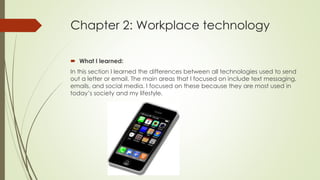
In this section I learned the differences between all technologies used to send
out a letter or email. The main areas that I focused on include text messaging,
emails, and social media. I focused on these because they are most used in
today’s society and my lifestyle.
How was this learned?
To learn this specific
section about technology
there was not a particular
assignment in
correspondence. I learned
about this section primarily
by reading the section in
the book to prepare myself
for the Unit 1 test.
Why was this significant?
This information is very
significant because
choosing the correct forum
of use is crucial. You would
not want to send an
informal text message to
your professional boss. In
the contrary you might not
want to send a lengthy
email to a coworker trying
to schedule a simple
meeting, an instant
message might be more
effective.
Correspondence to future
goals
This lesson is so important for
future goals, especially in
today’s society. For
specifically my goals this
lesson could be useful in
trying to promote my
business via social media.
Opening Facebook and
twitter webpages could
possibly be the most
effective way to gain
followers and promote the
company.
Chapter 4: Correspondence
What I learned:
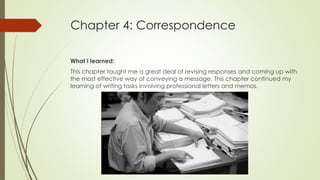
This chapter taught me a great deal of revising responses and coming up with
the most effective way of conveying a message. This chapter continued my
learning of writing tasks involving professional letters and memos.
How was this learned?
WA1: Complaint Letter
Assignment (rewriting an
unstructured and non
effective complaint
letter)
Why was this significant?
This section is important
because complaint
letters can be one of the
most difficult letters to
construct. Sometimes it
can be very difficult to
find a polite way of
complaining about an
experience, event,
structure, etc. This section
provided me with several
examples and helped me
to think of better ways of
constructing this.
Correspondence to
future goals
This is super significant
in correspondence
with my future goals in
that complaints are
bound to happen.
Often as the owner of
the business you do
not want to offend
any customers or send
them off in any way so
this section serves as
very useful in helping
to better understand
ways of doing so
inoffensively.
Chapter 10: Style & Clarity
What I learned:
What I learned in this section is how to respond using language that is
structured correctly. I learned about parallel structure, how to avoid
awkwardness, sentence variety, and how to select the appropriate word
choices. I also learned how to make my wording less biased in regard to race,
ethnics, religion, and gender. Last thing I learned was how to effectively use
the “you” viewpoint and when it should be used.
How was this learned?
WA2 Writing
assignment (writing to
the One book, One
campus committee
about future
recommendations of
common read books
for incoming students)
Why was this
significant?
This is significant
because language is
what can decipher
between a
professional and
nonprofessional letter.
Word choices and
business style can
have a big effect on
the response of your
letter or memo and
you don’t want to be
misleading in text.
Correspondence to
future goals
This section is
important for my
future goals because
text can very easily
be misunderstood.
When writing a news
letter about studio
procedures or writing
letters to displeased
customers, word
choice is the most
important factor. I
wouldn’t want to
unintentionally
offend anybody.
Chapter 7: Design & Visuals
What I learned:
In this chapter I learned how to enhance the visual effect of a webpage or
document. I learned that for webpages you don’t want them to be too
colorful, to flashy, or too full of text. I also learned how to properly construct
headings as well as bulleted lists. I also learned helpful tips as to what graphs
to use when and how to properly create them.
How was this learned?
Analysis Assignment 2
(analyze a poorly
structured webpage and
make comments on how
it could be improved)
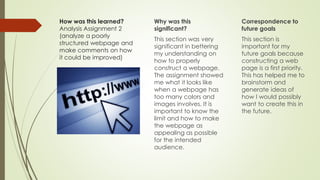
Why was this
significant?
This section was very
significant in bettering
my understanding on
how to properly
construct a webpage.
The assignment showed
me what it looks like
when a webpage has
too many colors and
images involves. It is
important to know the
limit and how to make
the webpage as
appealing as possible
for the intended
audience.
Correspondence to
future goals
This section is
important for my
future goals because
constructing a web
page is a first priority.
This has helped me to
brainstorm and
generate ideas of
how I would possibly
want to create this in
the future.
Photograph Reference Links
(Creative Commons)
 https://pixabay.com/en/photos/computer%20keyboard/
 https://www.google.com/search?tbs=sur:fmc&tbm=isch&q=honey&imgrc=CcOb1cGXwEeSxM%3A&ei=9hwcVsa
gL4r7gwSr9qywCQ&emsg=NCSR&noj=1
 https://www.google.com/search?noj=1&tbs=sur%3Afmc&tbm=isch&sa=1&q=ethics&oq=ethics&gs_l=img.3..0l10.1
2422.14530.0.14693.13.10.0.0.0.0.78.594.9.9.0....0...1c.1.64.img..6.7.471.xlDESGBDgNY#imgrc=wxi-d-ejq6IwbM%3A
 https://www.google.com/search?noj=1&tbs=sur%3Afmc&tbm=isch&sa=1&q=globe&oq=globe&gs_l=img.3..0l10.1
84764.186899.0.187104.10.8.0.0.0.0.485.885.6j4-1.7.0....0...1c.1.64.img..4.6.814.XaUfExc1TLQ#imgrc=1KEb-V7B2-
RLfM%3A
 https://www.google.com/search?noj=1&tbs=sur%3Afmc&tbm=isch&sa=1&q=facebook&oq=facebook&gs_l=img.
3..0l10.79271.82091.0.82334.17.9.0.4.4.0.117.486.7j1.8.0....0...1c.1.64.img..8.9.357.LD7BkJ559hU#imgrc=XSrDj4R4QkRZ
mM%3A
 https://www.google.com/search?noj=1&tbs=sur%3Afmc&tbm=isch&sa=1&q=cell+phone&oq=cell+phone&gs_l=i
mg.3..0l10.7030069.7034029.0.7035157.16.11.1.3.3.0.138.601.9j1.10.0....0...1c.1.64.img..3.13.564.dRwVPF8h_jQ#imgrc
=pHAb4VzcfzWdeM%3A
 https://www.google.com/search?noj=1&tbs=sur:fmc&tbm=isch&q=revising&spell=1&sa=X&ved=0CBoQvwUoAG
oVChMI16bG1Ju-yAIVypceCh0xZgCx&dpr=1&biw=1280&bih=633#imgrc=5w85sQmDbMG6_M%3A
Photograph Reference Links
(Creative Commons) Cont.
 https://www.google.com/search?noj=1&biw=1280&bih=633&tbs=sur%3Afmc&tbm=isch&sa=1&q=complaints&oq
=complaints&gs_l=img.3..0l10.6251.8145.0.8635.8.8.0.0.0.0.76.448.8.8.0....0...1c.1.64.img..0.8.445.OtqTyjzIcq4#imgrc
=EcGKrL7TYw5HsM%3A
 https://www.google.com/search?noj=1&biw=1280&bih=633&tbs=sur%3Afmc&tbm=isch&sa=1&q=religions+comin
g+together&oq=religions+comin&gs_l=img.3.0.0j0i5i30.24693.26863.0.27857.10.10.0.0.0.0.71.509.9.9.0....0...1c.1.64.i
mg..1.9.505.JD2sFX71Qyo#imgrc=8Y7Z_ARSWP913M%3A
 https://www.google.com/search?noj=1&biw=1280&bih=633&tbs=sur%3Afmc&tbm=isch&sa=1&q=you&oq=you&g
s_l=img.3..0l10.173819.177919.0.178211.31.15.2.0.0.0.75.799.14.14.0....0...1c.1.64.img..23.8.358.rz739epEbHM#imgdii=
oqA_f3iWRGagLM%3A%3BoqA_f3iWRGagLM%3A%3B4CxKFcqGd_YWSM%3A&imgrc=oqA_f3iWRGagLM%3A
 https://www.google.com/search?noj=1&biw=1280&bih=633&tbs=sur%3Afmc&tbm=isch&sa=1&q=webpages&oq
=webpages&gs_l=img.3..0l2j0i10l8.98149.101679.0.101833.10.10.0.0.0.0.100.525.8j1.9.0....0...1c.1.64.img..1.9.524.DUf
nQT70wCA#imgrc=vCof6eSLYDEmeM%3A
 https://www.google.com/search?noj=1&biw=1280&bih=633&tbs=sur%3Afmc&tbm=isch&sa=1&q=psychedelic&o
q=psyched&gs_l=img.3.0.0l10.50217.53040.0.54161.12.9.0.1.1.0.87.534.8.8.0....0...1c.1.64.img..4.8.479.uPPSA0561F0#i
mgrc=O6gjBgDX7UD0OM%3A
 https://www.google.com/search?noj=1&biw=1280&bih=633&tbs=sur%3Afmc&tbm=isch&sa=1&q=no&oq=no&gs_
l=img.3..0l10.108144.109739.0.110086.12.7.0.0.0.0.290.620.5j0j1.6.0....0...1c.1.64.img..9.3.430.f8S4hyviJKY#imgrc=u_I7i
biq9a7MfM%3A
References
 SBS’s chapter summaries
 Videos posted
 Assignment pages
 The Business Writer’s Companion by Gerald J. Alred, Charles T. Brusaw, and
Walter E. Oliu

Taylor graham midterm reflection

  • 1.
    ENC 3250 Professional Writing:Midterm Reflection 1. Functional outline and 5 C's 2. The writing process 3. Workplace technology 4. Correspondence 5. Style & Clarity 6. Design and visuals
  • 2.
    Functional Outline and5 C’s What I learned: 1. The four sections of the functional outline are useful in setting up a letter or memo. The sections consist of the news, the reason, the details and the closing. The news describes what your purpose consist of. This should be stated immediately in the beginning. The reason describes why you are writing the letter or memo (inform or request). The details describe how your purpose is important, by giving specific detail. Lastly, the closing or honey statement explains now what? Do you want your reader to complete a task or just simply read and observe? 2. The 5 C’s consist of clear, concise, complete correct and courteous. These aspects serve as rubric to pay particular attention to, in writing a letter or memo. Simply stated, you want to make sure that the reader can identify the purpose, get straight to the point, contains all details necessary has professional grammar and spelling, and remains polite.
  • 3.
    How was thislearned? All assignments that I have constructed this semester have consisted of the 5 c’s and the functional format. I have used these criteria’s to organize the structure of all assignments. I have also made sure that all assignments are created to be clear, concise, complete, correct and courteous. Why was this significant? I think this subject matter is important because it helps to organize any letter or memo. Any subject matter, whether it is to a professor, manager, or simply a peer, can abide to this format. Correspondence to future goals There are many different ways that I can use this information for future planning. My goal for the future is to open a yoga and healing studio. In relation to this goal, I can use to 5 C’s and functional format to properly send letters to customers. If I need to write a letter of concern I can use this info to go about that in a polite manner, or if I need to write an informational news letter I can use this info for that as well.
  • 4.
    Chapter 1: TheWriting Process What I learned: In this chapter I learned about the 5 steps of the writing process. These steps consist of preparation, research, organization, writing, and revising. These steps serve as the basis of writing any letter or memo. A few subsections that I learned a lot about include audience, ethics in writing, global communication, and purpose. I learned that audience and purpose go hand in hand; the purpose of your letter can be very influenced by who your intended audience may be. The needs of your audience are very important in constructing a letter or memo. Ethics are important in decided your tone of voice. They can also be important because our choice of words and tone can decide how influential our letter may become. Global communication is important if you want to expand your company internationally.
  • 5.
    How was thisLearned? - Analysis Assignment 1 (AA1): Audience and Purpose: Effective Instructions (This assignment used the 5 steps and subsections to analyze the purpose for an intended audience.  Why was this significant? This lesson was significant because it taught how to give structure to a letter. Before I maybe would have wrote a letter to my professor in the same voice as I would write to a peer. This lesson gave me examples of how to decipher the difference and write specifically to each intended audience. Also, it is important to know what tone to use when writing a not so friendly letter.  Correspondence to future goals This section is important for future use because when opening a business it is important to set a standard of ethics. This standard should be referred to when I personally send out letters or when an employee sends out letters as well.
  • 6.
    Chapter 2: Workplacetechnology  What I learned: In this section I learned the differences between all technologies used to send out a letter or email. The main areas that I focused on include text messaging, emails, and social media. I focused on these because they are most used in today’s society and my lifestyle.
  • 7.
    How was thislearned? To learn this specific section about technology there was not a particular assignment in correspondence. I learned about this section primarily by reading the section in the book to prepare myself for the Unit 1 test. Why was this significant? This information is very significant because choosing the correct forum of use is crucial. You would not want to send an informal text message to your professional boss. In the contrary you might not want to send a lengthy email to a coworker trying to schedule a simple meeting, an instant message might be more effective. Correspondence to future goals This lesson is so important for future goals, especially in today’s society. For specifically my goals this lesson could be useful in trying to promote my business via social media. Opening Facebook and twitter webpages could possibly be the most effective way to gain followers and promote the company.
  • 8.
    Chapter 4: Correspondence WhatI learned: This chapter taught me a great deal of revising responses and coming up with the most effective way of conveying a message. This chapter continued my learning of writing tasks involving professional letters and memos.
  • 9.
    How was thislearned? WA1: Complaint Letter Assignment (rewriting an unstructured and non effective complaint letter) Why was this significant? This section is important because complaint letters can be one of the most difficult letters to construct. Sometimes it can be very difficult to find a polite way of complaining about an experience, event, structure, etc. This section provided me with several examples and helped me to think of better ways of constructing this. Correspondence to future goals This is super significant in correspondence with my future goals in that complaints are bound to happen. Often as the owner of the business you do not want to offend any customers or send them off in any way so this section serves as very useful in helping to better understand ways of doing so inoffensively.
  • 10.
    Chapter 10: Style& Clarity What I learned: What I learned in this section is how to respond using language that is structured correctly. I learned about parallel structure, how to avoid awkwardness, sentence variety, and how to select the appropriate word choices. I also learned how to make my wording less biased in regard to race, ethnics, religion, and gender. Last thing I learned was how to effectively use the “you” viewpoint and when it should be used.
  • 11.
    How was thislearned? WA2 Writing assignment (writing to the One book, One campus committee about future recommendations of common read books for incoming students) Why was this significant? This is significant because language is what can decipher between a professional and nonprofessional letter. Word choices and business style can have a big effect on the response of your letter or memo and you don’t want to be misleading in text. Correspondence to future goals This section is important for my future goals because text can very easily be misunderstood. When writing a news letter about studio procedures or writing letters to displeased customers, word choice is the most important factor. I wouldn’t want to unintentionally offend anybody.
  • 12.
    Chapter 7: Design& Visuals What I learned: In this chapter I learned how to enhance the visual effect of a webpage or document. I learned that for webpages you don’t want them to be too colorful, to flashy, or too full of text. I also learned how to properly construct headings as well as bulleted lists. I also learned helpful tips as to what graphs to use when and how to properly create them.
  • 13.
    How was thislearned? Analysis Assignment 2 (analyze a poorly structured webpage and make comments on how it could be improved) Why was this significant? This section was very significant in bettering my understanding on how to properly construct a webpage. The assignment showed me what it looks like when a webpage has too many colors and images involves. It is important to know the limit and how to make the webpage as appealing as possible for the intended audience. Correspondence to future goals This section is important for my future goals because constructing a web page is a first priority. This has helped me to brainstorm and generate ideas of how I would possibly want to create this in the future.
  • 14.
    Photograph Reference Links (CreativeCommons)  https://pixabay.com/en/photos/computer%20keyboard/  https://www.google.com/search?tbs=sur:fmc&tbm=isch&q=honey&imgrc=CcOb1cGXwEeSxM%3A&ei=9hwcVsa gL4r7gwSr9qywCQ&emsg=NCSR&noj=1  https://www.google.com/search?noj=1&tbs=sur%3Afmc&tbm=isch&sa=1&q=ethics&oq=ethics&gs_l=img.3..0l10.1 2422.14530.0.14693.13.10.0.0.0.0.78.594.9.9.0....0...1c.1.64.img..6.7.471.xlDESGBDgNY#imgrc=wxi-d-ejq6IwbM%3A  https://www.google.com/search?noj=1&tbs=sur%3Afmc&tbm=isch&sa=1&q=globe&oq=globe&gs_l=img.3..0l10.1 84764.186899.0.187104.10.8.0.0.0.0.485.885.6j4-1.7.0....0...1c.1.64.img..4.6.814.XaUfExc1TLQ#imgrc=1KEb-V7B2- RLfM%3A  https://www.google.com/search?noj=1&tbs=sur%3Afmc&tbm=isch&sa=1&q=facebook&oq=facebook&gs_l=img. 3..0l10.79271.82091.0.82334.17.9.0.4.4.0.117.486.7j1.8.0....0...1c.1.64.img..8.9.357.LD7BkJ559hU#imgrc=XSrDj4R4QkRZ mM%3A  https://www.google.com/search?noj=1&tbs=sur%3Afmc&tbm=isch&sa=1&q=cell+phone&oq=cell+phone&gs_l=i mg.3..0l10.7030069.7034029.0.7035157.16.11.1.3.3.0.138.601.9j1.10.0....0...1c.1.64.img..3.13.564.dRwVPF8h_jQ#imgrc =pHAb4VzcfzWdeM%3A  https://www.google.com/search?noj=1&tbs=sur:fmc&tbm=isch&q=revising&spell=1&sa=X&ved=0CBoQvwUoAG oVChMI16bG1Ju-yAIVypceCh0xZgCx&dpr=1&biw=1280&bih=633#imgrc=5w85sQmDbMG6_M%3A
  • 15.
    Photograph Reference Links (CreativeCommons) Cont.  https://www.google.com/search?noj=1&biw=1280&bih=633&tbs=sur%3Afmc&tbm=isch&sa=1&q=complaints&oq =complaints&gs_l=img.3..0l10.6251.8145.0.8635.8.8.0.0.0.0.76.448.8.8.0....0...1c.1.64.img..0.8.445.OtqTyjzIcq4#imgrc =EcGKrL7TYw5HsM%3A  https://www.google.com/search?noj=1&biw=1280&bih=633&tbs=sur%3Afmc&tbm=isch&sa=1&q=religions+comin g+together&oq=religions+comin&gs_l=img.3.0.0j0i5i30.24693.26863.0.27857.10.10.0.0.0.0.71.509.9.9.0....0...1c.1.64.i mg..1.9.505.JD2sFX71Qyo#imgrc=8Y7Z_ARSWP913M%3A  https://www.google.com/search?noj=1&biw=1280&bih=633&tbs=sur%3Afmc&tbm=isch&sa=1&q=you&oq=you&g s_l=img.3..0l10.173819.177919.0.178211.31.15.2.0.0.0.75.799.14.14.0....0...1c.1.64.img..23.8.358.rz739epEbHM#imgdii= oqA_f3iWRGagLM%3A%3BoqA_f3iWRGagLM%3A%3B4CxKFcqGd_YWSM%3A&imgrc=oqA_f3iWRGagLM%3A  https://www.google.com/search?noj=1&biw=1280&bih=633&tbs=sur%3Afmc&tbm=isch&sa=1&q=webpages&oq =webpages&gs_l=img.3..0l2j0i10l8.98149.101679.0.101833.10.10.0.0.0.0.100.525.8j1.9.0....0...1c.1.64.img..1.9.524.DUf nQT70wCA#imgrc=vCof6eSLYDEmeM%3A  https://www.google.com/search?noj=1&biw=1280&bih=633&tbs=sur%3Afmc&tbm=isch&sa=1&q=psychedelic&o q=psyched&gs_l=img.3.0.0l10.50217.53040.0.54161.12.9.0.1.1.0.87.534.8.8.0....0...1c.1.64.img..4.8.479.uPPSA0561F0#i mgrc=O6gjBgDX7UD0OM%3A  https://www.google.com/search?noj=1&biw=1280&bih=633&tbs=sur%3Afmc&tbm=isch&sa=1&q=no&oq=no&gs_ l=img.3..0l10.108144.109739.0.110086.12.7.0.0.0.0.290.620.5j0j1.6.0....0...1c.1.64.img..9.3.430.f8S4hyviJKY#imgrc=u_I7i biq9a7MfM%3A
  • 16.
    References  SBS’s chaptersummaries  Videos posted  Assignment pages  The Business Writer’s Companion by Gerald J. Alred, Charles T. Brusaw, and Walter E. Oliu