Taxonomy of
educational
objectives:
New concept
Table of contents
01
03
02
04
Introduction to
new concept
Levels of
Taxonomy
Conclusion Questions
Introduction to
new concept
01
Taxonomy of educational
objectives:
Anderson's taxonomy was developed directly from Bloom's
Cognitive taxonomy. Bloom uses nouns, and Anderson uses verbs.
This is important because it affects the way we demonstrate these
abilities as things we perform.
Levels of
Taxonomy:
02
2.1. The first level is to Remember.
Remember
o Recognizing
o Recalling
Retrieving relevant knowledge from long‐term memory.
Example activities at the Remembering level: memorize a poem, recall state
capitals, and remember math formulas.
2.2. The second level is to Understand.
o Interpreting o Classifying o Summarizing o Inferring
o Exemplifying o Comparing o Explaining
Constructing meaning from oral, written, and graphic messages through
interpreting, exemplifying, classifying, summarizing, inferring, comparing, and
explaining.
Example activities at the Understanding level: organize the animal kingdom
based on a given framework, illustrate the difference between a rectangle and
square, summarize the plot of a simple story
Understand
2.3. The third level is to Apply.
Apply
o Executing
o Implementing
Carrying out or using a procedure for executing, or implementing.
Example activities at the Application level: use a formula to solve a problem,
select a design to meet a
purpose, reconstruct the passage of a new law through a given
government/system
2.4. The fourth level is to Analyze.
Analyze
o Differentiating
o Organizing
o Attributing
Breaking material into constituent parts, determining how the parts relate to
one another and to an overall structure or purpose through differentiating,
organizing, and attributing.
Example activities at the Analysis level: identify the ‘parts of’ democracy,
explain how the steps of the scientific process work together, identify why a
machine isn’t working
2.5. The fifth level is to Evaluate.
Evaluate
o Checking
o Critiquing
Making judgments based on criteria and standards through checking and
critiquing.
Example activities at the Evaluation level: make a judgment regarding an
ethical dilemma, interpret the significance of a given law of physics, illustrate
the relative value of a technological innovation in a specific setting—farming,
for example.
2.6. The sixth and final level is to Create.
Create
o Generating
o Planning
o Producing
Putting elements together to form a coherent or functional whole;
reorganizing elements into a new pattern or structure through generating,
planning, or producing.
Example activities at the Creation level: design a new solution to an ‘old’
problem that honors/acknowledges.
Conclusion
03
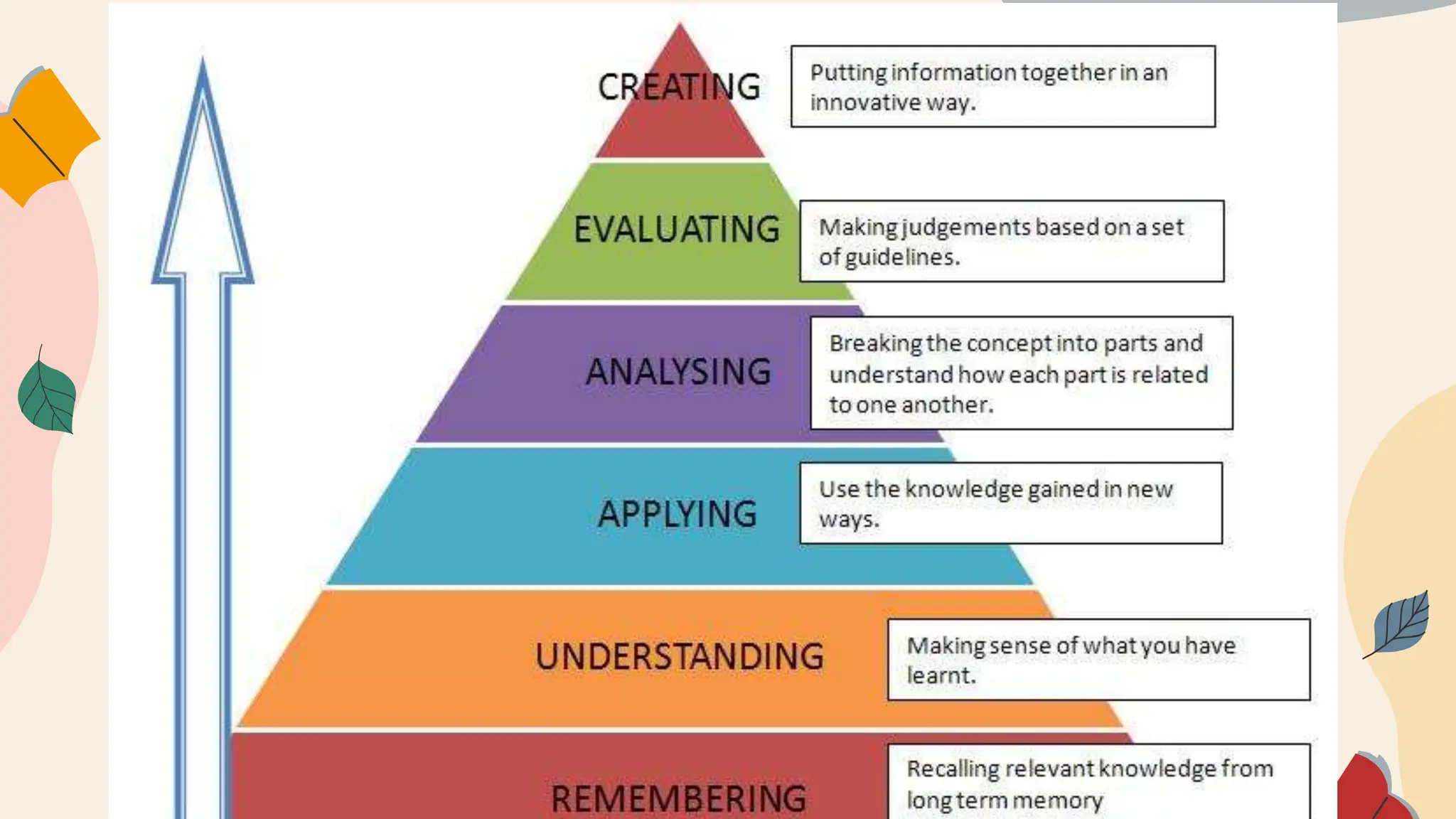
From the presentation we can understand that As comparing to
old(Bloom’s) taxonomy the new taxonomy includes the six levels of
cognitive domain as remembering, understanding, applying, analysing,
evaluating and creating.
Thank- you

taxonomy of educational objectives pptx

  • 1.
  • 2.
    Table of contents 01 03 02 04 Introductionto new concept Levels of Taxonomy Conclusion Questions
  • 3.
  • 4.
    Taxonomy of educational objectives: Anderson'staxonomy was developed directly from Bloom's Cognitive taxonomy. Bloom uses nouns, and Anderson uses verbs. This is important because it affects the way we demonstrate these abilities as things we perform.
  • 6.
  • 7.
    2.1. The firstlevel is to Remember. Remember o Recognizing o Recalling Retrieving relevant knowledge from long‐term memory. Example activities at the Remembering level: memorize a poem, recall state capitals, and remember math formulas.
  • 8.
    2.2. The secondlevel is to Understand. o Interpreting o Classifying o Summarizing o Inferring o Exemplifying o Comparing o Explaining Constructing meaning from oral, written, and graphic messages through interpreting, exemplifying, classifying, summarizing, inferring, comparing, and explaining. Example activities at the Understanding level: organize the animal kingdom based on a given framework, illustrate the difference between a rectangle and square, summarize the plot of a simple story Understand
  • 9.
    2.3. The thirdlevel is to Apply. Apply o Executing o Implementing Carrying out or using a procedure for executing, or implementing. Example activities at the Application level: use a formula to solve a problem, select a design to meet a purpose, reconstruct the passage of a new law through a given government/system
  • 10.
    2.4. The fourthlevel is to Analyze. Analyze o Differentiating o Organizing o Attributing Breaking material into constituent parts, determining how the parts relate to one another and to an overall structure or purpose through differentiating, organizing, and attributing. Example activities at the Analysis level: identify the ‘parts of’ democracy, explain how the steps of the scientific process work together, identify why a machine isn’t working
  • 11.
    2.5. The fifthlevel is to Evaluate. Evaluate o Checking o Critiquing Making judgments based on criteria and standards through checking and critiquing. Example activities at the Evaluation level: make a judgment regarding an ethical dilemma, interpret the significance of a given law of physics, illustrate the relative value of a technological innovation in a specific setting—farming, for example.
  • 12.
    2.6. The sixthand final level is to Create. Create o Generating o Planning o Producing Putting elements together to form a coherent or functional whole; reorganizing elements into a new pattern or structure through generating, planning, or producing. Example activities at the Creation level: design a new solution to an ‘old’ problem that honors/acknowledges.
  • 15.
  • 16.
    From the presentationwe can understand that As comparing to old(Bloom’s) taxonomy the new taxonomy includes the six levels of cognitive domain as remembering, understanding, applying, analysing, evaluating and creating.
  • 17.