TAXATION AND GROWTH
SOME FACTS ABOUT INDIA
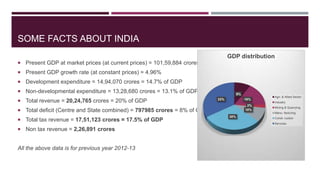
 Present GDP at market prices (at current prices) = 101,59,884 crores
 Present GDP growth rate (at constant prices) = 4.96%
 Development expenditure = 14,94,070 crores = 14.7% of GDP
 Non-developmental expenditure = 13,28,680 crores = 13.1% of GDP
 Total revenue = 20,24,765 crores = 20% of GDP
 Total deficit (Centre and State combined) = 797985 crores = 8% of GDP
 Total tax revenue = 17,51,123 crores = 17.5% of GDP
 Non tax revenue = 2,26,891 crores
All the above data is for previous year 2012-13
9%
16%
2%
10%
30%
33%
GDP distribution
Agri. & Allied Sector
Industry
Mining & Quarrying
Manu- facturing
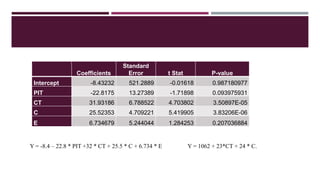
Const- ruction
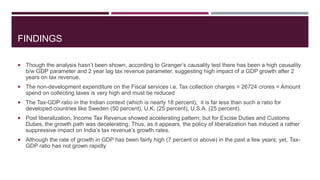
Services
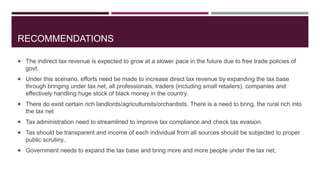
MINISTRY OF FINANCE
Five departments :
 Economic affairs
 Expenditure
 Revenue
 Financial Services
 Disinvestment
OBJECTIVE
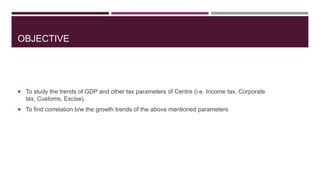
 To study the trends of GDP and other tax parameters of Centre (i.e. Income tax, Corporate
tax, Customs, Excise).
 To find correlation b/w the growth trends of the above mentioned parameters
INDIA'S GDP GROWTH RATE (CONSTANT PRICE)
-6.00
-4.00
-2.00
0.00
2.00
4.00
6.00
8.00
10.00
12.00
%changeinGDPannually
India's GDP growth rate (constant price)
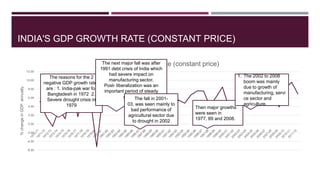
The reasons for the 2
negative GDP growth rates
are : 1. India-pak war for
Bangladesh in 1972 2.
Severe drought crisis in
1979
The next major fall was after
1991 debt crisis of India which
had severe impact on
manufacturing sector.
Post- liberalization was an
important period of steady
growth.The fall in 2001-
03, was seen mainly to
bad performance of
agricultural sector due
to drought in 2002
Then major growths
were seen in
1977, 89 and 2008.
1. The 2002 to 2008
boom was mainly
due to growth of
manufacturing, servi
ce sector and
agriculture.
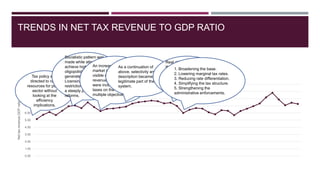
TRENDS IN NET TAX REVENUE TO GDP RATIO
0.00
1.00
2.00
3.00
4.00
5.00
6.00
7.00
8.00
9.00
10.00
Nettaxrevenue,GDPratio
Net Tax-GDP ratioTax policy was
directed to raise
resources for public
sector without
looking at the
efficiency
implications.
Socialistic pattern was
made while attempting to
achieve high taxation on
oligopolistic rents
generated by
Licensing, quotas and
restrictions. This involved
a steeply progressive tax
reforms.
An increase in the
market size, and more
visible sources of
revenue the policies
were inclined to collect
taxes on the basis of
multiple objectives
As a continuation of
above, selectivity and
description became a
legitimate part of the tax
system.
Real attempt to reform
the tax system was only
started in 1991, after the
unprecedented
economic crisis by the
Tax reforms committee
(TRC).
1. Broadening the base.
2. Lowering marginal tax rates.
3. Reducing rate differentiation.
4. Simplifying the tax structure.
5. Strengthening the
administrative enforcements.
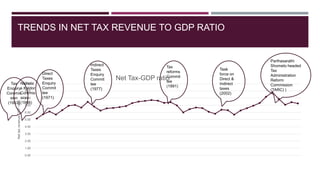
TRENDS IN NET TAX REVENUE TO GDP RATIO
0.00
1.00
2.00
3.00
4.00
5.00
6.00
7.00
8.00
9.00
10.00
Nettaxrevenue,GDPratio
Net Tax-GDP ratio
Tax
Enquiry
Commis
sion
(1953)
Nichola
s Kaldor
Commis
sion
(1956)
Direct
Taxes
Enquiry
Commit
tee
(1971)
Indirect
Taxes
Enquiry
Commit
tee
(1977)
Tax
reforms
Commit
tee
(1991)
Task
force on
Direct &
Indirect
taxes
(2002)
Parthasarathi
Shometo headed
Tax
Administration
Reform
Commission
(TARC) )
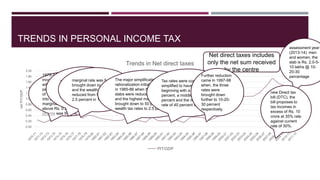
TRENDS IN PERSONAL INCOME TAX
0.00
0.20
0.40
0.60
0.80
1.00
1.20
1.40
1.60
1.80
2.00
netPIT/GDP,
Trends in Net direct taxes
PIT/GDP
Net direct taxes includes
only the net sum received
by the centre
1973-74, the personal
income tax had 11 tax slabs
with rates between 10
percent and 85. surcharge
of 15 percent was taken
into account, the highest
marginal rate for persons
above Rs. 0.2 million
income was 97.5 %
1974-75, the tax was
brought down to 77 percent
including a 10 percent
surcharge
marginal rate was further
brought down to 66 percent
and the wealth tax rate was
reduced from 5 percent to
2.5 percent in 1976-77.
The major simplification and
rationalization initiative, however, was
in 1985-86 when the number of tax
slabs were reduced from eight to four
and the highest marginal tax rate was
brought down to 50 percent and
wealth tax rates to 2.5 percent
Tax rates were considerably
simplified to have three slabs
beginning with a rate of 20
percent, a middle rate of 30
percent and the maximum
rate of 40 percent in 1992-93.
Further reduction
came in 1997-98
when, the three
rates were
brought down
further to 10-20-
30 percent
respectively.
assessment year
(2013-14) men
and women, the
slab is Rs. 2.0-5-
10 lakhs @ 10-
20-30
percentage
new Direct tax
bill (DTC), the
bill proposes to
tax incomes in
excess of Rs. 10
crore at 35% rate
against current
rate of 30%.
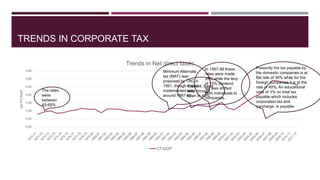
TRENDS IN CORPORATE TAX
0.00
0.50
1.00
1.50
2.00
2.50
3.00
3.50
netPIT/GDP,
Trends in Net direct taxes
CT/GDP
The rates
were
between
45-65%.
Minimum Alternate
tax (MAT) was
proposed by TRC in
1991, though it was
implemented only
around 1997-98.
1993-94, these
were brought
down to 40%
In 1997-98 these
rates were made
35% while the levy
of 10% dividend
tax was shifted
from individuals to
companies.
Presently the tax payable by
the domestic companies is at
flat rate of 30% while for the
foreign companies it is at the
rate of 40%. An educational
cess of 3% on total tax
payable which includes
corporation tax and
surcharge, is payable
TRENDS IN PERSONAL INCOME TAXES
0
2
4
6
8
10
12
14
16
-40 -20 0 20 40 60 80 100 120 140 160 180
Frequency
Bin Size of ▲PIT rates
Distribution of ▲PIT rates
-50
0
50
100
150
200
1971-72
1973-74
1975-76
1977-78
1979-80
1981-82
1983-84
1985-86
1987-88
1989-90
1991-92
1993-94
1995-96
1997-98
1999-00
2001-02
2003-04
2005-06
2007-08
2009-10
2011-12
PIT%
Annual changes in PIT
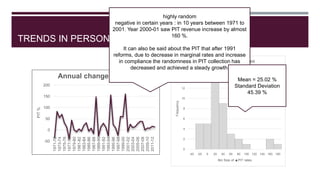
highly random
negative in certain years : in 10 years between 1971 to
2001. Year 2000-01 saw PIT revenue increase by almost
160 %.
It can also be said about the PIT that after 1991
reforms, due to decrease in marginal rates and increase
in compliance the randomness in PIT collection has
decreased and achieved a steady growth.
Mean = 25.02 %
Standard Deviation
45.39 %
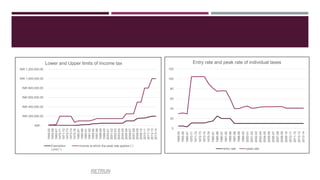
INR -
INR 200,000.00
INR 400,000.00
INR 600,000.00
INR 800,000.00
INR 1,000,000.00
INR 1,200,000.00
1949-50
1955-56
1960-61
1970-71
1971-72
1972-73
1973-74
1975-76
1980-81
1985-86
1990-91
1991-92
1995-96
1997-98
1998-99
1999-00
2000-01
2001-02
2002-03
2003-04
2004-05
2005-06
2006-07
2007-08
2008-09
2009-10
2010-11
2011-12
2012-13
2013-14
Lower and Upper limits of Income tax
Exemption
Limit (`)
Income at which the peak rate applies (`)
0
20
40
60
80
100
120
1949-50
1955-56
1960-61
1970-71
1971-72
1972-73
1973-74
1975-76
1980-81
1985-86
1990-91
1991-92
1995-96
1997-98
1998-99
1999-00
2000-01
2001-02
2002-03
2003-04
2004-05
2005-06
2006-07
2007-08
2008-09
2009-10
2010-11
2011-12
2012-13
2013-14
Entry rate and peak rate of individual taxes
entry rate peak rate
RETRUN
TRENDS IN CORPORATE TAX
-30
-20
-10
0
10
20
30
40
50
60
1971-72
1973-74
1975-76
1977-78
1979-80
1981-82
1983-84
1985-86
1987-88
1989-90
1991-92
1993-94
1995-96
1997-98
1999-00
2001-02
2003-04
2005-06
2007-08
2009-10
2011-12
CT%
Annual changes in CT
0
2
4
6
8
10
12
14
-20 -15 -10 -5 0 5 10 15 20 25 30 35 40 45 50 55
Frequency
Bin Size of ▲CT rates
Distribution of ▲CT rates
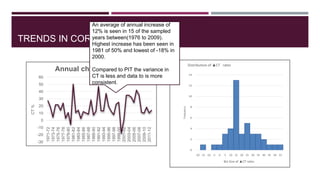
An average of annual increase of
12% is seen in 15 of the sampled
years between(1976 to 2009).
Highest increase has been seen in
1981 of 50% and lowest of -18% in
2000.
Compared to PIT the variance in
CT is less and data to is more
consistent.
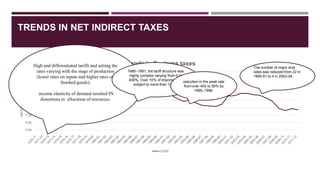
TRENDS IN NET INDIRECT TAXES
The rates
were
between
45-65%.
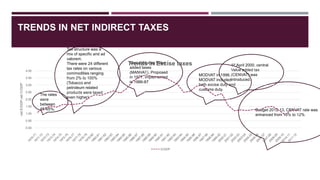
Tax structure was a
mix of specific and ad
valorem.
There were 24 different
tax rates on various
commodities ranging
from 2% to 100%
(Tobacco and
petroleum related
products were taxed
even higher).
Manufacturing Value
added taxes
(MANVAT). Proposed
in 1977. implemented
in 1986-87
MODVAT in 1996.
MODVAT included
both excise duty and
customs duty.
1st April 2000, central
Value added tax
(CENVAT) was
introduced.
Budget 2012-13, CENVAT rate was
enhanced from 10% to 12%
0.00
0.50
1.00
1.50
2.00
2.50
3.00
3.50
4.00
netE/GDP,netC/GDP
Trends in Excise taxes
E/GDP
TRENDS IN NET INDIRECT TAXES
0.00
0.50
1.00
1.50
2.00
2.50
3.00
3.50
4.00
netE/GDP,netC/GDP
Trends in Customs taxes
C/GDP
High and differentiated tariffs and setting the
rates varying with the stage of production
(lower rates on inputs and higher rates on
finished goods).
income elasticity of demand resulted IN
distortions in allocation of resources.
1990–1991, the tariff structure was
highly complex varying from 0 to
400%, Over 10% of imports were
subject to more than 120%.
reduction in the peak rate
from over 400 to 50% by
1995–1996.
The number of major duty
rates was reduced from 22 in
1990-91 to 4 in 2003-04.
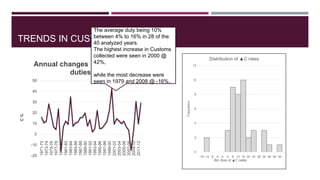
TRENDS IN CUSTOMS DUTY
-20
-10
0
10
20
30
40
50
1971-72
1973-74
1975-76
1977-78
1979-80
1981-82
1983-84
1985-86
1987-88
1989-90
1991-92
1993-94
1995-96
1997-98
1999-00
2001-02
2003-04
2005-06
2007-08
2009-10
2011-12
C%
Annual changes in Customs
duties
0
2
4
6
8
10
12
-16 -12 -8 -4 0 4 8 12 16 20 24 28 32 36 40 44
Frequency
Bin Size of ▲C rates
Distribution of ▲C rates
The average duty being 10%
between 4% to 16% in 28 of the
40 analyzed years.
The highest increase in Customs
collected were seen in 2000 @
42%,
while the most decrease were
seen in 1979 and 2008 @ -16%..
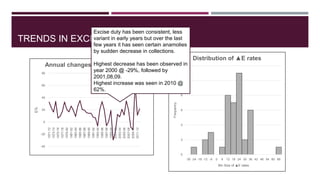
TRENDS IN EXCISE DUTY
-40
-20
0
20
40
60
80
1971-72
1973-74
1975-76
1977-78
1979-80
1981-82
1983-84
1985-86
1987-88
1989-90
1991-92
1993-94
1995-96
1997-98
1999-00
2001-02
2003-04
2005-06
2007-08
2009-10
2011-12
E%
Annual changes in Excise duties
0
2
4
6
8
10
12
-30 -24 -18 -12 -6 0 6 12 18 24 30 36 42 48 54 60 66
Frequency
Bin Size of ▲E rates
Distribution of ▲E rates
Excise duty has been consistent, less
variant in early years but over the last
few years it has seen certain anamolies
by sudden decrease in collections.
Highest decrease has been observed in
year 2000 @ -29%, followed by
2001,08,09.
Highest increase was seen in 2010 @
62%.
ANALYSIS
0.00
1.00
2.00
3.00
4.00
5.00
6.00
7.00
8.00
9.00
10.00
Nettaxrevenue,GDPratio
Net Tax-GDP ratio
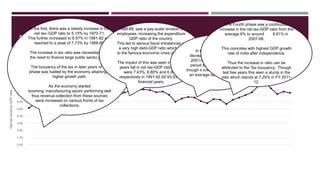
In the first, there was a steady increase in the
net tax–GDP ratio to 5.15% by 1970-71.
This further increased to 6.57% in 1981-82 and
reached to a peak of 7.73% by 1988-89.
The increase in tax ratio was necessitated by
the need to finance large public sector plans.
The buoyancy of the tax in later years of the
phase was fuelled by the economy attaining a
higher growth path.
As the economy started
booming, manufacturing sector performing well
thus revenue collection from these sources
were increased on various fronts of tax
collections.
1988-89, saw a pay-scale revision of
employees, increasing the expenditure
GDP ratio of the country.
This led to serious fiscal imbalances or
a very high debt-GDP ratio which led
to the famous economic crisis of India.
The impact of this was seen in coming
years fall in net tax-GDP ratio which
were 7.43%, 6.80% and 6.00%
respectively in 1991-92,92-93,93-94
financial years.
In third phase, the ratio
decreased to around 5.7 % in
2001-02. Thus 1991 to 2001
period saw slight fluctuations
though it overall remain steady at
an average rate of around 6%
The Fourth phase saw a continuous
increase in the net tax-GDP ratio from the
average 6% to around 8.81% in
2007-08.
This coincides with highest GDP growth
rate of India after independence.
Thus the increase in ratio can be
attributed to the Tax buoyancy. Though
last few years this seen a slump in the
ratio which stands at 7.25% in FY 2011-
12.
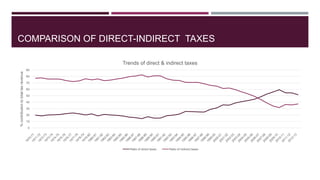
COMPARISON OF DIRECT-INDIRECT TAXES
0
10
20
30
40
50
60
70
80
90
%contributiontototaltaxrevenue
Trends of direct & indirect taxes
Ratio of direct taxes Ratio of Indirect taxes
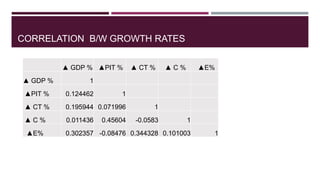
CORRELATION B/W GROWTH RATES
▲ GDP % ▲PIT % ▲ CT % ▲ C % ▲E%
▲ GDP % 1
▲PIT % 0.124462 1
▲ CT % 0.195944 0.071996 1
▲ C % 0.011436 0.45604 -0.0583 1
▲E% 0.302357 -0.08476 0.344328 0.101003 1
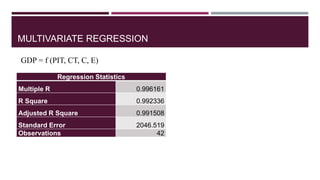
MULTIVARIATE REGRESSION
Regression Statistics
Multiple R 0.996161
R Square 0.992336
Adjusted R Square 0.991508
Standard Error 2046.519
Observations 42
GDP = f (PIT, CT, C, E)
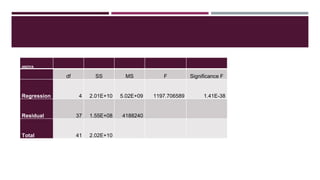
ANOVA
df SS MS F Significance F
Regression 4 2.01E+10 5.02E+09 1197.706589 1.41E-38
Residual 37 1.55E+08 4188240
Total 41 2.02E+10
Coefficients
Standard
Error t Stat P-value
Intercept -8.43232 521.2889 -0.01618 0.987180977
PIT -22.8175 13.27389 -1.71898 0.093975931
CT 31.93186 6.788522 4.703802 3.50897E-05
C 25.52353 4.709221 5.419905 3.83206E-06
E 6.734679 5.244044 1.284253 0.207036884
Y = -8.4 – 22.8 * PIT +32 * CT + 25.5 * C + 6.734 * E Y = 1062 + 23*CT + 24 * C.
FINDINGS
 Though the analysis hasn’t been shown, according to Granger’s causality test there has been a high causality
b/w GDP parameter and 2 year lag tax revenue parameter, suggesting high impact of a GDP growth after 2
years on tax revenue.
 The non-development expenditure on the Fiscal services i.e. Tax collection charges = 26724 crores = Amount
spend on collecting taxes is very high and must be reduced
 The Tax-GDP ratio in the Indian context (which is nearly 18 percent), it is far less than such a ratio for
developed countries like Sweden (50 percent), U.K. (25 percent), U.S.A. (25 percent).
 Post liberalization, Income Tax Revenue showed accelerating pattern; but for Excise Duties and Customs
Duties, the growth path was decelerating. Thus, as it appears, the policy of liberalization has induced a rather
suppressive impact on India’s tax revenue’s growth rates.
 Although the rate of growth in GDP has been fairly high (7 percent or above) in the past a few years; yet, Tax-
GDP ratio has not grown rapidly
RECOMMENDATIONS
 The indirect tax revenue is expected to grow at a slower pace in the future due to free trade policies of
govt.
 Under this scenario, efforts need be made to increase direct tax revenue by expanding the tax base
through bringing under tax net, all professionals, traders (including small retailers), companies and
effectively handling huge stock of black money in the country.
 There do exist certain rich landlords/agriculturists/orchardists. There is a need to bring, the rural rich into
the tax net
 Tax administration need to streamlined to improve tax compliance and check tax evasion.
 Tax should be transparent and income of each individual from all sources should be subjected to proper
public scrutiny..
 Government needs to expand the tax base and bring more and more people under the tax net;
RECOMENDATIONS
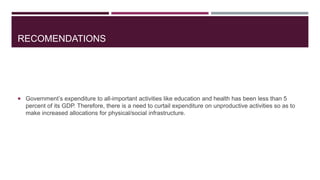
 Government’s expenditure to all-important activities like education and health has been less than 5
percent of its GDP. Therefore, there is a need to curtail expenditure on unproductive activities so as to
make increased allocations for physical/social infrastructure.
Taxation and growth

Taxation and growth

  • 1.
  • 2.
    SOME FACTS ABOUTINDIA  Present GDP at market prices (at current prices) = 101,59,884 crores  Present GDP growth rate (at constant prices) = 4.96%  Development expenditure = 14,94,070 crores = 14.7% of GDP  Non-developmental expenditure = 13,28,680 crores = 13.1% of GDP  Total revenue = 20,24,765 crores = 20% of GDP  Total deficit (Centre and State combined) = 797985 crores = 8% of GDP  Total tax revenue = 17,51,123 crores = 17.5% of GDP  Non tax revenue = 2,26,891 crores All the above data is for previous year 2012-13 9% 16% 2% 10% 30% 33% GDP distribution Agri. & Allied Sector Industry Mining & Quarrying Manu- facturing Const- ruction Services
  • 3.
    MINISTRY OF FINANCE Fivedepartments :  Economic affairs  Expenditure  Revenue  Financial Services  Disinvestment
  • 4.
    OBJECTIVE  To studythe trends of GDP and other tax parameters of Centre (i.e. Income tax, Corporate tax, Customs, Excise).  To find correlation b/w the growth trends of the above mentioned parameters
  • 5.
    INDIA'S GDP GROWTHRATE (CONSTANT PRICE) -6.00 -4.00 -2.00 0.00 2.00 4.00 6.00 8.00 10.00 12.00 %changeinGDPannually India's GDP growth rate (constant price) The reasons for the 2 negative GDP growth rates are : 1. India-pak war for Bangladesh in 1972 2. Severe drought crisis in 1979 The next major fall was after 1991 debt crisis of India which had severe impact on manufacturing sector. Post- liberalization was an important period of steady growth.The fall in 2001- 03, was seen mainly to bad performance of agricultural sector due to drought in 2002 Then major growths were seen in 1977, 89 and 2008. 1. The 2002 to 2008 boom was mainly due to growth of manufacturing, servi ce sector and agriculture.
  • 6.
    TRENDS IN NETTAX REVENUE TO GDP RATIO 0.00 1.00 2.00 3.00 4.00 5.00 6.00 7.00 8.00 9.00 10.00 Nettaxrevenue,GDPratio Net Tax-GDP ratioTax policy was directed to raise resources for public sector without looking at the efficiency implications. Socialistic pattern was made while attempting to achieve high taxation on oligopolistic rents generated by Licensing, quotas and restrictions. This involved a steeply progressive tax reforms. An increase in the market size, and more visible sources of revenue the policies were inclined to collect taxes on the basis of multiple objectives As a continuation of above, selectivity and description became a legitimate part of the tax system. Real attempt to reform the tax system was only started in 1991, after the unprecedented economic crisis by the Tax reforms committee (TRC). 1. Broadening the base. 2. Lowering marginal tax rates. 3. Reducing rate differentiation. 4. Simplifying the tax structure. 5. Strengthening the administrative enforcements.
  • 7.
    TRENDS IN NETTAX REVENUE TO GDP RATIO 0.00 1.00 2.00 3.00 4.00 5.00 6.00 7.00 8.00 9.00 10.00 Nettaxrevenue,GDPratio Net Tax-GDP ratio Tax Enquiry Commis sion (1953) Nichola s Kaldor Commis sion (1956) Direct Taxes Enquiry Commit tee (1971) Indirect Taxes Enquiry Commit tee (1977) Tax reforms Commit tee (1991) Task force on Direct & Indirect taxes (2002) Parthasarathi Shometo headed Tax Administration Reform Commission (TARC) )
  • 8.
    TRENDS IN PERSONALINCOME TAX 0.00 0.20 0.40 0.60 0.80 1.00 1.20 1.40 1.60 1.80 2.00 netPIT/GDP, Trends in Net direct taxes PIT/GDP Net direct taxes includes only the net sum received by the centre 1973-74, the personal income tax had 11 tax slabs with rates between 10 percent and 85. surcharge of 15 percent was taken into account, the highest marginal rate for persons above Rs. 0.2 million income was 97.5 % 1974-75, the tax was brought down to 77 percent including a 10 percent surcharge marginal rate was further brought down to 66 percent and the wealth tax rate was reduced from 5 percent to 2.5 percent in 1976-77. The major simplification and rationalization initiative, however, was in 1985-86 when the number of tax slabs were reduced from eight to four and the highest marginal tax rate was brought down to 50 percent and wealth tax rates to 2.5 percent Tax rates were considerably simplified to have three slabs beginning with a rate of 20 percent, a middle rate of 30 percent and the maximum rate of 40 percent in 1992-93. Further reduction came in 1997-98 when, the three rates were brought down further to 10-20- 30 percent respectively. assessment year (2013-14) men and women, the slab is Rs. 2.0-5- 10 lakhs @ 10- 20-30 percentage new Direct tax bill (DTC), the bill proposes to tax incomes in excess of Rs. 10 crore at 35% rate against current rate of 30%.
  • 9.
    TRENDS IN CORPORATETAX 0.00 0.50 1.00 1.50 2.00 2.50 3.00 3.50 netPIT/GDP, Trends in Net direct taxes CT/GDP The rates were between 45-65%. Minimum Alternate tax (MAT) was proposed by TRC in 1991, though it was implemented only around 1997-98. 1993-94, these were brought down to 40% In 1997-98 these rates were made 35% while the levy of 10% dividend tax was shifted from individuals to companies. Presently the tax payable by the domestic companies is at flat rate of 30% while for the foreign companies it is at the rate of 40%. An educational cess of 3% on total tax payable which includes corporation tax and surcharge, is payable
  • 10.
    TRENDS IN PERSONALINCOME TAXES 0 2 4 6 8 10 12 14 16 -40 -20 0 20 40 60 80 100 120 140 160 180 Frequency Bin Size of ▲PIT rates Distribution of ▲PIT rates -50 0 50 100 150 200 1971-72 1973-74 1975-76 1977-78 1979-80 1981-82 1983-84 1985-86 1987-88 1989-90 1991-92 1993-94 1995-96 1997-98 1999-00 2001-02 2003-04 2005-06 2007-08 2009-10 2011-12 PIT% Annual changes in PIT highly random negative in certain years : in 10 years between 1971 to 2001. Year 2000-01 saw PIT revenue increase by almost 160 %. It can also be said about the PIT that after 1991 reforms, due to decrease in marginal rates and increase in compliance the randomness in PIT collection has decreased and achieved a steady growth. Mean = 25.02 % Standard Deviation 45.39 %
  • 11.
    INR - INR 200,000.00 INR400,000.00 INR 600,000.00 INR 800,000.00 INR 1,000,000.00 INR 1,200,000.00 1949-50 1955-56 1960-61 1970-71 1971-72 1972-73 1973-74 1975-76 1980-81 1985-86 1990-91 1991-92 1995-96 1997-98 1998-99 1999-00 2000-01 2001-02 2002-03 2003-04 2004-05 2005-06 2006-07 2007-08 2008-09 2009-10 2010-11 2011-12 2012-13 2013-14 Lower and Upper limits of Income tax Exemption Limit (`) Income at which the peak rate applies (`) 0 20 40 60 80 100 120 1949-50 1955-56 1960-61 1970-71 1971-72 1972-73 1973-74 1975-76 1980-81 1985-86 1990-91 1991-92 1995-96 1997-98 1998-99 1999-00 2000-01 2001-02 2002-03 2003-04 2004-05 2005-06 2006-07 2007-08 2008-09 2009-10 2010-11 2011-12 2012-13 2013-14 Entry rate and peak rate of individual taxes entry rate peak rate RETRUN
  • 12.
    TRENDS IN CORPORATETAX -30 -20 -10 0 10 20 30 40 50 60 1971-72 1973-74 1975-76 1977-78 1979-80 1981-82 1983-84 1985-86 1987-88 1989-90 1991-92 1993-94 1995-96 1997-98 1999-00 2001-02 2003-04 2005-06 2007-08 2009-10 2011-12 CT% Annual changes in CT 0 2 4 6 8 10 12 14 -20 -15 -10 -5 0 5 10 15 20 25 30 35 40 45 50 55 Frequency Bin Size of ▲CT rates Distribution of ▲CT rates An average of annual increase of 12% is seen in 15 of the sampled years between(1976 to 2009). Highest increase has been seen in 1981 of 50% and lowest of -18% in 2000. Compared to PIT the variance in CT is less and data to is more consistent.
  • 13.
    TRENDS IN NETINDIRECT TAXES The rates were between 45-65%. Tax structure was a mix of specific and ad valorem. There were 24 different tax rates on various commodities ranging from 2% to 100% (Tobacco and petroleum related products were taxed even higher). Manufacturing Value added taxes (MANVAT). Proposed in 1977. implemented in 1986-87 MODVAT in 1996. MODVAT included both excise duty and customs duty. 1st April 2000, central Value added tax (CENVAT) was introduced. Budget 2012-13, CENVAT rate was enhanced from 10% to 12% 0.00 0.50 1.00 1.50 2.00 2.50 3.00 3.50 4.00 netE/GDP,netC/GDP Trends in Excise taxes E/GDP
  • 14.
    TRENDS IN NETINDIRECT TAXES 0.00 0.50 1.00 1.50 2.00 2.50 3.00 3.50 4.00 netE/GDP,netC/GDP Trends in Customs taxes C/GDP High and differentiated tariffs and setting the rates varying with the stage of production (lower rates on inputs and higher rates on finished goods). income elasticity of demand resulted IN distortions in allocation of resources. 1990–1991, the tariff structure was highly complex varying from 0 to 400%, Over 10% of imports were subject to more than 120%. reduction in the peak rate from over 400 to 50% by 1995–1996. The number of major duty rates was reduced from 22 in 1990-91 to 4 in 2003-04.
  • 15.
    TRENDS IN CUSTOMSDUTY -20 -10 0 10 20 30 40 50 1971-72 1973-74 1975-76 1977-78 1979-80 1981-82 1983-84 1985-86 1987-88 1989-90 1991-92 1993-94 1995-96 1997-98 1999-00 2001-02 2003-04 2005-06 2007-08 2009-10 2011-12 C% Annual changes in Customs duties 0 2 4 6 8 10 12 -16 -12 -8 -4 0 4 8 12 16 20 24 28 32 36 40 44 Frequency Bin Size of ▲C rates Distribution of ▲C rates The average duty being 10% between 4% to 16% in 28 of the 40 analyzed years. The highest increase in Customs collected were seen in 2000 @ 42%, while the most decrease were seen in 1979 and 2008 @ -16%..
  • 16.
    TRENDS IN EXCISEDUTY -40 -20 0 20 40 60 80 1971-72 1973-74 1975-76 1977-78 1979-80 1981-82 1983-84 1985-86 1987-88 1989-90 1991-92 1993-94 1995-96 1997-98 1999-00 2001-02 2003-04 2005-06 2007-08 2009-10 2011-12 E% Annual changes in Excise duties 0 2 4 6 8 10 12 -30 -24 -18 -12 -6 0 6 12 18 24 30 36 42 48 54 60 66 Frequency Bin Size of ▲E rates Distribution of ▲E rates Excise duty has been consistent, less variant in early years but over the last few years it has seen certain anamolies by sudden decrease in collections. Highest decrease has been observed in year 2000 @ -29%, followed by 2001,08,09. Highest increase was seen in 2010 @ 62%.
  • 17.
    ANALYSIS 0.00 1.00 2.00 3.00 4.00 5.00 6.00 7.00 8.00 9.00 10.00 Nettaxrevenue,GDPratio Net Tax-GDP ratio Inthe first, there was a steady increase in the net tax–GDP ratio to 5.15% by 1970-71. This further increased to 6.57% in 1981-82 and reached to a peak of 7.73% by 1988-89. The increase in tax ratio was necessitated by the need to finance large public sector plans. The buoyancy of the tax in later years of the phase was fuelled by the economy attaining a higher growth path. As the economy started booming, manufacturing sector performing well thus revenue collection from these sources were increased on various fronts of tax collections. 1988-89, saw a pay-scale revision of employees, increasing the expenditure GDP ratio of the country. This led to serious fiscal imbalances or a very high debt-GDP ratio which led to the famous economic crisis of India. The impact of this was seen in coming years fall in net tax-GDP ratio which were 7.43%, 6.80% and 6.00% respectively in 1991-92,92-93,93-94 financial years. In third phase, the ratio decreased to around 5.7 % in 2001-02. Thus 1991 to 2001 period saw slight fluctuations though it overall remain steady at an average rate of around 6% The Fourth phase saw a continuous increase in the net tax-GDP ratio from the average 6% to around 8.81% in 2007-08. This coincides with highest GDP growth rate of India after independence. Thus the increase in ratio can be attributed to the Tax buoyancy. Though last few years this seen a slump in the ratio which stands at 7.25% in FY 2011- 12.
  • 18.
    COMPARISON OF DIRECT-INDIRECTTAXES 0 10 20 30 40 50 60 70 80 90 %contributiontototaltaxrevenue Trends of direct & indirect taxes Ratio of direct taxes Ratio of Indirect taxes
  • 19.
    CORRELATION B/W GROWTHRATES ▲ GDP % ▲PIT % ▲ CT % ▲ C % ▲E% ▲ GDP % 1 ▲PIT % 0.124462 1 ▲ CT % 0.195944 0.071996 1 ▲ C % 0.011436 0.45604 -0.0583 1 ▲E% 0.302357 -0.08476 0.344328 0.101003 1
  • 20.
    MULTIVARIATE REGRESSION Regression Statistics MultipleR 0.996161 R Square 0.992336 Adjusted R Square 0.991508 Standard Error 2046.519 Observations 42 GDP = f (PIT, CT, C, E)
  • 21.
    ANOVA df SS MSF Significance F Regression 4 2.01E+10 5.02E+09 1197.706589 1.41E-38 Residual 37 1.55E+08 4188240 Total 41 2.02E+10
  • 22.
    Coefficients Standard Error t StatP-value Intercept -8.43232 521.2889 -0.01618 0.987180977 PIT -22.8175 13.27389 -1.71898 0.093975931 CT 31.93186 6.788522 4.703802 3.50897E-05 C 25.52353 4.709221 5.419905 3.83206E-06 E 6.734679 5.244044 1.284253 0.207036884 Y = -8.4 – 22.8 * PIT +32 * CT + 25.5 * C + 6.734 * E Y = 1062 + 23*CT + 24 * C.
  • 23.
    FINDINGS  Though theanalysis hasn’t been shown, according to Granger’s causality test there has been a high causality b/w GDP parameter and 2 year lag tax revenue parameter, suggesting high impact of a GDP growth after 2 years on tax revenue.  The non-development expenditure on the Fiscal services i.e. Tax collection charges = 26724 crores = Amount spend on collecting taxes is very high and must be reduced  The Tax-GDP ratio in the Indian context (which is nearly 18 percent), it is far less than such a ratio for developed countries like Sweden (50 percent), U.K. (25 percent), U.S.A. (25 percent).  Post liberalization, Income Tax Revenue showed accelerating pattern; but for Excise Duties and Customs Duties, the growth path was decelerating. Thus, as it appears, the policy of liberalization has induced a rather suppressive impact on India’s tax revenue’s growth rates.  Although the rate of growth in GDP has been fairly high (7 percent or above) in the past a few years; yet, Tax- GDP ratio has not grown rapidly
  • 24.
    RECOMMENDATIONS  The indirecttax revenue is expected to grow at a slower pace in the future due to free trade policies of govt.  Under this scenario, efforts need be made to increase direct tax revenue by expanding the tax base through bringing under tax net, all professionals, traders (including small retailers), companies and effectively handling huge stock of black money in the country.  There do exist certain rich landlords/agriculturists/orchardists. There is a need to bring, the rural rich into the tax net  Tax administration need to streamlined to improve tax compliance and check tax evasion.  Tax should be transparent and income of each individual from all sources should be subjected to proper public scrutiny..  Government needs to expand the tax base and bring more and more people under the tax net;
  • 25.
    RECOMENDATIONS  Government’s expenditureto all-important activities like education and health has been less than 5 percent of its GDP. Therefore, there is a need to curtail expenditure on unproductive activities so as to make increased allocations for physical/social infrastructure.

Editor's Notes

  • #12 1. Department of Financial Services is administering Government policies having a bearing on the working of banks and the term lending Financial Institutions. The Division is headed by Secretary , (Financial Services) and operates through three sub-divisions (I) Industrial Finance (II) Banking Operations and (III) Banking and Insurance. Each sub-division is headed by a Joint Secretary.2. Industrial Finance sub-division deals with the legislative and administrative work relating to All India Financial Institutions, appointment of Chief Executives of Financial Institutions, appointment of Chairman and Members of Board for Industrial and Financial Reconstruction (BIFR), Appellate Authority for Industrial and Financial Reconstruction (AAIFR) and matters relating to industrial sickness and miscellaneous issues of coordination between industry, banks and financial institutions. It also deals with establishment of Debts Recovery Tribunals(DRTs) and Debt Recovery Appellate Tribunals (DRATs).3. The Banking Operations sub division deals with legislative proposals relating to banks, non-banking financial companies, chit fund companies and other related matters and processing of appointments of chief Executives and Government nominee Directors/non official directors on the boards of public sector banks. In addition, policy matters relating to private banks, foreign banks and non banking financing companies, improvement of customer's service in banks and redressal of customer's grievances are also dealt in this sub division. This sub division also deals with Vigilance matters, appointment of Chief Vigilance Officers(CVOs) in the public sector banks and other related matters.4. The Banking and Insurance sub division deals with all policy matters relating to bank's credit linked self employment programmes implemented by Ministries/Departments of Central Government, operational and administrative matters of National Housing Bank (NHB) and coordination with the RBI on the above matters. This sub-division also deals with credit policy matters relating to village & cottage industries, handloom handicrafts, transport, education, small business, retail trade etc. Matters relating to selective credit control, credit guarantee corporation and administration of the Regional Rural Banks Act, 1976, negotiation and implementation of wage settlement in banking industry, man-power housing, processing of proposals for appointment of workmen employee directors, implementation of reservation policy for Scheduled Caste/Scheduled Tribes and the other specified categories is also being dealt by this sub division.
  • #14 1
  • #16 Tax Enquiry Commission (1953) was required to fulfil a variety of objectives such as raising the level of savings and investment, effecting resource transfer from private to public sector and achieving a desired state of redistribution. The implementation of the expenditure tax on the recommendation of Kaldor (India, 1956) was intended to curb consumption and raise the level of saving which was abysmally low at about 10 percent of GDP. However, this had to be withdrawn in 1957-58 as it did not generate the expected revenues. Nicholas kaldor is a renowned economists from Cambridge and was invited to India as part of reforms during the 2nd five year plan. Direct Taxes Enquiry Committee was put up as a consequence of low tax compliance mainly due to high marginal tax rates. Thus there main proposal was reduction in marginal rates to increase the compliance on tax fronts. While Indirect Taxes Enquiry Committee reported on reducing the marginal rates on excise and custom duties.The real attempt to reform the tax system was only started in 1991, after the unprecedented economic crisis by the Tax reforms committee (TRC). The interest of the reforms were to be obliged with the market based reforms. The paradigm shift involved:1. The best practice approach of broadening the base.2. Lowering marginal tax rates.3. Reducing rate differentiation.4. Simplifying the tax structure.5. Strengthening the administrative enforcements. The overall thrust of the TRC was to Decrease the share of trade taxes in total tax revenue Increase the share of domestic consumption taxes by transforming the domestic excises into VAT Increase the relative contribution of direct taxes. Recent reforms to convert state level production taxes to value added taxes were also recommended by TRC. Later the Task force on Direct & Indirect taxes (2002) report was instrumental in formulating the Fiscal responsibility management act (FRBM) bill, in which it was proposed to gradually reduce the fiscal deficit of the country and achieve a Sustainable growth. Tax Administration Reform Commission (TARC) has been formed very recently by govt. to head by Mr. ParthasarathiShome. TARC will be reviewing the entire tax laws of the country and suggesting appropriate measures to strengthen the tax administration. Some of its proposals will be concerning to Goods and services taxes (GST) and Direct tax codes (DTC) implementation in near future. It has been given a time frame of 18 months to put its proposal.