PUBLIC FINANCE
TAXATION AND GOVERNMENT
EXPENDITURE: A CASE STUDY OF
PAKISTAN
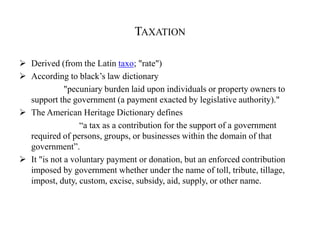
TAXATION
 Derived (from the Latin taxo; "rate")
 According to black’s law dictionary
"pecuniary burden laid upon individuals or property owners to
support the government (a payment exacted by legislative authority)."
 The American Heritage Dictionary defines
“a tax as a contribution for the support of a government
required of persons, groups, or businesses within the domain of that
government”.
 It "is not a voluntary payment or donation, but an enforced contribution
imposed by government whether under the name of toll, tribute, tillage,
impost, duty, custom, excise, subsidy, aid, supply, or other name.
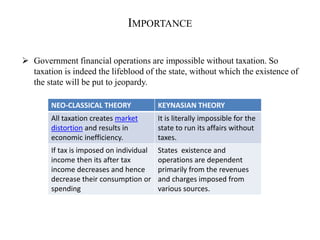
IMPORTANCE
NEO-CLASSICAL THEORY KEYNASIAN THEORY
All taxation creates market
distortion and results in
economic inefficiency.
It is literally impossible for the
state to run its affairs without
taxes.
If tax is imposed on individual
income then its after tax
income decreases and hence
decrease their consumption or
spending
States existence and
operations are dependent
primarily from the revenues
and charges imposed from
various sources.
 Government financial operations are impossible without taxation. So
taxation is indeed the lifeblood of the state, without which the existence of
the state will be put to jeopardy.
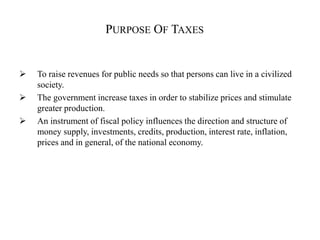
PURPOSE OF TAXES
 To raise revenues for public needs so that persons can live in a civilized
society.
 The government increase taxes in order to stabilize prices and stimulate
greater production.
 An instrument of fiscal policy influences the direction and structure of
money supply, investments, credits, production, interest rate, inflation,
prices and in general, of the national economy.
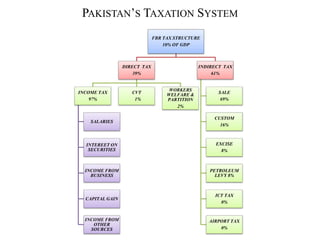
PAKISTAN’S TAXATION SYSTEM
FBR TAX STRUCTURE
10% OF GDP
DIRECT TAX
39%
INCOME TAX
97%
SALARIES
INTEREET ON
SECURITIES
INCOME FROM
BUSINESS
CAPITAL GAIN
INCOME FROM
OTHER
SOURCES
CVT
1%
WORKERS
WELFARE &
PARTITION
2%
INDIRECT TAX
61%
SALE
69%
CUSTOM
16%
EXCISE
8%
PETROLEUM
LEVY 8%
ICT TAX
0%
AIRPORT TAX
0%
0
500
1000
1500
2000
2500
3000
Rsinbillions
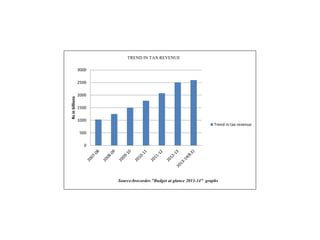
TREND IN TAX REVENUE
Trend in tax revenue
Source:brecorder."Budget at glance 2013-14" graphs
0
5
10
15
20
25
30
35
40
45
50
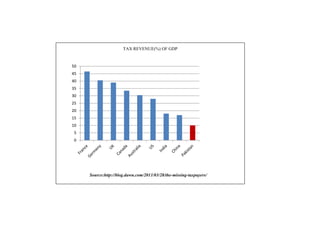
TAX REVENUE(%) OF GDP
Source:http://blog.dawn.com/2011/03/28/the-missing-taxpayers/
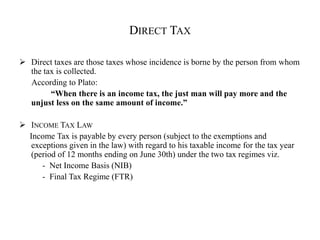
DIRECT TAX
 Direct taxes are those taxes whose incidence is borne by the person from whom
the tax is collected.
According to Plato:
“When there is an income tax, the just man will pay more and the
unjust less on the same amount of income.”
 INCOME TAX LAW
Income Tax is payable by every person (subject to the exemptions and
exceptions given in the law) with regard to his taxable income for the tax year
(period of 12 months ending on June 30th) under the two tax regimes viz.
- Net Income Basis (NIB)
- Final Tax Regime (FTR)
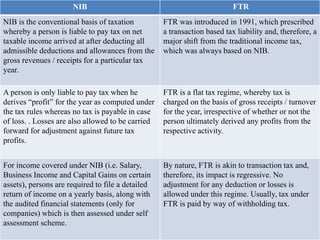
NIB FTR
NIB is the conventional basis of taxation
whereby a person is liable to pay tax on net
taxable income arrived at after deducting all
admissible deductions and allowances from the
gross revenues / receipts for a particular tax
year.
FTR was introduced in 1991, which prescribed
a transaction based tax liability and, therefore, a
major shift from the traditional income tax,
which was always based on NIB.
A person is only liable to pay tax when he
derives “profit” for the year as computed under
the tax rules whereas no tax is payable in case
of loss. . Losses are also allowed to be carried
forward for adjustment against future tax
profits.
FTR is a flat tax regime, whereby tax is
charged on the basis of gross receipts / turnover
for the year, irrespective of whether or not the
person ultimately derived any profits from the
respective activity.
For income covered under NIB (i.e. Salary,
Business Income and Capital Gains on certain
assets), persons are required to file a detailed
return of income on a yearly basis, along with
the audited financial statements (only for
companies) which is then assessed under self
assessment scheme.
By nature, FTR is akin to transaction tax and,
therefore, its impact is regressive. No
adjustment for any deduction or losses is
allowed under this regime. Usually, tax under
FTR is paid by way of withholding tax.
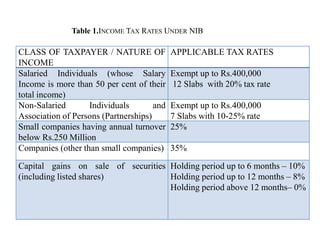
CLASS OF TAXPAYER / NATURE OF
INCOME
APPLICABLE TAX RATES
Salaried Individuals (whose Salary
Income is more than 50 per cent of their
total income)
Exempt up to Rs.400,000
12 Slabs with 20% tax rate
Non-Salaried Individuals and
Association of Persons (Partnerships)
Exempt up to Rs.400,000
7 Slabs with 10-25% rate
Small companies having annual turnover
below Rs.250 Million
25%
Companies (other than small companies) 35%
Capital gains on sale of securities
(including listed shares)
Holding period up to 6 months – 10%
Holding period up to 12 months – 8%
Holding period above 12 months– 0%
Table 1.INCOME TAX RATES UNDER NIB
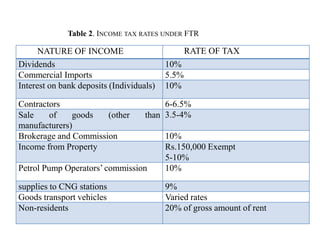
NATURE OF INCOME RATE OF TAX
Dividends 10%
Commercial Imports 5.5%
Interest on bank deposits (Individuals) 10%
Contractors 6-6.5%
Sale of goods (other than
manufacturers)
3.5-4%
Brokerage and Commission 10%
Income from Property Rs.150,000 Exempt
5-10%
Petrol Pump Operators’ commission 10%
supplies to CNG stations 9%
Goods transport vehicles Varied rates
Non-residents 20% of gross amount of rent
Table 2. INCOME TAX RATES UNDER FTR
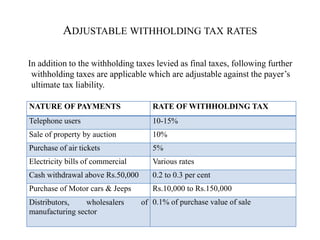
ADJUSTABLE WITHHOLDING TAX RATES
In addition to the withholding taxes levied as final taxes, following further
withholding taxes are applicable which are adjustable against the payer’s
ultimate tax liability.
NATURE OF PAYMENTS RATE OF WITHHOLDING TAX
Telephone users 10-15%
Sale of property by auction 10%
Purchase of air tickets 5%
Electricity bills of commercial Various rates
Cash withdrawal above Rs.50,000 0.2 to 0.3 per cent
Purchase of Motor cars & Jeeps Rs.10,000 to Rs.150,000
Distributors, wholesalers of
manufacturing sector
0.1% of purchase value of sale
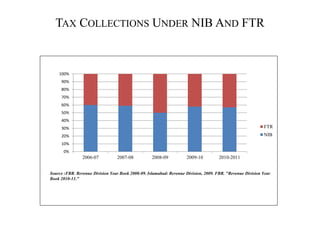
TAX COLLECTIONS UNDER NIB AND FTR
0%
10%
20%
30%
40%
50%
60%
70%
80%
90%
100%
2006-07 2007-08 2008-09 2009-10 2010-2011
FTR
NIB
Source :FBR. Revenue Division Year Book 2008-09. Islamabad: Revenue Division, 2009. FBR. "Revenue Division Year
Book 2010-11."
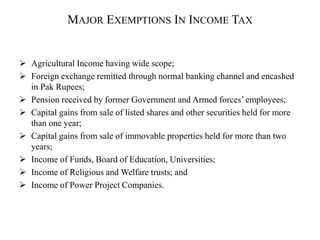
MAJOR EXEMPTIONS IN INCOME TAX
 Agricultural Income having wide scope;
 Foreign exchange remitted through normal banking channel and encashed
in Pak Rupees;
 Pension received by former Government and Armed forces’ employees;
 Capital gains from sale of listed shares and other securities held for more
than one year;
 Capital gains from sale of immovable properties held for more than two
years;
 Income of Funds, Board of Education, Universities;
 Income of Religious and Welfare trusts; and
 Income of Power Project Companies.
INDIRECT TAX
 Indirect Taxes are those added to the cost of goods or services and
ultimately borne by the consumers.
 There are three kinds of indirect taxes.
1. Sales Tax
2. Federal Excise Duty
3. Customs Duty.
SALE TAX
 It contributes about 68 per cent in indirect taxes and 45 per cent in total tax
revenue during fiscal year 2012-13. It is now presently applicable on the
value of goods imported into Pakistan and taxable supplies made by
following persons (subject to certain exemptions and concessions).
I. Manufacturers;
II. Retailers having annual turnover of Rs.5 Million and above;
III. Importers;
IV. Wholesalers and distributors; and
V. Certain services.
 On a broader basis, the components of GST can be segregated into imports
and domestic consumption.
SCOPE OF GST
 GST in its present form was introduced in Pakistan at the standard rate of 12.5
per cent in 1992, however, to meet the conditionality of the Structural
Adjustment Program of the IMF for reducing the budget deficit, the rate of
GST was raised to 18 per cent in 1995 with a reduced rate of 2 per cent
introduced to bring the small businessmen into the tax net.
 The said rate was, however, subsequently curtailed to 15 per cent due to the
pressure from the taxpayers.
 In 1999, further tax of 3 per cent was introduced on supplies made by
registered persons to unregistered persons.
 By 2004, GST was administered at five different rates i.e. 2 per cent, 15 per
cent, 18 per cent, 20 per cent and 23 per cent.
 Finally, the anomaly of different rates was removed by introducing a uniform
rate of 15 per cent with effect from July 2004. The said rate was subsequently
increased to 16 per cent in 2007 and 17 per cent in 2009. With effect from July
1, 2011, the rate of GST was again reduced to 16 per cent and recently it is 17
per cent.
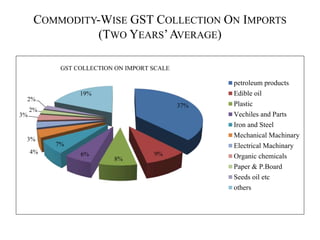
COMMODITY-WISE GST COLLECTION ON IMPORTS
(TWO YEARS’AVERAGE)
37%
9%
8%
6%
7%
4%
3%
3%
2%
2%
19%
petroleum products
Edible oil
Plastic
Vechiles and Parts
Iron and Steel
Mechanical Machinary
Electrical Machinary
Organic chemicals
Paper & P.Board
Seeds oil etc
others
GST COLLECTION ON IMPORT SCALE
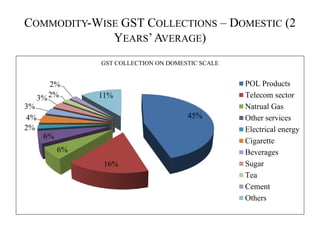
COMMODITY-WISE GST COLLECTIONS – DOMESTIC (2
YEARS’AVERAGE)
45%
16%
6%
6%
2%
4%
3%
3%2%
2%
11%
GST COLLECTION ON DOMESTIC SCALE
POL Products
Telecom sector
Natrual Gas
Other services
Electrical energy
Cigarette
Beverages
Sugar
Tea
Cement
Others
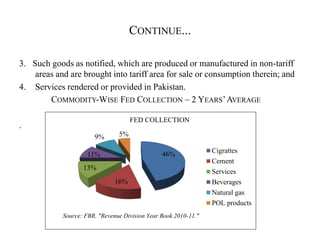
FEDERAL EXCISE DUTY
 It contribute about 8 per cent in the indirect taxes and 5 per cent in the total
tax receipts during fiscal year 2012-13.
 FED is levied on domestic production, imports and services rendered in the
country.
 The FED is an important component of Indirect taxes, whose main
objective in addition to generation of revenue is also to regulate the
consumption of certain commodities and services.
 The FED is collected both at domestic and import levels as per specified
rates. The FED is payable on-
1. Excisable goods produced or manufactured in Pakistan;
2. Goods imported into Pakistan; and
CONTINUE...
3. Such goods as notified, which are produced or manufactured in non-tariff
areas and are brought into tariff area for sale or consumption therein; and
4. Services rendered or provided in Pakistan.
COMMODITY-WISE FED COLLECTION – 2 YEARS’AVERAGE
.
46%
16%
13%
11%
9% 5%
FED COLLECTION
Cigrattes
Cement
Services
Beverages
Natural gas
POL products
Source: FBR. "Revenue Division Year Book 2010-11."
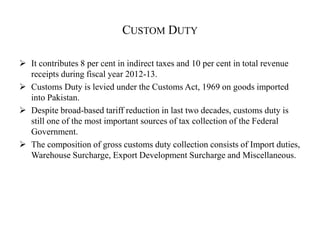
CUSTOM DUTY
 It contributes 8 per cent in indirect taxes and 10 per cent in total revenue
receipts during fiscal year 2012-13.
 Customs Duty is levied under the Customs Act, 1969 on goods imported
into Pakistan.
 Despite broad-based tariff reduction in last two decades, customs duty is
still one of the most important sources of tax collection of the Federal
Government.
 The composition of gross customs duty collection consists of Import duties,
Warehouse Surcharge, Export Development Surcharge and Miscellaneous.
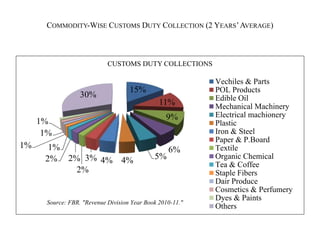
COMMODITY-WISE CUSTOMS DUTY COLLECTION (2 YEARS’AVERAGE)
15%
11%
9%
6%
5%4%4%3%
2%
2%2%
1%1%
1%
1%
30%
CUSTOMS DUTY COLLECTIONS
Vechiles & Parts
POL Products
Edible Oil
Mechanical Machinery
Electrical machionery
Plastic
Iron & Steel
Paper & P.Board
Textile
Organic Chemical
Tea & Coffee
Staple Fibers
Dair Produce
Cosmetics & Perfumery
Dyes & Paints
Others
Source: FBR. "Revenue Division Year Book 2010-11."
PROBLEMS
 Taxation in Pakistan is a complex system of more than 70 unique taxes
administered by at least 37 agencies of the Government of Pakistan.
 According to the International Development Committee, Pakistan had a
lower-than-average tax take. A low – and declining ‐ tax‐to‐GDP ratio, is
amongst Pakistan’s biggest structural weaknesses.
 Only 0.57% of Pakistanis or 768,000 people out of a population of 190
million pay income tax.
 No wealth tax and it has been stopped since 2007.
 The weak areas in PAKISTAN taxation system are:
 Taxpayer has trust deficit;
 Cost of collection of taxes;
 lack of tax compliance culture in a society;
CONTINUE...
 lack of tax education;
 lack of effective complaint redress mechanism in tax system and;
 malpractices of tax administration and estimated cost of certain major tax
exemptions is around PKR 46 Billion per annum;
 agriculture, large number of services, capital gains is not included in tax
net;
 wide spread exemptions;
 large undocumented informal sector;
 weak audit and enforcement
RECOMMENDATIONS
1. PROVISION OF ESSENTIAL SHARED SERVICES TO THE
TAXPAYERS
Provision of essential shared services to the taxpayers such as education,
health care, law and order, social services, etc. In order to achieve the
Exchange Equity and Fairness in the tax system of Pakistan, it is most
important that measures should be taken by the Government of Pakistan to
invest in Infrastructure, and other essential shared services so as to justify
the collection of taxes from the taxpayers.
2. TAX ADMINISTRATION
In order to bring process of equity and fairness, it is important that the tax
administration should be professionally competent and fair in terms of their
dealings with the taxpayers. Merely implementing the Information
Technology systems of the tax administration are not enough to achieve
process equity and fairness rather there is a need to change the mind-set of
tax administrators.
CONTINUE...
3. EQUITABLE TAXATION OF ALL ECONOMIC SECTORS
There are various segments of Economy, such as Agriculture, wholesalers,
distributors and retailers, real estate, stock exchange, etc. which are not
contributing towards the tax revenue in proportion to their contribution in
Economy. There is a dire need to make necessary corrections in the tax system
to have equitable distribution of tax incidence on all sectors of the Economy
rather than a concentration on some selective sectors as the same would result
in achievement of horizontal equity.
4. AGRICULTURAL INCOME TAX
Measures should be taken to ensure that Agricultural sector is taxed on
equitable grounds and in this regard, Provincial laws on Agricultural Income
Tax are required to be amended (by the respective Assemblies) to remove the
anomaly in the tax rates.
CONTINUE...
5. REAL ESTATE SECTOR
There is a need to review the local and provincial laws relating to transfer of
immovable properties so as to provide for payment of transfer related
taxes either on the basis of fair valuation of the properties at the time of
sale and not on the declared value.
6. FOREIGN EXCHANGE REMITTANCES
It is suggested to link the immunity of foreign exchange remittances with
the payment of a small percentage of tax on such remittance, which would
further enhance the documentation.
7. FTR
The Government has given a conditional option to Commercial Importers,
Exporters and Traders to opt for the normal tax regime. This is a positive
step; however, the FTR should be eventually phased out in a gradual
manner for all such sectors where documentation can be maintained.
CONTINUE...
8. TAXATION OF SERVICES’ SECTOR
Various measures have been taken by the Government in the past, such as
Universal Self Assessment Schemes for income tax and minimum / fixed
tax regimes for retail sector; however, no significant improvement has
been achieved. Even for GST, varied regimes were introduced; however, it
appears that there is no significant contribution of taxes from this sector.
There is, therefore, a need for all the Provinces to jointly formulate a
policy framework to extend the scope of GST on those services, which are
not presently taxed either due to expressed exemptions or due to evasions.
CONCLUSION
There are various issues with taxation system of Pakistan like huge
exemptions, wider tax gap, low tax-GDP ratio, less effective audit and
penalty system etc. If these issues are settled, tax revenues will improve
significantly which will further bring down cost of collection. Improvement
in revenue collection through reduced cost of collection should then be
viewed as a by-product of effective management of human and physical
resources. More resources are required for modernization and enforcement.
Similarly, skilled personnel will have to be increased. There is a need to
modernize the taxation system and more funds are required to be allocated
for human resource development.
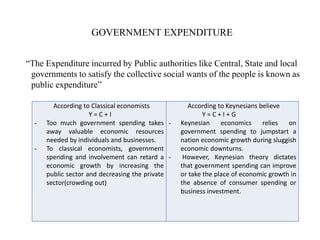
GOVERNMENT EXPENDITURE
“The Expenditure incurred by Public authorities like Central, State and local
governments to satisfy the collective social wants of the people is known as
public expenditure”
According to Classical economists
Y = C + I
- Too much government spending takes
away valuable economic resources
needed by individuals and businesses.
- To classical economists, government
spending and involvement can retard a
economic growth by increasing the
public sector and decreasing the private
sector(crowding out)
According to Keynesians believe
Y = C + I + G
- Keynesian economics relies on
government spending to jumpstart a
nation economic growth during sluggish
economic downturns.
- However, Keynesian theory dictates
that government spending can improve
or take the place of economic growth in
the absence of consumer spending or
business investment.
IMPORTANCE
 Throughout the 19th Century, most governments followed laissez faire
economic policies their functions were only restricted to defending
aggression & maintaining law & order. The size of pubic expenditure was
very small. But now the expenditure of governments all over has
significantly increased.
 In the early 20th Century, John Maynard Keynes advocated the role of
public expenditure in determination of level of income and its distribution.
 In developing countries, public expenditure policy not only accelerates
economic growth & promotes employment opportunities but also plays a
useful role in reducing poverty and inequalities in income distribution.
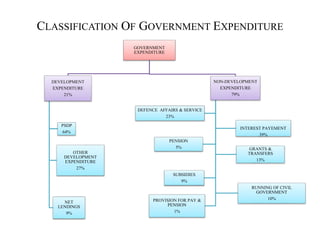
CLASSIFICATION OF GOVERNMENT EXPENDITURE
GOVERNMENT
EXPENDITURE
DEVELOPMENT
EXPENDITURE
21%
PSDP
64%
OTHER
DEVELOPMENT
EXPENDITURE
27%
NET
LENDINGS
9%
NON-DEVELOPMENT
EXPENDITURE
79%
DEFENCE AFFAIRS & SERVICE
23%
INTEREST PAYEMENT
39%
PENSION
5% GRANTS &
TRANSFERS
13%
SUBSIDIES
9%
RUNNING OF CIVIL
GOVERNMENT
10%PROVISION FOR PAY &
PENSION
1%
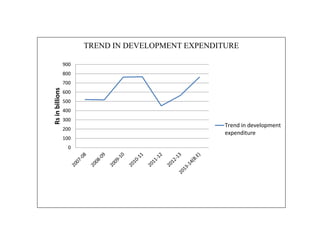
DEVELOPMENT EXPENDITURE
 It is also known as a “capital expenditure”.
 The expenditure in the capital budget is incurred on building assets of a
lasting character, like construction of canals, dams, water storage, roads
and railway lines, public buildings of various kinds, ports, etc.
 Such expenditure is of such a magnitude that it is not possible to meet it
from current revenues.
 It is mostly financed by raising loans, internal or even external.
0
100
200
300
400
500
600
700
800
900
Rsinbillions
TREND IN DEVELOPMENT EXPENDITURE
Trend in development
expenditure
NON-DEVELOPMENT EXPENDITURE
 The expenditure on ordinary maintenance and running of existing facilities
would be ‘non-development expenditure’.
 It is also known as “Current expenditure”.
 The main sources of financing non-developing expenditure or revenue
expenditure is the current revenue of the government which mainly consists
of taxes and certain non-tax revenues like profits, incidental incomes, fees
and some other extra-ordinary items.
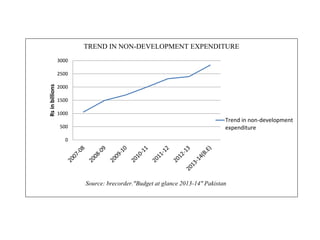
0
500
1000
1500
2000
2500
3000
Rsinbillions
TREND IN NON-DEVELOPMENT EXPENDITURE
Trend in non-development
expenditure
Source: brecorder."Budget at glance 2013-14" Pakistan
PROBLEMS
 First, at the most basic level the growth in expenditures far outstripped the
growth in revenues, thus leading to large fiscal deficit and unsustainable
levels of public debt. Hence to meet this debt, government start internal &
external barrowing and this borrowing by the federal government increases
the interest rate and reduces borrowing by households and private
businesses (crowding out).At the same time on the other hand money
supply increases which further raise the inflation.
 Second, the growth was especially rapid in non development expenditures,
including interest payment & defence affairs which constitute almost 50%
of the total expenditure and as a result the general government savings
turned negative.
 Pakistan spent just 0.27% of its gross domestic product (GDP) on health in
2011-12 which is insufficient to cater the needs of the population,
according to the Economic Survey of Pakistan of 2011-2012.
CONTINUE...
 On the other hand Pakistan spend just 1.9% of Gross Domestic Product
(GDP).In the recent election campaign, political parties promised to
increase financial allocation of education to at least by 4% of GDP, the
global standard to which most countries have committed and the majority
have lived up to. According to the UNDP Human Development Report
2013, only seven developing countries in the world spend less on education
than Pakistan.
 Then, the state intervention in commercial and industrial activities served
as a strong disincentive for the private sector .Many activities in which the
private sector could provide an efficient service without draining public
resources are in the hands of government departments or public
corporations.
RECOMMENDATIONS
 ENSURING FINANCIAL DISCIPLINE AND FISCAL SPACE
Contain the overall fiscal deficit (including external grants) to 3 percent o f
GDP on average. Accelerate FBR reforms, including a fundamental change
in HRM. Speedily complete the privatization plans that are underway and
to develop a realistic but proactive timetable for privatization of WAPDA
and KESC. Reinforce efforts to reduce technical losses in the power sector.
Reduce the cost of public barrowing.
 REORIENTING THE PUBLIC SECTOR PRIORITIES
Substantially increase allocation for education and health focusing o n both
quantitative and qualitative improvements. Devise incentive programs to
stimulate demand for education and encourage enrolments, especially
among the poor. Develop a clear vision, which integrates long-term
development of agriculture and power sectors with investments in irrigation
sectors. Develop a water sector investment strategy which strikes
appropriate balance between expansions of irrigation facilities. Implement
the institutional plans for raising the effectiveness of spending on irrigation,
drainage and water storage.
CONTINUE...
 IMPROVING THE EFFECTIVENESS OF PUBLIC SECTOR
Develop and adopt a rolling Medium-Term Budget Framework (MTBF) at
the federal level and in provinces, based on sector strategies and hard
budget constraints and integration of development and recurrent
expenditures. Undertake devolution from the federal to provincial
governments with appropriate funding arrangements. Establish mechanism,
including financial incentives (e.g. matching grants), through which
national and provincial priorities could be internalized by the local
government.
 STRENGHTING THE CIVIL SERVICES
Move ahead rapidly on the creation of a National Executive Service that
would greatly increase incentives both for improved performance and
upgrading of skills through learning and education. Use the fiscal space, on
the one hand, for restoring compensation closer to private sector for the
higher grades, and on the other to adjust pay scales for groups, for instance
primary school teachers, lady health workers who are particularly poorly
paid.
CONCLUSION
In short, Fiscal imbalances that have been persistent since the last two
decades still stand as a big challenge for policy makers in Pakistan. For
obtaining more favourable growth, external and internal balances and lower
rates of inflation, there stands a need for reducing current expenditures of
the government and controlling wastage of resources on current and
development outlays of the economy. With the end of cold war and the loss
of strategic position of Pakistan, the aid phenomenon faces an unsettled
future.
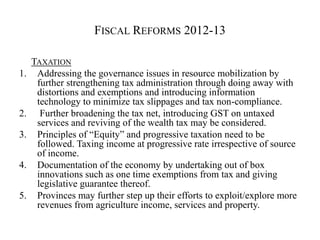
FISCAL REFORMS 2012-13
TAXATION
1. Addressing the governance issues in resource mobilization by
further strengthening tax administration through doing away with
distortions and exemptions and introducing information
technology to minimize tax slippages and tax non-compliance.
2. Further broadening the tax net, introducing GST on untaxed
services and reviving of the wealth tax may be considered.
3. Principles of “Equity” and progressive taxation need to be
followed. Taxing income at progressive rate irrespective of source
of income.
4. Documentation of the economy by undertaking out of box
innovations such as one time exemptions from tax and giving
legislative guarantee thereof.
5. Provinces may further step up their efforts to exploit/explore more
revenues from agriculture income, services and property.
CONTINUE...
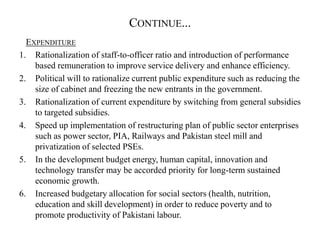
EXPENDITURE
1. Rationalization of staff-to-officer ratio and introduction of performance
based remuneration to improve service delivery and enhance efficiency.
2. Political will to rationalize current public expenditure such as reducing the
size of cabinet and freezing the new entrants in the government.
3. Rationalization of current expenditure by switching from general subsidies
to targeted subsidies.
4. Speed up implementation of restructuring plan of public sector enterprises
such as power sector, PIA, Railways and Pakistan steel mill and
privatization of selected PSEs.
5. In the development budget energy, human capital, innovation and
technology transfer may be accorded priority for long-term sustained
economic growth.
6. Increased budgetary allocation for social sectors (health, nutrition,
education and skill development) in order to reduce poverty and to
promote productivity of Pakistani labour.
REFERENCE
www.finance.gov.pk/
www.pbs.gov.pk/
www.fbr.gov.pk/
www.brecorder.com/

Taxation

  • 1.
    PUBLIC FINANCE TAXATION ANDGOVERNMENT EXPENDITURE: A CASE STUDY OF PAKISTAN
  • 2.
    TAXATION  Derived (fromthe Latin taxo; "rate")  According to black’s law dictionary "pecuniary burden laid upon individuals or property owners to support the government (a payment exacted by legislative authority)."  The American Heritage Dictionary defines “a tax as a contribution for the support of a government required of persons, groups, or businesses within the domain of that government”.  It "is not a voluntary payment or donation, but an enforced contribution imposed by government whether under the name of toll, tribute, tillage, impost, duty, custom, excise, subsidy, aid, supply, or other name.
  • 3.
    IMPORTANCE NEO-CLASSICAL THEORY KEYNASIANTHEORY All taxation creates market distortion and results in economic inefficiency. It is literally impossible for the state to run its affairs without taxes. If tax is imposed on individual income then its after tax income decreases and hence decrease their consumption or spending States existence and operations are dependent primarily from the revenues and charges imposed from various sources.  Government financial operations are impossible without taxation. So taxation is indeed the lifeblood of the state, without which the existence of the state will be put to jeopardy.
  • 4.
    PURPOSE OF TAXES To raise revenues for public needs so that persons can live in a civilized society.  The government increase taxes in order to stabilize prices and stimulate greater production.  An instrument of fiscal policy influences the direction and structure of money supply, investments, credits, production, interest rate, inflation, prices and in general, of the national economy.
  • 5.
    PAKISTAN’S TAXATION SYSTEM FBRTAX STRUCTURE 10% OF GDP DIRECT TAX 39% INCOME TAX 97% SALARIES INTEREET ON SECURITIES INCOME FROM BUSINESS CAPITAL GAIN INCOME FROM OTHER SOURCES CVT 1% WORKERS WELFARE & PARTITION 2% INDIRECT TAX 61% SALE 69% CUSTOM 16% EXCISE 8% PETROLEUM LEVY 8% ICT TAX 0% AIRPORT TAX 0%
  • 6.
    0 500 1000 1500 2000 2500 3000 Rsinbillions TREND IN TAXREVENUE Trend in tax revenue Source:brecorder."Budget at glance 2013-14" graphs
  • 7.
    0 5 10 15 20 25 30 35 40 45 50 TAX REVENUE(%) OFGDP Source:http://blog.dawn.com/2011/03/28/the-missing-taxpayers/
  • 8.
    DIRECT TAX  Directtaxes are those taxes whose incidence is borne by the person from whom the tax is collected. According to Plato: “When there is an income tax, the just man will pay more and the unjust less on the same amount of income.”  INCOME TAX LAW Income Tax is payable by every person (subject to the exemptions and exceptions given in the law) with regard to his taxable income for the tax year (period of 12 months ending on June 30th) under the two tax regimes viz. - Net Income Basis (NIB) - Final Tax Regime (FTR)
  • 9.
    NIB FTR NIB isthe conventional basis of taxation whereby a person is liable to pay tax on net taxable income arrived at after deducting all admissible deductions and allowances from the gross revenues / receipts for a particular tax year. FTR was introduced in 1991, which prescribed a transaction based tax liability and, therefore, a major shift from the traditional income tax, which was always based on NIB. A person is only liable to pay tax when he derives “profit” for the year as computed under the tax rules whereas no tax is payable in case of loss. . Losses are also allowed to be carried forward for adjustment against future tax profits. FTR is a flat tax regime, whereby tax is charged on the basis of gross receipts / turnover for the year, irrespective of whether or not the person ultimately derived any profits from the respective activity. For income covered under NIB (i.e. Salary, Business Income and Capital Gains on certain assets), persons are required to file a detailed return of income on a yearly basis, along with the audited financial statements (only for companies) which is then assessed under self assessment scheme. By nature, FTR is akin to transaction tax and, therefore, its impact is regressive. No adjustment for any deduction or losses is allowed under this regime. Usually, tax under FTR is paid by way of withholding tax.
  • 10.
    CLASS OF TAXPAYER/ NATURE OF INCOME APPLICABLE TAX RATES Salaried Individuals (whose Salary Income is more than 50 per cent of their total income) Exempt up to Rs.400,000 12 Slabs with 20% tax rate Non-Salaried Individuals and Association of Persons (Partnerships) Exempt up to Rs.400,000 7 Slabs with 10-25% rate Small companies having annual turnover below Rs.250 Million 25% Companies (other than small companies) 35% Capital gains on sale of securities (including listed shares) Holding period up to 6 months – 10% Holding period up to 12 months – 8% Holding period above 12 months– 0% Table 1.INCOME TAX RATES UNDER NIB
  • 11.
    NATURE OF INCOMERATE OF TAX Dividends 10% Commercial Imports 5.5% Interest on bank deposits (Individuals) 10% Contractors 6-6.5% Sale of goods (other than manufacturers) 3.5-4% Brokerage and Commission 10% Income from Property Rs.150,000 Exempt 5-10% Petrol Pump Operators’ commission 10% supplies to CNG stations 9% Goods transport vehicles Varied rates Non-residents 20% of gross amount of rent Table 2. INCOME TAX RATES UNDER FTR
  • 12.
    ADJUSTABLE WITHHOLDING TAXRATES In addition to the withholding taxes levied as final taxes, following further withholding taxes are applicable which are adjustable against the payer’s ultimate tax liability. NATURE OF PAYMENTS RATE OF WITHHOLDING TAX Telephone users 10-15% Sale of property by auction 10% Purchase of air tickets 5% Electricity bills of commercial Various rates Cash withdrawal above Rs.50,000 0.2 to 0.3 per cent Purchase of Motor cars & Jeeps Rs.10,000 to Rs.150,000 Distributors, wholesalers of manufacturing sector 0.1% of purchase value of sale
  • 13.
    TAX COLLECTIONS UNDERNIB AND FTR 0% 10% 20% 30% 40% 50% 60% 70% 80% 90% 100% 2006-07 2007-08 2008-09 2009-10 2010-2011 FTR NIB Source :FBR. Revenue Division Year Book 2008-09. Islamabad: Revenue Division, 2009. FBR. "Revenue Division Year Book 2010-11."
  • 14.
    MAJOR EXEMPTIONS ININCOME TAX  Agricultural Income having wide scope;  Foreign exchange remitted through normal banking channel and encashed in Pak Rupees;  Pension received by former Government and Armed forces’ employees;  Capital gains from sale of listed shares and other securities held for more than one year;  Capital gains from sale of immovable properties held for more than two years;  Income of Funds, Board of Education, Universities;  Income of Religious and Welfare trusts; and  Income of Power Project Companies.
  • 15.
    INDIRECT TAX  IndirectTaxes are those added to the cost of goods or services and ultimately borne by the consumers.  There are three kinds of indirect taxes. 1. Sales Tax 2. Federal Excise Duty 3. Customs Duty.
  • 16.
    SALE TAX  Itcontributes about 68 per cent in indirect taxes and 45 per cent in total tax revenue during fiscal year 2012-13. It is now presently applicable on the value of goods imported into Pakistan and taxable supplies made by following persons (subject to certain exemptions and concessions). I. Manufacturers; II. Retailers having annual turnover of Rs.5 Million and above; III. Importers; IV. Wholesalers and distributors; and V. Certain services.  On a broader basis, the components of GST can be segregated into imports and domestic consumption.
  • 17.
    SCOPE OF GST GST in its present form was introduced in Pakistan at the standard rate of 12.5 per cent in 1992, however, to meet the conditionality of the Structural Adjustment Program of the IMF for reducing the budget deficit, the rate of GST was raised to 18 per cent in 1995 with a reduced rate of 2 per cent introduced to bring the small businessmen into the tax net.  The said rate was, however, subsequently curtailed to 15 per cent due to the pressure from the taxpayers.  In 1999, further tax of 3 per cent was introduced on supplies made by registered persons to unregistered persons.  By 2004, GST was administered at five different rates i.e. 2 per cent, 15 per cent, 18 per cent, 20 per cent and 23 per cent.  Finally, the anomaly of different rates was removed by introducing a uniform rate of 15 per cent with effect from July 2004. The said rate was subsequently increased to 16 per cent in 2007 and 17 per cent in 2009. With effect from July 1, 2011, the rate of GST was again reduced to 16 per cent and recently it is 17 per cent.
  • 18.
    COMMODITY-WISE GST COLLECTIONON IMPORTS (TWO YEARS’AVERAGE) 37% 9% 8% 6% 7% 4% 3% 3% 2% 2% 19% petroleum products Edible oil Plastic Vechiles and Parts Iron and Steel Mechanical Machinary Electrical Machinary Organic chemicals Paper & P.Board Seeds oil etc others GST COLLECTION ON IMPORT SCALE
  • 19.
    COMMODITY-WISE GST COLLECTIONS– DOMESTIC (2 YEARS’AVERAGE) 45% 16% 6% 6% 2% 4% 3% 3%2% 2% 11% GST COLLECTION ON DOMESTIC SCALE POL Products Telecom sector Natrual Gas Other services Electrical energy Cigarette Beverages Sugar Tea Cement Others
  • 20.
    FEDERAL EXCISE DUTY It contribute about 8 per cent in the indirect taxes and 5 per cent in the total tax receipts during fiscal year 2012-13.  FED is levied on domestic production, imports and services rendered in the country.  The FED is an important component of Indirect taxes, whose main objective in addition to generation of revenue is also to regulate the consumption of certain commodities and services.  The FED is collected both at domestic and import levels as per specified rates. The FED is payable on- 1. Excisable goods produced or manufactured in Pakistan; 2. Goods imported into Pakistan; and
  • 21.
    CONTINUE... 3. Such goodsas notified, which are produced or manufactured in non-tariff areas and are brought into tariff area for sale or consumption therein; and 4. Services rendered or provided in Pakistan. COMMODITY-WISE FED COLLECTION – 2 YEARS’AVERAGE . 46% 16% 13% 11% 9% 5% FED COLLECTION Cigrattes Cement Services Beverages Natural gas POL products Source: FBR. "Revenue Division Year Book 2010-11."
  • 22.
    CUSTOM DUTY  Itcontributes 8 per cent in indirect taxes and 10 per cent in total revenue receipts during fiscal year 2012-13.  Customs Duty is levied under the Customs Act, 1969 on goods imported into Pakistan.  Despite broad-based tariff reduction in last two decades, customs duty is still one of the most important sources of tax collection of the Federal Government.  The composition of gross customs duty collection consists of Import duties, Warehouse Surcharge, Export Development Surcharge and Miscellaneous.
  • 23.
    COMMODITY-WISE CUSTOMS DUTYCOLLECTION (2 YEARS’AVERAGE) 15% 11% 9% 6% 5%4%4%3% 2% 2%2% 1%1% 1% 1% 30% CUSTOMS DUTY COLLECTIONS Vechiles & Parts POL Products Edible Oil Mechanical Machinery Electrical machionery Plastic Iron & Steel Paper & P.Board Textile Organic Chemical Tea & Coffee Staple Fibers Dair Produce Cosmetics & Perfumery Dyes & Paints Others Source: FBR. "Revenue Division Year Book 2010-11."
  • 24.
    PROBLEMS  Taxation inPakistan is a complex system of more than 70 unique taxes administered by at least 37 agencies of the Government of Pakistan.  According to the International Development Committee, Pakistan had a lower-than-average tax take. A low – and declining ‐ tax‐to‐GDP ratio, is amongst Pakistan’s biggest structural weaknesses.  Only 0.57% of Pakistanis or 768,000 people out of a population of 190 million pay income tax.  No wealth tax and it has been stopped since 2007.  The weak areas in PAKISTAN taxation system are:  Taxpayer has trust deficit;  Cost of collection of taxes;  lack of tax compliance culture in a society;
  • 25.
    CONTINUE...  lack oftax education;  lack of effective complaint redress mechanism in tax system and;  malpractices of tax administration and estimated cost of certain major tax exemptions is around PKR 46 Billion per annum;  agriculture, large number of services, capital gains is not included in tax net;  wide spread exemptions;  large undocumented informal sector;  weak audit and enforcement
  • 26.
    RECOMMENDATIONS 1. PROVISION OFESSENTIAL SHARED SERVICES TO THE TAXPAYERS Provision of essential shared services to the taxpayers such as education, health care, law and order, social services, etc. In order to achieve the Exchange Equity and Fairness in the tax system of Pakistan, it is most important that measures should be taken by the Government of Pakistan to invest in Infrastructure, and other essential shared services so as to justify the collection of taxes from the taxpayers. 2. TAX ADMINISTRATION In order to bring process of equity and fairness, it is important that the tax administration should be professionally competent and fair in terms of their dealings with the taxpayers. Merely implementing the Information Technology systems of the tax administration are not enough to achieve process equity and fairness rather there is a need to change the mind-set of tax administrators.
  • 27.
    CONTINUE... 3. EQUITABLE TAXATIONOF ALL ECONOMIC SECTORS There are various segments of Economy, such as Agriculture, wholesalers, distributors and retailers, real estate, stock exchange, etc. which are not contributing towards the tax revenue in proportion to their contribution in Economy. There is a dire need to make necessary corrections in the tax system to have equitable distribution of tax incidence on all sectors of the Economy rather than a concentration on some selective sectors as the same would result in achievement of horizontal equity. 4. AGRICULTURAL INCOME TAX Measures should be taken to ensure that Agricultural sector is taxed on equitable grounds and in this regard, Provincial laws on Agricultural Income Tax are required to be amended (by the respective Assemblies) to remove the anomaly in the tax rates.
  • 28.
    CONTINUE... 5. REAL ESTATESECTOR There is a need to review the local and provincial laws relating to transfer of immovable properties so as to provide for payment of transfer related taxes either on the basis of fair valuation of the properties at the time of sale and not on the declared value. 6. FOREIGN EXCHANGE REMITTANCES It is suggested to link the immunity of foreign exchange remittances with the payment of a small percentage of tax on such remittance, which would further enhance the documentation. 7. FTR The Government has given a conditional option to Commercial Importers, Exporters and Traders to opt for the normal tax regime. This is a positive step; however, the FTR should be eventually phased out in a gradual manner for all such sectors where documentation can be maintained.
  • 29.
    CONTINUE... 8. TAXATION OFSERVICES’ SECTOR Various measures have been taken by the Government in the past, such as Universal Self Assessment Schemes for income tax and minimum / fixed tax regimes for retail sector; however, no significant improvement has been achieved. Even for GST, varied regimes were introduced; however, it appears that there is no significant contribution of taxes from this sector. There is, therefore, a need for all the Provinces to jointly formulate a policy framework to extend the scope of GST on those services, which are not presently taxed either due to expressed exemptions or due to evasions.
  • 30.
    CONCLUSION There are variousissues with taxation system of Pakistan like huge exemptions, wider tax gap, low tax-GDP ratio, less effective audit and penalty system etc. If these issues are settled, tax revenues will improve significantly which will further bring down cost of collection. Improvement in revenue collection through reduced cost of collection should then be viewed as a by-product of effective management of human and physical resources. More resources are required for modernization and enforcement. Similarly, skilled personnel will have to be increased. There is a need to modernize the taxation system and more funds are required to be allocated for human resource development.
  • 31.
    GOVERNMENT EXPENDITURE “The Expenditureincurred by Public authorities like Central, State and local governments to satisfy the collective social wants of the people is known as public expenditure” According to Classical economists Y = C + I - Too much government spending takes away valuable economic resources needed by individuals and businesses. - To classical economists, government spending and involvement can retard a economic growth by increasing the public sector and decreasing the private sector(crowding out) According to Keynesians believe Y = C + I + G - Keynesian economics relies on government spending to jumpstart a nation economic growth during sluggish economic downturns. - However, Keynesian theory dictates that government spending can improve or take the place of economic growth in the absence of consumer spending or business investment.
  • 32.
    IMPORTANCE  Throughout the19th Century, most governments followed laissez faire economic policies their functions were only restricted to defending aggression & maintaining law & order. The size of pubic expenditure was very small. But now the expenditure of governments all over has significantly increased.  In the early 20th Century, John Maynard Keynes advocated the role of public expenditure in determination of level of income and its distribution.  In developing countries, public expenditure policy not only accelerates economic growth & promotes employment opportunities but also plays a useful role in reducing poverty and inequalities in income distribution.
  • 33.
    CLASSIFICATION OF GOVERNMENTEXPENDITURE GOVERNMENT EXPENDITURE DEVELOPMENT EXPENDITURE 21% PSDP 64% OTHER DEVELOPMENT EXPENDITURE 27% NET LENDINGS 9% NON-DEVELOPMENT EXPENDITURE 79% DEFENCE AFFAIRS & SERVICE 23% INTEREST PAYEMENT 39% PENSION 5% GRANTS & TRANSFERS 13% SUBSIDIES 9% RUNNING OF CIVIL GOVERNMENT 10%PROVISION FOR PAY & PENSION 1%
  • 34.
    DEVELOPMENT EXPENDITURE  Itis also known as a “capital expenditure”.  The expenditure in the capital budget is incurred on building assets of a lasting character, like construction of canals, dams, water storage, roads and railway lines, public buildings of various kinds, ports, etc.  Such expenditure is of such a magnitude that it is not possible to meet it from current revenues.  It is mostly financed by raising loans, internal or even external.
  • 35.
  • 36.
    NON-DEVELOPMENT EXPENDITURE  Theexpenditure on ordinary maintenance and running of existing facilities would be ‘non-development expenditure’.  It is also known as “Current expenditure”.  The main sources of financing non-developing expenditure or revenue expenditure is the current revenue of the government which mainly consists of taxes and certain non-tax revenues like profits, incidental incomes, fees and some other extra-ordinary items.
  • 37.
    0 500 1000 1500 2000 2500 3000 Rsinbillions TREND IN NON-DEVELOPMENTEXPENDITURE Trend in non-development expenditure Source: brecorder."Budget at glance 2013-14" Pakistan
  • 38.
    PROBLEMS  First, atthe most basic level the growth in expenditures far outstripped the growth in revenues, thus leading to large fiscal deficit and unsustainable levels of public debt. Hence to meet this debt, government start internal & external barrowing and this borrowing by the federal government increases the interest rate and reduces borrowing by households and private businesses (crowding out).At the same time on the other hand money supply increases which further raise the inflation.  Second, the growth was especially rapid in non development expenditures, including interest payment & defence affairs which constitute almost 50% of the total expenditure and as a result the general government savings turned negative.  Pakistan spent just 0.27% of its gross domestic product (GDP) on health in 2011-12 which is insufficient to cater the needs of the population, according to the Economic Survey of Pakistan of 2011-2012.
  • 39.
    CONTINUE...  On theother hand Pakistan spend just 1.9% of Gross Domestic Product (GDP).In the recent election campaign, political parties promised to increase financial allocation of education to at least by 4% of GDP, the global standard to which most countries have committed and the majority have lived up to. According to the UNDP Human Development Report 2013, only seven developing countries in the world spend less on education than Pakistan.  Then, the state intervention in commercial and industrial activities served as a strong disincentive for the private sector .Many activities in which the private sector could provide an efficient service without draining public resources are in the hands of government departments or public corporations.
  • 40.
    RECOMMENDATIONS  ENSURING FINANCIALDISCIPLINE AND FISCAL SPACE Contain the overall fiscal deficit (including external grants) to 3 percent o f GDP on average. Accelerate FBR reforms, including a fundamental change in HRM. Speedily complete the privatization plans that are underway and to develop a realistic but proactive timetable for privatization of WAPDA and KESC. Reinforce efforts to reduce technical losses in the power sector. Reduce the cost of public barrowing.  REORIENTING THE PUBLIC SECTOR PRIORITIES Substantially increase allocation for education and health focusing o n both quantitative and qualitative improvements. Devise incentive programs to stimulate demand for education and encourage enrolments, especially among the poor. Develop a clear vision, which integrates long-term development of agriculture and power sectors with investments in irrigation sectors. Develop a water sector investment strategy which strikes appropriate balance between expansions of irrigation facilities. Implement the institutional plans for raising the effectiveness of spending on irrigation, drainage and water storage.
  • 41.
    CONTINUE...  IMPROVING THEEFFECTIVENESS OF PUBLIC SECTOR Develop and adopt a rolling Medium-Term Budget Framework (MTBF) at the federal level and in provinces, based on sector strategies and hard budget constraints and integration of development and recurrent expenditures. Undertake devolution from the federal to provincial governments with appropriate funding arrangements. Establish mechanism, including financial incentives (e.g. matching grants), through which national and provincial priorities could be internalized by the local government.  STRENGHTING THE CIVIL SERVICES Move ahead rapidly on the creation of a National Executive Service that would greatly increase incentives both for improved performance and upgrading of skills through learning and education. Use the fiscal space, on the one hand, for restoring compensation closer to private sector for the higher grades, and on the other to adjust pay scales for groups, for instance primary school teachers, lady health workers who are particularly poorly paid.
  • 42.
    CONCLUSION In short, Fiscalimbalances that have been persistent since the last two decades still stand as a big challenge for policy makers in Pakistan. For obtaining more favourable growth, external and internal balances and lower rates of inflation, there stands a need for reducing current expenditures of the government and controlling wastage of resources on current and development outlays of the economy. With the end of cold war and the loss of strategic position of Pakistan, the aid phenomenon faces an unsettled future.
  • 43.
    FISCAL REFORMS 2012-13 TAXATION 1.Addressing the governance issues in resource mobilization by further strengthening tax administration through doing away with distortions and exemptions and introducing information technology to minimize tax slippages and tax non-compliance. 2. Further broadening the tax net, introducing GST on untaxed services and reviving of the wealth tax may be considered. 3. Principles of “Equity” and progressive taxation need to be followed. Taxing income at progressive rate irrespective of source of income. 4. Documentation of the economy by undertaking out of box innovations such as one time exemptions from tax and giving legislative guarantee thereof. 5. Provinces may further step up their efforts to exploit/explore more revenues from agriculture income, services and property.
  • 44.
    CONTINUE... EXPENDITURE 1. Rationalization ofstaff-to-officer ratio and introduction of performance based remuneration to improve service delivery and enhance efficiency. 2. Political will to rationalize current public expenditure such as reducing the size of cabinet and freezing the new entrants in the government. 3. Rationalization of current expenditure by switching from general subsidies to targeted subsidies. 4. Speed up implementation of restructuring plan of public sector enterprises such as power sector, PIA, Railways and Pakistan steel mill and privatization of selected PSEs. 5. In the development budget energy, human capital, innovation and technology transfer may be accorded priority for long-term sustained economic growth. 6. Increased budgetary allocation for social sectors (health, nutrition, education and skill development) in order to reduce poverty and to promote productivity of Pakistani labour.
  • 45.