Tax Diversifying  Your Retirement Income This presentation includes a discussion of one or more tax-related topics. This tax-related discussion was prepared to assist in the promotion or marketing of the transactions or matters addressed in this material.  It is not intended (and cannot be used by any taxpayer) for the purpose of avoiding any IRA penalties that may be imposed upon the taxpayer.  Taxpayers should always seek and rely on the advice of their own independent tax professionals.  Please understand that New York Life Insurance Company, its affiliates and subsidiaries, and agents and employees of any thereof, may not provide legal or tax advice to you.  00386186CV Exp. 12/2010
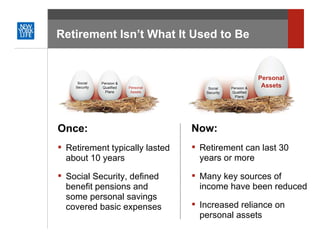
Retirement Isn’t What It Used to Be Once: Retirement typically lasted about 10 years Social Security, defined benefit pensions and some personal savings covered basic expenses Now:   Retirement can last 30 years or more Many key sources of income have been reduced  Increased reliance on personal assets Social Security  Pension & Qualified Plans Personal Assets Social Security Pension & Qualified Plans Personal Assets
Social Security Is Shaky  Social Security was never intended to be the only source of income for retirement The maximum Social Security Benefit in 2008 for a worker retiring at full retirement age was $2,185 per month 1 There are limits on how much you can earn before your Social Security benefits are reduced and/or taxed 1 Fast Facts & Figures about Social Security, 2008, SSA Publication No. 13-11785, Released: August 2008; page 2  Without changes, by 2041 the Social Security Trust Fund will be exhausted* and there will be enough money to pay only about 75 cents for each dollar of scheduled benefits. * These estimates are based on the intermediate assumptions from the Social Security Trustees’ Annual Report to the Congress. “ ”
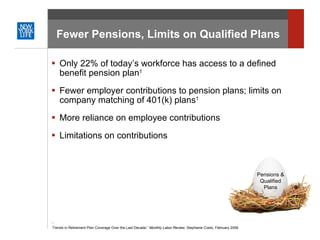
Fewer Pensions, Limits on Qualified Plans Only 22% of today’s workforce has access to a defined benefit pension plan 1   Fewer employer contributions to pension plans; limits on company matching of 401(k) plans 1 More reliance on employee contributions Limitations on contributions 1  ‘ Trends in Retirement Plan Coverage Over the Last Decade,”  Monthly Labor Review , Stephanie Costo, February 2006.  Pensions & Qualified Plans
Personal Assets Are Critical  Most people have more questions than answers when it comes to planning for retirement How much will I need?  How much will I have? How much do I need to save  to cover the shortfall? For personal savings, the questions are:  Where should I put my money?  How will I be affected by taxes? Personal Assets
Tax-Perfect Retirement Planning The “tax-perfect” retirement plan would include: Contributions that are  tax deductible Accumulation that is  tax deferred Distributions that are  tax free Such a plan does not exist, but you can have  any two  of these tax benefits
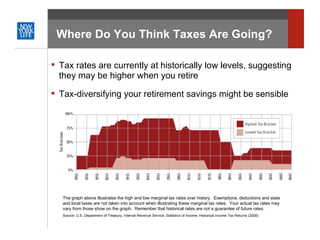
Where Do You Think Taxes Are Going?  Tax rates are currently at historically low levels, suggesting they may be higher when you retire Tax-diversifying your retirement savings might be sensible  The graph above illustrates the high and low marginal tax rates over history.  Exemptions, deductions and state and local taxes are not taken into account when illustrating these marginal tax rates.  Your actual tax rates may vary from those show on the graph.  Remember that historical rates are not a guarantee of future rates. Source: U.S. Department of Treasury, Internal Revenue Service, Statistics of Income, Historical income Tax Returns (2008)
Is Tax Deferral the Best Strategy? 30 years ago, tax rates were so high and there were so many tax brackets, deferring income generally reduced the tax burden In the new tax reality, the tax leverage benefits of deferring may not exist Lower tax rates and fewer tax brackets today call for a smarter strategy 1979-1980 2009
Your Retirement Savings Tax Options Financial Vehicles Traditional IRA 401(k) Pension plans Profit-sharing   plans Keogh  Roth IRA Tax-free municipal  bonds Cash value life   insurance Tax Treatment Contributions Accumulation Distributions Tax deductible Tax deferred Taxable After tax Tax deferred Tax free
A Non-Traditional Solution 1  The cash value in a life insurance policy is accessed through policy loans, which accrue interest at the current rate, and cash withdrawals. Loans and withdrawals will decrease the total death benefit and total cash value. Life Insurance In addition to protecting your family, cash value life insurance can provide an ideal way to tax-diversify your retirement savings Premiums are paid with after-tax dollars Generates cash value that generally accumulates on a tax-deferred basis Allows you access to policy values – before or during retirement – generally on a tax-free basis 1 Upon your death, when many other investments  are taxed, your beneficiaries also receive the  death benefit income tax free
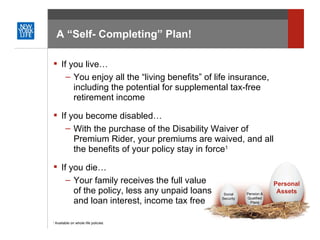
A “Self- Completing” Plan! If you live… You enjoy all the “living benefits” of life insurance, including the potential for supplemental tax-free retirement income If you become disabled… With the purchase of the Disability Waiver of Premium Rider, your premiums are waived, and all the benefits of your policy stay in force 1 If you die… Your family receives the full value  of the policy, less any unpaid loans  and loan interest, income tax free  1  Available on whole life policies Social Security Pension & Qualified Plans Personal Assets
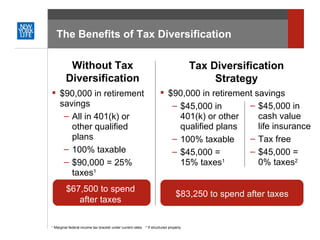
The Benefits of Tax Diversification $90,000 in retirement savings All in 401(k) or other qualified plans 100% taxable $90,000 = 25% taxes 1 Tax Diversification Strategy 1  Marginal federal income tax bracket under current rates.  2  If structured properly. Without Tax Diversification $90,000 in retirement savings $45,000 in  401(k) or other  qualified plans 100% taxable $45,000 =  15% taxes 1 $45,000 in  cash value life insurance Tax free $45,000 =  0% taxes 2 $67,500 to spend after taxes $83,250 to spend after taxes

Tax Diversification Powerpoint

  • 1.
    Tax Diversifying Your Retirement Income This presentation includes a discussion of one or more tax-related topics. This tax-related discussion was prepared to assist in the promotion or marketing of the transactions or matters addressed in this material. It is not intended (and cannot be used by any taxpayer) for the purpose of avoiding any IRA penalties that may be imposed upon the taxpayer. Taxpayers should always seek and rely on the advice of their own independent tax professionals. Please understand that New York Life Insurance Company, its affiliates and subsidiaries, and agents and employees of any thereof, may not provide legal or tax advice to you. 00386186CV Exp. 12/2010
  • 2.
    Retirement Isn’t WhatIt Used to Be Once: Retirement typically lasted about 10 years Social Security, defined benefit pensions and some personal savings covered basic expenses Now: Retirement can last 30 years or more Many key sources of income have been reduced Increased reliance on personal assets Social Security Pension & Qualified Plans Personal Assets Social Security Pension & Qualified Plans Personal Assets
  • 3.
    Social Security IsShaky Social Security was never intended to be the only source of income for retirement The maximum Social Security Benefit in 2008 for a worker retiring at full retirement age was $2,185 per month 1 There are limits on how much you can earn before your Social Security benefits are reduced and/or taxed 1 Fast Facts & Figures about Social Security, 2008, SSA Publication No. 13-11785, Released: August 2008; page 2 Without changes, by 2041 the Social Security Trust Fund will be exhausted* and there will be enough money to pay only about 75 cents for each dollar of scheduled benefits. * These estimates are based on the intermediate assumptions from the Social Security Trustees’ Annual Report to the Congress. “ ”
  • 4.
    Fewer Pensions, Limitson Qualified Plans Only 22% of today’s workforce has access to a defined benefit pension plan 1 Fewer employer contributions to pension plans; limits on company matching of 401(k) plans 1 More reliance on employee contributions Limitations on contributions 1 ‘ Trends in Retirement Plan Coverage Over the Last Decade,” Monthly Labor Review , Stephanie Costo, February 2006. Pensions & Qualified Plans
  • 5.
    Personal Assets AreCritical Most people have more questions than answers when it comes to planning for retirement How much will I need? How much will I have? How much do I need to save to cover the shortfall? For personal savings, the questions are: Where should I put my money? How will I be affected by taxes? Personal Assets
  • 6.
    Tax-Perfect Retirement PlanningThe “tax-perfect” retirement plan would include: Contributions that are tax deductible Accumulation that is tax deferred Distributions that are tax free Such a plan does not exist, but you can have any two of these tax benefits
  • 7.
    Where Do YouThink Taxes Are Going? Tax rates are currently at historically low levels, suggesting they may be higher when you retire Tax-diversifying your retirement savings might be sensible The graph above illustrates the high and low marginal tax rates over history. Exemptions, deductions and state and local taxes are not taken into account when illustrating these marginal tax rates. Your actual tax rates may vary from those show on the graph. Remember that historical rates are not a guarantee of future rates. Source: U.S. Department of Treasury, Internal Revenue Service, Statistics of Income, Historical income Tax Returns (2008)
  • 8.
    Is Tax Deferralthe Best Strategy? 30 years ago, tax rates were so high and there were so many tax brackets, deferring income generally reduced the tax burden In the new tax reality, the tax leverage benefits of deferring may not exist Lower tax rates and fewer tax brackets today call for a smarter strategy 1979-1980 2009
  • 9.
    Your Retirement SavingsTax Options Financial Vehicles Traditional IRA 401(k) Pension plans Profit-sharing plans Keogh Roth IRA Tax-free municipal bonds Cash value life insurance Tax Treatment Contributions Accumulation Distributions Tax deductible Tax deferred Taxable After tax Tax deferred Tax free
  • 10.
    A Non-Traditional Solution1 The cash value in a life insurance policy is accessed through policy loans, which accrue interest at the current rate, and cash withdrawals. Loans and withdrawals will decrease the total death benefit and total cash value. Life Insurance In addition to protecting your family, cash value life insurance can provide an ideal way to tax-diversify your retirement savings Premiums are paid with after-tax dollars Generates cash value that generally accumulates on a tax-deferred basis Allows you access to policy values – before or during retirement – generally on a tax-free basis 1 Upon your death, when many other investments are taxed, your beneficiaries also receive the death benefit income tax free
  • 11.
    A “Self- Completing”Plan! If you live… You enjoy all the “living benefits” of life insurance, including the potential for supplemental tax-free retirement income If you become disabled… With the purchase of the Disability Waiver of Premium Rider, your premiums are waived, and all the benefits of your policy stay in force 1 If you die… Your family receives the full value of the policy, less any unpaid loans and loan interest, income tax free 1 Available on whole life policies Social Security Pension & Qualified Plans Personal Assets
  • 12.
    The Benefits ofTax Diversification $90,000 in retirement savings All in 401(k) or other qualified plans 100% taxable $90,000 = 25% taxes 1 Tax Diversification Strategy 1 Marginal federal income tax bracket under current rates. 2 If structured properly. Without Tax Diversification $90,000 in retirement savings $45,000 in 401(k) or other qualified plans 100% taxable $45,000 = 15% taxes 1 $45,000 in cash value life insurance Tax free $45,000 = 0% taxes 2 $67,500 to spend after taxes $83,250 to spend after taxes