PENSIONS By: Richard Hurst
Questions What is a pension? What is the history of pensions? What options are available? How has the current economic crisis affected pensions? How much is needed for retirement?
Pensions Pension : an arrangement to provide a person with an income when he/she is no longer earning a regular income through employment Annuity : an investment on which one receives fixed payments for a lifetime or for a specific number of years
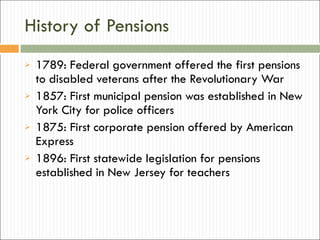
History of Pensions 1789: Federal government offered the first pensions to disabled veterans after the Revolutionary War 1857: First municipal pension was established in New York City for police officers 1875: First corporate pension offered by American Express 1896: First statewide legislation for pensions established in New Jersey for teachers
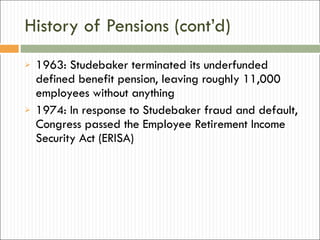
History of Pensions (cont’d) 1963: Studebaker terminated its underfunded defined benefit pension, leaving roughly 11,000 employees without anything 1974: In response to Studebaker fraud and default, Congress passed the Employee Retirement Income Security Act (ERISA)
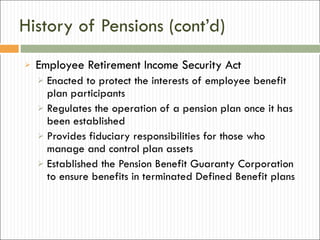
History of Pensions (cont’d) Employee Retirement Income Security Act Enacted to protect the interests of employee benefit plan participants Regulates the operation of a pension plan once it has been established  Provides fiduciary responsibilities for those who manage and control plan assets Established the Pension Benefit Guaranty Corporation to ensure benefits in terminated Defined Benefit plans
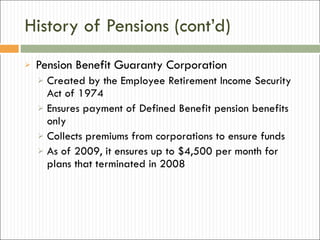
History of Pensions (cont’d) Pension Benefit Guaranty Corporation Created by the Employee Retirement Income Security Act of 1974 Ensures payment of Defined Benefit pension benefits only Collects premiums from corporations to ensure funds As of 2009, it ensures up to $4,500 per month for plans that terminated in 2008
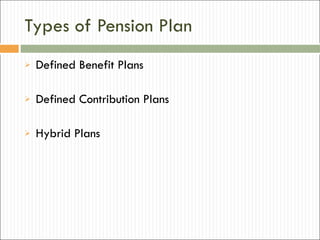
Types of Pension Plan Defined Benefit Plans Defined Contribution Plans Hybrid Plans
Defined Benefit Plans Determines benefits upon retirement based on a set formula, using factors such as salary history, years of employment, and retirement age Employer holds all of the risk Easier to plan income upon retirement Most administratively complex and costly type of plan
Defined Benefit Plans (cont’d) Vesting:  Cliff Vesting – You own 100% of your pension benefit after you’ve participated in the plan for 5 years Graded Vesting – You own a certain percentage of your benefit plan, which increases each year.  For example, after 3 years, you own 20%, and 20% more each year after that.  This is the Federal minimum.
Defined Benefit Plans (cont’d) Cons: Much of the value of the benefit is earned in the final years prior to retirement (focuses on staying with one employer your whole life) Little to no control over the funds No payout until retirement age is reached
Defined Contribution Plans Contribution is defined and set by the employer (or employee), and placed into an account Employee holds all of the risk Hard to plan retirement income Examples: Individual Retirement Accounts (IRA’s) 401(k)’s
Defined Contribution Plans (cont’d) 401(k)’s Must be sponsored by an employer Tax is not paid on the money contributed to the plan Employees choose a portion of their paycheck to be redirected to the plan A number of investment options are available, including mutual funds For 2009, the maximum contribution allowed is $16,500
Defined Contribution Plans (cont’d) Individual Retirement Accounts (IRAs): the largest component of total retirement assets; accounted for $3.7 trillion in 2008 Traditional IRA – Contributions are tax deductible; upon withdrawal, the funds are taxed as ordinary income Roth IRA – Contributions are made on an after tax basis, with earnings growing tax-free SIMPLE IRA – Similar to a 401(k) plan, but easier to manage and not as expensive
Hybrid Plans Combines the benefits of Defined Benefit and Defined Contribution plans Treated as Defined Benefit plan for tax purposes, and the risk is held by the employer Plans are expressed in terms of an account balance, like a Defined Contribution plan Example:  Cash Balance Plan
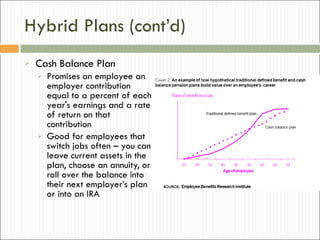
Hybrid Plans (cont’d) Cash Balance Plan Promises an employee an employer contribution equal to a percent of each year's earnings and a rate of return on that contribution Good for employees that switch jobs often – you can leave current assets in the plan, choose an annuity, or roll over the balance into their next employer’s plan or into an IRA
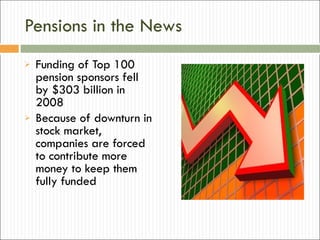
Pensions in the News Funding of Top 100 pension sponsors fell by $303 billion in 2008 Because of downturn in stock market, companies are forced to contribute more money to keep them fully funded
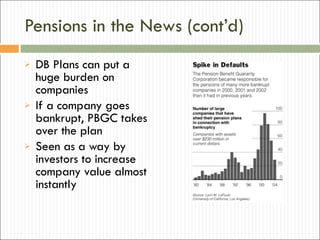
Pensions in the News (cont’d) DB Plans can put a huge burden on companies If a company goes bankrupt, PBGC takes over the plan Seen as a way by investors to increase company value almost instantly
Social Security Setup by FDR as part of the New Deal In 1945, the number of covered workers per beneficiary was 41.9, in 2007 it was 3.3 Expected to exceed income from taxes in 2017, and the fund is expected to be exhausted by 2041 Current monthly income from Social Security is $1,079 for single, $1,722 for a couple
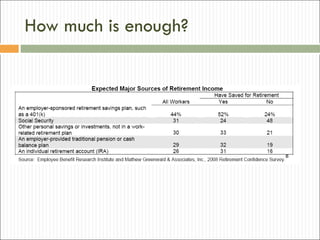
How much is enough?
How much is enough?
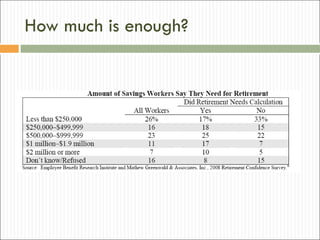
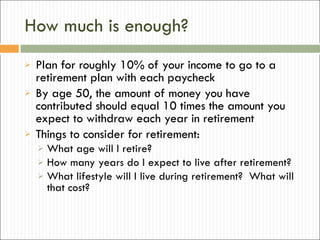
How much is enough? Plan for roughly 10% of your income to go to a retirement plan with each paycheck By age 50, the amount of money you have contributed should equal 10 times the amount you expect to withdraw each year in retirement Things to consider for retirement: What age will I retire? How many years do I expect to live after retirement? What lifestyle will I live during retirement?  What will that cost?
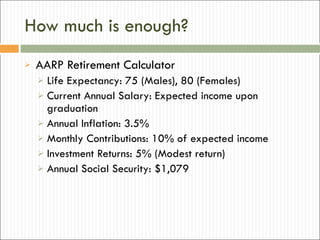
How much is enough? AARP Retirement Calculator Life Expectancy: 75 (Males), 80 (Females) Current Annual Salary: Expected income upon graduation Annual Inflation: 3.5% Monthly Contributions: 10% of expected income Investment Returns: 5% (Modest return) Annual Social Security: $1,079
Works Cited 2008 RCS Fact Sheet: Saving for Retirement in America . 9 Apr. 2008. Employee Benefit Research Institute. 20 Mar. 2009 <http://www.ebri.org/files/RCS08_FS2_Saving.pdf>. Block, Sandra, and Sue Kirchhoff.  Largest U.S. pension plans' assets fall $217 billion short . 12 Mar. 2009. USA Today. 18 Mar. 2009 <http://www.usatoday.com/money/perfi/retirement/2009-03-11-pension-plan-assets-short_N.htm>. Choosing A Retirement Plan .  Internal Revenue Service.  March 18, 2009 < http://www.irs.gov/retirement/article/0,,id=108950,00.html> Clark, Robert L., and Ann A. McDermed.  The Choice of Pension Plans in a Changing Regulatory Environment . Washington, DC: American Enterprise Institute, 1990. How much should I invest?  AARP. 20 Mar. 2009 <http://www.aarpfinancial.com/content/Learning/retPlanning_howMuchInvest.cfm>. IRS. 21 Mar. 2009 <http://www.dol.gov/dol/topic/health-plans/erisa.htm>. Lowenstein, Roger. &quot;The End of Pensions.&quot; 30 Oct. 2005. New York Times. 18 Mar. 2009 <http://www.nytimes.com/2005/10/30/magazine/30pensions.html?scp=3&sq=pensions&st=cse>. Modern Pensions and Social Security: A Timeline of Historic Events . 16 Oct. 2006. Society of Actuaries. 19 Mar. 2009 <http://www.soa.org/files/pdf/027bk_rev-annual06.pdf>. &quot;Pensions.&quot; Wikipedia. 10 Mar. 2009 <http://en.wikipedia.org/wiki/Pension#United_States>. Pension Benefit Guaranty Corporation . Wikipedia. 20 Mar. 2009 <http://en.wikipedia.org/wiki/Pension_Benefit_Guaranty_Corporation>. Retirement Confidence Surveys . 19 Mar. 2009. Employee Benefit Research Institute. 23 Mar. 2009 <http://www.ebri.org/publications/facts/index.cfm?fa=fastFacts>. Roth IRA . Wikipedia. 13 Mar. 2009 <http://en.wikipedia.org/wiki/Roth_ira>. The Basics of Social Security . Apr. 2008. Employee Benefit Research Institute. 18 Mar. 2009 <http://www.ebri.org/pdf/publications/facts/0408fact.pdf>. Traditional IRA . Wikipedia. 13 Mar. 2009 <http://en.wikipedia.org/wiki/Traditional_IRA>. Walsh, Mary W.  Whoops! There Goes Another Pension Plan . 18 Sept. 2005. The New York Times. 12 Mar. 2009 <http://www.nytimes.com/2005/09/18/business/18pensions.html?_r=1&scp=1&sq=whoops%20there%20goes%20another%20pension%20plan&st=cse>. What PBGC Guarantees . Pension Benefit Guaranty Corporation. 20 Mar. 2009 <http://www.pbgc.gov/workers-retirees/benefits-information/content/page13181.html>. Wise, David A., ed.  Pensions, Labor, and Individual Choice . Chicago: The University of Chicago P, 1985.

Pension Plans

  • 1.
  • 2.
    Questions What isa pension? What is the history of pensions? What options are available? How has the current economic crisis affected pensions? How much is needed for retirement?
  • 3.
    Pensions Pension :an arrangement to provide a person with an income when he/she is no longer earning a regular income through employment Annuity : an investment on which one receives fixed payments for a lifetime or for a specific number of years
  • 4.
    History of Pensions1789: Federal government offered the first pensions to disabled veterans after the Revolutionary War 1857: First municipal pension was established in New York City for police officers 1875: First corporate pension offered by American Express 1896: First statewide legislation for pensions established in New Jersey for teachers
  • 5.
    History of Pensions(cont’d) 1963: Studebaker terminated its underfunded defined benefit pension, leaving roughly 11,000 employees without anything 1974: In response to Studebaker fraud and default, Congress passed the Employee Retirement Income Security Act (ERISA)
  • 6.
    History of Pensions(cont’d) Employee Retirement Income Security Act Enacted to protect the interests of employee benefit plan participants Regulates the operation of a pension plan once it has been established Provides fiduciary responsibilities for those who manage and control plan assets Established the Pension Benefit Guaranty Corporation to ensure benefits in terminated Defined Benefit plans
  • 7.
    History of Pensions(cont’d) Pension Benefit Guaranty Corporation Created by the Employee Retirement Income Security Act of 1974 Ensures payment of Defined Benefit pension benefits only Collects premiums from corporations to ensure funds As of 2009, it ensures up to $4,500 per month for plans that terminated in 2008
  • 8.
    Types of PensionPlan Defined Benefit Plans Defined Contribution Plans Hybrid Plans
  • 9.
    Defined Benefit PlansDetermines benefits upon retirement based on a set formula, using factors such as salary history, years of employment, and retirement age Employer holds all of the risk Easier to plan income upon retirement Most administratively complex and costly type of plan
  • 10.
    Defined Benefit Plans(cont’d) Vesting: Cliff Vesting – You own 100% of your pension benefit after you’ve participated in the plan for 5 years Graded Vesting – You own a certain percentage of your benefit plan, which increases each year. For example, after 3 years, you own 20%, and 20% more each year after that. This is the Federal minimum.
  • 11.
    Defined Benefit Plans(cont’d) Cons: Much of the value of the benefit is earned in the final years prior to retirement (focuses on staying with one employer your whole life) Little to no control over the funds No payout until retirement age is reached
  • 12.
    Defined Contribution PlansContribution is defined and set by the employer (or employee), and placed into an account Employee holds all of the risk Hard to plan retirement income Examples: Individual Retirement Accounts (IRA’s) 401(k)’s
  • 13.
    Defined Contribution Plans(cont’d) 401(k)’s Must be sponsored by an employer Tax is not paid on the money contributed to the plan Employees choose a portion of their paycheck to be redirected to the plan A number of investment options are available, including mutual funds For 2009, the maximum contribution allowed is $16,500
  • 14.
    Defined Contribution Plans(cont’d) Individual Retirement Accounts (IRAs): the largest component of total retirement assets; accounted for $3.7 trillion in 2008 Traditional IRA – Contributions are tax deductible; upon withdrawal, the funds are taxed as ordinary income Roth IRA – Contributions are made on an after tax basis, with earnings growing tax-free SIMPLE IRA – Similar to a 401(k) plan, but easier to manage and not as expensive
  • 15.
    Hybrid Plans Combinesthe benefits of Defined Benefit and Defined Contribution plans Treated as Defined Benefit plan for tax purposes, and the risk is held by the employer Plans are expressed in terms of an account balance, like a Defined Contribution plan Example: Cash Balance Plan
  • 16.
    Hybrid Plans (cont’d)Cash Balance Plan Promises an employee an employer contribution equal to a percent of each year's earnings and a rate of return on that contribution Good for employees that switch jobs often – you can leave current assets in the plan, choose an annuity, or roll over the balance into their next employer’s plan or into an IRA
  • 17.
    Pensions in theNews Funding of Top 100 pension sponsors fell by $303 billion in 2008 Because of downturn in stock market, companies are forced to contribute more money to keep them fully funded
  • 18.
    Pensions in theNews (cont’d) DB Plans can put a huge burden on companies If a company goes bankrupt, PBGC takes over the plan Seen as a way by investors to increase company value almost instantly
  • 19.
    Social Security Setupby FDR as part of the New Deal In 1945, the number of covered workers per beneficiary was 41.9, in 2007 it was 3.3 Expected to exceed income from taxes in 2017, and the fund is expected to be exhausted by 2041 Current monthly income from Social Security is $1,079 for single, $1,722 for a couple
  • 20.
    How much isenough?
  • 21.
    How much isenough?
  • 22.
    How much isenough? Plan for roughly 10% of your income to go to a retirement plan with each paycheck By age 50, the amount of money you have contributed should equal 10 times the amount you expect to withdraw each year in retirement Things to consider for retirement: What age will I retire? How many years do I expect to live after retirement? What lifestyle will I live during retirement? What will that cost?
  • 23.
    How much isenough? AARP Retirement Calculator Life Expectancy: 75 (Males), 80 (Females) Current Annual Salary: Expected income upon graduation Annual Inflation: 3.5% Monthly Contributions: 10% of expected income Investment Returns: 5% (Modest return) Annual Social Security: $1,079
  • 24.
    Works Cited 2008RCS Fact Sheet: Saving for Retirement in America . 9 Apr. 2008. Employee Benefit Research Institute. 20 Mar. 2009 <http://www.ebri.org/files/RCS08_FS2_Saving.pdf>. Block, Sandra, and Sue Kirchhoff. Largest U.S. pension plans' assets fall $217 billion short . 12 Mar. 2009. USA Today. 18 Mar. 2009 <http://www.usatoday.com/money/perfi/retirement/2009-03-11-pension-plan-assets-short_N.htm>. Choosing A Retirement Plan . Internal Revenue Service. March 18, 2009 < http://www.irs.gov/retirement/article/0,,id=108950,00.html> Clark, Robert L., and Ann A. McDermed. The Choice of Pension Plans in a Changing Regulatory Environment . Washington, DC: American Enterprise Institute, 1990. How much should I invest? AARP. 20 Mar. 2009 <http://www.aarpfinancial.com/content/Learning/retPlanning_howMuchInvest.cfm>. IRS. 21 Mar. 2009 <http://www.dol.gov/dol/topic/health-plans/erisa.htm>. Lowenstein, Roger. &quot;The End of Pensions.&quot; 30 Oct. 2005. New York Times. 18 Mar. 2009 <http://www.nytimes.com/2005/10/30/magazine/30pensions.html?scp=3&sq=pensions&st=cse>. Modern Pensions and Social Security: A Timeline of Historic Events . 16 Oct. 2006. Society of Actuaries. 19 Mar. 2009 <http://www.soa.org/files/pdf/027bk_rev-annual06.pdf>. &quot;Pensions.&quot; Wikipedia. 10 Mar. 2009 <http://en.wikipedia.org/wiki/Pension#United_States>. Pension Benefit Guaranty Corporation . Wikipedia. 20 Mar. 2009 <http://en.wikipedia.org/wiki/Pension_Benefit_Guaranty_Corporation>. Retirement Confidence Surveys . 19 Mar. 2009. Employee Benefit Research Institute. 23 Mar. 2009 <http://www.ebri.org/publications/facts/index.cfm?fa=fastFacts>. Roth IRA . Wikipedia. 13 Mar. 2009 <http://en.wikipedia.org/wiki/Roth_ira>. The Basics of Social Security . Apr. 2008. Employee Benefit Research Institute. 18 Mar. 2009 <http://www.ebri.org/pdf/publications/facts/0408fact.pdf>. Traditional IRA . Wikipedia. 13 Mar. 2009 <http://en.wikipedia.org/wiki/Traditional_IRA>. Walsh, Mary W. Whoops! There Goes Another Pension Plan . 18 Sept. 2005. The New York Times. 12 Mar. 2009 <http://www.nytimes.com/2005/09/18/business/18pensions.html?_r=1&scp=1&sq=whoops%20there%20goes%20another%20pension%20plan&st=cse>. What PBGC Guarantees . Pension Benefit Guaranty Corporation. 20 Mar. 2009 <http://www.pbgc.gov/workers-retirees/benefits-information/content/page13181.html>. Wise, David A., ed. Pensions, Labor, and Individual Choice . Chicago: The University of Chicago P, 1985.