Presented by: ANKIT SINGH
Business
CASE STUDY
Journey from Indica to Jaguar
Company
OVERVIEW
TATA Motors is a part of the TATA Group and was
founded by Jehangir Ratanji Dadabhoy Tata in
1945 through a joint venture with the renowned
brand Daimler-Benz Germany.
The current chairman of Tata Motors is Natarajan
Chandrasekaran, and the company's headquarters
are situated in Mumbai, Maharashtra
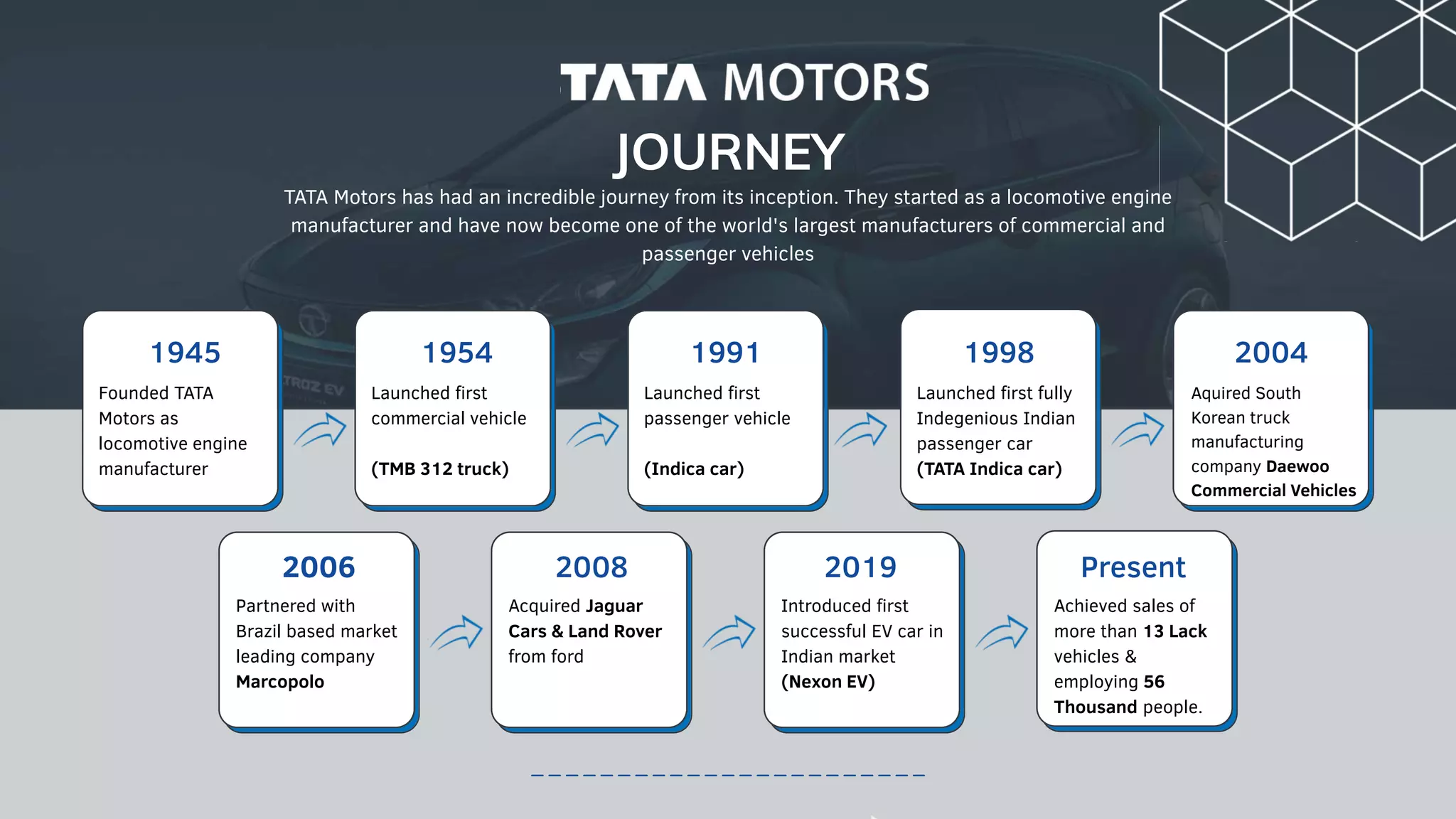
JOURNEY
1945
Founded TATA
Motors as
locomotive engine
manufacturer
1954
Launched first
commercial vehicle
(TMB 312 truck)
1991
Launched first
passenger vehicle
(Indica car)
1998
Launched first fully
Indegenious Indian
passenger car
(TATA Indica car)
2004
Aquired South
Korean truck
manufacturing
company Daewoo
Commercial Vehicles
2006
Partnered with
Brazil based market
leading company
Marcopolo
2008
Acquired Jaguar
Cars & Land Rover
from ford
2019
Introduced first
successful EV car in
Indian market
(Nexon EV)
Present
Achieved sales of
more than 13 Lack
vehicles &
employing 56
Thousand people.
TATA Motors has had an incredible journey from its inception. They started as a locomotive engine
manufacturer and have now become one of the world's largest manufacturers of commercial and
passenger vehicles
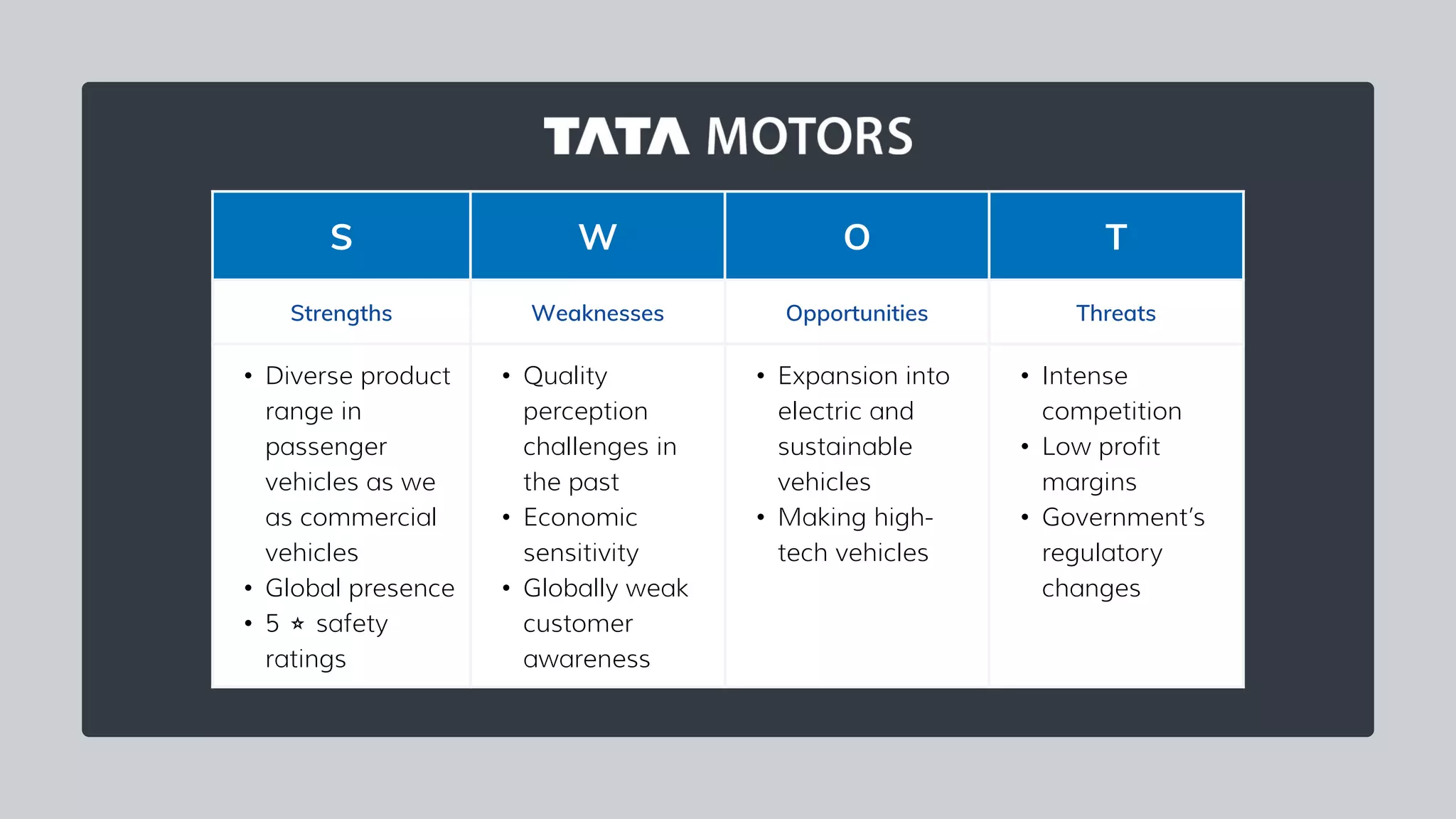
S W O T
Strengths Weaknesses Opportunities Threats
• Diverse product
range in
passenger
vehicles as we
as commercial
vehicles
• Global presence
• 5 ⭐ safety
ratings
• Quality
perception
challenges in
the past
• Economic
sensitivity
• Globally weak
customer
awareness
• Expansion into
electric and
sustainable
vehicles
• Making high-
tech vehicles
• Intense
competition
• Low profit
margins
• Government’s
regulatory
changes
• Tata Nano
• Tata Aria
• Tata Bolt
• Tata Zest
• Tata Indigo Marina
Flop Cars
Successful Cars
• Tata Indica
• Tata Safari
• Tata Tiago
• Tata Nexon
• Tata Harrier
Most successful
& Most flop CARS
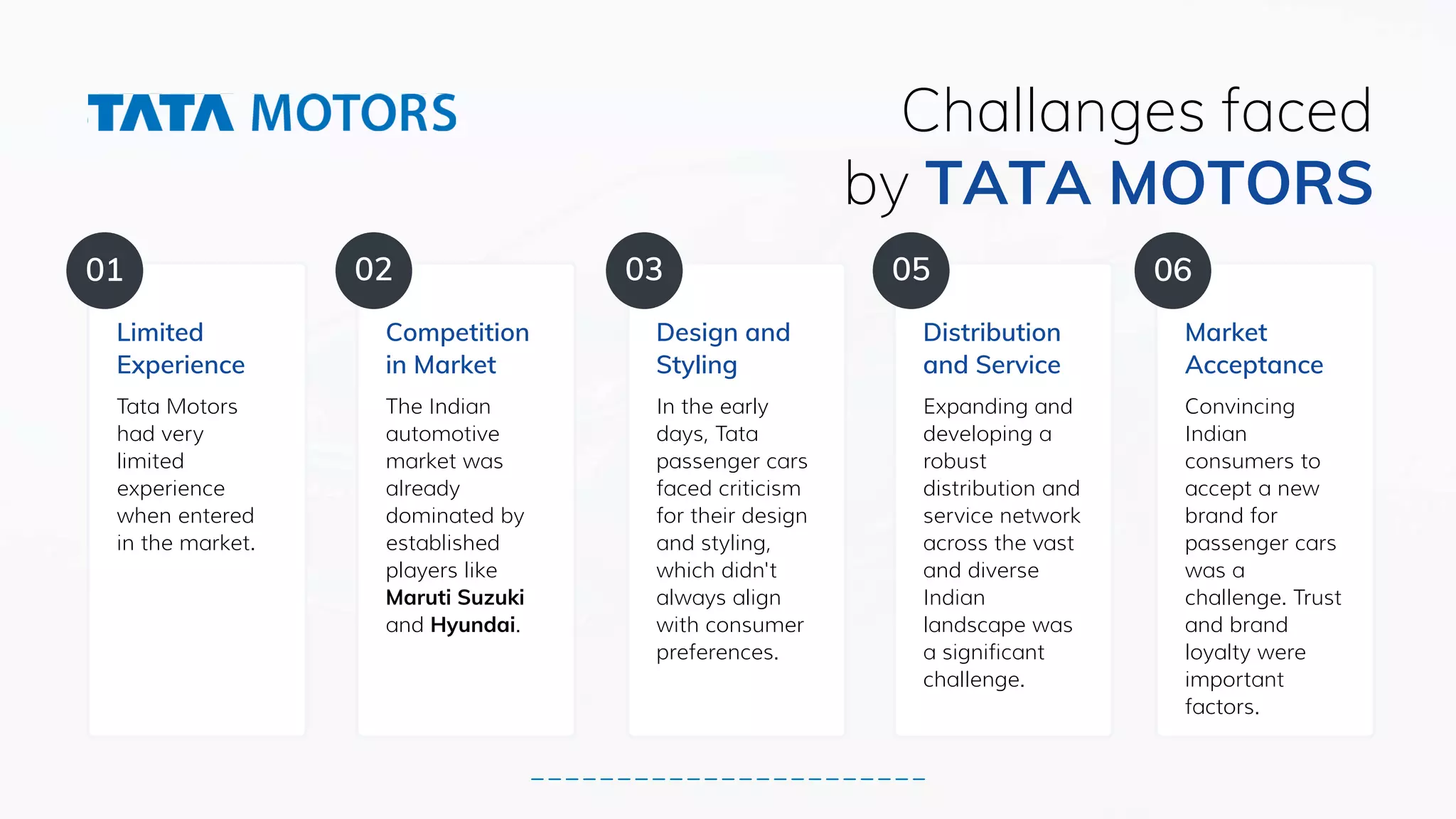
Limited
Experience
Market
Acceptance
Design and
Styling
01 06
03
02 05
Distribution
and Service
Tata Motors
had very
limited
experience
when entered
in the market.
Challanges faced
by TATA MOTORS
Convincing
Indian
consumers to
accept a new
brand for
passenger cars
was a
challenge. Trust
and brand
loyalty were
important
factors.
In the early
days, Tata
passenger cars
faced criticism
for their design
and styling,
which didn't
always align
with consumer
preferences.
The Indian
automotive
market was
already
dominated by
established
players like
Maruti Suzuki
and Hyundai.
Competition
in Market
Expanding and
developing a
robust
distribution and
service network
across the vast
and diverse
Indian
landscape was
a significant
challenge.
Tata Motors has vehicle assembly operations in India,
the United Kingdom, South Korea, Thailand, Spain, and
South Africa
Tata also has franchisee/joint venture assembly
operations in Kenya, Bangladesh, Ukraine, Russia, and
Senegal
Tata has dealerships in 26 countries across 4 continents.
Tata is present in many countries, it has managed to
create a large consumer base in the Indian subcontinent,
namely India, Bangladesh, Bhutan, Sri Lanka and Nepal.
Tata is also present in Italy, Spain, Poland, Romania,
Turkey, Chile, South Africa, Oman, Kuwait, Qatar, Saudi
Arabia, United Arab Emirates, Bahrain, Iraq, Syria and
Australia.
Global
Expansion of
COMPANY
Jaguar Land Rover British luxury car manufacturer
Marcopolo S.A Brazilian bus and coach manufacturer
Thonburi Automotive Assembly
Plant Company Limited (TAAP)
Assembly and distribution of Tata commercial vehicles in the ASEAN
region from Thailand
Daewoo Commercial Vehicle
Company
South Korea's Daewoo Commercial Vehicle Company
Hispano Motors Carrocera S.A For the production of urban and intercity buses in Spain
Tata Motors European Technical
Centre
For advanced engineering, design, and product development in UK
International partnerships
by TATA MOTORS
01 02 03
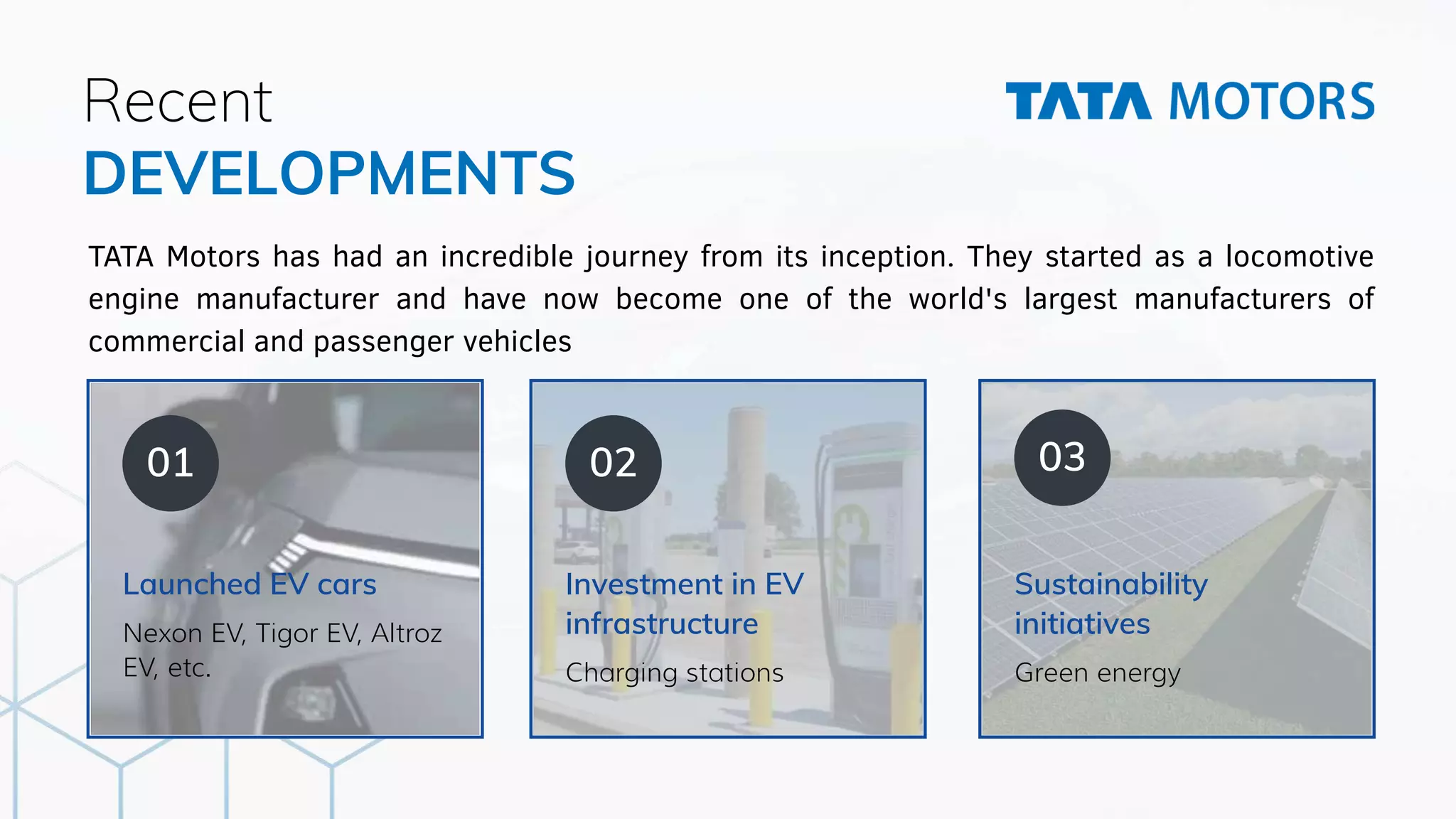
Nexon EV, Tigor EV, Altroz
EV, etc.
Launched EV cars
Charging stations
Investment in EV
infrastructure
Green energy
Sustainability
initiatives
Recent
DEVELOPMENTS
TATA Motors has had an incredible journey from its inception. They started as a locomotive
engine manufacturer and have now become one of the world's largest manufacturers of
commercial and passenger vehicles
In short, our short case study looked at Tata Motors' past,
achievements, strengths and weaknesses, early problems,
connection with the Indian market, successful products, and
future plans. This shows how Tata Motors has grown and
adapted in a tough industry.
As Tata Motors keeps changing and improving, it shows how
the car making businesses are always changing.
CONCLUSION
Presented By:
Ankit Singh

TATA Motors Business Case Study.pptx

  • 1.
    Presented by: ANKITSINGH Business CASE STUDY Journey from Indica to Jaguar
  • 2.
    Company OVERVIEW TATA Motors isa part of the TATA Group and was founded by Jehangir Ratanji Dadabhoy Tata in 1945 through a joint venture with the renowned brand Daimler-Benz Germany. The current chairman of Tata Motors is Natarajan Chandrasekaran, and the company's headquarters are situated in Mumbai, Maharashtra
  • 3.
    JOURNEY 1945 Founded TATA Motors as locomotiveengine manufacturer 1954 Launched first commercial vehicle (TMB 312 truck) 1991 Launched first passenger vehicle (Indica car) 1998 Launched first fully Indegenious Indian passenger car (TATA Indica car) 2004 Aquired South Korean truck manufacturing company Daewoo Commercial Vehicles 2006 Partnered with Brazil based market leading company Marcopolo 2008 Acquired Jaguar Cars & Land Rover from ford 2019 Introduced first successful EV car in Indian market (Nexon EV) Present Achieved sales of more than 13 Lack vehicles & employing 56 Thousand people. TATA Motors has had an incredible journey from its inception. They started as a locomotive engine manufacturer and have now become one of the world's largest manufacturers of commercial and passenger vehicles
  • 4.
    S W OT Strengths Weaknesses Opportunities Threats • Diverse product range in passenger vehicles as we as commercial vehicles • Global presence • 5 ⭐ safety ratings • Quality perception challenges in the past • Economic sensitivity • Globally weak customer awareness • Expansion into electric and sustainable vehicles • Making high- tech vehicles • Intense competition • Low profit margins • Government’s regulatory changes
  • 5.
    • Tata Nano •Tata Aria • Tata Bolt • Tata Zest • Tata Indigo Marina Flop Cars Successful Cars • Tata Indica • Tata Safari • Tata Tiago • Tata Nexon • Tata Harrier Most successful & Most flop CARS
  • 6.
    Limited Experience Market Acceptance Design and Styling 01 06 03 0205 Distribution and Service Tata Motors had very limited experience when entered in the market. Challanges faced by TATA MOTORS Convincing Indian consumers to accept a new brand for passenger cars was a challenge. Trust and brand loyalty were important factors. In the early days, Tata passenger cars faced criticism for their design and styling, which didn't always align with consumer preferences. The Indian automotive market was already dominated by established players like Maruti Suzuki and Hyundai. Competition in Market Expanding and developing a robust distribution and service network across the vast and diverse Indian landscape was a significant challenge.
  • 7.
    Tata Motors hasvehicle assembly operations in India, the United Kingdom, South Korea, Thailand, Spain, and South Africa Tata also has franchisee/joint venture assembly operations in Kenya, Bangladesh, Ukraine, Russia, and Senegal Tata has dealerships in 26 countries across 4 continents. Tata is present in many countries, it has managed to create a large consumer base in the Indian subcontinent, namely India, Bangladesh, Bhutan, Sri Lanka and Nepal. Tata is also present in Italy, Spain, Poland, Romania, Turkey, Chile, South Africa, Oman, Kuwait, Qatar, Saudi Arabia, United Arab Emirates, Bahrain, Iraq, Syria and Australia. Global Expansion of COMPANY
  • 8.
    Jaguar Land RoverBritish luxury car manufacturer Marcopolo S.A Brazilian bus and coach manufacturer Thonburi Automotive Assembly Plant Company Limited (TAAP) Assembly and distribution of Tata commercial vehicles in the ASEAN region from Thailand Daewoo Commercial Vehicle Company South Korea's Daewoo Commercial Vehicle Company Hispano Motors Carrocera S.A For the production of urban and intercity buses in Spain Tata Motors European Technical Centre For advanced engineering, design, and product development in UK International partnerships by TATA MOTORS
  • 9.
    01 02 03 NexonEV, Tigor EV, Altroz EV, etc. Launched EV cars Charging stations Investment in EV infrastructure Green energy Sustainability initiatives Recent DEVELOPMENTS TATA Motors has had an incredible journey from its inception. They started as a locomotive engine manufacturer and have now become one of the world's largest manufacturers of commercial and passenger vehicles
  • 10.
    In short, ourshort case study looked at Tata Motors' past, achievements, strengths and weaknesses, early problems, connection with the Indian market, successful products, and future plans. This shows how Tata Motors has grown and adapted in a tough industry. As Tata Motors keeps changing and improving, it shows how the car making businesses are always changing. CONCLUSION
  • 11.