Task 2 Research
By: Jonathan Newton Unit 21

TASK 2
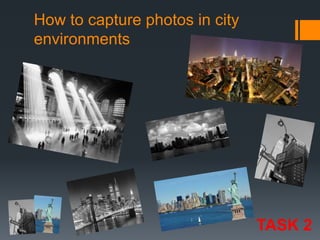
How to capture photos in city
environments

TASK 2
Capturing Night Signs
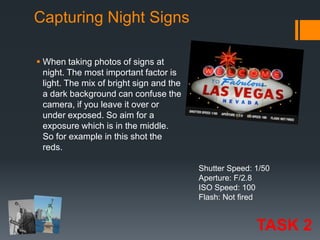
 When taking photos of signs at
night. The most important factor is
light. The mix of bright sign and the
a dark background can confuse the
camera, if you leave it over or
under exposed. So aim for a
exposure which is in the middle.
So for example in this shot the
reds.
Shutter Speed: 1/50
Aperture: F/2.8
ISO Speed: 100
Flash: Not fired

TASK 2
Stunning Cityscapes
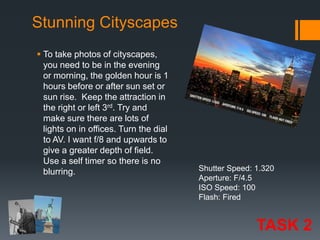
 To take photos of cityscapes,
you need to be in the evening
or morning, the golden hour is 1
hours before or after sun set or
sun rise. Keep the attraction in
the right or left 3rd. Try and
make sure there are lots of
lights on in offices. Turn the dial
to AV. I want f/8 and upwards to
give a greater depth of field.
Use a self timer so there is no
blurring.

Shutter Speed: 1.320
Aperture: F/4.5
ISO Speed: 100
Flash: Fired

TASK 2
Photographing Bridges
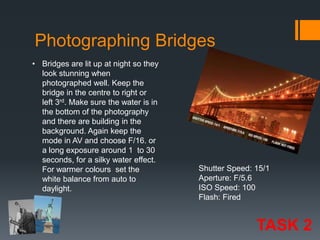
• Bridges are lit up at night so they
look stunning when
photographed well. Keep the
bridge in the centre to right or
left 3rd. Make sure the water is in
the bottom of the photography
and there are building in the
background. Again keep the
mode in AV and choose F/16. or
a long exposure around 1 to 30
seconds, for a silky water effect.
For warmer colours set the
white balance from auto to
daylight.

Shutter Speed: 15/1
Aperture: F/5.6
ISO Speed: 100
Flash: Fired

TASK 2
Monuments at Night
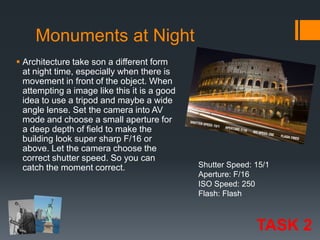
 Architecture take son a different form
at night time, especially when there is
movement in front of the object. When
attempting a image like this it is a good
idea to use a tripod and maybe a wide
angle lense. Set the camera into AV
mode and choose a small aperture for
a deep depth of field to make the
building look super sharp F/16 or
above. Let the camera choose the
correct shutter speed. So you can
catch the moment correct.

Shutter Speed: 15/1
Aperture: F/16
ISO Speed: 250
Flash: Flash

TASK 2
Capturing Street Life
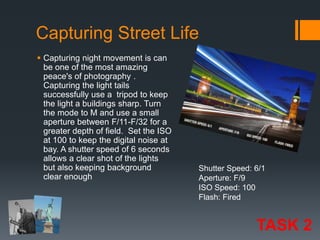
 Capturing night movement is can
be one of the most amazing
peace's of photography .
Capturing the light tails
successfully use a tripod to keep
the light a buildings sharp. Turn
the mode to M and use a small
aperture between F/11-F/32 for a
greater depth of field. Set the ISO
at 100 to keep the digital noise at
bay. A shutter speed of 6 seconds
allows a clear shot of the lights
but also keeping background
clear enough

Shutter Speed: 6/1
Aperture: F/9
ISO Speed: 100
Flash: Fired

TASK 2
Recommended Settings
 Night photography is a challenge, and quite often
experimentation is the key to success. It is possible to
handhold a camera and still shoot at night but this may
require a wider aperture, a higher ISO rating and some flash
so that the images don’t become blurry. You are usually
working with shutter speeds of 1/15th of a second or slower.
If you use a tripod then you can afford to use AV (aperture
priority) mode and let the camera choose the shutter speed.

TASK 2
Recommended Equipment
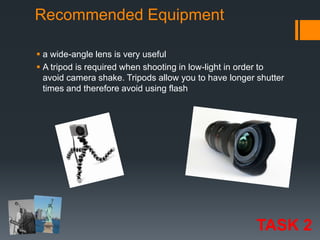
 a wide-angle lens is very useful
 A tripod is required when shooting in low-light in order to
avoid camera shake. Tripods allow you to have longer shutter
times and therefore avoid using flash

TASK 2
Conclusion
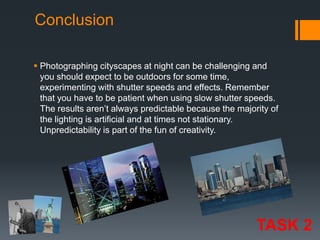
 Photographing cityscapes at night can be challenging and
you should expect to be outdoors for some time,
experimenting with shutter speeds and effects. Remember
that you have to be patient when using slow shutter speeds.
The results aren’t always predictable because the majority of
the lighting is artificial and at times not stationary.
Unpredictability is part of the fun of creativity.

TASK 2

Task 2 research

  • 1.
    Task 2 Research By:Jonathan Newton Unit 21 TASK 2
  • 2.
    How to capturephotos in city environments TASK 2
  • 3.
    Capturing Night Signs When taking photos of signs at night. The most important factor is light. The mix of bright sign and the a dark background can confuse the camera, if you leave it over or under exposed. So aim for a exposure which is in the middle. So for example in this shot the reds. Shutter Speed: 1/50 Aperture: F/2.8 ISO Speed: 100 Flash: Not fired TASK 2
  • 4.
    Stunning Cityscapes  Totake photos of cityscapes, you need to be in the evening or morning, the golden hour is 1 hours before or after sun set or sun rise. Keep the attraction in the right or left 3rd. Try and make sure there are lots of lights on in offices. Turn the dial to AV. I want f/8 and upwards to give a greater depth of field. Use a self timer so there is no blurring. Shutter Speed: 1.320 Aperture: F/4.5 ISO Speed: 100 Flash: Fired TASK 2
  • 5.
    Photographing Bridges • Bridgesare lit up at night so they look stunning when photographed well. Keep the bridge in the centre to right or left 3rd. Make sure the water is in the bottom of the photography and there are building in the background. Again keep the mode in AV and choose F/16. or a long exposure around 1 to 30 seconds, for a silky water effect. For warmer colours set the white balance from auto to daylight. Shutter Speed: 15/1 Aperture: F/5.6 ISO Speed: 100 Flash: Fired TASK 2
  • 6.
    Monuments at Night Architecture take son a different form at night time, especially when there is movement in front of the object. When attempting a image like this it is a good idea to use a tripod and maybe a wide angle lense. Set the camera into AV mode and choose a small aperture for a deep depth of field to make the building look super sharp F/16 or above. Let the camera choose the correct shutter speed. So you can catch the moment correct. Shutter Speed: 15/1 Aperture: F/16 ISO Speed: 250 Flash: Flash TASK 2
  • 7.
    Capturing Street Life Capturing night movement is can be one of the most amazing peace's of photography . Capturing the light tails successfully use a tripod to keep the light a buildings sharp. Turn the mode to M and use a small aperture between F/11-F/32 for a greater depth of field. Set the ISO at 100 to keep the digital noise at bay. A shutter speed of 6 seconds allows a clear shot of the lights but also keeping background clear enough Shutter Speed: 6/1 Aperture: F/9 ISO Speed: 100 Flash: Fired TASK 2
  • 8.
    Recommended Settings  Nightphotography is a challenge, and quite often experimentation is the key to success. It is possible to handhold a camera and still shoot at night but this may require a wider aperture, a higher ISO rating and some flash so that the images don’t become blurry. You are usually working with shutter speeds of 1/15th of a second or slower. If you use a tripod then you can afford to use AV (aperture priority) mode and let the camera choose the shutter speed. TASK 2
  • 9.
    Recommended Equipment  awide-angle lens is very useful  A tripod is required when shooting in low-light in order to avoid camera shake. Tripods allow you to have longer shutter times and therefore avoid using flash TASK 2
  • 10.
    Conclusion  Photographing cityscapesat night can be challenging and you should expect to be outdoors for some time, experimenting with shutter speeds and effects. Remember that you have to be patient when using slow shutter speeds. The results aren’t always predictable because the majority of the lighting is artificial and at times not stationary. Unpredictability is part of the fun of creativity. TASK 2