4, 5 and 62 Assignment 1 Task 2 – Briefs
A brief is a very important part of any deal being made with a client. It gives both parties a good
idea and outline as to how and what will be done in the final product. It lists all of the technical
details of the arrangement and will provide a guideline for the person creating the product as
well as the client. There are many, many different ways in which someone will construct a brief
– this depends on what the circumstances are, and if it needs to be formal, or informal.
However the format remains the same no matter what the style of the brief is. Usually a brief
will start with a small blurb outlining what is to be done, then going on to list bullet pointed
items which will break down what has been mentioned into its component parts to make it
easier to see key points. Each type of brief does have a different structure which will change for
each application. A brief is a useful tool when a designer is creating a product for a client as it
gives them a clear way in which they can gather information that will assist them in the creation
of a website. For example it may say on a brief that the client would like a 5 minute video
featuring the product and ways in which it would be advertised – this would then be the goal
the designer is working for.
Contractual Brief
This brief is a very formal example and will act as an agreement with the client. Usually these
briefs will start with some kind of binding hook that will give the company strict rights to any
product created and have full licencing over that product. This will then be signed by both the
client and the author. The next thing will be a declaration that no components of the product
will not infringe any copyright laws when creating the product, this may be things such as
stealing components of someone else’s work without permission to use in your own. These are
the important parts of the brief as it gives the client the rights that they will need to distribute
and sell the product. The rest of the brief will feature things that will sign all the input over to
the designer and will give the client no more input on their product, except for small suggestions
that may differ from already established ones. Briefs like this are only used when creating a
contract between a client and a designer, and are extremely important for both parties.
Formal and Informal Briefs
When setting out to create a brief it should be fairly obvious if it needs to be formal or informal,
this will entirely depend on who the brief is for and what it is trying to achieve. Usually the more
formal briefs will be used to arrange contracts and binding agreements with clients, and
informal ones used for competitions or outlines of products which will sometimes try and give
an example of the designer’s creative ability. It is very easy to tell apart both a formal brief and
an informal one, as typically both the style in which both are written differ greatly, and informal
briefs can use unique colour schemes and fonts, but can also appear formal when you are just
looking at it due to the fact they may use colour schemes similar to that of a formal one, but the
content and the way the content is written will be more formal. An example of a formal brief
would be a contractual brief as a higher level of finesse and seriousness is needed as the brief
acts as a contract and is a legal document. In an informal brief there will be more use of slang
and things to associate with the audience, it will also have things like exclamation marks at the
end of sentences.
Commission Brief
A commission brief is something that is sent out to a company once you have had an idea to
create things such as video advertisement. In this brief you will list things such as:
Duration
Need for a voiceover
Music requirements
Acted parts
Number of locations involved
DVD copies
This gives the company who you are sending the brief out to a clear and concise overview on
what you intend to do and how you intend to do it. Each of the previous points will become
important when deciding how to do certain aspects. Another way in which a commission brief
can be done is by a company sending them out to prospective filmmakers, as opposed to them
sending it to the company. In this case it will differ slightly as it requires them to create it. When
done like this the brief acts as a reference for the producer to find important details both when
filming or creating ideas for the film. This brief also acts as a proof document for the client as it
can be used if the producer didn’t meet certain criteria’s, such as budget, schedule and content.
Once this type of brief is complete, you are able to send it out to production companies, or vice-
versa, in order to get a quote and treatment for the job. Because detail has been given in the
brief you are able to give the production company a clear outline on what you want doing, and
how you want it doing. For this reason it is important to provide as much relevant detail in the
brief as possible.
Tender Brief
A brief should be clearly written and should detail every aspect of the job you want done. It is
important to outline what you expect of the successful contractor, supplier or consultant – it
needs to be clear and precise. Any misunderstanding at the first stages will lead to one or both
of the parties being unhappy with the job thus resulting in a waste of both side’s time.
As with other briefs it is important to put each detail about your proposal in the brief, a good
start is a clear title which will give the contractors a flavour of what you like, this should be
followed by a history and background to the project, other work done by your company would
be a good addition, such as studies and reports. After the brief is done it is important to
consider the time frame in which you will let the prospective suppliers respond, as if it is left out
for too short it may result in fewer responses. Once a formal notice of anything, such as a
deadline is issued it is under your obligation to ensure that it is rigidly adhered to by both you
and the supplier.Another important in a tender brief is to treat all potential suppliers equally.
Competition Brief
This type of brief is an example of an informal brief, it is published by companies in order to get
a response from competition entrants. It is used to clearly display things such as:
The prize
The rules
What you have to do; how, with who and what with
How to enter
How to submit your entry
When you have to submit the entry by
Closing date
When creating a competition brief it is important to be clear on all of these points in order to
get back relevant entries, and to make sure they are sent on time. If a competition brief fails to
answer any of these questions entrants may be confused as to what they are doing and how
they are to submit it.
It is quite important to be fairly informal when creating a competition brief, as it gives entrants
an idea of how your company operates and also gives them confidence to explore different
paths when entering, for example in the Nikon Foundation competition brief they use things
such as “three month’s paid employment as a photographer’s assistant to renowned fashion and
celebrity photographer John Wright!” which makes us think the company are more informal and are
trying to associate with a younger audience more. Another example of this would be “John Wright’s
portfolio is bursting at the seams”. They use words which would be unacceptable in formal brief, along
with the use of the exclamation mark at the end of sentences.
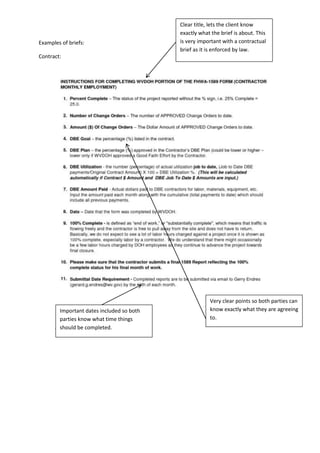
Examples of briefs:
Contract:
Clear title, lets the client know
exactly what the brief is about. This
is very important with a contractual
brief as it is enforced by law.
Very clear points so both parties can
know exactly what they are agreeing
to.
Important dates included so both
parties know what time things
should be completed.
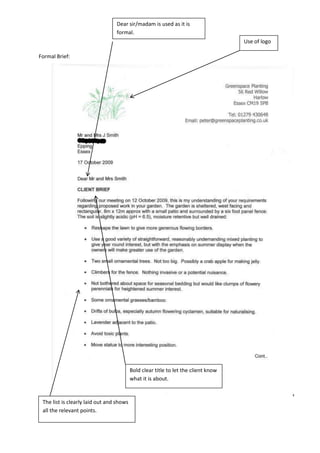
Formal Brief:
Dear sir/madam is used as it is
formal.
Use of logo
Bold clear title to let the client know
what it is about.
The list is clearly laid out and shows
all the relevant points.
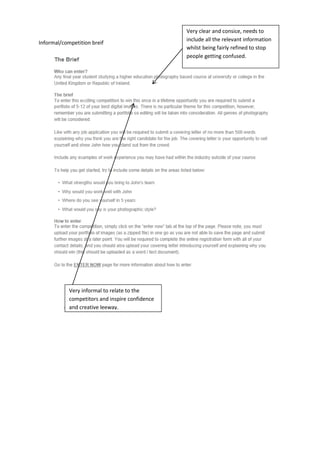
Informal/competition breif
Very informal to relate to the
competitors and inspire confidence
and creative leeway.
Very clear and consice, needs to
include all the relevant information
whilst being fairly refined to stop
people getting confused.

Task 2 briefs

  • 1.
    4, 5 and62 Assignment 1 Task 2 – Briefs A brief is a very important part of any deal being made with a client. It gives both parties a good idea and outline as to how and what will be done in the final product. It lists all of the technical details of the arrangement and will provide a guideline for the person creating the product as well as the client. There are many, many different ways in which someone will construct a brief – this depends on what the circumstances are, and if it needs to be formal, or informal. However the format remains the same no matter what the style of the brief is. Usually a brief will start with a small blurb outlining what is to be done, then going on to list bullet pointed items which will break down what has been mentioned into its component parts to make it easier to see key points. Each type of brief does have a different structure which will change for each application. A brief is a useful tool when a designer is creating a product for a client as it gives them a clear way in which they can gather information that will assist them in the creation of a website. For example it may say on a brief that the client would like a 5 minute video featuring the product and ways in which it would be advertised – this would then be the goal the designer is working for. Contractual Brief This brief is a very formal example and will act as an agreement with the client. Usually these briefs will start with some kind of binding hook that will give the company strict rights to any product created and have full licencing over that product. This will then be signed by both the client and the author. The next thing will be a declaration that no components of the product will not infringe any copyright laws when creating the product, this may be things such as stealing components of someone else’s work without permission to use in your own. These are the important parts of the brief as it gives the client the rights that they will need to distribute and sell the product. The rest of the brief will feature things that will sign all the input over to the designer and will give the client no more input on their product, except for small suggestions that may differ from already established ones. Briefs like this are only used when creating a contract between a client and a designer, and are extremely important for both parties. Formal and Informal Briefs When setting out to create a brief it should be fairly obvious if it needs to be formal or informal, this will entirely depend on who the brief is for and what it is trying to achieve. Usually the more formal briefs will be used to arrange contracts and binding agreements with clients, and informal ones used for competitions or outlines of products which will sometimes try and give an example of the designer’s creative ability. It is very easy to tell apart both a formal brief and an informal one, as typically both the style in which both are written differ greatly, and informal briefs can use unique colour schemes and fonts, but can also appear formal when you are just looking at it due to the fact they may use colour schemes similar to that of a formal one, but the content and the way the content is written will be more formal. An example of a formal brief would be a contractual brief as a higher level of finesse and seriousness is needed as the brief
  • 2.
    acts as acontract and is a legal document. In an informal brief there will be more use of slang and things to associate with the audience, it will also have things like exclamation marks at the end of sentences. Commission Brief A commission brief is something that is sent out to a company once you have had an idea to create things such as video advertisement. In this brief you will list things such as: Duration Need for a voiceover Music requirements Acted parts Number of locations involved DVD copies This gives the company who you are sending the brief out to a clear and concise overview on what you intend to do and how you intend to do it. Each of the previous points will become important when deciding how to do certain aspects. Another way in which a commission brief can be done is by a company sending them out to prospective filmmakers, as opposed to them sending it to the company. In this case it will differ slightly as it requires them to create it. When done like this the brief acts as a reference for the producer to find important details both when filming or creating ideas for the film. This brief also acts as a proof document for the client as it can be used if the producer didn’t meet certain criteria’s, such as budget, schedule and content. Once this type of brief is complete, you are able to send it out to production companies, or vice- versa, in order to get a quote and treatment for the job. Because detail has been given in the brief you are able to give the production company a clear outline on what you want doing, and how you want it doing. For this reason it is important to provide as much relevant detail in the brief as possible. Tender Brief A brief should be clearly written and should detail every aspect of the job you want done. It is important to outline what you expect of the successful contractor, supplier or consultant – it needs to be clear and precise. Any misunderstanding at the first stages will lead to one or both of the parties being unhappy with the job thus resulting in a waste of both side’s time. As with other briefs it is important to put each detail about your proposal in the brief, a good start is a clear title which will give the contractors a flavour of what you like, this should be followed by a history and background to the project, other work done by your company would be a good addition, such as studies and reports. After the brief is done it is important to consider the time frame in which you will let the prospective suppliers respond, as if it is left out for too short it may result in fewer responses. Once a formal notice of anything, such as a deadline is issued it is under your obligation to ensure that it is rigidly adhered to by both you and the supplier.Another important in a tender brief is to treat all potential suppliers equally.
  • 3.
    Competition Brief This typeof brief is an example of an informal brief, it is published by companies in order to get a response from competition entrants. It is used to clearly display things such as: The prize The rules What you have to do; how, with who and what with How to enter How to submit your entry When you have to submit the entry by Closing date When creating a competition brief it is important to be clear on all of these points in order to get back relevant entries, and to make sure they are sent on time. If a competition brief fails to answer any of these questions entrants may be confused as to what they are doing and how they are to submit it. It is quite important to be fairly informal when creating a competition brief, as it gives entrants an idea of how your company operates and also gives them confidence to explore different paths when entering, for example in the Nikon Foundation competition brief they use things such as “three month’s paid employment as a photographer’s assistant to renowned fashion and celebrity photographer John Wright!” which makes us think the company are more informal and are trying to associate with a younger audience more. Another example of this would be “John Wright’s portfolio is bursting at the seams”. They use words which would be unacceptable in formal brief, along with the use of the exclamation mark at the end of sentences.
  • 4.
    Examples of briefs: Contract: Cleartitle, lets the client know exactly what the brief is about. This is very important with a contractual brief as it is enforced by law. Very clear points so both parties can know exactly what they are agreeing to. Important dates included so both parties know what time things should be completed.
  • 5.
    Formal Brief: Dear sir/madamis used as it is formal. Use of logo Bold clear title to let the client know what it is about. The list is clearly laid out and shows all the relevant points.
  • 6.
    Informal/competition breif Very informalto relate to the competitors and inspire confidence and creative leeway. Very clear and consice, needs to include all the relevant information whilst being fairly refined to stop people getting confused.