Formats and Purposes
The purpose of short filmsisforfilmmakerstogainmore experience andhave aplatformto show their
talent.Filmmakerscansubmittheirshortsintofilmfestivalswhichallowsawideraudiencetowatch
themand start gettingconnectionsinthe industry. Itallowsthemtofindandsecure fundingforfuture
projectsfromvariouspeople includingprivate investors,filmstudiosandproductioncompanies.For
example,MartinScorsese’sthirdshortfilm ‘The BigShave’ wasthe firstfilmhe had successfully
releasedashe receivedagrantfrom the Cinematheque de Belgique tomake ashort film.Atthistime,
he had justfinishedhisfirstfeature filmbutcouldnotfinda distributor.
Narrative
Narrative ismade up of two parts:the plotandthe story.The plotis everythingvisiblyandaudibly
presentafilmandthe storyis the setof all eventsinanarrative,boththe onesthat are explicitly
presentedandthose thatthe audience infers.The purpose of narrative istodeliverastorythrough
visualsanddialogue,decideswhatorderinformationshouldandwhenitshouldbe delivered,itplaces
the viewersonthe side of the protagonistthroughaway of privilegingthe perspectiveabove others,
establishesthe pace anddeliversideologieswhichsupportthe perspective of the filmmakers.
“We can considernarrative tobe a chain of eventsincause-effectrelationshipoccurringintime and
space”- Bordwell
Narrationisthe art of storytelling.The cleareryoutell astory,the more emotionallyinvolvedthe
audience will be.Here are the typesof narrative andnarrative effects:
 LinearNarrative – Wheneventsunfoldinachronological sequence.
 Non-linearNarrative –Wheneventsunfoldinanon-chronologicalsequence.A filmthatuses
thisis MulhollandDrive as itis lookingbackonevents,andmanyare not real.
 Multi-StrandedNarrative–Referstofilmswithmultiple stories.Anexampleof thisis Pulp
Fictionas it followsmore thanone storyandthere are a varietyof characters.
 RestrictedandUnrestrictedNarrative –The amountof informationthatisreleasedtothe
audience.Unrestricted=whenviewersare toldmore informationthanthe charactersknow.
 Focaliser– The character that the story revolvesaround.The characterthatthe narrative
follows.Itis usedineverylength,type andgenre of films.
 Ellipsis –The compressionof time withinafilm.A clearexampleof afilmthatusesellipsisis
Boyhood as it wasfilmedovertwelve years,butthe runtime isaroundthree hours.
 Closure – The endingorresolutionof the narrative.
 Exposition –Whenthe filmsexplainsimportantinformationaboutthe backstorybehinda
character or plot.
Structure:
Structure isimportantinstorytellingasitcommunicatestothe audience the story,sotheycan
understandwhatishappening.Withoutstructure astorywouldnotmake sense.Mostfilms,shortor
feature,followthe three-actstructure,whichmeanstheyinclude anintroduction(beginning),a
conflict/problem(middle) andthenaresolution(ending).ThistheorywascreatedbySydField,whowas
an Americanscreenwriteranauthor.
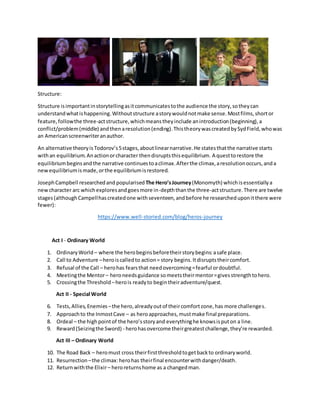
An alternative theoryisTodorov’s5stages,aboutlinearnarrative.He statesthatthe narrative starts
withan equilibrium.Anactionorcharacter thendisruptsthisequilibrium. A questtorestore the
equilibriumbeginsandthe narrative continuestoaclimax.Afterthe climax,aresolutionoccurs,anda
newequilibriumismade,orthe equilibriumisrestored.
JosephCampbell researchedand popularised The Hero’sJourney(Monomyth) whichisessentiallya
newcharacter arc whichexploresandgoesmore in-depththanthe three-actstructure.There are twelve
stages(althoughCampellhascreatedone withseventeen,andbefore he researcheduponitthere were
fewer):
https://www.well-storied.com/blog/heros-journey
Act I - Ordinary World
1. OrdinaryWorld – where the herobeginsbeforetheirstorybegins:asafe place.
2. Call to Adventure –heroiscalledto action= story begins.Itdisruptstheircomfort.
3. Refusal of the Call – herohas fearsthat needovercoming=fearful ordoubtful.
4. Meetingthe Mentor– heroneedsguidance someetstheirmentor=givesstrengthtohero.
5. Crossingthe Threshold –herois readyto begintheiradventure/quest.
Act II - Special World
6. Tests,Allies,Enemies –the hero,alreadyoutof theircomfortzone,has more challenges.
7. Approachto the InmostCave – as heroapproaches,mustmake final preparations.
8. Ordeal – the highpointof the hero’sstoryand everythinghe knowsisputon a line.
9. Reward(Seizingthe Sword) - herohasovercome theirgreatestchallenge,they’re rewarded.
Act III – Ordinary World
10. The Road Back – heromust cross theirfirstthresholdtogetbackto ordinaryworld.
11. Resurrection –the climax:herohas theirfinal encounterwithdanger/death.
12. Returnwiththe Elixir– heroreturnshome as a changedman.
These stagesmaynot alwaysbe inthisorder,but theyare all usedmostlytosome degree.
A shortfilm’sstructure doesnotdifferthatmuchfroma feature filmsstructure asitstill musthave a
beginning,middleandend;like anystory.Itstill followsthe three-actstructure asthat isthe basisof
moststorytelling.However,itdoeshave tochange some thingsdifferentlyfromafeature lengthfilm.
Firstly,ashort filmmuststartthe storystraightaway ratherthan havinga longtitle sequenceasthatwill
divertthe audiences’attentionandwaste time thatcanbe usedfor tellingthe story.Also,the main
character shouldbe introduced.Afterthe audience knowswhichcharactertheyare following,they
usuallyhave empathyforthatcharacter. The character is givenaflaw.Thensomethingeventful or
unexpectedhappens,whichdisturbsthe charactersnormal life.The characterthenreactsto thisevent:
theymay use guidance fromfriendsorsome sortof mentor.Theythenseektofix thisevent;the
character growsas a personfromthiseventandthe filmendswitharesolution.
Characters:
Charactersare importantina narrative as theyare commonlywhatthe narrative revolvesaround.They
are unique individualsbutoftendisplayfrequentlydisplay recognised traitssothe audience can
empathise andunderstandwhatthe charactersare goingthrough.The narrative theory,whichclaims
that all filmsare structurallythe same,startsoff withthe filmintroducingthe hero/heroine andshows
the worldthe filmisset.Thenthe normalityof the worldisdestructed,andthe hero/heroine setsoutto
restore order.
VladimirPropp,aSovietfolkloristandscholar whoanalysedthe basicstructural elementsof Russianfolk
talessaidstoriesare character drivenandthe plotonlydevelopsfromthe decisionsandactionsof the
characters. He claimedthatcharacters couldbe classifiedintocertainrolesthatmake astoryprogress:
 The Villain –strugglesagainstthe hero.
 The Donor – preparesthe herofortheirquest.
 The Helper(sidekick) - offerstohelpthe herointheirquest.
 The Princess – the personwhothe heromarries,andwhois oftensearchedforonthe quest.
 The Dispatcher– the personthatsendsthe heroon theirquest.
 The Hero – the persononthe questthroughwhichthe audience followsthe narrative.
 The Oracle – an older,wise figure whoprovidesessentialwisdom,informationorcluestothe
heroon theirquest.
Example:Harry Potter
o The Villain=Voldemort
o The Dispatcherand the Donor = Dumbledore
o The Helper(s) =Ron andHermione
o The Princess= Ginny
o The False Hero = Draco Malfoy
o The Hero = Harry Potter
Levi Strauss’sTheoryof BinaryOppositesstatesthatmostnarrativesinmediaformssuchas booksand
filmcontainopposingmaincharacters.Theyuse binaryoppositestohelpthickenthe plot,furtherthe
narrative andintroduce contrastintothe mediaform.Overtime these stereotypeshave become less
clearcut, withmediachangingandscriptsbecomingcomplex,sothere are manybinarycontrasts
applyingtotwocharacters. Examplesof BinaryOppositesare goodvsevil andyoungvs old.These types
relate tomany differentfilms.There isaproblemwiththistheory,however,asitalwaysportraysone
groupnegativelyandcreatesnegativestereotypes.
Examplesof BinaryOpposites:
 In Rom-Coms– goodcharacter vs meanercharacter
 In Horror – humanvs supernatural –alsolightinge.g.in Paranormal Activityit has the binary
oppositesof nightandday,so youcan easilytell whateventshappeninthe dayandwhat ones
happenat night.
 In Thriller–good vsbad
In Harry Potter,Harry isthe ‘good’character and Voldemortisthe ‘bad’character.
Themes:
Many themesare stuck to one genre.Forexample,the science fictiongenre usuallycoversthemesof
goodvs evil,dystopian/utopiansocietiesoran alien/robotinvasion.Theyare commonlysetinthe future
or may be setin the past that contradictshistorical records.Fantasyfilmcoversthemesthatinvolve
magic,supernatural eventsorfantasyworlds.Thrillerfilmstendtocoverthemesof terrorismand
political conspiracy.Plotsof these thrillersusuallyinvolvescharacterswhichcome intoconflictwith
each otheror other,outsiderforces.There isalwaysaproblem.
Analysisof shortfilms:
Post-itLove – 3:01
Thisshort filmisalsosetinan office.Inthe beginningyoucansee twoprintersasthe two main
characters are both photocopyinginunison. The charactersare wearingsmart-casual office clothing,so
theylooklike office workers.The filmishigh-keylit,withwarmertoneswhichforebodesthe happy
ending.The mainpropsare post-itnotesastheydictate the whole story.Atthe beginningabirds-eye
viewshotisusedto showthe womanand mandoingtheirphotocopyingactivity.Itshowsthemone ata
time to letthe viewerworkoutthattheyare bothdoingthe exactsame thing.Long shotsare usedto
showthe audience the locationof the characters.Nearthe endof the filma longshotisusedto show
the post-itnote picture of the twotogetheronthe wall foreveryone tosee.Anextreme close-upisused
on the womanwhenshe seesthe massive picture of the twoonthe wall.Itallowsthe audience tosee
the characters emotions.Thisshortfilmdoesnotincludeanydialogue;itismade upof diegeticand
non-diegeticsounds.The score of the filmchangesalongwiththe charactersemotions;whenthe
characters become joyful,the musicbecomesmore upbeat.However,the musicstaysmostlythe same
throughoutthe film.The title atthe beginningof the shortfilmisinpinkwriting.Pinkrepresentslove
and romance,sothe title representsthe endingof the film.Itforebodesthe ending.The twocharacters
are representedasbeingshybutshare a love interestinone another.Theydonotspeakto eachother
inthe shortfilm.There interactionsinvolve makingpicturesoutof post-itnotesandlookingateach
otherawkwardlysimultaneously.
The Fly:6:23
The leadactor showscomedythroughhismovements,notdialogue:whenthe flystartstoannoyhim,
he throwshisarms around like achild.Thisshortfilmisfilmedinside andaroundacar that isparked
outside abank.The lightingisbrightandwarmtonedwhichcontraststo the eventsandgenre of the
film.The actor useseverydayitemsthatare inhiscar to try and get ridof the fly(e.g.coffee cups).His
frustrationof the flyisfurther emphasised whenhe getsagunout to try and shootit,which wouldnot
workand woulddrawattentiontothe robberytakingplace.Itis setout like anoldslapsticksilentfilm.
Thisshort filmstartsoff a close-upof the leadactor withhisheadbentdowntothe heightof a steering
wheel of acar, andhe istappinghisfingersonthe steeringwheel.Itthencutsto a close-upof the keyin
the ignition,thencutstoa longshot of the exteriorof the car andwhere itis placed.Throughoutthe
whole of thisshortfilmitcuts betweenlongshotsandclose-upshotsof the man,the car andthe bank,
and eachshot has a purpose.The close-upshotsshow usof anitemthe man is goingtouse to try and
kill theyflyormakesthe audience focusonsomethingthathasimportance,while the longshotsshow
us that the man hasnot movedandis drawinga lotof attentiontohimself.Thisfilmisaboutagetaway
driverwaitingoutsideabankrobbery,whohas three minutestowaitbefore hiscrew returnsbutis
tormentedbya flywhichisexaggeratedbyhisfearandguilt.There isa lotof diegeticsoundinthisshort
film;the flybuzzingaroundandthe man’sgruntswhile he’stryingtokill the flyetc.There isa lotof
dramaticnon-diegeticmusicusedthroughoutthisfilmto emphasised the man’sstrugglewiththe fly
and the crime all fourmen are doing.There isalsodiegeticsoundinthe shortfilm;the flybuzzingand
man speakingsinglewords.The targetaudience forthisfilmisforolderteensandanyone olderasthere
are some gorydetailsinthisshort. The title of thisfilmisverylarge andis redin colour.It’sverybold
and isplacedinfrontof a black andwhite backgroundwhichswapsquickly.
5 FilmsaboutTechnology:4:37
The tone/moodinthisshortfilmiscomedicasit endswitha shortclipof a man walkingintoapole due
to beingonhisphone.Theyintroduce the charactersbyusinga title toexplainwhatevents/daywe are
aboutto witness.The people inthe filmwere quitestereotypical,butalsopeople thateveryone can
recognise andknowwhatthey’re like,due toreal lifeexamples.The filmstyle fitsintothe comedygenre
as it isbrightlylitthe whole waythroughout,eventhoughitchangesscenesandlocationsmultiple of
timesandis setina real-timesettingandfocusesontopicswhichare happeningtoday.Itfeelslike a
veryrealisticfilm;the actorsfeel like real people whoare beinginterviewed.
Comparison:
All three of these filmsare verysimilarintermsof theirlighting:theyall use high-keylightingso
everythinginframe canbe seen.Thisisdue to the type of filmstheyare,andpartlydue totheirgenres.
None of themhave any needtouse low-keylighting.Similarly,inPost-itLove andThe Flythere islittle
to no dialogue andthe whole storyistoldthroughthe charactersactions.The mise enscene andsetting
helpsthe viewersunderstandwhere the filmisset,andthe actionsandconsequencesare easilyseen
and recognised byanaudience.5FilmsAboutTechnoloyisthe mostunique film, outof these three,in
termsof lightingandsettingasitusesmultiplesettings,charactersandstoriesbuttheyall linkwithone
another.ThisfilmandThe Flyare partlyin the same genre,comedy,butthe Flyisalsoconsideredan
actionfilmdue to the eventsandnature of it.It goesintomore thanone genre.All three of themhave a
similareditingstyle astheyrarelyuse transitions,theyjustuse clearcuts,andall use,to some extent,
cross cutting,matchon action andshot reverse shot.All of these filmsuse non-diegeticsounds,but
some use itmore thanothers.5 FilmsaboutTechnologyonlyusesitwhenatitle cardappearsto
transitiontoa differentareawithdifferentpeople.Post-itLove usesnon-diegeticall the waythroughas
there isno dialogue.Itmatchesthe storyandis upbeatandhappy.The Flyusesdramaticmusicinsome
parts to highlightthe man’sstruggle withhisguiltwhichisportrayedbythe flyirritatinghim.
Conclusion:
Narrative,Ithink,isone of the mostimportantpartsof filmmaking.The narrative tellsthe story;visuals
and soundcome afteralthoughtheyare put togetherasthe plotand the story. The narrative’sstructure
can vary, as itcan be linear,non-linear,multi-strandedandvariousotherthings,butif itconveysastory
to an audience itisdone well.The storyiswhatgetsan audience involvedinthe filmandevokesan
emotional response.
Genre
Genre can be definedasa categorysystembasedonsimilaritieseitherinthe narrative elementsorin
the emotional responsetomediaof afilm.StephenNeale,aBritishphilosopher,referstogenresas
“instancesof repetitionanddifference”,howevermere repetitionwouldnotattractan audience so
“differenceisabsolutelyessentialtothe economyof genre”.Repetitionishow genresare formed.
Producerslike touse genresasit makesthe more money.Itiseasierto raise moneytofunda filmif they
knowwhatgenre it fitsintoandtheycan cash in on populargenresastheyknow there isa demandfor
them.Many genreshave a formulaof how theyare written,sotheyare cheapertowrite and can be
guaranteedtofitintoone genre well.Distributorsandmarketerslikegenresastheycanmarketthe film
usingstars thatare connectedtothat genre.Theycan alsopredictand targeta specificaudience
throughusinggenres.Italsoallowstrailerstobe targetedtoa certainaudience.Incinemas,the trailers
try to linktothe film youhave paidtowatch.
Theory – establishingcodesandconventions:
In NickLacey’sbook Narrativeand Genre: Key Conceptsin Media Studies, he definesgenre elementsas
listedbelow:(NICSS)
 Narrative – Referstothe story structure as well the specific narrative deviceswhichgenres
employ.
 Iconography – Filmshave visual andaudioimages,whichbecomerecognisableandassociated
withone genre.
 Character – Narrative isdevelopedthroughcharactersandtheirfunctions.Some characters
become genericin one genre.Protagonist=hero,antagonist= villain.
 Setting– Some genresuse/havedistinctlocations.Genrescanalsobe associatedwithcertain
time periods.
 Style – Style isthe waythe objectsthatare part of iconographyare presented.Editing,lighting,
camera anglesandcolourall make up the style of a film.
Example usingThe Shining:
 Narrative – istoldinorder of events,plottwistandthe end,unusual,supernatural occurrences
throughoutanda dramaticclimax,
 Iconography – Bloodandgore,longshots,editingtechniques,musictocreate tension/silence
and location(isolated).
 Character – Jack = antagonist/villain,Wendy=protagonist/hero,Danny=protagonist.
 Setting– hotel,winter,outside atnight-time.We don’tknow the time of dayfor mostof the
filmasthere are no windows.
 Style – Low-keylightingwhenoutside,fastpacededitingatdramaticmoments,butcontinuity
editingatothertimes,variouscameraanglesincludinglow anglesandeye-line matchand
saturatedbutrealisticcolourgrading – it isdulleratsome pointstoreflectthe eventsinthe film.
Audience Expectations:
Audienceslike genresformanyreasons.Firstly,itallowsthemtopicka filmtowatch easierastheycan
predictwhatwill happenand theywill have acertainexpectationof whathappensinthatfilm.Askey
elementsare repeatedwithineachfilmgenres,there ispleasure expectedtothe audience.Mostwell-
knowngenresinclude sub-genreswhichallowsaudiencestoenjoycurrentexpectationsfromthe main
genre alongwithsomethingnew.
Genre Analysis:
Post-itLove – A womanmeetsa man inan office.They’re bothtooshytotalk to one anothersofind
anotherwayto communicate toeach other;throughpost-itnotesart.Upbeat,cheerymusicwhichgoes
alongside the charactersactions.There are nottoo manyprops,justtypical office equipmentlike
printers,deskandpost-itnotes.The charactersgoback and forthof creatingpost-itnote pictures,
upscalingeachtime.Theyare bothwearingsmartclotheswhichisexpectedof the location.Itissetin
an office,whichisnotan uncommonlocationfora romance film. Ituseshigh-keylightingwhichlooks
artificial asmostofficeshave minimalnatural light.Shallow depthof fieldsisusedthroughoutwhich
allowsthe audience tosee the charactersreactionstothe post-itnotes.The editingissharpandshows
quickglimpsesof partsinthe short.(Romance)
The Fly– A getawaydriveriswaitinginacar outside abank.He has three minutestowaittill the crew
come out. He triesto focusbut getsirritatedbya fly.There are few props/visualsinthisshort.It
includesacar, masks,a toothpickanda gun.The soundismostlydiegetic,withlittle dialogue,soit’slike
a silentfilm.Thischaracterbecomesriddledwithhisownguilt,anditisdriveninsane bythe fly.Atthe
end,the robberscannotescape as the driverhas ruinedthe car.It is setoutside abank,on a road, ina
car. A getawaydriverisusuallyassociatedwithanactionfilms,alongwithbanks.Thisshortusesmany
close-upsandlongshotstoshowhow small of a space thisfilmisfilmedwithin.Everythingisclearlylit
as it issetin the day.(Action/Comedy)
5 FilmsAbout Technology– Thisfilmshows5 separate stories abouthow peopleuse technology.The
mainpropsin thisshortare mobile phones.Thisshortfocusesonfive differentcharacters,andtheyall
linktoone anotherin some way.The short has multiplesettings;acafé,a home,a car, an art gallery,a
toilet,anoffice anda streetwithapole.Many of these locationshave beenusedwithinthe comedy
genre.The editingforthisshortisquite quicktowardsthe end,itbecomesfaster,whichspeedsupthe
pace.It is neutrally,well-litthe whole waythrough, andthere are manyclose-upsonthe manyphones
as the narrative revolvesaroundthe actiononthe screens.(Comedy)
Comparinggenresfromthese three films:
All three of the short filmsIlookedatfitintodifferentgenres,butalsooverlapandhave partsof hybrid
genres.The mainone that ispart of thisisThe Flyas itis an actionfilmwithcomedicelements.Most
modernfilmsfitintomore thanone genre astheydelve intomanytomake it more entertainingforthe
audience,andsotheycan marketit to more than one type of audience.Post-itlovesisheavily
associatedwiththe romance genre,asthe narrative fits.Itmay alsohave elementsof acomedydue to
the low-keylighting,andmotif of the charactersexpressingtheiremotionstowardseachotherbypost-
it notesart pieces,butoverall itisaromance film.The Fly,outof these three films,showsthe most
elementsclearlyfrommore thanone genre.Itshowsfeaturesfromthe actionandcomedygenre.The
mainstoryline isaction,whilewhatthe characterisexperiencing,andhisactual actionsare comedic.For
example,whenatthe end,he justshrugshisshoulderstothe othermembersof the groupwho had
committedthe crime.The settingof thisfilmisalsoverystereotypical of the actiongenre.The film‘5
FilmsAboutTechnology’fitsintothe comedygenre asitismakingfunof multipletypesof generations
nowadays,andthe endingisveryquickandhumorous.The characters are verystereotypical of people
todayand may typesof people inthe comedygenre.The storyline isthe mostimportantreasonwhyit
fitsintothisgenre.
Conclusion:
The use of codesand conventionsare veryimportantinshortorfeature filmsasitcreatesthe genre of
the filmandallowsthe audience toexpectcertainexpectationsfromafilm.Itallowsdistributorsand
marketerstotarget a certainaudience due tothe genre of a film, andtailorit towardsthem.Using
certainconventions,andformulastowrite andcreate filmsislesscostlyforthe producersandmakesit
easiertoraise moneytofundthe film.Atthe endof the productionprocessitthenmakesiteasierto
distribute the filmasmarketersknowwhotomarketthe filmtowardsandcan create special posters
and trailersthatare similaramongfilmsthatfitintothe same genres.

Task 1

  • 1.
    Formats and Purposes Thepurpose of short filmsisforfilmmakerstogainmore experience andhave aplatformto show their talent.Filmmakerscansubmittheirshortsintofilmfestivalswhichallowsawideraudiencetowatch themand start gettingconnectionsinthe industry. Itallowsthemtofindandsecure fundingforfuture projectsfromvariouspeople includingprivate investors,filmstudiosandproductioncompanies.For example,MartinScorsese’sthirdshortfilm ‘The BigShave’ wasthe firstfilmhe had successfully releasedashe receivedagrantfrom the Cinematheque de Belgique tomake ashort film.Atthistime, he had justfinishedhisfirstfeature filmbutcouldnotfinda distributor. Narrative Narrative ismade up of two parts:the plotandthe story.The plotis everythingvisiblyandaudibly presentafilmandthe storyis the setof all eventsinanarrative,boththe onesthat are explicitly presentedandthose thatthe audience infers.The purpose of narrative istodeliverastorythrough visualsanddialogue,decideswhatorderinformationshouldandwhenitshouldbe delivered,itplaces the viewersonthe side of the protagonistthroughaway of privilegingthe perspectiveabove others, establishesthe pace anddeliversideologieswhichsupportthe perspective of the filmmakers. “We can considernarrative tobe a chain of eventsincause-effectrelationshipoccurringintime and space”- Bordwell Narrationisthe art of storytelling.The cleareryoutell astory,the more emotionallyinvolvedthe audience will be.Here are the typesof narrative andnarrative effects:  LinearNarrative – Wheneventsunfoldinachronological sequence.  Non-linearNarrative –Wheneventsunfoldinanon-chronologicalsequence.A filmthatuses thisis MulhollandDrive as itis lookingbackonevents,andmanyare not real.  Multi-StrandedNarrative–Referstofilmswithmultiple stories.Anexampleof thisis Pulp Fictionas it followsmore thanone storyandthere are a varietyof characters.  RestrictedandUnrestrictedNarrative –The amountof informationthatisreleasedtothe audience.Unrestricted=whenviewersare toldmore informationthanthe charactersknow.  Focaliser– The character that the story revolvesaround.The characterthatthe narrative follows.Itis usedineverylength,type andgenre of films.  Ellipsis –The compressionof time withinafilm.A clearexampleof afilmthatusesellipsisis Boyhood as it wasfilmedovertwelve years,butthe runtime isaroundthree hours.  Closure – The endingorresolutionof the narrative.  Exposition –Whenthe filmsexplainsimportantinformationaboutthe backstorybehinda character or plot.
  • 2.
    Structure: Structure isimportantinstorytellingasitcommunicatestothe audiencethe story,sotheycan understandwhatishappening.Withoutstructure astorywouldnotmake sense.Mostfilms,shortor feature,followthe three-actstructure,whichmeanstheyinclude anintroduction(beginning),a conflict/problem(middle) andthenaresolution(ending).ThistheorywascreatedbySydField,whowas an Americanscreenwriteranauthor. An alternative theoryisTodorov’s5stages,aboutlinearnarrative.He statesthatthe narrative starts withan equilibrium.Anactionorcharacter thendisruptsthisequilibrium. A questtorestore the equilibriumbeginsandthe narrative continuestoaclimax.Afterthe climax,aresolutionoccurs,anda newequilibriumismade,orthe equilibriumisrestored. JosephCampbell researchedand popularised The Hero’sJourney(Monomyth) whichisessentiallya newcharacter arc whichexploresandgoesmore in-depththanthe three-actstructure.There are twelve stages(althoughCampellhascreatedone withseventeen,andbefore he researcheduponitthere were fewer): https://www.well-storied.com/blog/heros-journey Act I - Ordinary World 1. OrdinaryWorld – where the herobeginsbeforetheirstorybegins:asafe place. 2. Call to Adventure –heroiscalledto action= story begins.Itdisruptstheircomfort. 3. Refusal of the Call – herohas fearsthat needovercoming=fearful ordoubtful. 4. Meetingthe Mentor– heroneedsguidance someetstheirmentor=givesstrengthtohero. 5. Crossingthe Threshold –herois readyto begintheiradventure/quest. Act II - Special World 6. Tests,Allies,Enemies –the hero,alreadyoutof theircomfortzone,has more challenges. 7. Approachto the InmostCave – as heroapproaches,mustmake final preparations. 8. Ordeal – the highpointof the hero’sstoryand everythinghe knowsisputon a line. 9. Reward(Seizingthe Sword) - herohasovercome theirgreatestchallenge,they’re rewarded. Act III – Ordinary World 10. The Road Back – heromust cross theirfirstthresholdtogetbackto ordinaryworld. 11. Resurrection –the climax:herohas theirfinal encounterwithdanger/death. 12. Returnwiththe Elixir– heroreturnshome as a changedman.
  • 3.
    These stagesmaynot alwaysbeinthisorder,but theyare all usedmostlytosome degree. A shortfilm’sstructure doesnotdifferthatmuchfroma feature filmsstructure asitstill musthave a beginning,middleandend;like anystory.Itstill followsthe three-actstructure asthat isthe basisof moststorytelling.However,itdoeshave tochange some thingsdifferentlyfromafeature lengthfilm. Firstly,ashort filmmuststartthe storystraightaway ratherthan havinga longtitle sequenceasthatwill divertthe audiences’attentionandwaste time thatcanbe usedfor tellingthe story.Also,the main character shouldbe introduced.Afterthe audience knowswhichcharactertheyare following,they usuallyhave empathyforthatcharacter. The character is givenaflaw.Thensomethingeventful or unexpectedhappens,whichdisturbsthe charactersnormal life.The characterthenreactsto thisevent: theymay use guidance fromfriendsorsome sortof mentor.Theythenseektofix thisevent;the character growsas a personfromthiseventandthe filmendswitharesolution. Characters: Charactersare importantina narrative as theyare commonlywhatthe narrative revolvesaround.They are unique individualsbutoftendisplayfrequentlydisplay recognised traitssothe audience can empathise andunderstandwhatthe charactersare goingthrough.The narrative theory,whichclaims that all filmsare structurallythe same,startsoff withthe filmintroducingthe hero/heroine andshows the worldthe filmisset.Thenthe normalityof the worldisdestructed,andthe hero/heroine setsoutto restore order. VladimirPropp,aSovietfolkloristandscholar whoanalysedthe basicstructural elementsof Russianfolk talessaidstoriesare character drivenandthe plotonlydevelopsfromthe decisionsandactionsof the characters. He claimedthatcharacters couldbe classifiedintocertainrolesthatmake astoryprogress:  The Villain –strugglesagainstthe hero.  The Donor – preparesthe herofortheirquest.  The Helper(sidekick) - offerstohelpthe herointheirquest.  The Princess – the personwhothe heromarries,andwhois oftensearchedforonthe quest.  The Dispatcher– the personthatsendsthe heroon theirquest.  The Hero – the persononthe questthroughwhichthe audience followsthe narrative.
  • 4.
     The Oracle– an older,wise figure whoprovidesessentialwisdom,informationorcluestothe heroon theirquest. Example:Harry Potter o The Villain=Voldemort o The Dispatcherand the Donor = Dumbledore o The Helper(s) =Ron andHermione o The Princess= Ginny o The False Hero = Draco Malfoy o The Hero = Harry Potter Levi Strauss’sTheoryof BinaryOppositesstatesthatmostnarrativesinmediaformssuchas booksand filmcontainopposingmaincharacters.Theyuse binaryoppositestohelpthickenthe plot,furtherthe narrative andintroduce contrastintothe mediaform.Overtime these stereotypeshave become less clearcut, withmediachangingandscriptsbecomingcomplex,sothere are manybinarycontrasts applyingtotwocharacters. Examplesof BinaryOppositesare goodvsevil andyoungvs old.These types relate tomany differentfilms.There isaproblemwiththistheory,however,asitalwaysportraysone groupnegativelyandcreatesnegativestereotypes. Examplesof BinaryOpposites:  In Rom-Coms– goodcharacter vs meanercharacter  In Horror – humanvs supernatural –alsolightinge.g.in Paranormal Activityit has the binary oppositesof nightandday,so youcan easilytell whateventshappeninthe dayandwhat ones happenat night.  In Thriller–good vsbad In Harry Potter,Harry isthe ‘good’character and Voldemortisthe ‘bad’character.
  • 5.
    Themes: Many themesare stuckto one genre.Forexample,the science fictiongenre usuallycoversthemesof goodvs evil,dystopian/utopiansocietiesoran alien/robotinvasion.Theyare commonlysetinthe future or may be setin the past that contradictshistorical records.Fantasyfilmcoversthemesthatinvolve magic,supernatural eventsorfantasyworlds.Thrillerfilmstendtocoverthemesof terrorismand political conspiracy.Plotsof these thrillersusuallyinvolvescharacterswhichcome intoconflictwith each otheror other,outsiderforces.There isalwaysaproblem. Analysisof shortfilms: Post-itLove – 3:01 Thisshort filmisalsosetinan office.Inthe beginningyoucansee twoprintersasthe two main characters are both photocopyinginunison. The charactersare wearingsmart-casual office clothing,so theylooklike office workers.The filmishigh-keylit,withwarmertoneswhichforebodesthe happy ending.The mainpropsare post-itnotesastheydictate the whole story.Atthe beginningabirds-eye viewshotisusedto showthe womanand mandoingtheirphotocopyingactivity.Itshowsthemone ata time to letthe viewerworkoutthattheyare bothdoingthe exactsame thing.Long shotsare usedto showthe audience the locationof the characters.Nearthe endof the filma longshotisusedto show the post-itnote picture of the twotogetheronthe wall foreveryone tosee.Anextreme close-upisused on the womanwhenshe seesthe massive picture of the twoonthe wall.Itallowsthe audience tosee the characters emotions.Thisshortfilmdoesnotincludeanydialogue;itismade upof diegeticand non-diegeticsounds.The score of the filmchangesalongwiththe charactersemotions;whenthe characters become joyful,the musicbecomesmore upbeat.However,the musicstaysmostlythe same throughoutthe film.The title atthe beginningof the shortfilmisinpinkwriting.Pinkrepresentslove and romance,sothe title representsthe endingof the film.Itforebodesthe ending.The twocharacters are representedasbeingshybutshare a love interestinone another.Theydonotspeakto eachother inthe shortfilm.There interactionsinvolve makingpicturesoutof post-itnotesandlookingateach otherawkwardlysimultaneously. The Fly:6:23 The leadactor showscomedythroughhismovements,notdialogue:whenthe flystartstoannoyhim, he throwshisarms around like achild.Thisshortfilmisfilmedinside andaroundacar that isparked outside abank.The lightingisbrightandwarmtonedwhichcontraststo the eventsandgenre of the film.The actor useseverydayitemsthatare inhiscar to try and get ridof the fly(e.g.coffee cups).His frustrationof the flyisfurther emphasised whenhe getsagunout to try and shootit,which wouldnot workand woulddrawattentiontothe robberytakingplace.Itis setout like anoldslapsticksilentfilm. Thisshort filmstartsoff a close-upof the leadactor withhisheadbentdowntothe heightof a steering wheel of acar, andhe istappinghisfingersonthe steeringwheel.Itthencutsto a close-upof the keyin the ignition,thencutstoa longshot of the exteriorof the car andwhere itis placed.Throughoutthe whole of thisshortfilmitcuts betweenlongshotsandclose-upshotsof the man,the car andthe bank, and eachshot has a purpose.The close-upshotsshow usof anitemthe man is goingtouse to try and kill theyflyormakesthe audience focusonsomethingthathasimportance,while the longshotsshow
  • 6.
    us that theman hasnot movedandis drawinga lotof attentiontohimself.Thisfilmisaboutagetaway driverwaitingoutsideabankrobbery,whohas three minutestowaitbefore hiscrew returnsbutis tormentedbya flywhichisexaggeratedbyhisfearandguilt.There isa lotof diegeticsoundinthisshort film;the flybuzzingaroundandthe man’sgruntswhile he’stryingtokill the flyetc.There isa lotof dramaticnon-diegeticmusicusedthroughoutthisfilmto emphasised the man’sstrugglewiththe fly and the crime all fourmen are doing.There isalsodiegeticsoundinthe shortfilm;the flybuzzingand man speakingsinglewords.The targetaudience forthisfilmisforolderteensandanyone olderasthere are some gorydetailsinthisshort. The title of thisfilmisverylarge andis redin colour.It’sverybold and isplacedinfrontof a black andwhite backgroundwhichswapsquickly. 5 FilmsaboutTechnology:4:37 The tone/moodinthisshortfilmiscomedicasit endswitha shortclipof a man walkingintoapole due to beingonhisphone.Theyintroduce the charactersbyusinga title toexplainwhatevents/daywe are aboutto witness.The people inthe filmwere quitestereotypical,butalsopeople thateveryone can recognise andknowwhatthey’re like,due toreal lifeexamples.The filmstyle fitsintothe comedygenre as it isbrightlylitthe whole waythroughout,eventhoughitchangesscenesandlocationsmultiple of timesandis setina real-timesettingandfocusesontopicswhichare happeningtoday.Itfeelslike a veryrealisticfilm;the actorsfeel like real people whoare beinginterviewed. Comparison: All three of these filmsare verysimilarintermsof theirlighting:theyall use high-keylightingso everythinginframe canbe seen.Thisisdue to the type of filmstheyare,andpartlydue totheirgenres. None of themhave any needtouse low-keylighting.Similarly,inPost-itLove andThe Flythere islittle to no dialogue andthe whole storyistoldthroughthe charactersactions.The mise enscene andsetting helpsthe viewersunderstandwhere the filmisset,andthe actionsandconsequencesare easilyseen and recognised byanaudience.5FilmsAboutTechnoloyisthe mostunique film, outof these three,in termsof lightingandsettingasitusesmultiplesettings,charactersandstoriesbuttheyall linkwithone another.ThisfilmandThe Flyare partlyin the same genre,comedy,butthe Flyisalsoconsideredan actionfilmdue to the eventsandnature of it.It goesintomore thanone genre.All three of themhave a similareditingstyle astheyrarelyuse transitions,theyjustuse clearcuts,andall use,to some extent, cross cutting,matchon action andshot reverse shot.All of these filmsuse non-diegeticsounds,but some use itmore thanothers.5 FilmsaboutTechnologyonlyusesitwhenatitle cardappearsto transitiontoa differentareawithdifferentpeople.Post-itLove usesnon-diegeticall the waythroughas there isno dialogue.Itmatchesthe storyandis upbeatandhappy.The Flyusesdramaticmusicinsome parts to highlightthe man’sstruggle withhisguiltwhichisportrayedbythe flyirritatinghim. Conclusion: Narrative,Ithink,isone of the mostimportantpartsof filmmaking.The narrative tellsthe story;visuals and soundcome afteralthoughtheyare put togetherasthe plotand the story. The narrative’sstructure can vary, as itcan be linear,non-linear,multi-strandedandvariousotherthings,butif itconveysastory to an audience itisdone well.The storyiswhatgetsan audience involvedinthe filmandevokesan emotional response. Genre
  • 7.
    Genre can bedefinedasa categorysystembasedonsimilaritieseitherinthe narrative elementsorin the emotional responsetomediaof afilm.StephenNeale,aBritishphilosopher,referstogenresas “instancesof repetitionanddifference”,howevermere repetitionwouldnotattractan audience so “differenceisabsolutelyessentialtothe economyof genre”.Repetitionishow genresare formed. Producerslike touse genresasit makesthe more money.Itiseasierto raise moneytofunda filmif they knowwhatgenre it fitsintoandtheycan cash in on populargenresastheyknow there isa demandfor them.Many genreshave a formulaof how theyare written,sotheyare cheapertowrite and can be guaranteedtofitintoone genre well.Distributorsandmarketerslikegenresastheycanmarketthe film usingstars thatare connectedtothat genre.Theycan alsopredictand targeta specificaudience throughusinggenres.Italsoallowstrailerstobe targetedtoa certainaudience.Incinemas,the trailers try to linktothe film youhave paidtowatch. Theory – establishingcodesandconventions: In NickLacey’sbook Narrativeand Genre: Key Conceptsin Media Studies, he definesgenre elementsas listedbelow:(NICSS)  Narrative – Referstothe story structure as well the specific narrative deviceswhichgenres employ.  Iconography – Filmshave visual andaudioimages,whichbecomerecognisableandassociated withone genre.  Character – Narrative isdevelopedthroughcharactersandtheirfunctions.Some characters become genericin one genre.Protagonist=hero,antagonist= villain.  Setting– Some genresuse/havedistinctlocations.Genrescanalsobe associatedwithcertain time periods.  Style – Style isthe waythe objectsthatare part of iconographyare presented.Editing,lighting, camera anglesandcolourall make up the style of a film. Example usingThe Shining:  Narrative – istoldinorder of events,plottwistandthe end,unusual,supernatural occurrences throughoutanda dramaticclimax,  Iconography – Bloodandgore,longshots,editingtechniques,musictocreate tension/silence and location(isolated).  Character – Jack = antagonist/villain,Wendy=protagonist/hero,Danny=protagonist.  Setting– hotel,winter,outside atnight-time.We don’tknow the time of dayfor mostof the filmasthere are no windows.  Style – Low-keylightingwhenoutside,fastpacededitingatdramaticmoments,butcontinuity editingatothertimes,variouscameraanglesincludinglow anglesandeye-line matchand saturatedbutrealisticcolourgrading – it isdulleratsome pointstoreflectthe eventsinthe film.
  • 8.
    Audience Expectations: Audienceslike genresformanyreasons.Firstly,itallowsthemtopickafilmtowatch easierastheycan predictwhatwill happenand theywill have acertainexpectationof whathappensinthatfilm.Askey elementsare repeatedwithineachfilmgenres,there ispleasure expectedtothe audience.Mostwell- knowngenresinclude sub-genreswhichallowsaudiencestoenjoycurrentexpectationsfromthe main genre alongwithsomethingnew. Genre Analysis: Post-itLove – A womanmeetsa man inan office.They’re bothtooshytotalk to one anothersofind anotherwayto communicate toeach other;throughpost-itnotesart.Upbeat,cheerymusicwhichgoes alongside the charactersactions.There are nottoo manyprops,justtypical office equipmentlike printers,deskandpost-itnotes.The charactersgoback and forthof creatingpost-itnote pictures, upscalingeachtime.Theyare bothwearingsmartclotheswhichisexpectedof the location.Itissetin an office,whichisnotan uncommonlocationfora romance film. Ituseshigh-keylightingwhichlooks artificial asmostofficeshave minimalnatural light.Shallow depthof fieldsisusedthroughoutwhich allowsthe audience tosee the charactersreactionstothe post-itnotes.The editingissharpandshows quickglimpsesof partsinthe short.(Romance)
  • 9.
    The Fly– Agetawaydriveriswaitinginacar outside abank.He has three minutestowaittill the crew come out. He triesto focusbut getsirritatedbya fly.There are few props/visualsinthisshort.It includesacar, masks,a toothpickanda gun.The soundismostlydiegetic,withlittle dialogue,soit’slike a silentfilm.Thischaracterbecomesriddledwithhisownguilt,anditisdriveninsane bythe fly.Atthe end,the robberscannotescape as the driverhas ruinedthe car.It is setoutside abank,on a road, ina car. A getawaydriverisusuallyassociatedwithanactionfilms,alongwithbanks.Thisshortusesmany close-upsandlongshotstoshowhow small of a space thisfilmisfilmedwithin.Everythingisclearlylit as it issetin the day.(Action/Comedy) 5 FilmsAbout Technology– Thisfilmshows5 separate stories abouthow peopleuse technology.The mainpropsin thisshortare mobile phones.Thisshortfocusesonfive differentcharacters,andtheyall linktoone anotherin some way.The short has multiplesettings;acafé,a home,a car, an art gallery,a toilet,anoffice anda streetwithapole.Many of these locationshave beenusedwithinthe comedy genre.The editingforthisshortisquite quicktowardsthe end,itbecomesfaster,whichspeedsupthe pace.It is neutrally,well-litthe whole waythrough, andthere are manyclose-upsonthe manyphones as the narrative revolvesaroundthe actiononthe screens.(Comedy) Comparinggenresfromthese three films: All three of the short filmsIlookedatfitintodifferentgenres,butalsooverlapandhave partsof hybrid genres.The mainone that ispart of thisisThe Flyas itis an actionfilmwithcomedicelements.Most modernfilmsfitintomore thanone genre astheydelve intomanytomake it more entertainingforthe audience,andsotheycan marketit to more than one type of audience.Post-itlovesisheavily associatedwiththe romance genre,asthe narrative fits.Itmay alsohave elementsof acomedydue to the low-keylighting,andmotif of the charactersexpressingtheiremotionstowardseachotherbypost- it notesart pieces,butoverall itisaromance film.The Fly,outof these three films,showsthe most elementsclearlyfrommore thanone genre.Itshowsfeaturesfromthe actionandcomedygenre.The mainstoryline isaction,whilewhatthe characterisexperiencing,andhisactual actionsare comedic.For
  • 10.
    example,whenatthe end,he justshrugshisshoulderstotheothermembersof the groupwho had committedthe crime.The settingof thisfilmisalsoverystereotypical of the actiongenre.The film‘5 FilmsAboutTechnology’fitsintothe comedygenre asitismakingfunof multipletypesof generations nowadays,andthe endingisveryquickandhumorous.The characters are verystereotypical of people todayand may typesof people inthe comedygenre.The storyline isthe mostimportantreasonwhyit fitsintothisgenre. Conclusion: The use of codesand conventionsare veryimportantinshortorfeature filmsasitcreatesthe genre of the filmandallowsthe audience toexpectcertainexpectationsfromafilm.Itallowsdistributorsand marketerstotarget a certainaudience due tothe genre of a film, andtailorit towardsthem.Using certainconventions,andformulastowrite andcreate filmsislesscostlyforthe producersandmakesit easiertoraise moneytofundthe film.Atthe endof the productionprocessitthenmakesiteasierto distribute the filmasmarketersknowwhotomarketthe filmtowardsandcan create special posters and trailersthatare similaramongfilmsthatfitintothe same genres.