Soap Opera Genre –
Target Audience
Name: Claire Olney
Candidate Number: 1186
Center Name: St. Andrew’s Catholic School
Center Number: 64135
OCR Media Studies – A2 Level
Unit G324: Advanced Portfolio
Trailer 1 - Eastenders
Socio-Economic Needs:
Stereotypically, the audience of Eastenders would fall into the C1-E groups.
This is ultimately because the characters within the soap opera would also be
grouped in the same way, as most of them are of working class backgrounds
and some are pensioners/students. Therefore, the fact that the typical working
class audience watch this soap, which features characters of a similar lifestyle,
the audience can therefore relate more to the situations presented.
Hartley’s 7 Subjectivities:
• Age: The audience’s demographic for this soap opera would be quite a wide
group ranging between ages 16-80. This is because a lot of young people
enjoy soap operas like Eastenders as well as the elderly, as all ages within
this range could relate to aspects of the content covered in the storyline.
• Gender: Predominantly, females make up a larger part of the audience of
soap operas as they are more likely to be able to relate and understand the
issues and situations within the program. Rebecca Feasey (2007) supports
this when she states that the soap opera genre fixates on: ‘The home, the
family, domestic tribulations and the strong women and as such, it has
long been said to appeal to the female viewer.’
• Class: Typically, people of a middle/lower class would watch Eastenders
because the characters within the soap opera are of a similar class, so
therefore they are more likely to cover issues and problems that people of a
middle/lower class would potentially face.
• Ethnicity: An audience would be formed of all ethnicities as they are all
present within Eastenders, and none of the characters are in any way
racially stereotypical, and people of every ethnic background is able to
relate to the problems the characters deal with.
Maslow’s Hierarchy of Needs:
I believe that the audience for Eastenders would be ‘Mainstreamers’ because
these are people who live in the world of the domestic and the everyday. They
are conformists of society, and a daily routine is a fundamental to the way they
live their lives. Like the audience, Eastenders is a soap opera based around the
lives of ordinary people living in the Eastend in London, however the amount of
issues and problems they face within one area is exaggerated, but the issues
covered are relatable to a wide audience of ‘Mainstreamers’, who may find a
sense of security by watching Eastenders, as their issues being shared by others
could serve as a comfort to them.
Psychographics:
The consumers of this text would most likely be in some form of
education or just leading a regular life as an adult/elderly citizen, Due
to watching the program, they may feel a sense of pressure to live up to
the standards of the character’s lives within the soap. For example,
some of the bad events in the program such as acts of violence, could
influence unstable audience members to act in the same way towards
others.
Katz’ Uses & Gratifications Theory:
• Diversion – In a way, the audience may potentially watch
Eastenders in order to relax and enjoy themselves. The members
of the audience who can particularly relate to the lives of the
characters on the program may not be able to find diversion
within it as it is not an escape from their everyday lives. The
audience members who can’t entirely relate to the lives of the
characters would be more likely to find diversion within the soap,
as it is less relatable to them, so it has no relation to their daily
lives.
• Personal Identity – The people watching this program who are
of a working class background may use Eastenders to understand
more about themselves through relating to the feelings and issues
that the characters face.
• Personal Relationships – I think that the audience will able to
build a personal relationship with the characters in the program if
they are able to relate to the issues/emotions they’re facing. I also
think that the audience will be able to see how the characters deal
with the issues raised that they also can relate to, and they will be
able to factor it into their own lives.
Eastenders is on television 4 times a
week, generally within the prime time
hour slot at 8pm. This is important
because it allows people in the E group of
the socio-economics scale in particular to
watch it as it is before the watershed at
9pm, so it therefore doesn’t contain any
offensive language or inappropriate
themes.
http://www.radiotimes.com/eastenders
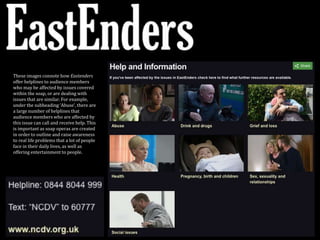
These images connote how Eastenders
offer helplines to audience members
who may be affected by issues covered
within the soap, or are dealing with
issues that are similar. For example,
under the subheading ‘Abuse’, there are
a large number of helplines that
audience members who are affected by
this issue can call and receive help. This
is important as soap operas are created
in order to outline and raise awareness
to real life problems that a lot of people
face in their daily lives, as well as
offering entertainment to people.
Trailer 2 - Hollyoaks
Socio-Economic Needs:
Stereotypically, the audience of Hollyoaks would fall into the E group. This
is ultimately because the characters within the soap opera are young and
some are still in education, and they are therefore more likely to be able to
relate to the situations presented in the program if they are of a similar age.
Hartley’s 7 Subjectivities:
• Age: The audience’s demographic for this soap opera would be quite a
small group ranging between ages 16-25. This is because a lot of young
people would be able to relate to the situations in the program and they
would lead similar lives to the characters.
• Gender: Predominantly, females make up a larger part of the audience
of soap operas as they are more likely to be able to relate and
understand the issues and situations within the program. Rebecca
Feasey (2007) supports this when she states that the soap opera genre
fixates on: ‘The home, the family, domestic tribulations and the
strong women and as such, it has long been said to appeal to the
female viewer.’
• Class: Typically, people of a middle/lower class would watch Hollyoaks,
because the characters within the soap opera are of a similar class, so
therefore they are more likely to cover issues and problems that people
of a middle/lower class would potentially face.
• Ethnicity: An audience would be formed of all ethnicities as they are all
present within Hollyoaks, and none of the characters are in any way
racially stereotypical, and people of every ethnic background is able to
relate to the problems the characters deal with.
Maslow’s Hierarchy of Needs:
I believe that the audience for Hollyoaks would be viewed as ‘Explorers’, as
this particular category is suited to younger people and students, which
contains energy and experience, which young people typically want to
experience.
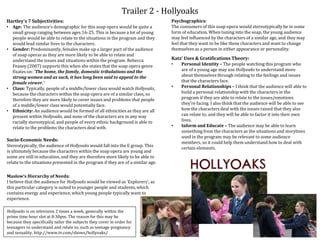
Psychographics:
The consumers of this soap opera would stereotypically be in some
form of education. When tuning into the soap, the young audience
may feel influenced by the characters of a similar age, and they may
feel that they want to be like these characters and want to change
themselves as a person in either appearance or personality.
Katz’ Uses & Gratifications Theory:
• Personal Identity – The people watching this program who
are of a young age may use Hollyoaks to understand more
about themselves through relating to the feelings and issues
that the characters face.
• Personal Relationships – I think that the audience will able to
build a personal relationship with the characters in the
program if they are able to relate to the issues/emotions
they’re facing. I also think that the audience will be able to see
how the characters deal with the issues raised that they also
can relate to, and they will be able to factor it into their own
lives.
• Inform and Educate – The audience may be able to learn
something from the characters as the situations and storylines
used in the program may be relevant to some audience
members, so it could help them understand how to deal with
certain elements.
Hollyoaks is on television 2 times a week, generally within the
prime time hour slot at 8:30pm. The reason for this may be
because they specifically tailor the subjects they cover in order for
teenagers to understand and relate to, such as teenage pregnancy
and sexuality. http://www.tv.com/shows/hollyoaks/
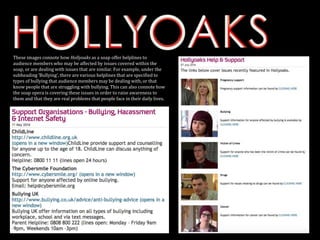
These images connote how Hollyoaks as a soap offer helplines to
audience members who may be affected by issues covered within the
soap, or are dealing with issues that are similar. For example, under the
subheading ‘Bullying’, there are various helplines that are specified to
types of bullying that audience members may be dealing with, or that
know people that are struggling with bullying. This can also connote how
the soap opera is covering these issues in order to raise awareness to
them and that they are real problems that people face in their daily lives.

Target Audience Task

  • 1.
    Soap Opera Genre– Target Audience Name: Claire Olney Candidate Number: 1186 Center Name: St. Andrew’s Catholic School Center Number: 64135 OCR Media Studies – A2 Level Unit G324: Advanced Portfolio
  • 2.
    Trailer 1 -Eastenders Socio-Economic Needs: Stereotypically, the audience of Eastenders would fall into the C1-E groups. This is ultimately because the characters within the soap opera would also be grouped in the same way, as most of them are of working class backgrounds and some are pensioners/students. Therefore, the fact that the typical working class audience watch this soap, which features characters of a similar lifestyle, the audience can therefore relate more to the situations presented. Hartley’s 7 Subjectivities: • Age: The audience’s demographic for this soap opera would be quite a wide group ranging between ages 16-80. This is because a lot of young people enjoy soap operas like Eastenders as well as the elderly, as all ages within this range could relate to aspects of the content covered in the storyline. • Gender: Predominantly, females make up a larger part of the audience of soap operas as they are more likely to be able to relate and understand the issues and situations within the program. Rebecca Feasey (2007) supports this when she states that the soap opera genre fixates on: ‘The home, the family, domestic tribulations and the strong women and as such, it has long been said to appeal to the female viewer.’ • Class: Typically, people of a middle/lower class would watch Eastenders because the characters within the soap opera are of a similar class, so therefore they are more likely to cover issues and problems that people of a middle/lower class would potentially face. • Ethnicity: An audience would be formed of all ethnicities as they are all present within Eastenders, and none of the characters are in any way racially stereotypical, and people of every ethnic background is able to relate to the problems the characters deal with. Maslow’s Hierarchy of Needs: I believe that the audience for Eastenders would be ‘Mainstreamers’ because these are people who live in the world of the domestic and the everyday. They are conformists of society, and a daily routine is a fundamental to the way they live their lives. Like the audience, Eastenders is a soap opera based around the lives of ordinary people living in the Eastend in London, however the amount of issues and problems they face within one area is exaggerated, but the issues covered are relatable to a wide audience of ‘Mainstreamers’, who may find a sense of security by watching Eastenders, as their issues being shared by others could serve as a comfort to them. Psychographics: The consumers of this text would most likely be in some form of education or just leading a regular life as an adult/elderly citizen, Due to watching the program, they may feel a sense of pressure to live up to the standards of the character’s lives within the soap. For example, some of the bad events in the program such as acts of violence, could influence unstable audience members to act in the same way towards others. Katz’ Uses & Gratifications Theory: • Diversion – In a way, the audience may potentially watch Eastenders in order to relax and enjoy themselves. The members of the audience who can particularly relate to the lives of the characters on the program may not be able to find diversion within it as it is not an escape from their everyday lives. The audience members who can’t entirely relate to the lives of the characters would be more likely to find diversion within the soap, as it is less relatable to them, so it has no relation to their daily lives. • Personal Identity – The people watching this program who are of a working class background may use Eastenders to understand more about themselves through relating to the feelings and issues that the characters face. • Personal Relationships – I think that the audience will able to build a personal relationship with the characters in the program if they are able to relate to the issues/emotions they’re facing. I also think that the audience will be able to see how the characters deal with the issues raised that they also can relate to, and they will be able to factor it into their own lives. Eastenders is on television 4 times a week, generally within the prime time hour slot at 8pm. This is important because it allows people in the E group of the socio-economics scale in particular to watch it as it is before the watershed at 9pm, so it therefore doesn’t contain any offensive language or inappropriate themes. http://www.radiotimes.com/eastenders
  • 3.
    These images connotehow Eastenders offer helplines to audience members who may be affected by issues covered within the soap, or are dealing with issues that are similar. For example, under the subheading ‘Abuse’, there are a large number of helplines that audience members who are affected by this issue can call and receive help. This is important as soap operas are created in order to outline and raise awareness to real life problems that a lot of people face in their daily lives, as well as offering entertainment to people.
  • 4.
    Trailer 2 -Hollyoaks Socio-Economic Needs: Stereotypically, the audience of Hollyoaks would fall into the E group. This is ultimately because the characters within the soap opera are young and some are still in education, and they are therefore more likely to be able to relate to the situations presented in the program if they are of a similar age. Hartley’s 7 Subjectivities: • Age: The audience’s demographic for this soap opera would be quite a small group ranging between ages 16-25. This is because a lot of young people would be able to relate to the situations in the program and they would lead similar lives to the characters. • Gender: Predominantly, females make up a larger part of the audience of soap operas as they are more likely to be able to relate and understand the issues and situations within the program. Rebecca Feasey (2007) supports this when she states that the soap opera genre fixates on: ‘The home, the family, domestic tribulations and the strong women and as such, it has long been said to appeal to the female viewer.’ • Class: Typically, people of a middle/lower class would watch Hollyoaks, because the characters within the soap opera are of a similar class, so therefore they are more likely to cover issues and problems that people of a middle/lower class would potentially face. • Ethnicity: An audience would be formed of all ethnicities as they are all present within Hollyoaks, and none of the characters are in any way racially stereotypical, and people of every ethnic background is able to relate to the problems the characters deal with. Maslow’s Hierarchy of Needs: I believe that the audience for Hollyoaks would be viewed as ‘Explorers’, as this particular category is suited to younger people and students, which contains energy and experience, which young people typically want to experience. Psychographics: The consumers of this soap opera would stereotypically be in some form of education. When tuning into the soap, the young audience may feel influenced by the characters of a similar age, and they may feel that they want to be like these characters and want to change themselves as a person in either appearance or personality. Katz’ Uses & Gratifications Theory: • Personal Identity – The people watching this program who are of a young age may use Hollyoaks to understand more about themselves through relating to the feelings and issues that the characters face. • Personal Relationships – I think that the audience will able to build a personal relationship with the characters in the program if they are able to relate to the issues/emotions they’re facing. I also think that the audience will be able to see how the characters deal with the issues raised that they also can relate to, and they will be able to factor it into their own lives. • Inform and Educate – The audience may be able to learn something from the characters as the situations and storylines used in the program may be relevant to some audience members, so it could help them understand how to deal with certain elements. Hollyoaks is on television 2 times a week, generally within the prime time hour slot at 8:30pm. The reason for this may be because they specifically tailor the subjects they cover in order for teenagers to understand and relate to, such as teenage pregnancy and sexuality. http://www.tv.com/shows/hollyoaks/
  • 5.
    These images connotehow Hollyoaks as a soap offer helplines to audience members who may be affected by issues covered within the soap, or are dealing with issues that are similar. For example, under the subheading ‘Bullying’, there are various helplines that are specified to types of bullying that audience members may be dealing with, or that know people that are struggling with bullying. This can also connote how the soap opera is covering these issues in order to raise awareness to them and that they are real problems that people face in their daily lives.