Soap Opera Genre –
Target Audience
Name: Lucas Kirkland
Candidate Number: 1159
Center Name: St. Andrew’s
Catholic School
Center Number: 64135
OCR Media Studies – A2 Level
Unit G324: Advanced Portfolio
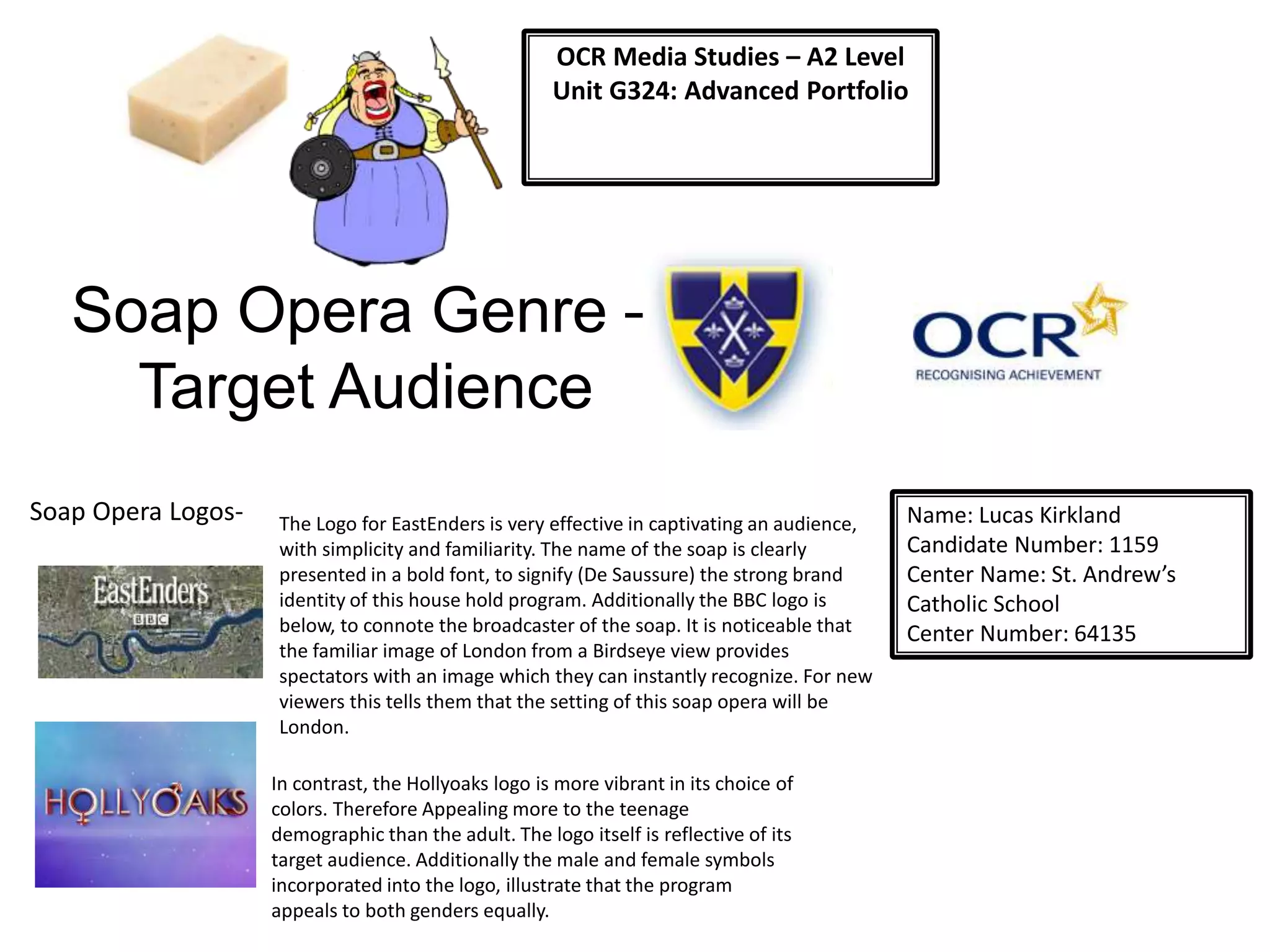
Soap Opera Logos- The Logo for EastEnders is very effective in captivating an audience,
with simplicity and familiarity. The name of the soap is clearly
presented in a bold font, to signify (De Saussure) the strong brand
identity of this house hold program. Additionally the BBC logo is
below, to connote the broadcaster of the soap. It is noticeable that
the familiar image of London from a Birdseye view provides
spectators with an image which they can instantly recognize. For new
viewers this tells them that the setting of this soap opera will be
London.
In contrast, the Hollyoaks logo is more vibrant in its choice of
colors. Therefore Appealing more to the teenage
demographic than the adult. The logo itself is reflective of its
target audience. Additionally the male and female symbols
incorporated into the logo, illustrate that the program
appeals to both genders equally.
Trailer 1 – Eastenders
Hartley's 7 Subjectivities:
• Age- Typically the soap opera genre would attract a
large amount of age groups. Therefore 16-70 is a
scale which fits the popularity of a soap opera such
as Eastenders. The reason that soaps cover such a
large scale of ages is due to the vast amount of
subjects covered in a programme. Audiences of all
ages are able to ‘Personally identify’ (Katz) with
themes and issues.
• Gender- The stereotypical gender for soap opera
genres is female. This is because this gender
stereotypically is able to relate to an opera, as it
features multiple themes such as: The home, the
family, domestic tribulations and strong women.
Additionally Dr. Aaliya Ahmed (2010) states that
“Women typically use soaps as a way of talking
indirectly about their own attitudes and behavior.”
This verbal code ‘signifies’ (De Saussure) that
women are able to identify with the soaps
effectively.
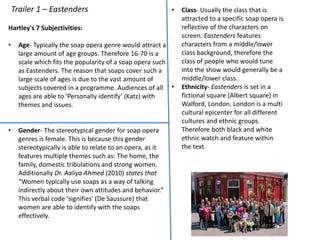
• Class- Usually the class that is
attracted to a specific soap opera is
reflective of the characters on
screen. Eastenders features
characters from a middle/lower
class background, therefore the
class of people who would tune
into the show would generally be a
middle/lower class.
• Ethnicity- Eastenders is set in a
fictional square (Albert square) in
Walford, London. London is a multi
cultural epicenter for all different
cultures and ethnic groups.
Therefore both black and white
ethnic watch and feature within
the text.
Secondary Research
• When looking for secondary evidence, I came across a Google article detailing the
relationship between soap operas and its female audience. Merve Yesilyurt, explains how
soap operas “Congregate a massive female audience whenever shown”. This suggests that
soap operas are mainly appealing to the female gender. Later on in her article Merve
Yesilyurt discusses why the female gender is such a popular target audience. One of the
reasons discussed is that “soaps represent woman's culture by representing everyday daily
life. This is perhaps because conventionally, many 20th century western woman live lives
that are very similar to those in the soap operas. Goodwin and Whannel, both male, claim
that the ‘world of gossip’ is commonly seen as a ‘’women’s world’’ existing as a part of the
domain of the household and personal. This is perhaps why soap operas appeal to the
female gender.
• Socio-Economic Needs-
Typically the viewers that would watch EastEnders, fit
into the C1-E group. This is due to the fact that
students and workers are most likely to watch the
Soap. Often the characters featured within the text
portray these kinds of roles, therefore viewers in this
group can relate to the characters. For example a
majority of the characters are working class, therefore
audiences can relate to the issues of day to day life,
such as money and debt.
• Physiographic-
Generally the consumers of this text would either be in full time
education or in a full time job. However by watching the program these
groups may be influenced greatly by the fictional characters on screen.
For example drugs, crime and cheating are featured heavily within sub
plots. Some viewers may take on the view that this is acceptable in
society. The people who generally watch soap operas come under the
“strugglers” category. These types of people seek escape in something,
for example escaping in a soap opera. This is also a typically lower
demographics.
• Helplines-
Often, soap opera dramas take on story's that effect
viewers emotionally, as its something they can relate
to. Typically after the end of a ‘heavy’ episode a
helpline is displayed that will offer the correct
support for viewers.
Katz’ Uses and gratifications theory-
• Personal Identification- Certain
moments within the opera, may
cause audience members to feel that
they have made the same decisions
as characters on screen. This can be
dangerous as audience members may
take on the impression that it is
acceptable to act like certain
characters.
• ‘Personal Relationship’ – Certain
audiences may take a liking to a
certain and begin to create a fictional
relationship with the character. This
happens usually when that character
has been through the same themes
an audience may have been through.
• ‘Inform and educate’ -
Learning from others mistakes.
Audience can better there own lives by
not making the same mistakes as the
fictional characters on screen. All the
different multi stranded narratives,
themes and issues cover areas to
inform and educate spectators.
• Show times
Broadcasted four times a week,
normally at prime time hour of
8pm. This time specifically is
crucial as it allows the soap to
explore adult themes and issues.
However it is not at the watershed
time of 9pm, therefore typically
the program will not feature too
much or any violence and/or
swearing.
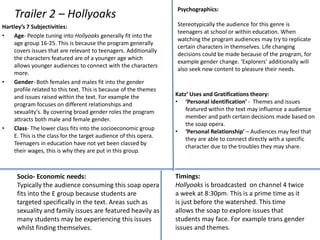
Trailer 2 – Hollyoaks
Hartley’s 7 Subjectivities:
• Age- People tuning into Hollyoaks generally fit into the
age group 16-25. This is because the program generally
covers issues that are relevant to teenagers. Additionally
the characters featured are of a younger age which
allows younger audiences to connect with the characters
more.
• Gender- Both females and males fit into the gender
profile related to this text. This is because of the themes
and issues raised within the text. For example the
program focuses on different relationships and
sexuality's. By covering broad gender roles the program
attracts both male and female gender.
• Class- The lower class fits into the socioeconomic group
E. This is the class for the target audience of this opera.
Teenagers in education have not yet been classed by
their wages, this is why they are put in this group.
Socio- Economic needs:
Typically the audience consuming this soap opera
fits into the E group because students are
targeted specifically in the text. Areas such as
sexuality and family issues are featured heavily as
many students may be experiencing this issues
whilst finding themselves.
Psychographics:
Stereotypically the audience for this genre is
teenagers at school or within education. When
watching the program audiences may try to replicate
certain characters in themselves. Life changing
decisions could be made because of the program, for
example gender change. ‘Explorers’ additionally will
also seek new content to pleasure their needs.
Katz’ Uses and Gratifications theory:
• ‘Personal identification’ - Themes and issues
featured within the text may influence a audience
member and path certain decisions made based on
the soap opera.
• ‘Personal Relationship’ – Audiences may feel that
they are able to connect directly with a specific
character due to the troubles they may share.
Timings:
Hollyoaks is broadcasted on channel 4 twice
a week at 8:30pm. This is a prime time as it
is just before the watershed. This time
allows the soap to explore issues that
students may face. For example trans gender
issues and themes.
References
1. Women and Soap-Operas: Popularity, Portrayal and
perception – Dr. Aaliya Ahmed
Source: http://www.ijsrp.org/research_paper_jun2012/ijsrp-
June-2012-47.pdf
2. Soap opera and its female audience written by Merve Yesilyurt
https://www.academia.edu/6656923/Soap_opera_and_its_fema
le_audience_written_by_Merve_Yesilyurt
soap opera genre target audience task

soap opera genre target audience task

  • 1.
    Soap Opera Genre– Target Audience Name: Lucas Kirkland Candidate Number: 1159 Center Name: St. Andrew’s Catholic School Center Number: 64135 OCR Media Studies – A2 Level Unit G324: Advanced Portfolio Soap Opera Logos- The Logo for EastEnders is very effective in captivating an audience, with simplicity and familiarity. The name of the soap is clearly presented in a bold font, to signify (De Saussure) the strong brand identity of this house hold program. Additionally the BBC logo is below, to connote the broadcaster of the soap. It is noticeable that the familiar image of London from a Birdseye view provides spectators with an image which they can instantly recognize. For new viewers this tells them that the setting of this soap opera will be London. In contrast, the Hollyoaks logo is more vibrant in its choice of colors. Therefore Appealing more to the teenage demographic than the adult. The logo itself is reflective of its target audience. Additionally the male and female symbols incorporated into the logo, illustrate that the program appeals to both genders equally.
  • 2.
    Trailer 1 –Eastenders Hartley's 7 Subjectivities: • Age- Typically the soap opera genre would attract a large amount of age groups. Therefore 16-70 is a scale which fits the popularity of a soap opera such as Eastenders. The reason that soaps cover such a large scale of ages is due to the vast amount of subjects covered in a programme. Audiences of all ages are able to ‘Personally identify’ (Katz) with themes and issues. • Gender- The stereotypical gender for soap opera genres is female. This is because this gender stereotypically is able to relate to an opera, as it features multiple themes such as: The home, the family, domestic tribulations and strong women. Additionally Dr. Aaliya Ahmed (2010) states that “Women typically use soaps as a way of talking indirectly about their own attitudes and behavior.” This verbal code ‘signifies’ (De Saussure) that women are able to identify with the soaps effectively. • Class- Usually the class that is attracted to a specific soap opera is reflective of the characters on screen. Eastenders features characters from a middle/lower class background, therefore the class of people who would tune into the show would generally be a middle/lower class. • Ethnicity- Eastenders is set in a fictional square (Albert square) in Walford, London. London is a multi cultural epicenter for all different cultures and ethnic groups. Therefore both black and white ethnic watch and feature within the text.
  • 3.
    Secondary Research • Whenlooking for secondary evidence, I came across a Google article detailing the relationship between soap operas and its female audience. Merve Yesilyurt, explains how soap operas “Congregate a massive female audience whenever shown”. This suggests that soap operas are mainly appealing to the female gender. Later on in her article Merve Yesilyurt discusses why the female gender is such a popular target audience. One of the reasons discussed is that “soaps represent woman's culture by representing everyday daily life. This is perhaps because conventionally, many 20th century western woman live lives that are very similar to those in the soap operas. Goodwin and Whannel, both male, claim that the ‘world of gossip’ is commonly seen as a ‘’women’s world’’ existing as a part of the domain of the household and personal. This is perhaps why soap operas appeal to the female gender.
  • 4.
    • Socio-Economic Needs- Typicallythe viewers that would watch EastEnders, fit into the C1-E group. This is due to the fact that students and workers are most likely to watch the Soap. Often the characters featured within the text portray these kinds of roles, therefore viewers in this group can relate to the characters. For example a majority of the characters are working class, therefore audiences can relate to the issues of day to day life, such as money and debt. • Physiographic- Generally the consumers of this text would either be in full time education or in a full time job. However by watching the program these groups may be influenced greatly by the fictional characters on screen. For example drugs, crime and cheating are featured heavily within sub plots. Some viewers may take on the view that this is acceptable in society. The people who generally watch soap operas come under the “strugglers” category. These types of people seek escape in something, for example escaping in a soap opera. This is also a typically lower demographics. • Helplines- Often, soap opera dramas take on story's that effect viewers emotionally, as its something they can relate to. Typically after the end of a ‘heavy’ episode a helpline is displayed that will offer the correct support for viewers. Katz’ Uses and gratifications theory- • Personal Identification- Certain moments within the opera, may cause audience members to feel that they have made the same decisions as characters on screen. This can be dangerous as audience members may take on the impression that it is acceptable to act like certain characters. • ‘Personal Relationship’ – Certain audiences may take a liking to a certain and begin to create a fictional relationship with the character. This happens usually when that character has been through the same themes an audience may have been through. • ‘Inform and educate’ - Learning from others mistakes. Audience can better there own lives by not making the same mistakes as the fictional characters on screen. All the different multi stranded narratives, themes and issues cover areas to inform and educate spectators. • Show times Broadcasted four times a week, normally at prime time hour of 8pm. This time specifically is crucial as it allows the soap to explore adult themes and issues. However it is not at the watershed time of 9pm, therefore typically the program will not feature too much or any violence and/or swearing.
  • 5.
    Trailer 2 –Hollyoaks Hartley’s 7 Subjectivities: • Age- People tuning into Hollyoaks generally fit into the age group 16-25. This is because the program generally covers issues that are relevant to teenagers. Additionally the characters featured are of a younger age which allows younger audiences to connect with the characters more. • Gender- Both females and males fit into the gender profile related to this text. This is because of the themes and issues raised within the text. For example the program focuses on different relationships and sexuality's. By covering broad gender roles the program attracts both male and female gender. • Class- The lower class fits into the socioeconomic group E. This is the class for the target audience of this opera. Teenagers in education have not yet been classed by their wages, this is why they are put in this group. Socio- Economic needs: Typically the audience consuming this soap opera fits into the E group because students are targeted specifically in the text. Areas such as sexuality and family issues are featured heavily as many students may be experiencing this issues whilst finding themselves. Psychographics: Stereotypically the audience for this genre is teenagers at school or within education. When watching the program audiences may try to replicate certain characters in themselves. Life changing decisions could be made because of the program, for example gender change. ‘Explorers’ additionally will also seek new content to pleasure their needs. Katz’ Uses and Gratifications theory: • ‘Personal identification’ - Themes and issues featured within the text may influence a audience member and path certain decisions made based on the soap opera. • ‘Personal Relationship’ – Audiences may feel that they are able to connect directly with a specific character due to the troubles they may share. Timings: Hollyoaks is broadcasted on channel 4 twice a week at 8:30pm. This is a prime time as it is just before the watershed. This time allows the soap to explore issues that students may face. For example trans gender issues and themes.
  • 6.
    References 1. Women andSoap-Operas: Popularity, Portrayal and perception – Dr. Aaliya Ahmed Source: http://www.ijsrp.org/research_paper_jun2012/ijsrp- June-2012-47.pdf 2. Soap opera and its female audience written by Merve Yesilyurt https://www.academia.edu/6656923/Soap_opera_and_its_fema le_audience_written_by_Merve_Yesilyurt