Initiating a Benchmark for
UML and OCL Analysis Tools
Martin Gogolla, Fabian Büttner, Jordi Cabot
University of Bremen, Germany
AtlanMod, Ecole des Mines de Nantes - INRIA, LINA, France
Context: Model-Based (Software) Engineering
here focus on UML and OCL
Model: UML class diagram + OCL constraints
Various tools for analyzing such models exist
- Test-oriented tools (USE, EMF2toCSP, mOdCL, ...)
- Proof-oriented tools (HOL-OCL, KeY, ...)
Tools offer various functionalities
- building valid/invalid object diagrams, manually or
automatically; valid: explicit and inherent constraints
- debugging invalid object diagrams by revealing
failing constraints, constraint parts or model elements
- prooving consequences from stated constraints
- revealing classes or associations which cannot be populated
- ...
Aim of planned benchmark (here 1st version)
- Compare tool functionality with an agreed set of
example models
- Include models and proposals from other tool builders
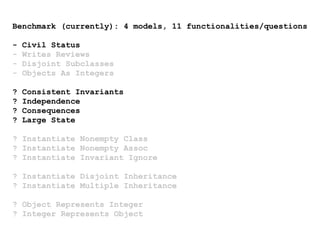
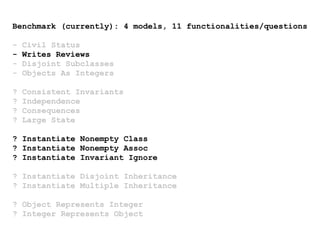
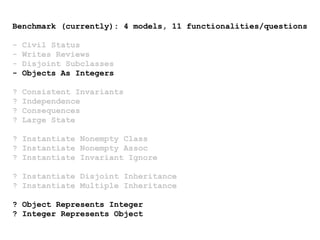
Benchmark (currently): 4 models, 11 functionalities/questions
- Civil Status
- Writes Reviews
- Disjoint Subclasses
- Objects As Integers
? Consistent Invariants
? Independence
? Consequences
? Large State
? Instantiate Nonempty Class
? Instantiate Nonempty Assoc
? Instantiate Invariant Ignore
? Instantiate Disjoint Inheritance
? Instantiate Multiple Inheritance
? Object Represents Integer
? Integer Represents Object
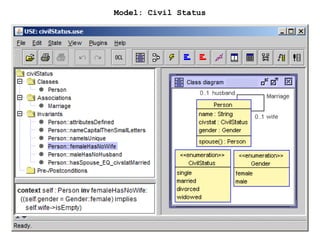
Model: Civil Status
Model: Civil Status
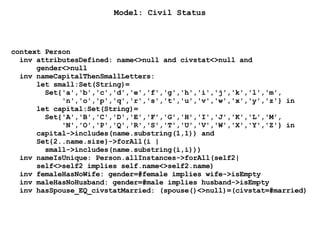
context Person
inv attributesDefined: name<>null and civstat<>null and
gender<>null
inv nameCapitalThenSmallLetters:
let small:Set(String)=
Set{'a','b','c','d','e','f','g','h','i','j','k','l','m',
'n','o','p','q','r','s','t','u','v','w','x','y','z'} in
let capital:Set(String)=
Set{'A','B','C','D','E','F','G','H','I','J','K','L','M',
'N','O','P','Q','R','S','T','U','V','W','X','Y','Z'} in
capital->includes(name.substring(1,1)) and
Set{2..name.size}->forAll(i |
small->includes(name.substring(i,i)))
inv nameIsUnique: Person.allInstances->forAll(self2|
self<>self2 implies self.name<>self2.name)
inv femaleHasNoWife: gender=#female implies wife->isEmpty
inv maleHasNoHusband: gender=#male implies husband->isEmpty
inv hasSpouse_EQ_civstatMarried: (spouse()<>null)=(civstat=#married)
Benchmark (currently): 4 models, 11 functionalities/questions
- Civil Status
- Writes Reviews
- Disjoint Subclasses
- Objects As Integers
? Consistent Invariants
? Independence
? Consequences
? Large State
? Instantiate Nonempty Class
? Instantiate Nonempty Assoc
? Instantiate Invariant Ignore
? Instantiate Disjoint Inheritance
? Instantiate Multiple Inheritance
? Object Represents Integer
? Integer Represents Object
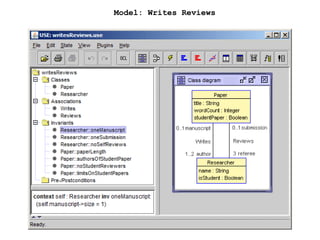
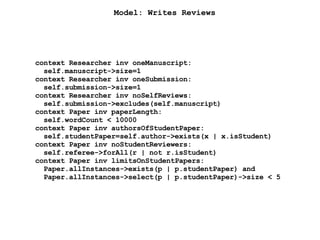
Model: Writes Reviews
context Researcher inv oneManuscript:
self.manuscript->size=1
context Researcher inv oneSubmission:
self.submission->size=1
context Researcher inv noSelfReviews:
self.submission->excludes(self.manuscript)
context Paper inv paperLength:
self.wordCount < 10000
context Paper inv authorsOfStudentPaper:
self.studentPaper=self.author->exists(x | x.isStudent)
context Paper inv noStudentReviewers:
self.referee->forAll(r | not r.isStudent)
context Paper inv limitsOnStudentPapers:
Paper.allInstances->exists(p | p.studentPaper) and
Paper.allInstances->select(p | p.studentPaper)->size < 5
Benchmark (currently): 4 models, 11 functionalities/questions
- Civil Status
- Writes Reviews
- Disjoint Subclasses
- Objects As Integers
? Consistent Invariants
? Independence
? Consequences
? Large State
? Instantiate Nonempty Class
? Instantiate Nonempty Assoc
? Instantiate Invariant Ignore
? Instantiate Disjoint Inheritance
? Instantiate Multiple Inheritance
? Object Represents Integer
? Integer Represents Object
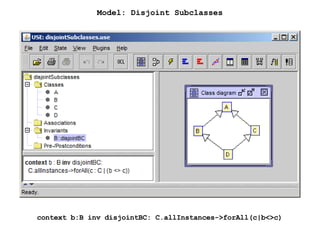
Model: Disjoint Subclasses
context b:B inv disjointBC: C.allInstances->forAll(c|b<>c)
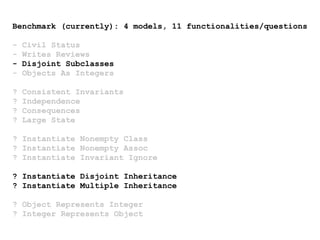
Benchmark (currently): 4 models, 11 functionalities/questions
- Civil Status
- Writes Reviews
- Disjoint Subclasses
- Objects As Integers
? Consistent Invariants
? Independence
? Consequences
? Large State
? Instantiate Nonempty Class
? Instantiate Nonempty Assoc
? Instantiate Invariant Ignore
? Instantiate Disjoint Inheritance
? Instantiate Multiple Inheritance
? Object Represents Integer
? Integer Represents Object
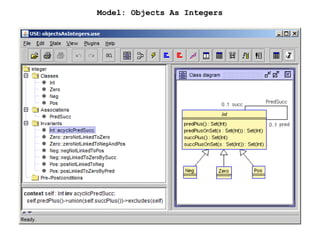
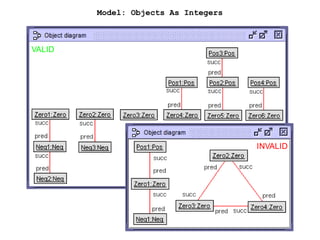
Model: Objects As Integers
VALID
INVALID
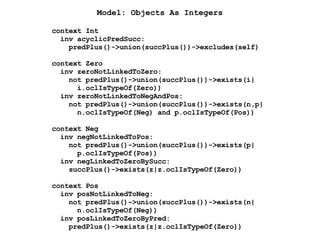
context Int
inv acyclicPredSucc:
predPlus()->union(succPlus())->excludes(self)
context Zero
inv zeroNotLinkedToZero:
not predPlus()->union(succPlus())->exists(i|
i.oclIsTypeOf(Zero))
inv zeroNotLinkedToNegAndPos:
not predPlus()->union(succPlus())->exists(n,p|
n.oclIsTypeOf(Neg) and p.oclIsTypeOf(Pos))
context Neg
inv negNotLinkedToPos:
not predPlus()->union(succPlus())->exists(p|
p.oclIsTypeOf(Pos))
inv negLinkedToZeroBySucc:
succPlus()->exists(z|z.oclIsTypeOf(Zero))
context Pos
inv posNotLinkedToNeg:
not predPlus()->union(succPlus())->exists(n|
n.oclIsTypeOf(Neg))
inv posLinkedToZeroByPred:
predPlus()->exists(z|z.oclIsTypeOf(Zero))
Model: Objects As Integers
Benchmark (currently): 4 models, 11 functionalities/questions
- Civil Status
- Writes Reviews
- Disjoint Subclasses
- Objects As Integers
? Consistent Invariants
? Independence
? Consequences
? Large State
? Instantiate Nonempty Class
? Instantiate Nonempty Assoc
? Instantiate Invariant Ignore
? Instantiate Disjoint Inheritance
? Instantiate Multiple Inheritance
? Object Represents Integer
? Integer Represents Object
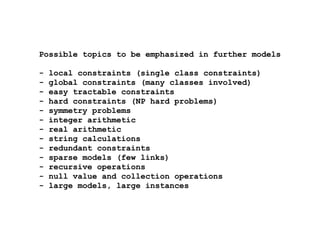
Possible topics to be emphasized in further models
- local constraints (single class constraints)
- global constraints (many classes involved)
- easy tractable constraints
- hard constraints (NP hard problems)
- symmetry problems
- integer arithmetic
- real arithmetic
- string calculations
- redundant constraints
- sparse models (few links)
- recursive operations
- null value and collection operations
- large models, large instances
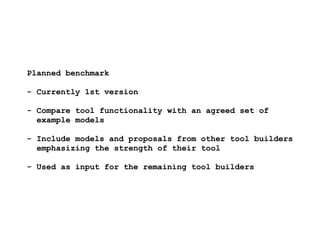
Planned benchmark
- Currently 1st version
- Compare tool functionality with an agreed set of
example models
- Include models and proposals from other tool builders
emphasizing the strength of their tool
- Used as input for the remaining tool builders
... waiting for contributions ...
Thanks for your attention!

Tap2013

  • 1.
    Initiating a Benchmarkfor UML and OCL Analysis Tools Martin Gogolla, Fabian Büttner, Jordi Cabot University of Bremen, Germany AtlanMod, Ecole des Mines de Nantes - INRIA, LINA, France
  • 2.
    Context: Model-Based (Software)Engineering here focus on UML and OCL Model: UML class diagram + OCL constraints Various tools for analyzing such models exist - Test-oriented tools (USE, EMF2toCSP, mOdCL, ...) - Proof-oriented tools (HOL-OCL, KeY, ...) Tools offer various functionalities - building valid/invalid object diagrams, manually or automatically; valid: explicit and inherent constraints - debugging invalid object diagrams by revealing failing constraints, constraint parts or model elements - prooving consequences from stated constraints - revealing classes or associations which cannot be populated - ... Aim of planned benchmark (here 1st version) - Compare tool functionality with an agreed set of example models - Include models and proposals from other tool builders
  • 3.
    Benchmark (currently): 4models, 11 functionalities/questions - Civil Status - Writes Reviews - Disjoint Subclasses - Objects As Integers ? Consistent Invariants ? Independence ? Consequences ? Large State ? Instantiate Nonempty Class ? Instantiate Nonempty Assoc ? Instantiate Invariant Ignore ? Instantiate Disjoint Inheritance ? Instantiate Multiple Inheritance ? Object Represents Integer ? Integer Represents Object
  • 4.
  • 5.
    Model: Civil Status contextPerson inv attributesDefined: name<>null and civstat<>null and gender<>null inv nameCapitalThenSmallLetters: let small:Set(String)= Set{'a','b','c','d','e','f','g','h','i','j','k','l','m', 'n','o','p','q','r','s','t','u','v','w','x','y','z'} in let capital:Set(String)= Set{'A','B','C','D','E','F','G','H','I','J','K','L','M', 'N','O','P','Q','R','S','T','U','V','W','X','Y','Z'} in capital->includes(name.substring(1,1)) and Set{2..name.size}->forAll(i | small->includes(name.substring(i,i))) inv nameIsUnique: Person.allInstances->forAll(self2| self<>self2 implies self.name<>self2.name) inv femaleHasNoWife: gender=#female implies wife->isEmpty inv maleHasNoHusband: gender=#male implies husband->isEmpty inv hasSpouse_EQ_civstatMarried: (spouse()<>null)=(civstat=#married)
  • 6.
    Benchmark (currently): 4models, 11 functionalities/questions - Civil Status - Writes Reviews - Disjoint Subclasses - Objects As Integers ? Consistent Invariants ? Independence ? Consequences ? Large State ? Instantiate Nonempty Class ? Instantiate Nonempty Assoc ? Instantiate Invariant Ignore ? Instantiate Disjoint Inheritance ? Instantiate Multiple Inheritance ? Object Represents Integer ? Integer Represents Object
  • 7.
  • 8.
    Model: Writes Reviews contextResearcher inv oneManuscript: self.manuscript->size=1 context Researcher inv oneSubmission: self.submission->size=1 context Researcher inv noSelfReviews: self.submission->excludes(self.manuscript) context Paper inv paperLength: self.wordCount < 10000 context Paper inv authorsOfStudentPaper: self.studentPaper=self.author->exists(x | x.isStudent) context Paper inv noStudentReviewers: self.referee->forAll(r | not r.isStudent) context Paper inv limitsOnStudentPapers: Paper.allInstances->exists(p | p.studentPaper) and Paper.allInstances->select(p | p.studentPaper)->size < 5
  • 9.
    Benchmark (currently): 4models, 11 functionalities/questions - Civil Status - Writes Reviews - Disjoint Subclasses - Objects As Integers ? Consistent Invariants ? Independence ? Consequences ? Large State ? Instantiate Nonempty Class ? Instantiate Nonempty Assoc ? Instantiate Invariant Ignore ? Instantiate Disjoint Inheritance ? Instantiate Multiple Inheritance ? Object Represents Integer ? Integer Represents Object
  • 10.
    Model: Disjoint Subclasses contextb:B inv disjointBC: C.allInstances->forAll(c|b<>c)
  • 11.
    Benchmark (currently): 4models, 11 functionalities/questions - Civil Status - Writes Reviews - Disjoint Subclasses - Objects As Integers ? Consistent Invariants ? Independence ? Consequences ? Large State ? Instantiate Nonempty Class ? Instantiate Nonempty Assoc ? Instantiate Invariant Ignore ? Instantiate Disjoint Inheritance ? Instantiate Multiple Inheritance ? Object Represents Integer ? Integer Represents Object
  • 12.
  • 13.
    Model: Objects AsIntegers VALID INVALID
  • 14.
    context Int inv acyclicPredSucc: predPlus()->union(succPlus())->excludes(self) contextZero inv zeroNotLinkedToZero: not predPlus()->union(succPlus())->exists(i| i.oclIsTypeOf(Zero)) inv zeroNotLinkedToNegAndPos: not predPlus()->union(succPlus())->exists(n,p| n.oclIsTypeOf(Neg) and p.oclIsTypeOf(Pos)) context Neg inv negNotLinkedToPos: not predPlus()->union(succPlus())->exists(p| p.oclIsTypeOf(Pos)) inv negLinkedToZeroBySucc: succPlus()->exists(z|z.oclIsTypeOf(Zero)) context Pos inv posNotLinkedToNeg: not predPlus()->union(succPlus())->exists(n| n.oclIsTypeOf(Neg)) inv posLinkedToZeroByPred: predPlus()->exists(z|z.oclIsTypeOf(Zero)) Model: Objects As Integers
  • 15.
    Benchmark (currently): 4models, 11 functionalities/questions - Civil Status - Writes Reviews - Disjoint Subclasses - Objects As Integers ? Consistent Invariants ? Independence ? Consequences ? Large State ? Instantiate Nonempty Class ? Instantiate Nonempty Assoc ? Instantiate Invariant Ignore ? Instantiate Disjoint Inheritance ? Instantiate Multiple Inheritance ? Object Represents Integer ? Integer Represents Object
  • 16.
    Possible topics tobe emphasized in further models - local constraints (single class constraints) - global constraints (many classes involved) - easy tractable constraints - hard constraints (NP hard problems) - symmetry problems - integer arithmetic - real arithmetic - string calculations - redundant constraints - sparse models (few links) - recursive operations - null value and collection operations - large models, large instances
  • 17.
    Planned benchmark - Currently1st version - Compare tool functionality with an agreed set of example models - Include models and proposals from other tool builders emphasizing the strength of their tool - Used as input for the remaining tool builders
  • 18.
    ... waiting forcontributions ... Thanks for your attention!