Download to read offline

 = ?
2 / 22](https://image.slidesharecdn.com/demystifyingtypeclassderivationwithshapeless-171023142842/85/Demystifying-Type-Class-derivation-with-Shapeless-2-320.jpg)
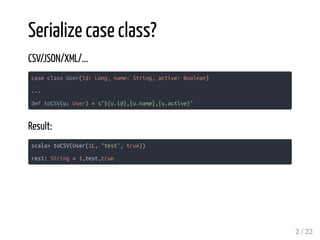
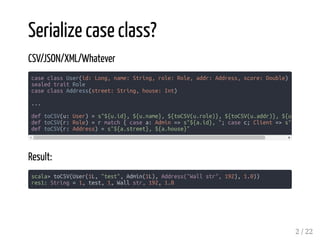
: String = ???
3 / 22](https://image.slidesharecdn.com/demystifyingtypeclassderivationwithshapeless-171023142842/85/Demystifying-Type-Class-derivation-with-Shapeless-5-320.jpg)

![Agenda
Basics: ADTs, Products & Coproducts
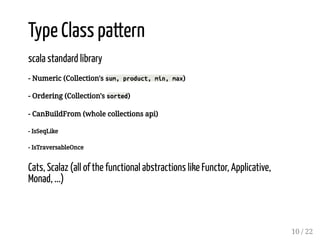
Type Class pattern
Generic Derivation
[live-code]
Lazy, Aux
Debugging
4 / 22](https://image.slidesharecdn.com/demystifyingtypeclassderivationwithshapeless-171023142842/85/Demystifying-Type-Class-derivation-with-Shapeless-7-320.jpg)
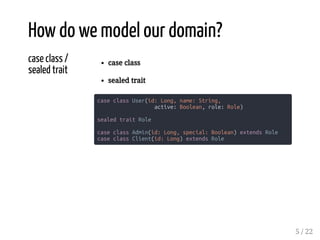
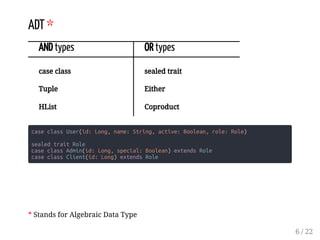
![case class /
sealed trait
TupleN / Either
TupleN[...] extends Product
scala.Either / cats.Xor / scalaz./
type User = (Long, String, Boolean, Role)
type Role = Either[Admin, Client]
type Admin = (Long, Boolean)
type Client = Long
How do we model our domain?
5 / 22](https://image.slidesharecdn.com/demystifyingtypeclassderivationwithshapeless-171023142842/85/Demystifying-Type-Class-derivation-with-Shapeless-10-320.jpg)
![case class /
sealed trait
TupleN / Either
TupleN[...] extends Product
scala.Either / cats.Xor / scalaz./
type User = (Long, String, Boolean, Role)
type Role = Either[Admin, Client]
type Admin = (Long, Boolean)
type Client = Long
How do we model our domain?
5 / 22](https://image.slidesharecdn.com/demystifyingtypeclassderivationwithshapeless-171023142842/85/Demystifying-Type-Class-derivation-with-Shapeless-11-320.jpg)
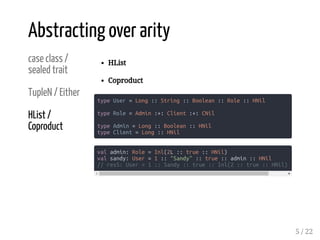
![HList
val hlist = 1 :: "one" :: 1L :: HNil
// res0: shapeless.::[
// Int,shapeless.::[
// String,shapeless.::[Long,
// shapeless.HNil
// ]
// ]
// ] = 1 :: "one" :: 1L :: HNil
hlist.head // Int
hlist.tail.head // String
hlist.tail.tail.head // Long
val s = hlist.select[String] // returns "one".
demo.select[List[Int]] // Compilation error. demo does not contain a List[Int]
take, head, tail, map, flatMap, zip
7 / 22](https://image.slidesharecdn.com/demystifyingtypeclassderivationwithshapeless-171023142842/85/Demystifying-Type-Class-derivation-with-Shapeless-14-320.jpg)
 extends HList // HCons
case object HNil extends HList
7 / 22](https://image.slidesharecdn.com/demystifyingtypeclassderivationwithshapeless-171023142842/85/Demystifying-Type-Class-derivation-with-Shapeless-15-320.jpg)
 extends HList // HCons
case object HNil extends HList
List De nition:
sealed trait List[+A]
case class ::[A](head: A, tail: List[A]) extends List[A]
case object Nil extends List[Nothing]
7 / 22](https://image.slidesharecdn.com/demystifyingtypeclassderivationwithshapeless-171023142842/85/Demystifying-Type-Class-derivation-with-Shapeless-16-320.jpg)
![Coproduct
Once you feel comfortable with an HList - for Coproduct it is quite similar
sealed trait Coproduct
sealed trait :+:[+H, +T <: Coproduct] extends Coproduct
case class Inl[+H, +T <: Coproduct](head : H) extends :+:[H, T]
case class Inr[+H, +T <: Coproduct](tail : T) extends :+:[H, T]
sealed trait CNil extends Coproduct
Usage:
// 'kind-of' Either[Int, String, Boolean]
type Co = Int :+: String :+: Boolean :+: CNil
val co1 = Inl(42L) // Int :+: String :+: Boolean :+: CNil
val co2 = Inr(Inl("forty-two") // Int :+: String :+: Boolean :+: CNil
val co3 = Inr(Inr(Inl(true)) // Int :+: String :+: Boolean :+: CNil
8 / 22](https://image.slidesharecdn.com/demystifyingtypeclassderivationwithshapeless-171023142842/85/Demystifying-Type-Class-derivation-with-Shapeless-17-320.jpg)

![Generic
import shapeless.Generic
case class User(id: Long, name: String, active: Boolean)
val generic = Generic[User]
// res0: shapeless.Generic[User]{type Repr = shapeless.::[Long,
// shapeless.::[String,
// shapeless.::[Boolean,
// shapeless.HNil
// ]
// ]
//]}
9 / 22](https://image.slidesharecdn.com/demystifyingtypeclassderivationwithshapeless-171023142842/85/Demystifying-Type-Class-derivation-with-Shapeless-19-320.jpg)
![Generic
trait Generic[A] {
type Repr
def to(value: A): Repr
def from(value: Repr): A
}
Usage:
scala> val user = User(1L, "josh", true)
user: User = User(1,josh,true)
scala> generic.to(user)
res2: res1.Repr = 1 :: josh :: true :: HNil
scala> generic.from(res2)
res3: User = User(1,josh,true)
9 / 22](https://image.slidesharecdn.com/demystifyingtypeclassderivationwithshapeless-171023142842/85/Demystifying-Type-Class-derivation-with-Shapeless-20-320.jpg)
![Generic
trait Generic[A] {
type Repr
def to(value: A): Repr
def from(value: Repr): A
}
Usage:
scala> val user = User(1L, "josh", true)
user: User = User(1,josh,true)
scala> generic.to(user)
res2: res1.Repr = 1 :: josh :: true :: HNil
scala> generic.from(res2)
res3: User = User(1,josh,true)
9 / 22](https://image.slidesharecdn.com/demystifyingtypeclassderivationwithshapeless-171023142842/85/Demystifying-Type-Class-derivation-with-Shapeless-21-320.jpg)

![scala.Ordering /**
* Ordering is a trait whose instances each represent
* a strategy for sorting instances of a type.
* ...
*/
trait Ordering[T] extends Comparator[T] {
/**
* Returns an integer whose sign communicates
* how x compares to y.
*/
def compare(x: T, y: T): Int
}
Type Class pattern
11 / 22](https://image.slidesharecdn.com/demystifyingtypeclassderivationwithshapeless-171023142842/85/Demystifying-Type-Class-derivation-with-Shapeless-24-320.jpg)
![scala.Ordering
De nition
trait Ordering[T] extends Comparator[T] {
def compare(x: T, y: T): Int
}
Type Class pattern
11 / 22](https://image.slidesharecdn.com/demystifyingtypeclassderivationwithshapeless-171023142842/85/Demystifying-Type-Class-derivation-with-Shapeless-25-320.jpg)
![scala.Ordering
De nition
Instances
trait Ordering[T] extends Comparator[T] {
def compare(x: T, y: T): Int
}
Type Class pattern
object Ordering {
implicit val intOrd: Ordering[Int] = new Ordering[Int] {
def compare(x: Int, y: Int) = lang.Integer.compare(x, y)
}
implicit val longOrd: Ordering[Long] = new Ordering[Long]
def compare(x: Long, y: Long) = lang.Long.compare(x, y)
}
...
}
11 / 22](https://image.slidesharecdn.com/demystifyingtypeclassderivationwithshapeless-171023142842/85/Demystifying-Type-Class-derivation-with-Shapeless-26-320.jpg)
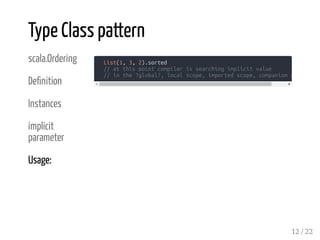
![scala.Ordering
De nition
Instances
implicit
parameter
trait Ordering[T] extends Comparator[T] {
def compare(x: T, y: T): Int
}
def sorted[T](implicit ord: Ordering[T]): Repr
..or context bound
def sorted[T: Ordering]: Repr
Type Class pattern
object Ordering {
implicit val intOrd: Ordering[Int] = new Ordering[Int] {
def compare(x: Int, y: Int) = lang.Integer.compare(x, y)
}
implicit val longOrd: Ordering[Long] = new Ordering[Long]
def compare(x: Long, y: Long) = lang.Long.compare(x, y)
}
...
}
11 / 22](https://image.slidesharecdn.com/demystifyingtypeclassderivationwithshapeless-171023142842/85/Demystifying-Type-Class-derivation-with-Shapeless-27-320.jpg)
![Type Class pattern
https://github.com/mpilquist/simulacrum
@typeclass trait CSVSerializer[A] {
@op("§") def serialize(a: A): String
}
13 / 22](https://image.slidesharecdn.com/demystifyingtypeclassderivationwithshapeless-171023142842/85/Demystifying-Type-Class-derivation-with-Shapeless-29-320.jpg)
![Type Class pattern
https://github.com/mpilquist/simulacrum
@typeclass trait CSVSerializer[A] {
@op("§") def serialize(a: A): String
}
trait CSVSerializer[A] {
def serialize(x: A, y: A): A
}
object CSVSerializer {
def apply[A](implicit instance: CSVSerializer[A]): CSVSerializer[A] = instance
trait Ops[A] {
def typeClassInstance: CSVSerializer[A]
def self: A
def §(y: A): A = typeClassInstance.append(self, y)
}
trait ToCSVSerializerOps {
implicit def toCSVSerializerOps[A](target: A)(implicit tc: CSVSerializer[A]): O
val self = target
val typeClassInstance = tc
}
}
...
13 / 22](https://image.slidesharecdn.com/demystifyingtypeclassderivationwithshapeless-171023142842/85/Demystifying-Type-Class-derivation-with-Shapeless-30-320.jpg)
![CSV Serializer
Type Class de nition
trait CSVSerializer[A] {
def serialize(a: A): List[String]
}
14 / 22](https://image.slidesharecdn.com/demystifyingtypeclassderivationwithshapeless-171023142842/85/Demystifying-Type-Class-derivation-with-Shapeless-31-320.jpg)
![CSV Serializer
Type Class de nition
trait CSVSerializer[A] {
def serialize(a: A): List[String]
}
lets de ne some helpers..
object CSVSerializer {
def apply[A](implicit serializer: CSVSerializer[A]): CSVSerializer[A] =
serializer
implicit class WithSerialize[A](a: A) {
def toCSV(implicit serializer: CSVSerializer[A]) =
serializer.serialize(a).mkString(",")
}
}
14 / 22](https://image.slidesharecdn.com/demystifyingtypeclassderivationwithshapeless-171023142842/85/Demystifying-Type-Class-derivation-with-Shapeless-32-320.jpg)
![deriving serializer
[live-code]
14 / 22](https://image.slidesharecdn.com/demystifyingtypeclassderivationwithshapeless-171023142842/85/Demystifying-Type-Class-derivation-with-Shapeless-33-320.jpg)
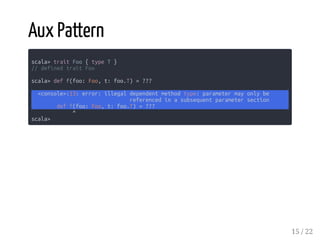
![Aux Pattern
scala> trait Foo { type T }
// defined trait Foo
scala> def f(foo: Foo, t: foo.T) = ???
<console>:13: error: illegal dependent method type: parameter may only be
referenced in a subsequent parameter section
def f(foo: Foo, t: foo.T) = ???
^
scala>
Solution:
scala> trait Foo { type T }
// defined trait Foo
scala> type Aux[T0] = Foo { type T = T0 }
// defined type alias Aux
scala> def f[T](foo: Aux[T], t: T) = ???
// f: [T](foo: Aux[T], t: T)Nothing
15 / 22](https://image.slidesharecdn.com/demystifyingtypeclassderivationwithshapeless-171023142842/85/Demystifying-Type-Class-derivation-with-Shapeless-35-320.jpg)
![Aux Pattern
type Aux[T, Repr0] = Generic[T] { type Repr = Repr0 }
16 / 22](https://image.slidesharecdn.com/demystifyingtypeclassderivationwithshapeless-171023142842/85/Demystifying-Type-Class-derivation-with-Shapeless-36-320.jpg)
![Implicit divergence
nested structure
case class Account(id: Long, user: User)
case class User(id: Long, name: String, active: Boolean)
/*1*/ CSVSerializer[Account]
/*2*/ CSVSerializer[::[Long, ::[User, HNil]]]
/*3*/ CSVSerializer[::[User, HNil]]
/*4*/ CSVSerializer[User]
/*5*/ CSVSerializer[::[Long, ::[String, ::[Boolean, HNil]]]] // failed
// diverging implicit expansion for type xyz.codefastdieyoung
// .CSVSerializer[Long :: String :: Boolean :: shapeless.HNil]
the compiler sees the same type constructor twice and the complexity of the
type parameters is increasing...
17 / 22](https://image.slidesharecdn.com/demystifyingtypeclassderivationwithshapeless-171023142842/85/Demystifying-Type-Class-derivation-with-Shapeless-37-320.jpg)
: CSVSerializer[H :: T] = { t =>
s"${hSerializer(t.head)}, ${tailSerializer(t.tail)}"
}
wrap diverging implicit parameter...
it suppresses implicit divergence at compile time
it defers evaluation of the implicit parameter at runtime
17 / 22](https://image.slidesharecdn.com/demystifyingtypeclassderivationwithshapeless-171023142842/85/Demystifying-Type-Class-derivation-with-Shapeless-38-320.jpg)

: F[B] = ???
18 / 22](https://image.slidesharecdn.com/demystifyingtypeclassderivationwithshapeless-171023142842/85/Demystifying-Type-Class-derivation-with-Shapeless-40-320.jpg)







The document discusses type class derivation in Shapeless, focusing on serialization of case classes into different formats like CSV and JSON. It covers concepts such as algebraic data types, generic programming, and the type class pattern in Scala, providing examples and live coding demonstrations. Additionally, the document addresses complexities related to implicit parameters and the challenge of nested structures in serialization.


