Downloaded 15 times


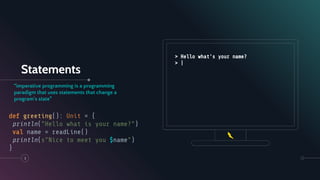
![55
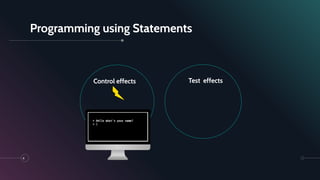
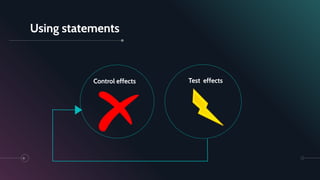
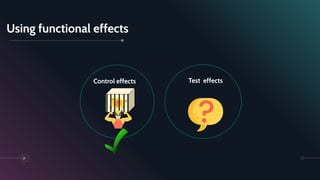
Test effectsControl effects
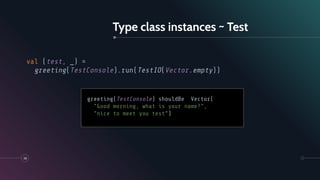
greeting() shouldBe {
["Good morning, what is your name?",
"nice to meet you user-test”]
}
Programming using Statements](https://image.slidesharecdn.com/berlinmeetup-190828194120/85/Berlin-meetup-5-320.jpg)
![Test Console Impl
8
var outputs: Vector[String] = Vector.empty
object TestConsole extends Console {
def println(line: String): Unit = outputs = outputs :+ line
def readLine: String = "test"
}](https://image.slidesharecdn.com/berlinmeetup-190828194120/85/Berlin-meetup-8-320.jpg)
![Effects !
var outputs: Vector[String] = Vector.empty
// In PROD:
greeting(ProdConsole)
// In TEST:
greeting(TestConsole)
outputs shouldBe
Vector("Good morning, what is your name?",
"nice to meet you user-test”)
10
PROD
TEST](https://image.slidesharecdn.com/berlinmeetup-190828194120/85/Berlin-meetup-10-320.jpg)
 => A) { s =>
def map[B](f: A => B) =
flatMap(f.andThen(IO.effect(_)))
def flatMap[B](f: A => IO[B]): IO[B] =
IO.effect(f(s.unsafeRun()).unsafeRun())
}
object IO {
def effect[A](eff: => A) = new IO(() => eff)
}](https://image.slidesharecdn.com/berlinmeetup-190828194120/85/Berlin-meetup-17-320.jpg)
![Functional effects
19
ZIO[R, E, A]
Environment Error Success](https://image.slidesharecdn.com/berlinmeetup-190828194120/85/Berlin-meetup-19-320.jpg)
![Functional effects
20
ZIO[R, Throwable, A]
TaskR[R, A]
0](https://image.slidesharecdn.com/berlinmeetup-190828194120/85/Berlin-meetup-20-320.jpg)
![Functional effects
21
ZIO[Any, Throwable, A]
Task[A]
0](https://image.slidesharecdn.com/berlinmeetup-190828194120/85/Berlin-meetup-21-320.jpg)
![Functional effects
22
ZIO[Any, E, A]
IO[E, A]
0](https://image.slidesharecdn.com/berlinmeetup-190828194120/85/Berlin-meetup-22-320.jpg)
![Functional effects
23
ZIO[Any, Nothing, A]
UIO[A]
0](https://image.slidesharecdn.com/berlinmeetup-190828194120/85/Berlin-meetup-23-320.jpg)
![Describe programs
24
val greeting: UIO[Unit] =
for {
_ <- UIO(println("Hello what is your name?"))
name <- Task(readLine())
_ <- UIO(println(s"Nice to meet you $name"))
} yield ()](https://image.slidesharecdn.com/berlinmeetup-190828194120/85/Berlin-meetup-24-320.jpg)
![Describe programs
25
val greeting: UIO[Unit] =
for {
_ <- UIO(println("Hello what is your name?"))
name <- Task(readLine())
_ <- UIO(println(s"Nice to meet you $name"))
} yield ()](https://image.slidesharecdn.com/berlinmeetup-190828194120/85/Berlin-meetup-25-320.jpg)
![Execute effects
26
val greeting: UIO[Unit] =
unsafeRun(
for {
_ <- UIO(println("Hello what is your name?"))
name <- Task(readLine())
_ <- UIO(println(s"Nice to meet you $name"))
} yield ())
> Hello what's your name?
> |](https://image.slidesharecdn.com/berlinmeetup-190828194120/85/Berlin-meetup-26-320.jpg)
![ZIO-Environment
28
ZIO[R, E, A]
Environment Error Success](https://image.slidesharecdn.com/berlinmeetup-190828194120/85/Berlin-meetup-28-320.jpg)

![Console interface
30
trait Console[F[_]] {
def println(line: String): F[Unit]
val readLine: F[String]
}
object Console {
def apply[F[_]](implicit F: Console[F]) = F
}](https://image.slidesharecdn.com/berlinmeetup-190828194120/85/Berlin-meetup-30-320.jpg)
![Polymorphic effect program
31
def greeting[F[_]: Monad](console: Console[F]): F[Unit] =
for {
_ <- console.println("Hello what is your name?")
name <- console.readLine
_ <- console.println(s"Nice to meet you $name")
} yield ()](https://image.slidesharecdn.com/berlinmeetup-190828194120/85/Berlin-meetup-31-320.jpg)
![Type class instances ~ Test
32
type Test[A] = State[Vector[String], A]
implicit val TestConsole = new Console[Test] {
def println(line: String): Test[Unit] =
State.modify(oldState => TestIO(oldState.outputs :+ line))
val readLine: Test[String] = State.get.map(_ => "test")
}](https://image.slidesharecdn.com/berlinmeetup-190828194120/85/Berlin-meetup-32-320.jpg)
![Type class instances ~ Test
33
type Test[A] = State[Vector[String], A]
implicit val TestConsole = new Console[Test] {
def println(line: String): Test[Unit] =
State.modify(oldState => TestIO(oldState.outputs :+ line))
val readLine: Test[String] = State.get.map(_ => "test")
}](https://image.slidesharecdn.com/berlinmeetup-190828194120/85/Berlin-meetup-33-320.jpg)
![Type class instances ~ Test
34
type Test[A] = State[Vector[String], A]
implicit val TestConsole = new Console[Test] {
def println(line: String): Test[Unit] =
State.modify(oldState => TestIO(oldState.outputs :+ line))
val readLine: Test[String] = State.get.map(_ => "test")
}
Applicative
Monad](https://image.slidesharecdn.com/berlinmeetup-190828194120/85/Berlin-meetup-34-320.jpg)
![Type class instances ~ Test
36
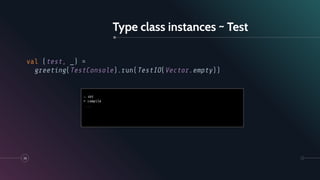
val (test, _) =
greeting(TestConsole).run(TestIO(Vector.empty))
value flatMap is not a member of type parameter F[Unit]
[error] Note: implicit value TestConsole is not applicable here because it
comes after the application point and it lacks an explicit result type
[error] _ <- console.println("Hello what is your name?")
value map is not a member of type parameter F[Unit]
[error] Note: implicit value TestConsole is not applicable here because it
comes after the application point and it lacks an explicit result type
[error] _ <- console.println(s"Nice to meet you $name")](https://image.slidesharecdn.com/berlinmeetup-190828194120/85/Berlin-meetup-36-320.jpg)
![Type class instances ~ Test
37
import scalaz.syntax.monad._
→ sbt
> compile
…
[info] Done compiling.
[success] Total time: 3 s, completed Jul 28, 2019 5:29:26 PM](https://image.slidesharecdn.com/berlinmeetup-190828194120/85/Berlin-meetup-37-320.jpg)
![Type class instances ~ Prod
39
val LiveConsole = new Console[Task] {
def println(line: String): UIO[Unit] = UIO(scala.Console.println(line))
val readLine: Task[String] = Task(scala.io.StdIn.readLine)
}
class ZIOMonad[R, E] extends Monad[ZIO[R, E, ?]] {
def point[A](a: => A): ZIO[R, E, A] = UIO(a)
def bind[A, B](fa: ZIO[R, E, A])(f: A => ZIO[R, E, B]): ZIO[R, E, B] = fa.flatMap(f)
}
val resultIO: Task[Unit] = greeting(LiveConsole)(new ZIOMonad[Any, Throwable])](https://image.slidesharecdn.com/berlinmeetup-190828194120/85/Berlin-meetup-39-320.jpg)
![Using many services
40
def program[F[_]: Monad : Console : Config : ...]](https://image.slidesharecdn.com/berlinmeetup-190828194120/85/Berlin-meetup-40-320.jpg)
![Using many services
41
def program[F[_]: Monad : Console : Config : ...]
[error] could not find implicit value for evidence
parameter of type Config](https://image.slidesharecdn.com/berlinmeetup-190828194120/85/Berlin-meetup-41-320.jpg)
![Requirements
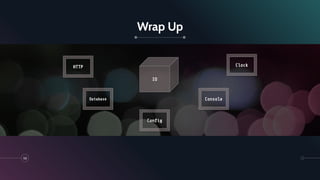
To use Tagless final
1
Functional Effects
2
F[ _ ]
3
Type classes
42
Type class instancesIO[ E, ?]
Either[Error, ?]](https://image.slidesharecdn.com/berlinmeetup-190828194120/85/Berlin-meetup-42-320.jpg)

![ZIO-Environment
44
ZIO[R, E, A]
Environment Error Success](https://image.slidesharecdn.com/berlinmeetup-190828194120/85/Berlin-meetup-44-320.jpg)
![API
45
ZIO[R, E, A]
sealed trait ZIO[-R, +E, +A] {
def provide(environment: R): ZIO[Any, E, A]
}
object ZIO {
def accessM[R, E, A](f: R => IO[E, A]): ZIO[R, E, A]
def access[R, E, A](f: R => A): ZIO[R, E, A]
def environment[R]: ZIO[R, Nothing, R]
}
R => IO[E, A]](https://image.slidesharecdn.com/berlinmeetup-190828194120/85/Berlin-meetup-45-320.jpg)
![Console Service
46
trait Console {
val console: Console.Service[Any]
}
object Console {
trait Service[R] {
def println(line: String): ZIO[R, Nothing, Unit]
val readLine: TaskR[R, String]
}
}](https://image.slidesharecdn.com/berlinmeetup-190828194120/85/Berlin-meetup-46-320.jpg)
![Test Module
47
case class Test(ref: Ref[Vector[String]]) extends Console {
val console: Service[Any] = new Service[Any] {
def println(line: String): UIO[Unit] = ref.update(_ :+ line).unit
val readLine: UIO[String] = UIO("test")
}
}](https://image.slidesharecdn.com/berlinmeetup-190828194120/85/Berlin-meetup-47-320.jpg)
![Prod Module
48
trait Live extends Console {
val console: Service[Any] = new Service[Any] {
def println(line: String): UIO[Unit] = UIO(scala.Console.println(line))
val readLine: Task[String] = Task(scala.io.StdIn.readLine)
}
}](https://image.slidesharecdn.com/berlinmeetup-190828194120/85/Berlin-meetup-48-320.jpg)
![Console helper
49
package console extends Console.Service[Console] {
def println(line: String): ZIO[Console, Nothing, Unit] =
ZIO.accessM(_.console println line)
val readLine: TaskR[Console, String] = ZIO.accessM(_.console.readLine)
}](https://image.slidesharecdn.com/berlinmeetup-190828194120/85/Berlin-meetup-49-320.jpg)
![Program
50
val greeting: TaskR[Console, Unit] =
for {
_ <- console.println("Hello what is your name?")
name <- console.readLine
_ <- console.println(s"Nice to meet you $name")
} yield ()](https://image.slidesharecdn.com/berlinmeetup-190828194120/85/Berlin-meetup-50-320.jpg)
![Test vs Prod
for {
state <-
Ref.make(Vector.empty[String])
_ <- greeting.provide(Test(state))
result <- state.get
} yield result shouldBe Vector(
"Good morning, what is your name?",
"nice to meet you user-test”)
val program =
greeting.provide(Live)
51](https://image.slidesharecdn.com/berlinmeetup-190828194120/85/Berlin-meetup-51-320.jpg)

![Program with
Multi services
def program(id: UserId): TaskR[Config with Http with Database with Clock, Unit] =
for {
conf <- configuration.loadConfig
user <-
ZIO.bracket(
runServer(conf),
_.close,
server =>
http.getUser(id)(server)
.retry(Schedule.doWhile(_.status == CommunicationError.status)))
_ <- db.create(user)
now <- clock.currentTime
_ <- console.putStrLn(s"$now User has been added successfully")
} yield ()
53](https://image.slidesharecdn.com/berlinmeetup-190828194120/85/Berlin-meetup-53-320.jpg)
![//TODO error
Program with
Multi services
def program(id: UserId): TaskR[Config with Http with Database with Clock, Unit] =
for {
conf <- configuration.loadConfig
user <-
ZIO.bracket(
runServer(conf),
_.close,
server =>
http.getUser(id)(server)
.retry(Schedule.doWhile(_.status == CommunicationError.status)))
_ <- db.create(user)
now <- clock.currentTime
_ <- console.putStrLn(s"$now User has been added successfully")
} yield ()
54
type mismatch;
[error] found : scalaz.zio.Task[Config with Http with
Database with Clock, Unit]
[error] required: sscalaz.zio.Task[Config with Http with
Database with Clock with Console, Unit]](https://image.slidesharecdn.com/berlinmeetup-190828194120/85/Berlin-meetup-54-320.jpg)
![Program with
Multi services
def program(id: UserId): TaskR[Config with Http with Database with Clock with Console, Unit] =
for {
conf <- configuration.loadConfig
user <-
ZIO.bracket(
runServer(conf),
_.close,
server =>
http.getUser(id)(server)
.retry(Schedule.doWhile(_.status == CommunicationError.status)))
_ <- db.create(user)
now <- clock.currentTime
_ <- console.putStrLn(s"$now User has been added successfully")
} yield ()
55](https://image.slidesharecdn.com/berlinmeetup-190828194120/85/Berlin-meetup-55-320.jpg)





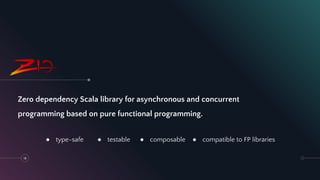
The document discusses making programs testable using the ZIO environment in Scala through functional programming concepts such as pure functions and immutability. It presents coding examples, including a greeting function that prints to the console and handles user input, while introducing a test console implementation for effect control. Additionally, it touches on integrating multiple services within a ZIO application context and provides links to further resources and tests with ZIO.


