Cargo tank
Atmosphere
A tank is an enclosed
space which is sealed
and may not have any
ventilation.
As a result, there is a
accumulation of gases
which can be
dangerous and
harmful to humans.
What do we
FEAR MOST
when we speak
about Cargo
Tank
atmospheres ?
There are Different
types of Tankers.
Such as:
ü Crude Oil Tankers
ü Product Tankers
ü Chemical Tankers
ü LNG
ü LPG
ü Bitumen Tankers
ü Fruit Juice Tankers (stainless steel tanks)
ü Wine Tankers (stainless steel tanks)
BUT, we are speaking about our vessels :
Crude Oil & Product Tankers
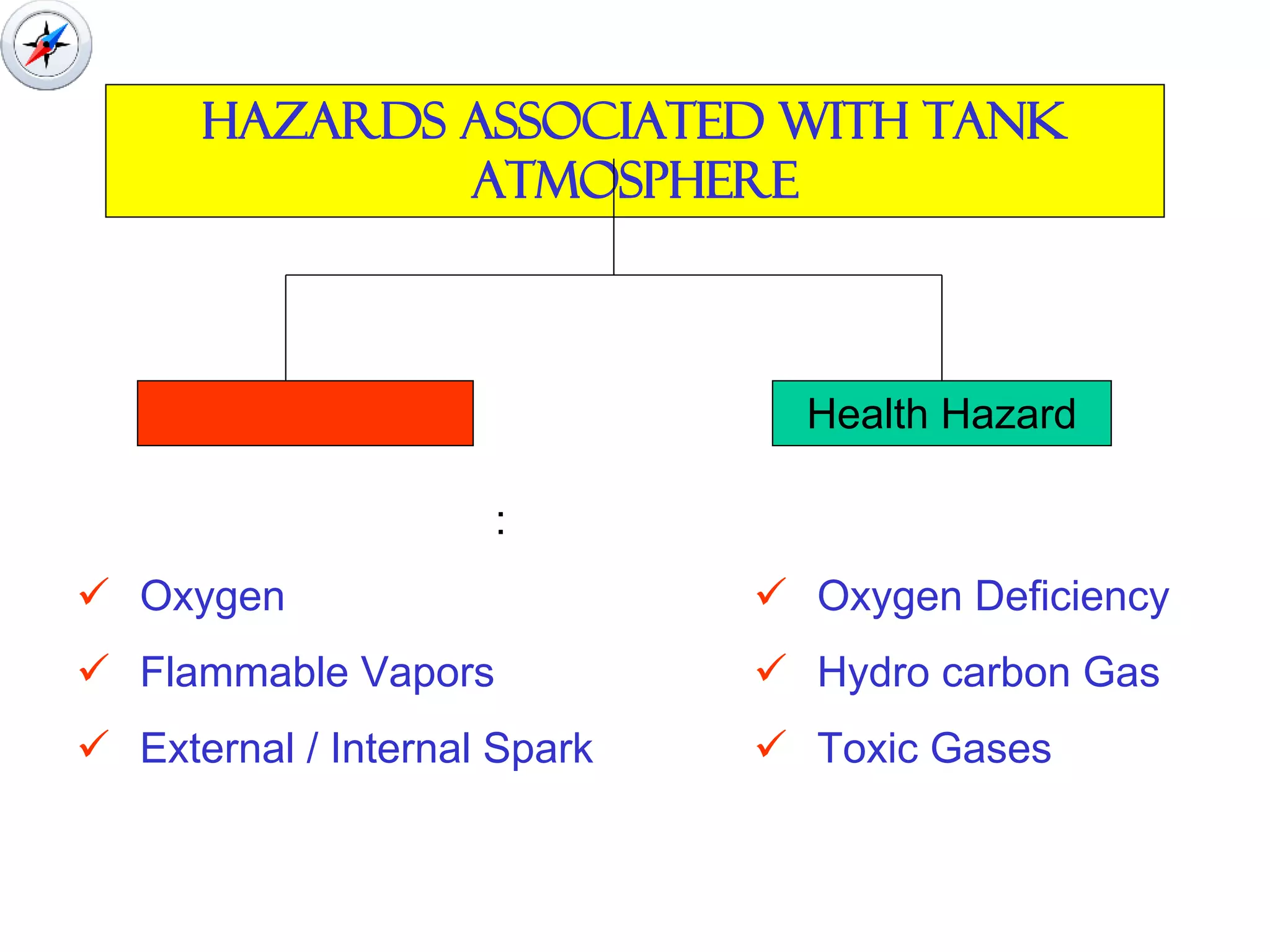
Contributing Factors:
ü Oxygen
ü Flammable Vapors
ü External / Internal Spark
Contributing Factors:
ü Oxygen Deficiency
ü Hydro carbon Gas
ü Toxic Gases
Health Hazard
Hazards associated with tank
atmosphere
Fire Hazard
Or simply said
A potential source of ignition hazard on oil tankers
Pyrophoric Reaction
What is this ? It is a rapid exothermic oxidation with
Incandescence.
How it is formed ?
• In an inerted atmosphere, the Hydrogen
Sulphide reacts with Iron Oxide (rust) and
forms Iron Sulphide.
• When a tank is exposed to air,the Iron
Sulphide is oxidized back to Iron Oxide This
oxidation is accompanied by generation of
considerable heat so that individual particles
may be incandescent.
Prevention ? All cargo operation is carried in controlled
inerted condition.
Vapor + Gas
mixture
Ignition
Hazard- Static
Electricity
Oxygen
Contents of a Cargo Oil Tank atmosphere
in a Petroleum tanker
Fire hazards can be best explained by
a Fire Tetrahedron
It describes the four different factors
required for ignition of a fire.
The Inert Gas is introduced into a
tank to remove the Oxygen side of
the tetrahedron by reducing the
Oxygen content below required
percentage for combustion.
Essentially all four elements must be
present at the same time for a fire to
occur. Removal of any one of these
essential elements will result in the fire
being extinguished :
1. Air (Oxygen)
2. Heat ( Internal / External Spark)
3. Fuel (Cargo vapours)
4. Chain Reaction
Introduction of IG in the tank
Safe atmosphere in tank
NO FIRE
In absence of any
one side of the
original Fire
Tetrahedron , the
risk of a fire is non-
existent.
No Fire can take Place even in the presence of Heat or Fuel
because there is not enough oxygen to support it
Chemical
Chain
Reaction
Inert Gas
Critical dilution lineG
21
Oxygen-Percentage by volume
HydrocarbonsGas-Percentagebyvolume
Flammable
Mixture
5 10 15 20
5
10
15
Flammable
Mixture
The Flammability diagram
Inerted Atmosphere-
Oxygen less than 8%
F Path taken by directly Gas Freeing
PathtakenbyPurging
Consider a point representing
typical condition of tank
atmosphere in a inerted
condition
Purged Atmosphere-
Hydrocarbons less than
2% by voulme & oxygen-
less than 8%
Unsafe
atmosphere
Safe Atmosphere
passing well
below the critical
dilution line
Path taken by gas freeing after purging
What happens when
cargo oil tank
atmosphere is diluted
with air or when air is
introduced for gas
free condition.
What is the percentage of
oxygen required to sustain
combustion ?
More than 11 %
What percentage of
oxygen are we required to
maintain in the cargo
tanks ?
By law less than 8 %.
(Some ports require a
vessel to maintain less
than 5 %.)
A Cargo tank is considered “Inerted” when the oxygen content in
the tank is less than 8 % by volume
Controlling Fire Hazard in Cargo
Oil Tank
Health Hazards
Hazards inside the tank
ü Oxygen deficiency. (Minimum 20.8% required for man entry)
ü Contact with Body parts
ü Inhalation and Ingestion
ü Risk of slip / trip/ fall due to cargo cling age in the access areas of
tanks.
Hidden risk :The risk of exposure to Health is not only inside a tank but that
same atmosphere may also be present on the open deck areas.
Hazards outside the tank
ü Release of tank atmosphere content during key cargo operations.
ü Accidental release by negligence or mechanical faults.
ü Accumulation due to still air conditions.
Beware!!
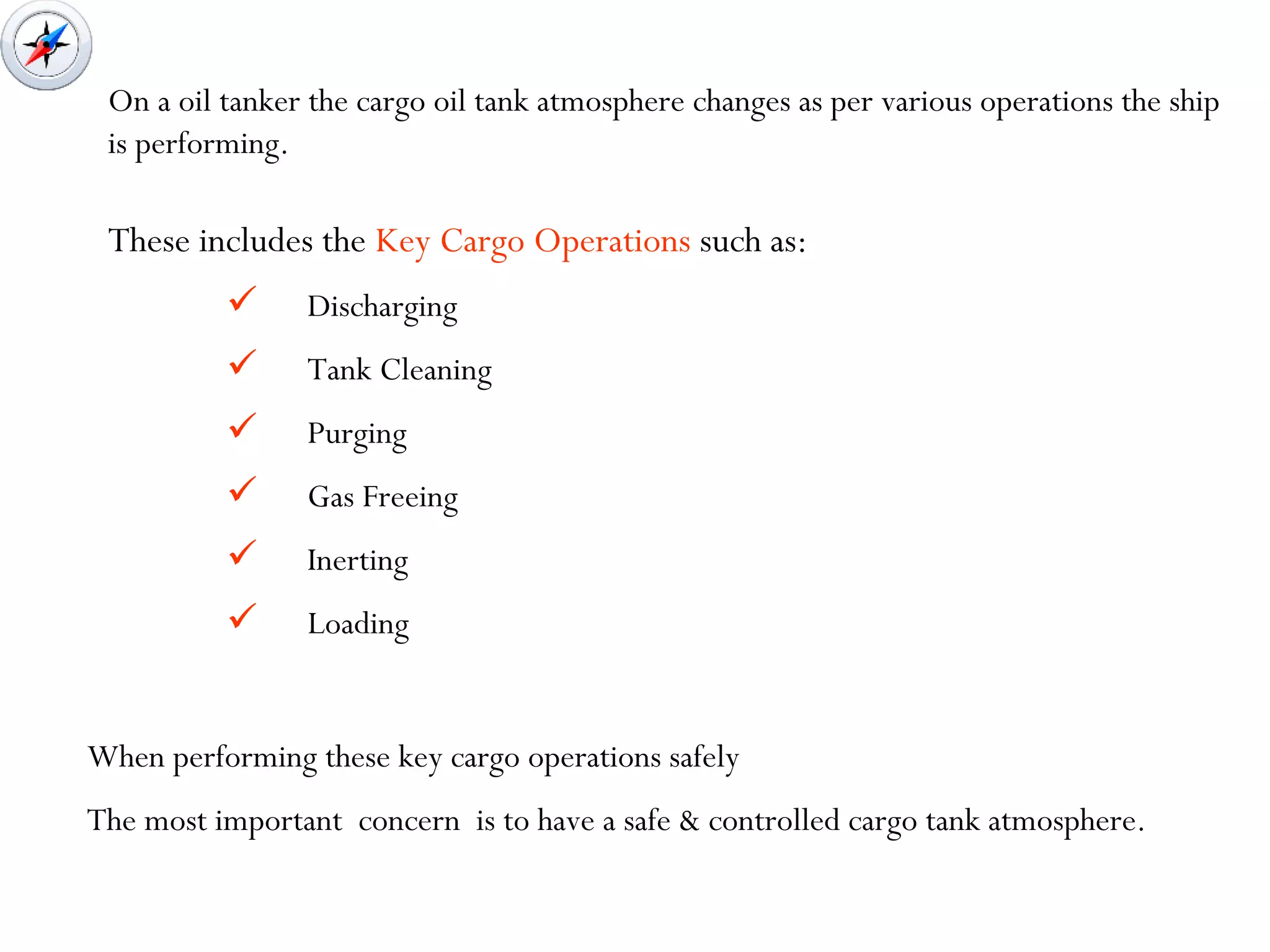
These includes the Key Cargo Operations such as:
ü Discharging
ü Tank Cleaning
ü Purging
ü Gas Freeing
ü Inerting
ü Loading
When performing these key cargo operations safely
The most important concern is to have a safe & controlled cargo tank atmosphere.
On a oil tanker the cargo oil tank atmosphere changes as per various operations the ship
is performing.
General Policy of Cargo tank atmosphere control
Tankers fitted with an inert gas system should maintain their cargo tanks in a non-
flammable condition at all times.
It follows that:
üTanks are kept inerted when they contain cargo /cargo residue
üThe atmosphere within the tank should make the transition from inert condition to gas
-free condition without passing through flammable condition.
üIn practice before any tank is gas freed, it would be purged with inert gas until the
hydrocarbon content of the tank atmosphere is below the critical dilution line.
üWhen a ship is in a gas-free condition before arrival at a loading port, tanks should be
re-inerted prior to loading.
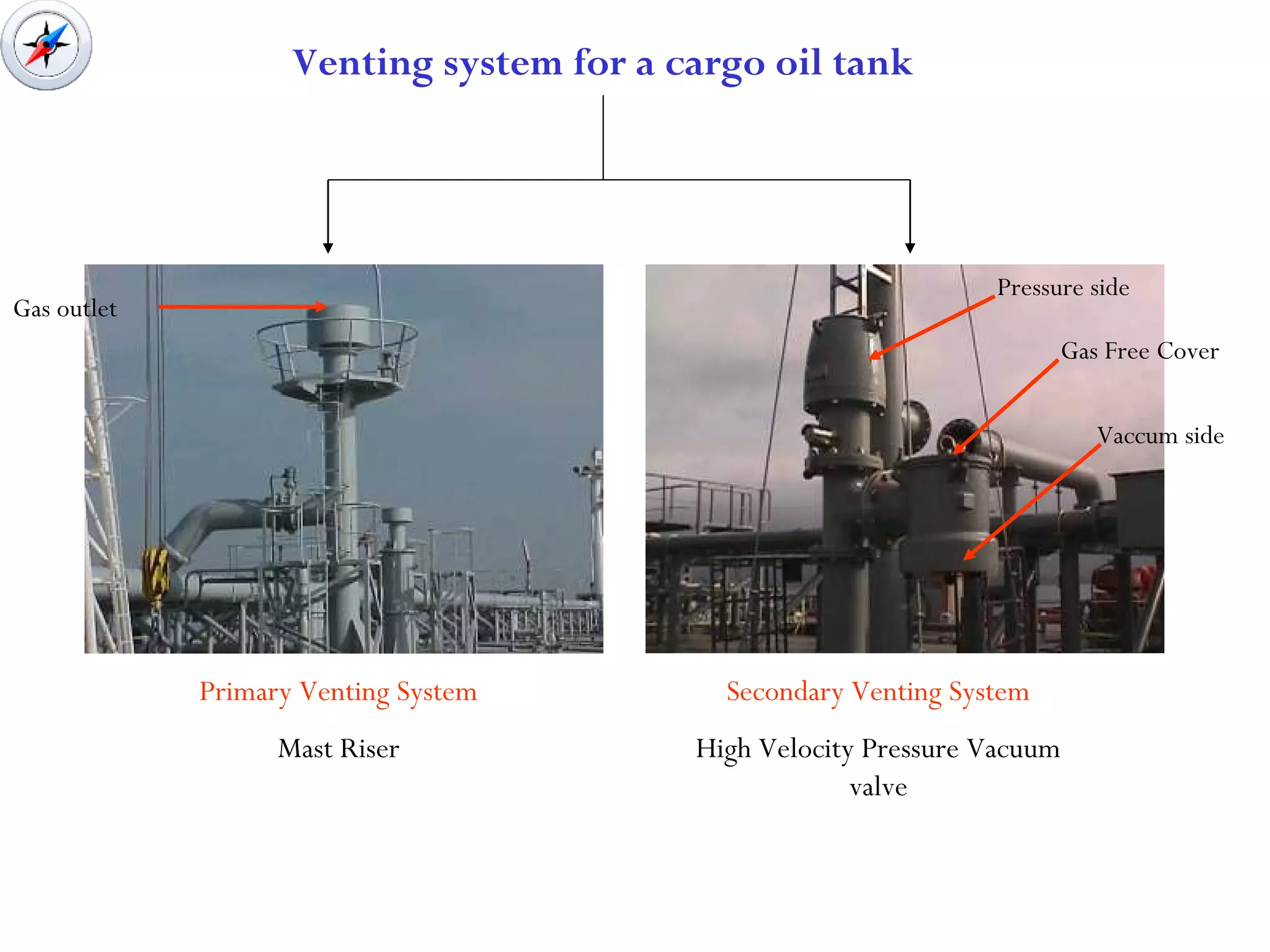
Venting system for a cargo oil tank
Secondary Venting System
High Velocity Pressure Vacuum
valve
Primary Venting System
Mast Riser
Pressure side
Vaccum side
Gas Free Cover
Gas outlet
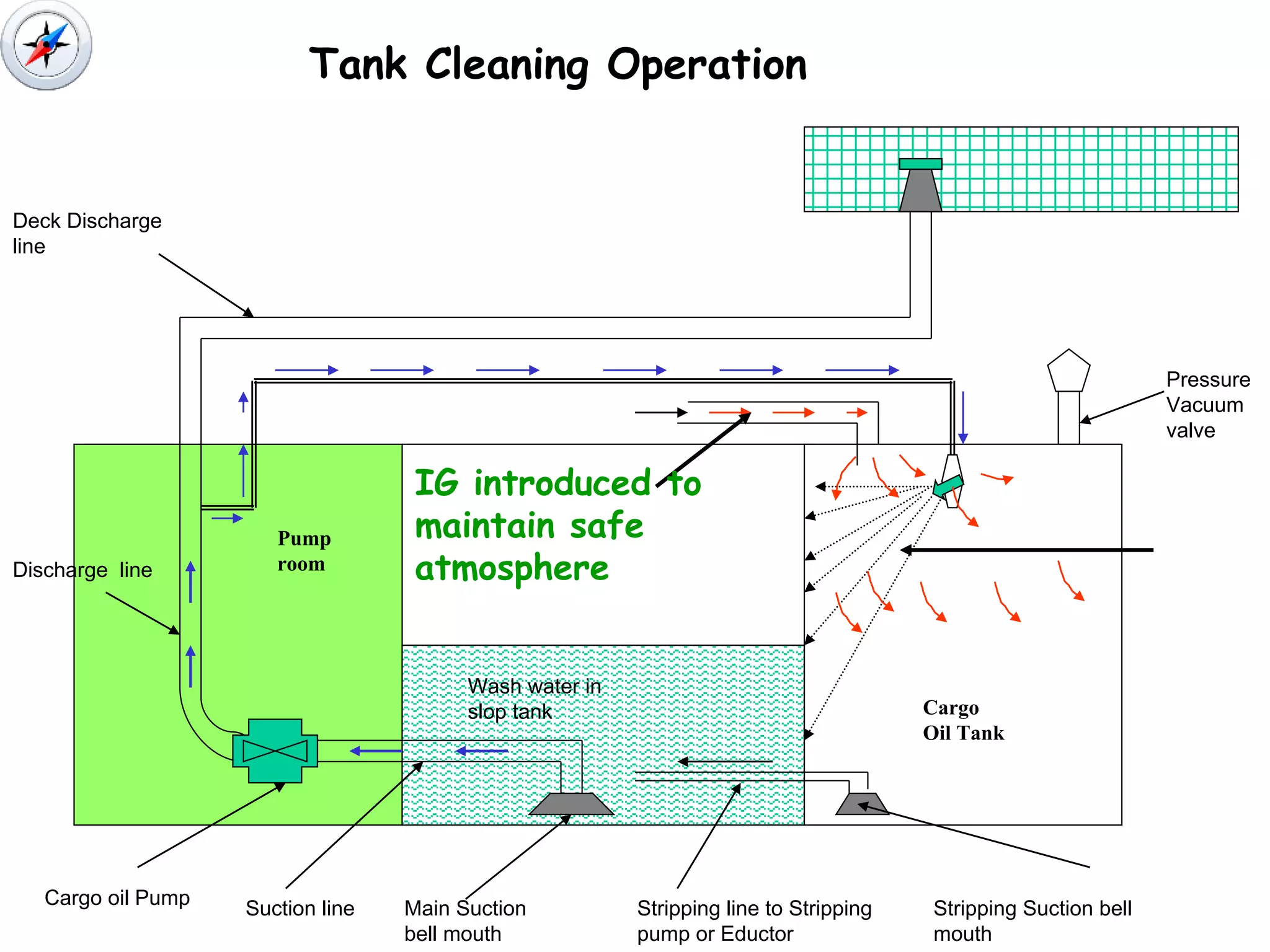
Cargo oil Pump
Suction bell mouth
Suction line
Cargo
in the
tank
Ullage
space
Discharge line
Deck Discharge
line
Pump room
Cargo Oil Tank
Manifold
Shore Hose / Arm
Pressure
Vacuum
valve
From Inert Gas System
Drop of level & increase
of ullage space.
This increase in ullage space is filled with
Inert gas, so that there is no vacuum and no
ingress of air in tank
Discharging Operation
Tank atmosphere is
controlled with use of
IG
Empty cargo tank
Cargo oil Pump
Main Suction
bell mouth
Suction line
Discharge line
Deck Discharge
line
Pump
room
Cargo
Oil Tank
Manifold
Pressure
Vacuum
valve
From Inert Gas System
Tank Cleaning Operation
Stripping Suction bell
mouth
Stripping line to Stripping
pump or Eductor
Generation
of static
electricity
due water
droplets
Wash water in
slop tank
Unsafe
Atmosphere
IG introduced to
maintain safe
atmosphere
After tank cleaning there are 3 operations which involve replacement of gas
in cargo tanks.
And there are 2 principal means of Gas Replacement for above operations, these are :
üDilution , which is a mixing process
üDisplacement, which is layering process
Namely:
üPurging (For reducing the hydrocarbon /H2S content )
üGas-freeing (For man-entry).
üInerting (For preparation before arrival load Port)
Dilution method
Dilution theory assumes Incoming inert
gas / air, mixes with the original gas
mixture in tank to form a homogenous
mixture throughout the tank,
In result concentration of original gas
decreases gradually.
For complete replacement the entry velocity of incoming
gas should be high enough for the jet to reach the bottom of
tank.
Important!!!
Displacement method
For ideal replacement a stable horizontal
interface should be formed between the
lighter gas entering at the top of tank and
heavier gas being displayed from the
bottom of tank through some suitable
pipping arrangment.
In result the tank atmosphere is changed
gradually.
For complete replacement a relativley low entry velocity of
gas is required. In practice more than one volume change
is necessary
Important!!!
Inert gas or fresh
air
Purge Pipe
kept open for
venting.
Completion of gas
replacement
Several arrangements are put in use on board tanker, when using
dilution or displacement method.
One feature which is common to all is that the inlet and outlet points
should be so located that efficient gas replacement can take place
through out the tank.
There are three principal arrangement:
Inlet Point Outlet point Principle
1. Top Top Dilution
2. Bottom Top Dilution
3. Top Bottom Displacement
or dilution
Displacement /Dilution method-using
bottom cargo lines from one tank to
other tank
Inert gas or
fresh air from
top PV valve gas free
cover kept open
for venting from
top
PV Valve on auto
mode.
Completion of gas
replacement by
displacement
Cargo Bottom line
Completion of gas
replacement by
dilution
Dilution method-using bottom cargo lines
from IG line to tank
Inert gas or
fresh air
Gas free cover on PV
Valve for venting from
top
Gas Freeing blowers
Used for
ü Gas freeing purposes
ü Continuous ventilation
during the duration of
man entry in cargo oil
tank
Butterworth holes for cargo oil tank
Main deck
Ventilation ducts
Loading Operation
Bell mouth
Suction line
Cargo
in the
tank
Ullage
space
Drop line
Deck Cargo line
Cargo
Oil Tank
Manifold
Shore Hose / Arm
Pressure
Vacuum
valve
From pump room
For a safe and effective control of tank atmosphere, it is important to know and
understand the tank content at all stages of operations.
There a various equipments available on board for the detecting the contents in a
cargo oil tank.
Some of these are:
ü Portable Oxygen Meter (To check oxygen content)
ü Explosimeter or Combustible Gas Indicator (To measure hydrocarbon
content in a gas free condition)
ü Tankscope (To measure hydrocarbon content in a inerted condition)
ü Multi-Gas meters (Basically used to check oxygen, hdrocarbon and any
one toxic gas for a gas free tank).
ü Gas detector tubes (To measure other toxic gases such as; ammonia,
benzene, carbon monoxifr,mercaptans.)
Portable Gas Detectors on board
Oxygen meter Hydro carbon detector
Portable Gas Detectors on board
Multi gas
Monitor
Gas Detector Tubes
Thank you

Tank Atmosphere - Tanker Vessels

  • 1.
  • 2.
    A tank isan enclosed space which is sealed and may not have any ventilation. As a result, there is a accumulation of gases which can be dangerous and harmful to humans.
  • 3.
    What do we FEARMOST when we speak about Cargo Tank atmospheres ?
  • 4.
    There are Different typesof Tankers. Such as: ü Crude Oil Tankers ü Product Tankers ü Chemical Tankers ü LNG ü LPG ü Bitumen Tankers ü Fruit Juice Tankers (stainless steel tanks) ü Wine Tankers (stainless steel tanks) BUT, we are speaking about our vessels : Crude Oil & Product Tankers
  • 5.
    Contributing Factors: ü Oxygen üFlammable Vapors ü External / Internal Spark Contributing Factors: ü Oxygen Deficiency ü Hydro carbon Gas ü Toxic Gases Health Hazard Hazards associated with tank atmosphere Fire Hazard
  • 6.
    Or simply said Apotential source of ignition hazard on oil tankers Pyrophoric Reaction What is this ? It is a rapid exothermic oxidation with Incandescence. How it is formed ? • In an inerted atmosphere, the Hydrogen Sulphide reacts with Iron Oxide (rust) and forms Iron Sulphide. • When a tank is exposed to air,the Iron Sulphide is oxidized back to Iron Oxide This oxidation is accompanied by generation of considerable heat so that individual particles may be incandescent. Prevention ? All cargo operation is carried in controlled inerted condition.
  • 7.
    Vapor + Gas mixture Ignition Hazard-Static Electricity Oxygen Contents of a Cargo Oil Tank atmosphere in a Petroleum tanker
  • 8.
    Fire hazards canbe best explained by a Fire Tetrahedron It describes the four different factors required for ignition of a fire. The Inert Gas is introduced into a tank to remove the Oxygen side of the tetrahedron by reducing the Oxygen content below required percentage for combustion. Essentially all four elements must be present at the same time for a fire to occur. Removal of any one of these essential elements will result in the fire being extinguished : 1. Air (Oxygen) 2. Heat ( Internal / External Spark) 3. Fuel (Cargo vapours) 4. Chain Reaction
  • 9.
    Introduction of IGin the tank Safe atmosphere in tank NO FIRE In absence of any one side of the original Fire Tetrahedron , the risk of a fire is non- existent. No Fire can take Place even in the presence of Heat or Fuel because there is not enough oxygen to support it Chemical Chain Reaction Inert Gas
  • 10.
    Critical dilution lineG 21 Oxygen-Percentageby volume HydrocarbonsGas-Percentagebyvolume Flammable Mixture 5 10 15 20 5 10 15 Flammable Mixture The Flammability diagram Inerted Atmosphere- Oxygen less than 8% F Path taken by directly Gas Freeing PathtakenbyPurging Consider a point representing typical condition of tank atmosphere in a inerted condition Purged Atmosphere- Hydrocarbons less than 2% by voulme & oxygen- less than 8% Unsafe atmosphere Safe Atmosphere passing well below the critical dilution line Path taken by gas freeing after purging What happens when cargo oil tank atmosphere is diluted with air or when air is introduced for gas free condition.
  • 11.
    What is thepercentage of oxygen required to sustain combustion ? More than 11 % What percentage of oxygen are we required to maintain in the cargo tanks ? By law less than 8 %. (Some ports require a vessel to maintain less than 5 %.) A Cargo tank is considered “Inerted” when the oxygen content in the tank is less than 8 % by volume Controlling Fire Hazard in Cargo Oil Tank
  • 12.
    Health Hazards Hazards insidethe tank ü Oxygen deficiency. (Minimum 20.8% required for man entry) ü Contact with Body parts ü Inhalation and Ingestion ü Risk of slip / trip/ fall due to cargo cling age in the access areas of tanks. Hidden risk :The risk of exposure to Health is not only inside a tank but that same atmosphere may also be present on the open deck areas. Hazards outside the tank ü Release of tank atmosphere content during key cargo operations. ü Accidental release by negligence or mechanical faults. ü Accumulation due to still air conditions. Beware!!
  • 13.
    These includes theKey Cargo Operations such as: ü Discharging ü Tank Cleaning ü Purging ü Gas Freeing ü Inerting ü Loading When performing these key cargo operations safely The most important concern is to have a safe & controlled cargo tank atmosphere. On a oil tanker the cargo oil tank atmosphere changes as per various operations the ship is performing.
  • 14.
    General Policy ofCargo tank atmosphere control Tankers fitted with an inert gas system should maintain their cargo tanks in a non- flammable condition at all times. It follows that: üTanks are kept inerted when they contain cargo /cargo residue üThe atmosphere within the tank should make the transition from inert condition to gas -free condition without passing through flammable condition. üIn practice before any tank is gas freed, it would be purged with inert gas until the hydrocarbon content of the tank atmosphere is below the critical dilution line. üWhen a ship is in a gas-free condition before arrival at a loading port, tanks should be re-inerted prior to loading.
  • 15.
    Venting system fora cargo oil tank Secondary Venting System High Velocity Pressure Vacuum valve Primary Venting System Mast Riser Pressure side Vaccum side Gas Free Cover Gas outlet
  • 16.
    Cargo oil Pump Suctionbell mouth Suction line Cargo in the tank Ullage space Discharge line Deck Discharge line Pump room Cargo Oil Tank Manifold Shore Hose / Arm Pressure Vacuum valve From Inert Gas System Drop of level & increase of ullage space. This increase in ullage space is filled with Inert gas, so that there is no vacuum and no ingress of air in tank Discharging Operation Tank atmosphere is controlled with use of IG Empty cargo tank
  • 17.
    Cargo oil Pump MainSuction bell mouth Suction line Discharge line Deck Discharge line Pump room Cargo Oil Tank Manifold Pressure Vacuum valve From Inert Gas System Tank Cleaning Operation Stripping Suction bell mouth Stripping line to Stripping pump or Eductor Generation of static electricity due water droplets Wash water in slop tank Unsafe Atmosphere IG introduced to maintain safe atmosphere
  • 18.
    After tank cleaningthere are 3 operations which involve replacement of gas in cargo tanks. And there are 2 principal means of Gas Replacement for above operations, these are : üDilution , which is a mixing process üDisplacement, which is layering process Namely: üPurging (For reducing the hydrocarbon /H2S content ) üGas-freeing (For man-entry). üInerting (For preparation before arrival load Port)
  • 19.
    Dilution method Dilution theoryassumes Incoming inert gas / air, mixes with the original gas mixture in tank to form a homogenous mixture throughout the tank, In result concentration of original gas decreases gradually. For complete replacement the entry velocity of incoming gas should be high enough for the jet to reach the bottom of tank. Important!!!
  • 20.
    Displacement method For idealreplacement a stable horizontal interface should be formed between the lighter gas entering at the top of tank and heavier gas being displayed from the bottom of tank through some suitable pipping arrangment. In result the tank atmosphere is changed gradually. For complete replacement a relativley low entry velocity of gas is required. In practice more than one volume change is necessary Important!!! Inert gas or fresh air Purge Pipe kept open for venting. Completion of gas replacement
  • 21.
    Several arrangements areput in use on board tanker, when using dilution or displacement method. One feature which is common to all is that the inlet and outlet points should be so located that efficient gas replacement can take place through out the tank. There are three principal arrangement: Inlet Point Outlet point Principle 1. Top Top Dilution 2. Bottom Top Dilution 3. Top Bottom Displacement or dilution
  • 22.
    Displacement /Dilution method-using bottomcargo lines from one tank to other tank Inert gas or fresh air from top PV valve gas free cover kept open for venting from top PV Valve on auto mode. Completion of gas replacement by displacement Cargo Bottom line Completion of gas replacement by dilution
  • 23.
    Dilution method-using bottomcargo lines from IG line to tank Inert gas or fresh air Gas free cover on PV Valve for venting from top
  • 24.
    Gas Freeing blowers Usedfor ü Gas freeing purposes ü Continuous ventilation during the duration of man entry in cargo oil tank Butterworth holes for cargo oil tank Main deck Ventilation ducts
  • 25.
    Loading Operation Bell mouth Suctionline Cargo in the tank Ullage space Drop line Deck Cargo line Cargo Oil Tank Manifold Shore Hose / Arm Pressure Vacuum valve From pump room
  • 26.
    For a safeand effective control of tank atmosphere, it is important to know and understand the tank content at all stages of operations. There a various equipments available on board for the detecting the contents in a cargo oil tank. Some of these are: ü Portable Oxygen Meter (To check oxygen content) ü Explosimeter or Combustible Gas Indicator (To measure hydrocarbon content in a gas free condition) ü Tankscope (To measure hydrocarbon content in a inerted condition) ü Multi-Gas meters (Basically used to check oxygen, hdrocarbon and any one toxic gas for a gas free tank). ü Gas detector tubes (To measure other toxic gases such as; ammonia, benzene, carbon monoxifr,mercaptans.) Portable Gas Detectors on board
  • 27.
    Oxygen meter Hydrocarbon detector Portable Gas Detectors on board Multi gas Monitor Gas Detector Tubes
  • 28.