Re-Thinking Rule-Making in the Digital
Internet Governance beyond Institutions
1
Christian Katzenbach
!
Guest Lecture
University of Tampere
March 28, 2014
!2
Internet Policy/Governance on the Agenda!
!3
!4
What is Internet Governance, anyways?
!5
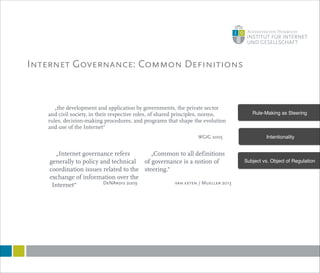
Internet Governance: Common Definitions
„the development and application by governments, the private sector
and civil society, in their respective roles, of shared principles, norms,
rules, decision-making procedures, and programs that shape the evolution
and use of the Internet“
WGIG 2005
„Common to all definitions
of governance is a notion of
steering.“
„Internet governance refers
generally to policy and technical
coordination issues related to the
exchange of information over the
Internet“ DeNArdis 2009 van eeten / Mueller 2013
Rule-Making as Steering
Intentionality
Subject vs. Object of Regulation
Internet Governance: Common Institutions
Internet Governance as Transnational Governance
!7
!
!
!
Pluralization of Actors
!
!
Puppis 2010
Internet Governance as Transnational Governance
!7
transnational
self-/co-regulation
transnational
self-/co-regulation
!
!
!
Pluralization of Actors
!
!
Puppis 2010
Internet Governance Definitions
!8
!
Process-Dimension
Internet Governance as Steering
!
Structural Dimension
Internet Governance as Policy Organizations
Internet Policy/Governance on the Agenda!
!9
!10
What is Internet Governance, anyways?
!11
!11
What is Governance, anyways?
!12
Governance: Common Definitions
„governance refers to all
patterns of rule and explores the
construction of social order and
social coordination“
„sustaining co-ordination and
coherence among a wide variety of actors
with different purposes and objectives such
as political actors and institutions,
corporate interests, civil society, and
transnational organizations.’’Bevir 2009
„the regulatory structure as a whole,
i.e., the entirety of forms of rules that aim
to organize media systems
Rechtswissenschaft„the sum total of mechanisms,
both formal and informal, national and
supranational, centralized and dispersed,
that aim to organize media systems“
Pierre 2000
Freedman 2008 Puppis 2010
!13
Coordination and
Interdependencies
Sociology
Binding Rules and
Collective Goods
Political Science
Law and
Regulatory Structures
Legal Scholars
Transaction Costs
Economics
Governance: Disciplinary Interests
Governance (Structure): Pluralization of Actors
!14
!
!
!
Pluralization of Actors
!
• Multiple Fora und Policy Organizations
• Heterogenous Actors
• Heterogenous Intentions
!
Puppis 2010
Governance (Structure): Pluralization of Actors
!14
transnational
self-/co-regulation
transnational
self-/co-regulation
!
!
!
Pluralization of Actors
!
• Multiple Fora und Policy Organizations
• Heterogenous Actors
• Heterogenous Intentions
!
Puppis 2010
Governance (Process): De-Centering Coordination
!15
!
!
!
Pluralization of Mechanisms
!
!
!
Discourse
Values
Competition
Legislation
Norms
Expertise
Knowledge
Institutions
Coordination
Legitimation
Markets
Governance: Summary
!16
!
!
Governance Research undermines notion of…
!
• Rule-Making as Steering and of…
• Rule-Making as happening exclusively in Policy Organizations
!
— De-centered and Heterogenous Governance Arrangements
!17
From Governance as Regulation
to Governance as (reflexive) Coordination
!17
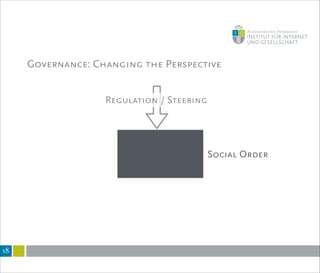
Governance: Changing the Perspective
!18
Social Order
Regulation / Steering
Governance: Changing the Perspective
!19
Social Order
Regulation / Steering
Coordination
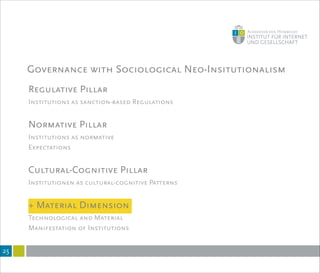
Governance with Sociological Neo-Insitutionalism
!20
Regulative Pillar
Institutions as sanction-based Regulations
!
Normative Pillar
Institutions as normative
Expectations
!
Cultural-Cognitive Pillar
Institutionen as cultural-cognitive Patterns
!
+ Material Dimension
Technological and Material
Manifestation of Institutions
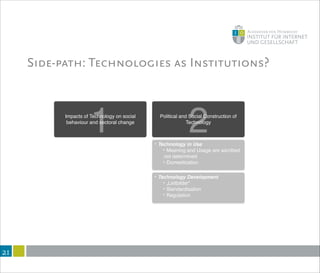
Side-path: Technologies as Institutions?
!21
Side-path: Technologies as Institutions?
!21
Impacts of Technology on social
behaviour and sectoral change
1
Side-path: Technologies as Institutions?
!21
Impacts of Technology on social
behaviour and sectoral change
1 Political and Social Construction of
Technology
2
Side-path: Technologies as Institutions?
!21
Impacts of Technology on social
behaviour and sectoral change
1 Political and Social Construction of
Technology
2‣ Technology in Use!
‣ Meaning and Usage are ascribed,
not determined!
‣ Domestication
Side-path: Technologies as Institutions?
!21
Impacts of Technology on social
behaviour and sectoral change
1 Political and Social Construction of
Technology
2‣ Technology in Use!
‣ Meaning and Usage are ascribed,
not determined!
‣ Domestication
‣ Technology Development!
‣ „Leitbilder“!
‣ Standardisation!
‣ Regulation
Side-path: Technologies as Institutions?
!21
Impacts of Technology on social
behaviour and sectoral change
1 Political and Social Construction of
Technology
2‣ Technology in Use!
‣ Meaning and Usage are ascribed,
not determined!
‣ Domestication
‣ Technology Development!
‣ „Leitbilder“!
‣ Standardisation!
‣ Regulation
‣ Technology as functional
equivalent!
‣ Durkheim‘s social facts!
‣ Hardened social action and
structured
Side-path: Technologies as Institutions?
!21
Impacts of Technology on social
behaviour and sectoral change
1 Political and Social Construction of
Technology
2‣ Technology in Use!
‣ Meaning and Usage are ascribed,
not determined!
‣ Domestication
‣ Technology Development!
‣ „Leitbilder“!
‣ Standardisation!
‣ Regulation
‣ Technology as functional
equivalent!
‣ Durkheim‘s social facts!
‣ Hardened social action and
structured
‣ Technology is Society made
durable
17.00 - 17.15 Arrival
17.15 - 17.30 Welcome
17.30 - 18.00 Welcome
18.00 - 18.15 Welcome
18.15 - 18.30 Welcome
18.30 - 18.45 Welcome
18.45 - 19.45 Welcome
19.45 - 20.00 Welcome
17.00 - 17.15 Arrival
17.15 - 17.30 Welcome
17.30 - 18.00 Welcome
18.00 - 18.15 Welcome
18.15 - 18.30 Welcome
18.30 - 18.45 Welcome
18.45 - 19.45 Welcome
19.45 - 20.00 Welcome
Picture: clemensfranz (CC By-SA 3.0)
Side-path: Technologies as Institutions?
!24
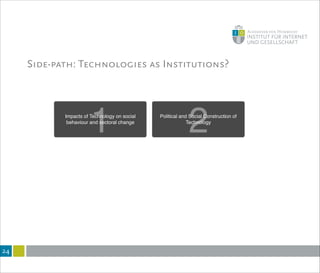
Side-path: Technologies as Institutions?
!24
Impacts of Technology on social
behaviour and sectoral change
1
Side-path: Technologies as Institutions?
!24
Impacts of Technology on social
behaviour and sectoral change
1 Political and Social Construction of
Technology
2
Side-path: Technologies as Institutions?
!24
Impacts of Technology on social
behaviour and sectoral change
1 Political and Social Construction of
Technology
2‣ Technology in Use!
‣ Meaning and Usage are ascribed,
not determined!
‣ Domestication
Side-path: Technologies as Institutions?
!24
Impacts of Technology on social
behaviour and sectoral change
1 Political and Social Construction of
Technology
2‣ Technology in Use!
‣ Meaning and Usage are ascribed,
not determined!
‣ Domestication
‣ Technology Development!
‣ „Leitbilder“!
‣ Standardisation!
‣ Regulation
Side-path: Technologies as Institutions?
!24
Impacts of Technology on social
behaviour and sectoral change
1 Political and Social Construction of
Technology
2‣ Technology in Use!
‣ Meaning and Usage are ascribed,
not determined!
‣ Domestication
‣ Technology Development!
‣ „Leitbilder“!
‣ Standardisation!
‣ Regulation
‣ Technology as functional
equivalent!
‣ Durkheim‘s social facts!
‣ Hardened social action and
structured
Side-path: Technologies as Institutions?
!24
Impacts of Technology on social
behaviour and sectoral change
1 Political and Social Construction of
Technology
2‣ Technology in Use!
‣ Meaning and Usage are ascribed,
not determined!
‣ Domestication
‣ Technology Development!
‣ „Leitbilder“!
‣ Standardisation!
‣ Regulation
‣ Technology as functional
equivalent!
‣ Durkheim‘s social facts!
‣ Hardened social action and
structured
‣ Technology is Society made
durable
Side-path: Technologies as Institutions?
!24
Impacts of Technology on social
behaviour and sectoral change
1 Political and Social Construction of
Technology
2‣ Technology in Use!
‣ Meaning and Usage are ascribed,
not determined!
‣ Domestication
‣ Technology Development!
‣ „Leitbilder“!
‣ Standardisation!
‣ Regulation
‣ Technology as functional
equivalent!
‣ Durkheim‘s social facts!
‣ Hardened social action and
structured
‣ Technology is Society made
durable
Governance with Sociological Neo-Insitutionalism
!25
Regulative Pillar
Institutions as sanction-based Regulations
!
Normative Pillar
Institutions as normative
Expectations
!
Cultural-Cognitive Pillar
Institutionen as cultural-cognitive Patterns
!
+ Material Dimension
Technological and Material
Manifestation of Institutions
Regulation (+ incl. Private ordering
!
!
(informal) Norms and Practises
!
Discourses and Framings
!
!
Governance and Technology
4 Research Perspectives
!26
Regulative Pillar
Institutions as sanction-based Regulations
!
Normative Pillar
Institutions as normative
Expectations
!
Cultural-Cognitive Pillar
Institutionen as cultural-cognitive Patterns
!
+ Material Dimension
Technological and Material
Manifestation of Institutions
!27
Illustrating the 4 Research Perspectives
!
Coordinating the Circulation of Cultural Goods
(the regulatory Field formerly known as Coypright)
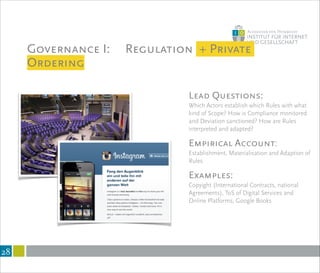
Governance I: Regulation + Private
Ordering
!28
Lead Questions:
Which Actors establish which Rules with what
kind of Scope? How is Compliance monitored
and Deviation sanctioned? How are Rules
interpreted and adapted?
!
Empirical Account:
Establishment, Materialisation and Adaption of
Rules
!
Examples:
Copyight (International Contracts, national
Agreements), ToS of Digital Services and
Online Platforms, Google Books
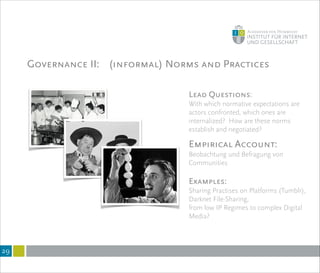
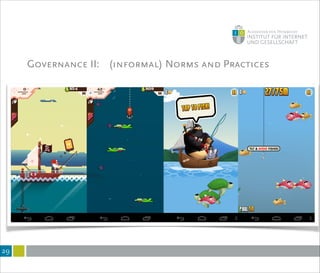
Governance II: (informal) Norms and Practices
!29
Lead Questions:
With which normative expectations are
actors confronted, which ones are
internalized? How are these norms
establish and negotiated?
!
Empirical Account:
Beobachtung und Befragung von
Communities
!
Examples:
Sharing Practises on Platforms (Tumblr),
Darknet File-Sharing,
from low IP Regimes to complex Digital
Media?
Governance II: (informal) Norms and Practices
!29
Lead Questions:
With which normative expectations are
actors confronted, which ones are
internalized? How are these norms
establish and negotiated?
!
Empirical Account:
Beobachtung und Befragung von
Communities
!
Examples:
Sharing Practises on Platforms (Tumblr),
Darknet File-Sharing,
from low IP Regimes to complex Digital
Media?
Governance II: (informal) Norms and Practices
!29
Lead Questions:
With which normative expectations are
actors confronted, which ones are
internalized? How are these norms
establish and negotiated?
!
Empirical Account:
Beobachtung und Befragung von
Communities
!
Examples:
Sharing Practises on Platforms (Tumblr),
Darknet File-Sharing,
from low IP Regimes to complex Digital
Media?
Governance II: (informal) Norms and Practices
!29
Lead Questions:
With which normative expectations are
actors confronted, which ones are
internalized? How are these norms
establish and negotiated?
!
Empirical Account:
Beobachtung und Befragung von
Communities
!
Examples:
Sharing Practises on Platforms (Tumblr),
Darknet File-Sharing,
from low IP Regimes to complex Digital
Media?
Governance III: Discourses and Framings
!30
Lead Questions:
What is „taken for granted“? Construction
and Deconstruction of shared Frames and
Perspectives?
!
Empirical Accounts:
Discourse Analyses, Politisation, Issue
Formation, Frames
!
Examples:
Conflicts on „Intellectual Property“ Haunss); the
construction of „music piracy“(Denegri-Knott);
Imitation und Innovation in der Games-Branche
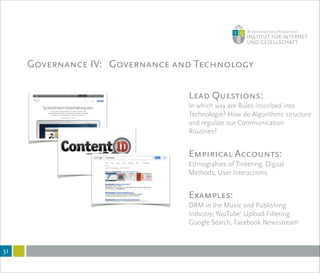
Governance IV: Governance and Technology
!31
Lead Questions:
In which way are Rules inscribed into
Technologie? How do Algorithms structure
and regulate our Communication
Routines?
!
Empirical Accounts:
Ethnograhies of Tinkering, Digital
Methods, User Interactions
!
Examples:
DRM in the Music and Publishing
Industry; YouTube’ Upload-Filtering
Google Search, Facebook Newsstream
Conclusion: Internet Governance as Coordination
!32
!
!
Rule-Making is not only about Steering
!
Rule-Making that does not only happen in Policy Organization
!
Complexity and Disarray of regulatory sources, sites and process
!
From Governance as Regulation to Governance as Coordination
!
» Internet Governance and Everyday Life
!33
!
!
Pictures
Bundestag: Times, CC-BY-SA-3.0-2.5-2.0-1.0 (http://creativecommons.org/licenses/by-sa/3.0)], via Wikimedia
Commons. URL: http://commons.wikimedia.org/wiki/File:Deutscher_Bundestag_Plenarsaal_Seitenansicht.jpg
DSDS, American Idol, Indian Idol: Pressematerial der Sender.
Instagram, iTunes: Eigene Screenshots der Websites.
Küche: Cornelius Jacobsen (Riksarkivet, National Archives of Norway. Archivnr: Pa1528_ua2_012. URL: http://
www.flickr.com/photos/national_archives_of_norway/6475926375/)
Laurel  Hardy: Dougal McGuire CC-BY-SA 2.0. URL: http://www.flickr.com/photos/tom-margie/1535543995/)
Christian Katzenbach
!
Alexander von Humboldt Institute for Internet
and Society
Berlin, Germany
katzenbach@hiig.de
Visit our Internet Policy Review under
http://policyreview.info !
for short-form papers on !
Internet Governance

Internet Governance beyond Institutions? Rethinking Rule-Making in the Digital

  • 1.
    Re-Thinking Rule-Making inthe Digital Internet Governance beyond Institutions 1 Christian Katzenbach ! Guest Lecture University of Tampere March 28, 2014
  • 2.
  • 3.
  • 4.
    !4 What is InternetGovernance, anyways?
  • 5.
    !5 Internet Governance: CommonDefinitions „the development and application by governments, the private sector and civil society, in their respective roles, of shared principles, norms, rules, decision-making procedures, and programs that shape the evolution and use of the Internet“ WGIG 2005 „Common to all definitions of governance is a notion of steering.“ „Internet governance refers generally to policy and technical coordination issues related to the exchange of information over the Internet“ DeNArdis 2009 van eeten / Mueller 2013 Rule-Making as Steering Intentionality Subject vs. Object of Regulation
  • 6.
  • 7.
    Internet Governance asTransnational Governance !7 ! ! ! Pluralization of Actors ! ! Puppis 2010
  • 8.
    Internet Governance asTransnational Governance !7 transnational self-/co-regulation transnational self-/co-regulation ! ! ! Pluralization of Actors ! ! Puppis 2010
  • 9.
    Internet Governance Definitions !8 ! Process-Dimension InternetGovernance as Steering ! Structural Dimension Internet Governance as Policy Organizations
  • 10.
  • 11.
    !10 What is InternetGovernance, anyways?
  • 12.
  • 13.
  • 14.
    !12 Governance: Common Definitions „governancerefers to all patterns of rule and explores the construction of social order and social coordination“ „sustaining co-ordination and coherence among a wide variety of actors with different purposes and objectives such as political actors and institutions, corporate interests, civil society, and transnational organizations.’’Bevir 2009 „the regulatory structure as a whole, i.e., the entirety of forms of rules that aim to organize media systems Rechtswissenschaft„the sum total of mechanisms, both formal and informal, national and supranational, centralized and dispersed, that aim to organize media systems“ Pierre 2000 Freedman 2008 Puppis 2010
  • 15.
    !13 Coordination and Interdependencies Sociology Binding Rulesand Collective Goods Political Science Law and Regulatory Structures Legal Scholars Transaction Costs Economics Governance: Disciplinary Interests
  • 16.
    Governance (Structure): Pluralizationof Actors !14 ! ! ! Pluralization of Actors ! • Multiple Fora und Policy Organizations • Heterogenous Actors • Heterogenous Intentions ! Puppis 2010
  • 17.
    Governance (Structure): Pluralizationof Actors !14 transnational self-/co-regulation transnational self-/co-regulation ! ! ! Pluralization of Actors ! • Multiple Fora und Policy Organizations • Heterogenous Actors • Heterogenous Intentions ! Puppis 2010
  • 18.
    Governance (Process): De-CenteringCoordination !15 ! ! ! Pluralization of Mechanisms ! ! ! Discourse Values Competition Legislation Norms Expertise Knowledge Institutions Coordination Legitimation Markets
  • 19.
    Governance: Summary !16 ! ! Governance Researchundermines notion of… ! • Rule-Making as Steering and of… • Rule-Making as happening exclusively in Policy Organizations ! — De-centered and Heterogenous Governance Arrangements
  • 20.
    !17 From Governance asRegulation to Governance as (reflexive) Coordination
  • 21.
  • 22.
    Governance: Changing thePerspective !18 Social Order Regulation / Steering
  • 23.
    Governance: Changing thePerspective !19 Social Order Regulation / Steering Coordination
  • 24.
    Governance with SociologicalNeo-Insitutionalism !20 Regulative Pillar Institutions as sanction-based Regulations ! Normative Pillar Institutions as normative Expectations ! Cultural-Cognitive Pillar Institutionen as cultural-cognitive Patterns ! + Material Dimension Technological and Material Manifestation of Institutions
  • 25.
    Side-path: Technologies asInstitutions? !21
  • 26.
    Side-path: Technologies asInstitutions? !21 Impacts of Technology on social behaviour and sectoral change 1
  • 27.
    Side-path: Technologies asInstitutions? !21 Impacts of Technology on social behaviour and sectoral change 1 Political and Social Construction of Technology 2
  • 28.
    Side-path: Technologies asInstitutions? !21 Impacts of Technology on social behaviour and sectoral change 1 Political and Social Construction of Technology 2‣ Technology in Use! ‣ Meaning and Usage are ascribed, not determined! ‣ Domestication
  • 29.
    Side-path: Technologies asInstitutions? !21 Impacts of Technology on social behaviour and sectoral change 1 Political and Social Construction of Technology 2‣ Technology in Use! ‣ Meaning and Usage are ascribed, not determined! ‣ Domestication ‣ Technology Development! ‣ „Leitbilder“! ‣ Standardisation! ‣ Regulation
  • 30.
    Side-path: Technologies asInstitutions? !21 Impacts of Technology on social behaviour and sectoral change 1 Political and Social Construction of Technology 2‣ Technology in Use! ‣ Meaning and Usage are ascribed, not determined! ‣ Domestication ‣ Technology Development! ‣ „Leitbilder“! ‣ Standardisation! ‣ Regulation ‣ Technology as functional equivalent! ‣ Durkheim‘s social facts! ‣ Hardened social action and structured
  • 31.
    Side-path: Technologies asInstitutions? !21 Impacts of Technology on social behaviour and sectoral change 1 Political and Social Construction of Technology 2‣ Technology in Use! ‣ Meaning and Usage are ascribed, not determined! ‣ Domestication ‣ Technology Development! ‣ „Leitbilder“! ‣ Standardisation! ‣ Regulation ‣ Technology as functional equivalent! ‣ Durkheim‘s social facts! ‣ Hardened social action and structured ‣ Technology is Society made durable
  • 32.
    17.00 - 17.15Arrival 17.15 - 17.30 Welcome 17.30 - 18.00 Welcome 18.00 - 18.15 Welcome 18.15 - 18.30 Welcome 18.30 - 18.45 Welcome 18.45 - 19.45 Welcome 19.45 - 20.00 Welcome
  • 33.
    17.00 - 17.15Arrival 17.15 - 17.30 Welcome 17.30 - 18.00 Welcome 18.00 - 18.15 Welcome 18.15 - 18.30 Welcome 18.30 - 18.45 Welcome 18.45 - 19.45 Welcome 19.45 - 20.00 Welcome Picture: clemensfranz (CC By-SA 3.0)
  • 34.
    Side-path: Technologies asInstitutions? !24
  • 35.
    Side-path: Technologies asInstitutions? !24 Impacts of Technology on social behaviour and sectoral change 1
  • 36.
    Side-path: Technologies asInstitutions? !24 Impacts of Technology on social behaviour and sectoral change 1 Political and Social Construction of Technology 2
  • 37.
    Side-path: Technologies asInstitutions? !24 Impacts of Technology on social behaviour and sectoral change 1 Political and Social Construction of Technology 2‣ Technology in Use! ‣ Meaning and Usage are ascribed, not determined! ‣ Domestication
  • 38.
    Side-path: Technologies asInstitutions? !24 Impacts of Technology on social behaviour and sectoral change 1 Political and Social Construction of Technology 2‣ Technology in Use! ‣ Meaning and Usage are ascribed, not determined! ‣ Domestication ‣ Technology Development! ‣ „Leitbilder“! ‣ Standardisation! ‣ Regulation
  • 39.
    Side-path: Technologies asInstitutions? !24 Impacts of Technology on social behaviour and sectoral change 1 Political and Social Construction of Technology 2‣ Technology in Use! ‣ Meaning and Usage are ascribed, not determined! ‣ Domestication ‣ Technology Development! ‣ „Leitbilder“! ‣ Standardisation! ‣ Regulation ‣ Technology as functional equivalent! ‣ Durkheim‘s social facts! ‣ Hardened social action and structured
  • 40.
    Side-path: Technologies asInstitutions? !24 Impacts of Technology on social behaviour and sectoral change 1 Political and Social Construction of Technology 2‣ Technology in Use! ‣ Meaning and Usage are ascribed, not determined! ‣ Domestication ‣ Technology Development! ‣ „Leitbilder“! ‣ Standardisation! ‣ Regulation ‣ Technology as functional equivalent! ‣ Durkheim‘s social facts! ‣ Hardened social action and structured ‣ Technology is Society made durable
  • 41.
    Side-path: Technologies asInstitutions? !24 Impacts of Technology on social behaviour and sectoral change 1 Political and Social Construction of Technology 2‣ Technology in Use! ‣ Meaning and Usage are ascribed, not determined! ‣ Domestication ‣ Technology Development! ‣ „Leitbilder“! ‣ Standardisation! ‣ Regulation ‣ Technology as functional equivalent! ‣ Durkheim‘s social facts! ‣ Hardened social action and structured ‣ Technology is Society made durable
  • 42.
    Governance with SociologicalNeo-Insitutionalism !25 Regulative Pillar Institutions as sanction-based Regulations ! Normative Pillar Institutions as normative Expectations ! Cultural-Cognitive Pillar Institutionen as cultural-cognitive Patterns ! + Material Dimension Technological and Material Manifestation of Institutions
  • 43.
    Regulation (+ incl.Private ordering ! ! (informal) Norms and Practises ! Discourses and Framings ! ! Governance and Technology 4 Research Perspectives !26 Regulative Pillar Institutions as sanction-based Regulations ! Normative Pillar Institutions as normative Expectations ! Cultural-Cognitive Pillar Institutionen as cultural-cognitive Patterns ! + Material Dimension Technological and Material Manifestation of Institutions
  • 44.
    !27 Illustrating the 4Research Perspectives ! Coordinating the Circulation of Cultural Goods (the regulatory Field formerly known as Coypright)
  • 45.
    Governance I: Regulation+ Private Ordering !28 Lead Questions: Which Actors establish which Rules with what kind of Scope? How is Compliance monitored and Deviation sanctioned? How are Rules interpreted and adapted? ! Empirical Account: Establishment, Materialisation and Adaption of Rules ! Examples: Copyight (International Contracts, national Agreements), ToS of Digital Services and Online Platforms, Google Books
  • 46.
    Governance II: (informal)Norms and Practices !29 Lead Questions: With which normative expectations are actors confronted, which ones are internalized? How are these norms establish and negotiated? ! Empirical Account: Beobachtung und Befragung von Communities ! Examples: Sharing Practises on Platforms (Tumblr), Darknet File-Sharing, from low IP Regimes to complex Digital Media?
  • 47.
    Governance II: (informal)Norms and Practices !29 Lead Questions: With which normative expectations are actors confronted, which ones are internalized? How are these norms establish and negotiated? ! Empirical Account: Beobachtung und Befragung von Communities ! Examples: Sharing Practises on Platforms (Tumblr), Darknet File-Sharing, from low IP Regimes to complex Digital Media?
  • 48.
    Governance II: (informal)Norms and Practices !29 Lead Questions: With which normative expectations are actors confronted, which ones are internalized? How are these norms establish and negotiated? ! Empirical Account: Beobachtung und Befragung von Communities ! Examples: Sharing Practises on Platforms (Tumblr), Darknet File-Sharing, from low IP Regimes to complex Digital Media?
  • 49.
    Governance II: (informal)Norms and Practices !29 Lead Questions: With which normative expectations are actors confronted, which ones are internalized? How are these norms establish and negotiated? ! Empirical Account: Beobachtung und Befragung von Communities ! Examples: Sharing Practises on Platforms (Tumblr), Darknet File-Sharing, from low IP Regimes to complex Digital Media?
  • 50.
    Governance III: Discoursesand Framings !30 Lead Questions: What is „taken for granted“? Construction and Deconstruction of shared Frames and Perspectives? ! Empirical Accounts: Discourse Analyses, Politisation, Issue Formation, Frames ! Examples: Conflicts on „Intellectual Property“ Haunss); the construction of „music piracy“(Denegri-Knott); Imitation und Innovation in der Games-Branche
  • 51.
    Governance IV: Governanceand Technology !31 Lead Questions: In which way are Rules inscribed into Technologie? How do Algorithms structure and regulate our Communication Routines? ! Empirical Accounts: Ethnograhies of Tinkering, Digital Methods, User Interactions ! Examples: DRM in the Music and Publishing Industry; YouTube’ Upload-Filtering Google Search, Facebook Newsstream
  • 52.
    Conclusion: Internet Governanceas Coordination !32 ! ! Rule-Making is not only about Steering ! Rule-Making that does not only happen in Policy Organization ! Complexity and Disarray of regulatory sources, sites and process ! From Governance as Regulation to Governance as Coordination ! » Internet Governance and Everyday Life
  • 53.
    !33 ! ! Pictures Bundestag: Times, CC-BY-SA-3.0-2.5-2.0-1.0(http://creativecommons.org/licenses/by-sa/3.0)], via Wikimedia Commons. URL: http://commons.wikimedia.org/wiki/File:Deutscher_Bundestag_Plenarsaal_Seitenansicht.jpg DSDS, American Idol, Indian Idol: Pressematerial der Sender. Instagram, iTunes: Eigene Screenshots der Websites. Küche: Cornelius Jacobsen (Riksarkivet, National Archives of Norway. Archivnr: Pa1528_ua2_012. URL: http:// www.flickr.com/photos/national_archives_of_norway/6475926375/) Laurel Hardy: Dougal McGuire CC-BY-SA 2.0. URL: http://www.flickr.com/photos/tom-margie/1535543995/) Christian Katzenbach ! Alexander von Humboldt Institute for Internet and Society Berlin, Germany katzenbach@hiig.de Visit our Internet Policy Review under http://policyreview.info ! for short-form papers on ! Internet Governance