
Technology and Social Communication
 Exploring the Gap between Technological Determinism
               and Social Constructivism


                                                                     Christian Katzenbach
                                                   Institute for Media and Communication Studies
                                                                  Freie Universität Berlin, Germany


                                     Young European Researchers Seminar on New Media Studies
                          Institute of Journalism and Social Communication, University of Wroclaw
                                                                  Wroclaw, November 17, 2009.
Introduction
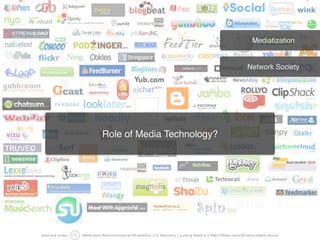
Mediatization


                            Network Society


Role of Media Technology?
Accounts of Technology

                                                                             Context                      Context
                                                                                       Media Technology


                                                                                            Context
  Media
Technology
                                                                                                                    Context
                                                                                                                              Context
                                                                                                   Context
                                        Role of Media Technology?
                                                       Context                                                        Media Technology


                                                                                            Media
                                                                                          Technology


                                                                                      Context


         Technological Determinism                                                              Constructivism


Christian Katzenbach | Technologies and Social Communication | PhD-Workshop, November 17 2009, Workshop                                  4
Sociology of Science
  and Technology
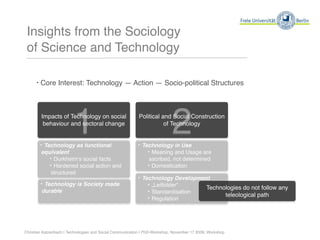
Insights from the Sociology
 of Science and Technology

      ‣ Core Interest: Technology — Action — Socio-political Structures


                         1
        Impacts of Technology on social
         behaviour and sectoral change


        ‣ Technology as functional
                                                                           2
                                                          Political and Social Construction
                                                                     of Technology


                                                          ‣ Technology in Use
        equivalent                                            ‣ Meaning and Usage are
           ‣ Durkheimʻs social facts                           ascribed, not determined
           ‣ Hardened social action and                        ‣ Domestication
           structured
                                                          ‣ Technology Development
        ‣ Technology is Society made                          ‣ „Leitbilder“     Technologies do not follow any
        durable                                               ‣ Standardisation        teleological path
                                                              ‣ Regulation


Christian Katzenbach | Technologies and Social Communication | PhD-Workshop, November 17 2009, Workshop
Picture: clemensfranz (CC By-SA 3.0)
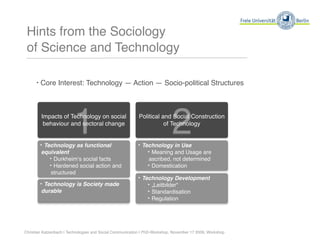
Hints from the Sociology
 of Science and Technology

      ‣ Core Interest: Technology — Action — Socio-political Structures


                         1
        Impacts of Technology on social
         behaviour and sectoral change


        ‣ Technology as functional
                                                                           2
                                                          Political and Social Construction
                                                                     of Technology


                                                          ‣ Technology in Use
        equivalent                                            ‣ Meaning and Usage are
           ‣ Durkheimʻs social facts                           ascribed, not determined
           ‣ Hardened social action and                        ‣ Domestication
           structured
                                                          ‣ Technology Development
        ‣ Technology is Society made                          ‣ „Leitbilder“
        durable                                               ‣ Standardisation
                                                              ‣ Regulation


Christian Katzenbach | Technologies and Social Communication | PhD-Workshop, November 17 2009, Workshop
Hints from the Sociology
 of Science and Technology

      ‣ Core Interest: Technology — Action — Socio-political Structures

         Resources                                                                              Routines


                         1
        Impacts of Technology on social
         behaviour and sectoral change


        ‣ Technology as functional
                                                                           2
                                                          Political and Social Construction
                                                                     of Technology


                                                          ‣ Technology in Use
        equivalent                                            ‣ Meaning and Usage are
           ‣ Durkheimʻs social facts                           ascribed, not determined
           ‣ Hardened social action and                        ‣ Domestication
           structured
                                                     ‣ Technology Development
        ‣ Technology is Society made                     ‣ „Leitbilder“
        durable                                          ‣ Standardisation
                                                         ‣ Regulation
                                                 Co-Evolution


Christian Katzenbach | Technologies and Social Communication | PhD-Workshop, November 17 2009, Workshop
Governance
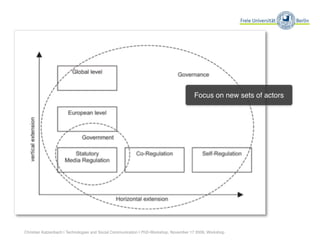
Governance as a Theoretical Frame

      ‣ Governance Frame: Regulation in a wider sense
                                                          Focus on new sets of actors
           ‣ gained attention as analytical concept and practical approach

           ‣ Shift of focus in several dimensions:

                 ‣ Actors: Vertical and Horizontal Extension of the traditional
                   mode of rule-making through the nation-state

                       ‣ Vertical: International Institutions

                       ‣ Horizontal: Inclusion of private actors (self- and Co-
                         Regulation)


Christian Katzenbach | Technologies and Social Communication | PhD-Workshop, November 17 2009, Workshop
Values
                                                                                     Norms
      Coordination
                    Markets                                    Discourse
                                                                                              Focus on new mechanisms

Competition
                       Institutions
             Legitimation           Expertise
Legislation                                                Knowledge


Christian Katzenbach | Technologies as Institutions | ECREA-Workshop, November 2009, Zurich
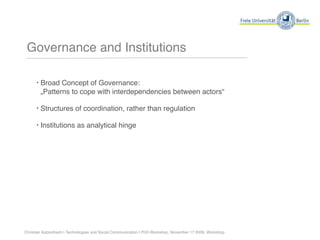
Governance and Institutions

      ‣ Broad Concept of Governance:
        „Patterns to cope with interdependencies between actors“

      ‣ Structures of coordination, rather than regulation

      ‣ Institutions as analytical hinge


Christian Katzenbach | Technologies and Social Communication | PhD-Workshop, November 17 2009, Workshop
“[Institutions are] symbolic and behavioral systems containing
representational, constitutive and normative rules together with
regulatory mechanisms that define a common meaning system
     and give rise to distinctive actors and action routines.

                                                         Scott, 1994
Governance and Institutions

      ‣ Broad Concept of Governance:
        „Patterns to cope with interdependencies between actors“

      ‣ Schuppert: Structures of coordination, rather than regulation

      ‣ Institutions as analytical hinge

                 ‣ They are both outcome…

                 ‣ … as well as instruments of regulation.


Christian Katzenbach | Technologies and Social Communication | PhD-Workshop, November 17 2009, Workshop
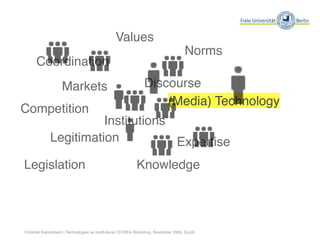
Values
                                                                                     Norms
      Coordination
                    Markets                                    Discourse
                                                                   (Media) Technology
Competition
                       Institutions
             Legitimation           Expertise
Legislation                                                Knowledge


Christian Katzenbach | Technologies as Institutions | ECREA-Workshop, November 2009, Zurich
“   Indeed, the very design of the Internet seemed technologically
     proof against attempts to put the genie back in the bottle. […]
        [It] treats censorship like damage and routes around it.

                                                            Walker 2003
Lessig 2007
Politics of
Media Technology
“    [.…] a politics deeply embedded not just within the institutions
    that design and distribute technologies and services, but within
       the technology itself, as software products and information
      networks both prescribe and proscribe, configuring suppliers
         and users, containing and constraining behaviour, and
       embodying in their algorithms and their gateways both the
                       normative and the seductive.

                                                    Mansell /Silverstone, 1996
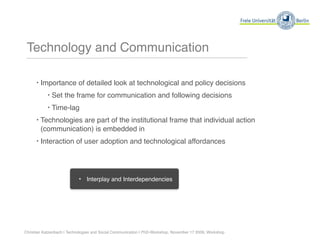
Technology and Communication

      ‣ Importance of detailed look at technological and policy decisions
           ‣ Set the frame for communication and following decisions
           ‣ Time-lag
      ‣ Technologies are part of the institutional frame that individual action
        (communication) is embedded in
      ‣ Interaction of user adoption and technological affordances


                            ‣   Interplay and Interdependencies


Christian Katzenbach | Technologies and Social Communication | PhD-Workshop, November 17 2009, Workshop
Copyright
Selected References

  ‣ Berker, T., Hartmann, M., Punie, Y., & Ward, K. (Eds.). (2006). Domestication of media and
    technology. Maidenhead, Berkshire [u.a.]: Open Univ. Press.
  ‣ Bijker, W. E. und Law, J. (Eds.). (1992). Shaping technology/building society : studies in
    sociotechnical change. Cambridge, MA: MIT Press.
  ‣ Donges, Patrick. (2007). The New Institutionalism as a theoretical foundation of media
    governance. Communications, 32, 325-330.
  ‣ Latour, Bruno. (2007). Reassembling the social : an introduction to Actor-Network-Theory. Oxford
    [u.a.]: Oxford Univ. Press.
  ‣ Latour, Bruno. (1991). Technology is Society made durable., in: John Law (Hrsg.), A Sociology of
    Monsters. London: Routledge. 103-131.
  ‣ Lessig, Lawrence. (1999). Code and other laws of cyberspace. New York, NY: Basic Books.
  ‣ Mansell, R. & Silverstone, R. (Eds.). (1996). Communication by design: The politics of
    information and communication technologies. Oxford: Oxford University Press.
  ‣ Schuppert, Gunnar Folke. (2008). Governance: Auf der Suche nach Konturen eines "anerkannt
    uneindeutigen Begriffs", in: Gunnar Folke Schuppert und Michael Zürn (Hrsg.), Governance in
    einer sich wandelnden Welt. Wiesbaden: VS Verlag für Sozialwissenschaften. 13-40.
  ‣ Walker, John. (2003). "The digital imprimatur: How big brother and big media can put the internet
    genie back in the bottle". Knowledge, Technology & Policy, 16(3), 24-77.
  ‣ Winner, Langdon. (1980). "Do Artifacts Have Politics?". Daedulus, 109, 121-136.


Christian Katzenbach | Technologies and Social Communication | PhD-Workshop, November 17 2009, Workshop
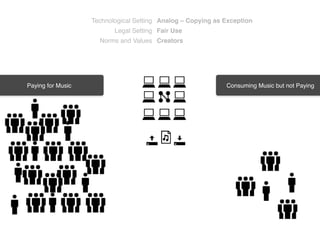
Technological Setting Analog – Copying as Exception
                          Legal Setting Fair Use
                     Norms and Values Creators


Paying for Music                                             Consuming Music but not Paying
Technological Setting Analog – Copying as Exception
                          Legal Setting Fair Use
                     Norms and Values Creators


Paying for Music                                             Consuming Music but not Paying
Technological Setting Digitally Networked – Copying = Usage
                          Legal Setting Fair Use???
                     Norms and Values Creators, but also: Rip, Mix, and Burn / Sharing


Paying for Music                                              Consuming Music but not Paying
Technology and Social Communication

Technology and Social Communication

  • 1.
    Technology and SocialCommunication Exploring the Gap between Technological Determinism and Social Constructivism Christian Katzenbach Institute for Media and Communication Studies Freie Universität Berlin, Germany Young European Researchers Seminar on New Media Studies Institute of Journalism and Social Communication, University of Wroclaw Wroclaw, November 17, 2009.
  • 2.
  • 3.
    Mediatization Network Society Role of Media Technology?
  • 4.
    Accounts of Technology Context Context Media Technology Context Media Technology Context Context Context Role of Media Technology? Context Media Technology Media Technology Context Technological Determinism Constructivism Christian Katzenbach | Technologies and Social Communication | PhD-Workshop, November 17 2009, Workshop 4
  • 5.
    Sociology of Science and Technology
  • 6.
    Insights from theSociology of Science and Technology ‣ Core Interest: Technology — Action — Socio-political Structures 1 Impacts of Technology on social behaviour and sectoral change ‣ Technology as functional 2 Political and Social Construction of Technology ‣ Technology in Use equivalent ‣ Meaning and Usage are ‣ Durkheimʻs social facts ascribed, not determined ‣ Hardened social action and ‣ Domestication structured ‣ Technology Development ‣ Technology is Society made ‣ „Leitbilder“ Technologies do not follow any durable ‣ Standardisation teleological path ‣ Regulation Christian Katzenbach | Technologies and Social Communication | PhD-Workshop, November 17 2009, Workshop
  • 8.
  • 9.
    Hints from theSociology of Science and Technology ‣ Core Interest: Technology — Action — Socio-political Structures 1 Impacts of Technology on social behaviour and sectoral change ‣ Technology as functional 2 Political and Social Construction of Technology ‣ Technology in Use equivalent ‣ Meaning and Usage are ‣ Durkheimʻs social facts ascribed, not determined ‣ Hardened social action and ‣ Domestication structured ‣ Technology Development ‣ Technology is Society made ‣ „Leitbilder“ durable ‣ Standardisation ‣ Regulation Christian Katzenbach | Technologies and Social Communication | PhD-Workshop, November 17 2009, Workshop
  • 10.
    Hints from theSociology of Science and Technology ‣ Core Interest: Technology — Action — Socio-political Structures Resources Routines 1 Impacts of Technology on social behaviour and sectoral change ‣ Technology as functional 2 Political and Social Construction of Technology ‣ Technology in Use equivalent ‣ Meaning and Usage are ‣ Durkheimʻs social facts ascribed, not determined ‣ Hardened social action and ‣ Domestication structured ‣ Technology Development ‣ Technology is Society made ‣ „Leitbilder“ durable ‣ Standardisation ‣ Regulation Co-Evolution Christian Katzenbach | Technologies and Social Communication | PhD-Workshop, November 17 2009, Workshop
  • 11.
  • 12.
    Governance as aTheoretical Frame ‣ Governance Frame: Regulation in a wider sense Focus on new sets of actors ‣ gained attention as analytical concept and practical approach ‣ Shift of focus in several dimensions: ‣ Actors: Vertical and Horizontal Extension of the traditional mode of rule-making through the nation-state ‣ Vertical: International Institutions ‣ Horizontal: Inclusion of private actors (self- and Co- Regulation) Christian Katzenbach | Technologies and Social Communication | PhD-Workshop, November 17 2009, Workshop
  • 13.
    Values Norms Coordination Markets Discourse Focus on new mechanisms Competition Institutions Legitimation Expertise Legislation Knowledge Christian Katzenbach | Technologies as Institutions | ECREA-Workshop, November 2009, Zurich
  • 14.
    Governance and Institutions ‣ Broad Concept of Governance: „Patterns to cope with interdependencies between actors“ ‣ Structures of coordination, rather than regulation ‣ Institutions as analytical hinge Christian Katzenbach | Technologies and Social Communication | PhD-Workshop, November 17 2009, Workshop
  • 15.
    “[Institutions are] symbolicand behavioral systems containing representational, constitutive and normative rules together with regulatory mechanisms that define a common meaning system and give rise to distinctive actors and action routines. Scott, 1994
  • 16.
    Governance and Institutions ‣ Broad Concept of Governance: „Patterns to cope with interdependencies between actors“ ‣ Schuppert: Structures of coordination, rather than regulation ‣ Institutions as analytical hinge ‣ They are both outcome… ‣ … as well as instruments of regulation. Christian Katzenbach | Technologies and Social Communication | PhD-Workshop, November 17 2009, Workshop
  • 17.
    Values Norms Coordination Markets Discourse (Media) Technology Competition Institutions Legitimation Expertise Legislation Knowledge Christian Katzenbach | Technologies as Institutions | ECREA-Workshop, November 2009, Zurich
  • 18.
    Indeed, the very design of the Internet seemed technologically proof against attempts to put the genie back in the bottle. […] [It] treats censorship like damage and routes around it. Walker 2003
  • 19.
  • 20.
  • 21.
    [.…] a politics deeply embedded not just within the institutions that design and distribute technologies and services, but within the technology itself, as software products and information networks both prescribe and proscribe, configuring suppliers and users, containing and constraining behaviour, and embodying in their algorithms and their gateways both the normative and the seductive. Mansell /Silverstone, 1996
  • 22.
    Technology and Communication ‣ Importance of detailed look at technological and policy decisions ‣ Set the frame for communication and following decisions ‣ Time-lag ‣ Technologies are part of the institutional frame that individual action (communication) is embedded in ‣ Interaction of user adoption and technological affordances ‣ Interplay and Interdependencies Christian Katzenbach | Technologies and Social Communication | PhD-Workshop, November 17 2009, Workshop
  • 23.
  • 24.
    Selected References ‣ Berker, T., Hartmann, M., Punie, Y., & Ward, K. (Eds.). (2006). Domestication of media and technology. Maidenhead, Berkshire [u.a.]: Open Univ. Press. ‣ Bijker, W. E. und Law, J. (Eds.). (1992). Shaping technology/building society : studies in sociotechnical change. Cambridge, MA: MIT Press. ‣ Donges, Patrick. (2007). The New Institutionalism as a theoretical foundation of media governance. Communications, 32, 325-330. ‣ Latour, Bruno. (2007). Reassembling the social : an introduction to Actor-Network-Theory. Oxford [u.a.]: Oxford Univ. Press. ‣ Latour, Bruno. (1991). Technology is Society made durable., in: John Law (Hrsg.), A Sociology of Monsters. London: Routledge. 103-131. ‣ Lessig, Lawrence. (1999). Code and other laws of cyberspace. New York, NY: Basic Books. ‣ Mansell, R. & Silverstone, R. (Eds.). (1996). Communication by design: The politics of information and communication technologies. Oxford: Oxford University Press. ‣ Schuppert, Gunnar Folke. (2008). Governance: Auf der Suche nach Konturen eines "anerkannt uneindeutigen Begriffs", in: Gunnar Folke Schuppert und Michael Zürn (Hrsg.), Governance in einer sich wandelnden Welt. Wiesbaden: VS Verlag für Sozialwissenschaften. 13-40. ‣ Walker, John. (2003). "The digital imprimatur: How big brother and big media can put the internet genie back in the bottle". Knowledge, Technology & Policy, 16(3), 24-77. ‣ Winner, Langdon. (1980). "Do Artifacts Have Politics?". Daedulus, 109, 121-136. Christian Katzenbach | Technologies and Social Communication | PhD-Workshop, November 17 2009, Workshop
  • 25.
    Technological Setting Analog– Copying as Exception Legal Setting Fair Use Norms and Values Creators Paying for Music Consuming Music but not Paying
  • 26.
    Technological Setting Analog– Copying as Exception Legal Setting Fair Use Norms and Values Creators Paying for Music Consuming Music but not Paying
  • 27.
    Technological Setting DigitallyNetworked – Copying = Usage Legal Setting Fair Use??? Norms and Values Creators, but also: Rip, Mix, and Burn / Sharing Paying for Music Consuming Music but not Paying