Between 
Coordination and Regulation 
Conceptualizing Governance in 
Internet Governance 
GigaNet Symposium 2014, Istanbul 
Prof. Dr. Jeanette Hofmann, Social Science Center Berlin 
Christian Katzenbach, Alexander von Humboldt Institute for Internet & Society 
Kirsten Gollatz, Alexander von Humboldt Institute for Internet & Society
Structure 
“Internet Governance” 
Internet governance 
ref lexive 
coordination 
governance as 
reflexive coordination in: Internet governance
“Internet Governance”
“ 
A common definition 
Internet governance is the 
development and application by Governments, 
the private sector and civil society, 
in their respective roles, 
of shared principles, norms, rules, decision-making 
procedures, and programmes 
that shape the evolution and use of the Internet. 
(WGIG 2005)
Contradictions and shortcomings of 
Internet governance research 
“shared principles, norms, rules, 
decision-making procedures, 
and programmes” 
versus distributed agency 
versus governance as side-effects 
? 
“steering and shaping” 
Scope – What is not Internet governance? 
Modes – Governance and regulation: Are they the same? 
Reflection of governance and regulation literature?
Internet governance
The Concept of Governance 
Different terminological traditions 
Anglo-American Approach European Approach 
Governance = Government 3-step paradigm shift: 
(Mayntz 2003) 
Public planning 
Public steering 
Governance 
- hierarchical, 
command & control 
- distributed, 
cooperative, network
Governance versus Regulation 
Modes of Coordination Constellation of Actors Structure Formation 
non-hierarchal 
regulation 
distinction between 
steering subject and 
steering object 
intentional 
simple 
governance 
integration of steering 
subject and steering 
object 
intentional 
complex 
governance 
integration of steering 
subject and steering 
object 
non-intentional 
(Translation of Grande 2012: 583)
Governance versus Regulation: 
Analytical Shortcomings 
Regulation – misses empirical phenomena that 
cannot be explained as outcomes of rational 
problem solving 
Governance – vague term without clear 
boundaries: what is outside of governance? 
Task – Specifying a middle ground between 
concepts too narrow and too broad
ref lexive 
coordination governance as
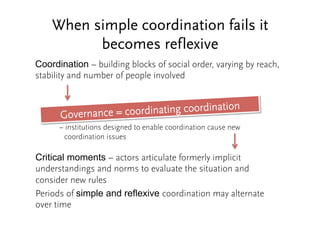
When simple coordination fails it 
becomes reflexive 
Coordination – building blocks of social order, varying by reach, 
stability and number of people involved 
Governance = coordinating coordination 
– institutions designed to enable coordination cause new 
coordination issues 
Critical moments – actors articulate formerly implicit 
understandings and norms to evaluate the situation and 
consider new rules 
Periods of simple and reflexive coordination may alternate 
over time
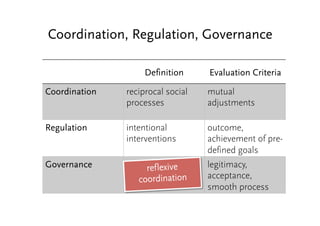
Coordination, Regulation, Governance 
Definition Evaluation Criteria 
Coordination reciprocal social 
processes 
mutual 
adjustments 
Regulation intentional 
interventions 
outcome, 
achievement of pre-defined 
goals 
Governance legitimacy, 
acceptance, 
smooth process 
ref lexive 
coordination
reflexive coordination in: Internet governance
Internet Governance as Reflexive 
Coordination: The IGF 
Conditions of coordination – (re-)shaping its own 
context 
Coordinating coordination – “recursive loops” (p.3) 
Critical moments – compromising different worldviews 
and conflicting opinions 
Bottom-up perspective – debating the formal and 
informal practices 
Reflexivity – boundaries are enacted and constantly 
negotiated by the actors involved 
Outcome – a fluid concept 
(Epstein 2011: 6)
Summary 
Shortcomings – lack of a systematic reflection of 
governance in Internet governance 
Task – specifying a conceptual and pragmatic 
ground 
Approach – governance as reflexive coordination 
Further research – empirical applicability in 
Internet governance arrangements, 
contextualization, theoretical extensions

Between Coordination and Regulation. Conceptualizing Governance in Internet Governance

  • 1.
    Between Coordination andRegulation Conceptualizing Governance in Internet Governance GigaNet Symposium 2014, Istanbul Prof. Dr. Jeanette Hofmann, Social Science Center Berlin Christian Katzenbach, Alexander von Humboldt Institute for Internet & Society Kirsten Gollatz, Alexander von Humboldt Institute for Internet & Society
  • 2.
    Structure “Internet Governance” Internet governance ref lexive coordination governance as reflexive coordination in: Internet governance
  • 3.
  • 4.
    “ A commondefinition Internet governance is the development and application by Governments, the private sector and civil society, in their respective roles, of shared principles, norms, rules, decision-making procedures, and programmes that shape the evolution and use of the Internet. (WGIG 2005)
  • 5.
    Contradictions and shortcomingsof Internet governance research “shared principles, norms, rules, decision-making procedures, and programmes” versus distributed agency versus governance as side-effects ? “steering and shaping” Scope – What is not Internet governance? Modes – Governance and regulation: Are they the same? Reflection of governance and regulation literature?
  • 6.
  • 7.
    The Concept ofGovernance Different terminological traditions Anglo-American Approach European Approach Governance = Government 3-step paradigm shift: (Mayntz 2003) Public planning Public steering Governance - hierarchical, command & control - distributed, cooperative, network
  • 8.
    Governance versus Regulation Modes of Coordination Constellation of Actors Structure Formation non-hierarchal regulation distinction between steering subject and steering object intentional simple governance integration of steering subject and steering object intentional complex governance integration of steering subject and steering object non-intentional (Translation of Grande 2012: 583)
  • 9.
    Governance versus Regulation: Analytical Shortcomings Regulation – misses empirical phenomena that cannot be explained as outcomes of rational problem solving Governance – vague term without clear boundaries: what is outside of governance? Task – Specifying a middle ground between concepts too narrow and too broad
  • 10.
  • 11.
    When simple coordinationfails it becomes reflexive Coordination – building blocks of social order, varying by reach, stability and number of people involved Governance = coordinating coordination – institutions designed to enable coordination cause new coordination issues Critical moments – actors articulate formerly implicit understandings and norms to evaluate the situation and consider new rules Periods of simple and reflexive coordination may alternate over time
  • 12.
    Coordination, Regulation, Governance Definition Evaluation Criteria Coordination reciprocal social processes mutual adjustments Regulation intentional interventions outcome, achievement of pre-defined goals Governance legitimacy, acceptance, smooth process ref lexive coordination
  • 13.
    reflexive coordination in:Internet governance
  • 14.
    Internet Governance asReflexive Coordination: The IGF Conditions of coordination – (re-)shaping its own context Coordinating coordination – “recursive loops” (p.3) Critical moments – compromising different worldviews and conflicting opinions Bottom-up perspective – debating the formal and informal practices Reflexivity – boundaries are enacted and constantly negotiated by the actors involved Outcome – a fluid concept (Epstein 2011: 6)
  • 15.
    Summary Shortcomings –lack of a systematic reflection of governance in Internet governance Task – specifying a conceptual and pragmatic ground Approach – governance as reflexive coordination Further research – empirical applicability in Internet governance arrangements, contextualization, theoretical extensions

Editor's Notes

  • #3 How to conceptualize governance in Internet governance? Conceptual history of Internet Governance Revisiting the governance concept Governance as reflexive coordination Reflexive coordination in Internet governance
  • #5 Political definition that bears the marks of its context and time: 1. Actor constellation; 2. quote of "in their respective roles" 3. SHARED principles, norms etc; 4. no laws, no policies or contracts. We need a theoretically informed definition!
  • #6 Predominantly empirical research Lack of defintion, terminology Blurred lines between analytical and normative No systematic discussion, nor conceptual terminology "Common to all definitions of governance is a notion of steering. (van Eeten & Mueller) Regulation: targeted action with clearly defined regulatory goals Governance is the same?
  • #8 Different terminological traditions between anglo-american and European research US: Governance = Government EU: Governance as the latest instant in a 3 step paradigm shift (Mayntz 2003): Modes of coordination in politics: Public planning hierarchical, command & control Public steering Governance : distributed, cooperative, networks
  • #9 Def Regulation: operations intending to influence a given state in a regulatory field Regulation: Emphasis on acts and situations of decision making Governance: Emphasis on structures and processes of coordination, Significance of intentionality varies with the complexity of governance arrangement
  • #11 Introducing our own approach to the question of „how to define internet governance?“ and finding reflexivity in governance. combining ideas from scholars Strassheim, Jessop and Grande
  • #12 Fundmental idea: Coming from Coordination instead of regulation: mutual adjustments, internalized norms and rules we do not reflect. Would be too broad to understand every act of coordination as governance Narrowing it down to: coordinating coordination  reflexive action eminating from exisiting coordination structures First question: When becomes regular coordination reflexive?  Critical moments: circumstances where coordination requires coordination Routines break down, are becoming problematic  Paper: Example of two cars Reflexive, procedural elements The reflexive momentum: routines break down  to assess this problematic situation, and to reflect on each other’s intentions, expectations, strategies and available creative solutions, continuously being evaluated and justified. Implicit understanding  explicit negotiation articulate formerly implicit understandings, assumptions and norms framing the situation in question in order to mutually evaluate the situation and justify their behavior
  • #13 Disentangling Governance, Regulation and Coordination  defintion and evaluation criteria Such approach is rather grounded in coordination than in the concept of regulation Coordination: the shared understandings and expectations form elementary building blocks of our social order: the “mutual adjustments” of our daily social life (Kaufmann 1986; Strassheim 2009) rules we have internalised and conventionally agreed to Often local implicit nature of shared norms and understandings that enable coordination However, shortcomings: understanding of governance as coordination to be too broad to be analytically and empirically helpful Regulation: intentional design of programs, rules or norms aiming to influence the behavior of others. Outcome evaluated against predefined goals  Governance dynamics of evaluating and articulating rules in the face of complex situations that arise when authorities and regulatory structures overlap, when implicit expectations of the actors involved collide and contradictory interests become visible According to Grande (2012: 584), the assessment of governance arrangements depends on the acceptance of its consequences for the actors involved. In this sense, evaluation criteria are defined as part of governance processes
  • #15 Informed by Dimitri Epsteins work of 2011, and Diss. 2012 - Epstein describes the IGF as a "space that produces discourse and is shaped by discourse at the same time" (p.3) PROCESS: Recursive Loops In a form of a "recursive loop" (p.3) the IGF debates its role, its shape and processes of decisions-making within the IGF and continues to negotiate and renegotiate the boundaries and institutional arrangements. CRITICAL MOMENTS - Continuous conflict for instance about where the IGF should formally be based, or on agreeing on participation and decision-making mechanisms (p.17, 19) , esp. On the role of the MAGs   - in this open, discursive space, the challenge is however to compromise of many different worldviews and the conflicting opinions the participants bring in about how the internet should be governed.   - IGF gains and maintains legitimacy through participation, but at the same time exercise some kind of authority: "The discursive attributes employed in the IGF, are symbolic representations of different worldviews on Internet and Internet governance. To participate effectively in the IGF, one needs to internalize those attributes and to accept a model of coexistence of the different perspectives." (p. 37) BOTTOM up By debating the formal and the informal practices of the forum, IGF participants engage in discursive reflection not only on the technical modus operandi of the forum, but also on the underlying normative framework for Internet policy decision-making." (p.5)   OUTCOME: a fluid concept - primary outcome is language - "In absence of predefined “tangible” outcomes, the success of the IGF is a fluid concept." (p. 23)