
1
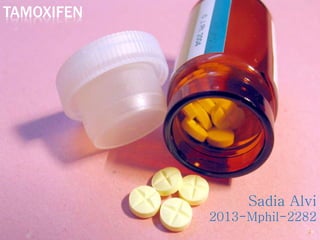
TAMOXIFEN
Sadia Alvi
2013-Mphil-2282
2
CONTENTS
History
Introducing Tamoxifen
Approved Indications
Pharmacokinetics
Pharmacodynamics
Effect of Drug on Body Systems
Special Population Study
3
HISTORY
 Originally marketed as a an antifertility drug
and developed in the cornerstone treatment for
breast cancer.
 Approved by the FDA for postmenopausal
metastatic breast cancer in 1977
4
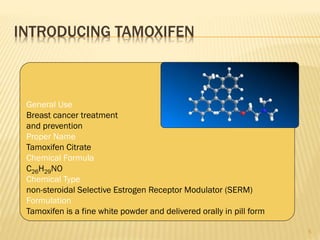
INTRODUCING TAMOXIFEN
General Use
Breast cancer treatment
and prevention
Proper Name
Tamoxifen Citrate
Chemical Formula
C26H29NO
Chemical Type
non-steroidal Selective Estrogen Receptor Modulator (SERM)
Formulation
Tamoxifen is a fine white powder and delivered orally in pill form
5
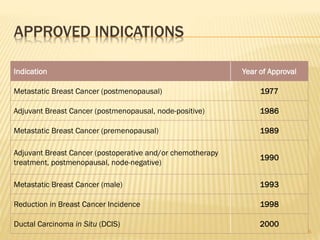
APPROVED INDICATIONS
Indication Year of Approval
Metastatic Breast Cancer (postmenopausal) 1977
Adjuvant Breast Cancer (postmenopausal, node-positive) 1986
Metastatic Breast Cancer (premenopausal) 1989
Adjuvant Breast Cancer (postoperative and/or chemotherapy
treatment, postmenopausal, node-negative)
1990
Metastatic Breast Cancer (male) 1993
Reduction in Breast Cancer Incidence 1998
Ductal Carcinoma in Situ (DCIS) 2000
6
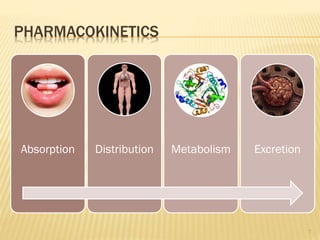
PHARMACOKINETICS
Absorption Distribution Metabolism Excretion
7
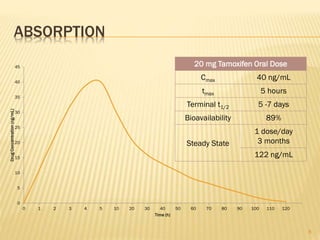
ABSORPTION
20 mg Tamoxifen Oral Dose
Cmax 40 ng/mL
tmax 5 hours
Terminal t1/2 5 -7 days
Bioavailability 89%
Steady State
1 dose/day
3 months
122 ng/mL
0
5
10
15
20
25
30
35
40
45
0 1 2 3 4 5 10 20 30 40 50 60 70 80 90 100 110 120
DrugConcentration(ng/mL)
Time (h)
8
DISTRIBUTION
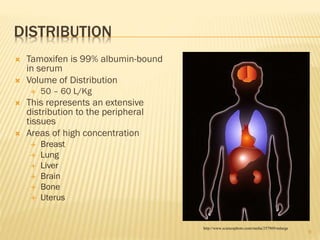
 Tamoxifen is 99% albumin-bound
in serum
 Volume of Distribution
 50 – 60 L/Kg
 This represents an extensive
distribution to the peripheral
tissues
 Areas of high concentration
 Breast
 Lung
 Liver
 Brain
 Bone
 Uterus
http://www.sciencephoto.com/media/257869/enlarge
9
METABOLISM
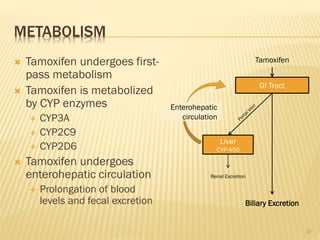
 Tamoxifen undergoes first-
pass metabolism
 Tamoxifen is metabolized
by CYP enzymes
 CYP3A
 CYP2C9
 CYP2D6
 Tamoxifen undergoes
enterohepatic circulation
 Prolongation of blood
levels and fecal excretion
Liver
CYP-450
GI Tract
Renal Excretion
Tamoxifen
Enterohepatic
circulation
Biliary Excretion
10
METABOLISM
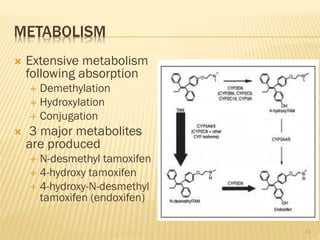
 Extensive metabolism
following absorption
 Demethylation
 Hydroxylation
 Conjugation
 3 major metabolites
are produced
 N-desmethyl tamoxifen
 4-hydroxy tamoxifen
 4-hydroxy-N-desmethyl
tamoxifen (endoxifen)
11
EXCRETION
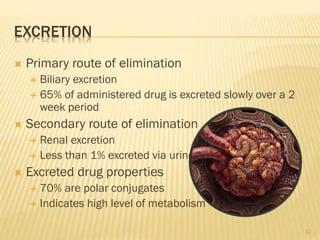
 Primary route of elimination
 Biliary excretion
 65% of administered drug is excreted slowly over a 2
week period
 Secondary route of elimination
 Renal excretion
 Less than 1% excreted via urine
 Excreted drug properties
 70% are polar conjugates
 Indicates high level of metabolism
12
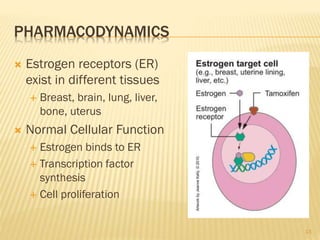
PHARMACODYNAMICS
 Estrogen receptors (ER)
exist in different tissues
 Breast, brain, lung, liver,
bone, uterus
 Normal Cellular Function
 Estrogen binds to ER
 Transcription factor
synthesis
 Cell proliferation
13
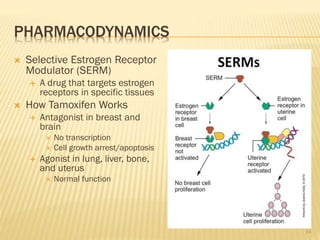
PHARMACODYNAMICS
 Selective Estrogen Receptor
Modulator (SERM)
 A drug that targets estrogen
receptors in specific tissues
 How Tamoxifen Works
 Antagonist in breast and
brain
 No transcription
 Cell growth arrest/apoptosis
 Agonist in lung, liver, bone,
and uterus
 Normal function
14
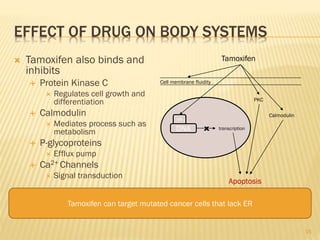
EFFECT OF DRUG ON BODY SYSTEMS
 Tamoxifen also binds and
inhibits
 Protein Kinase C
 Regulates cell growth and
differentiation
 Calmodulin
 Mediates process such as
metabolism
 P-glycoproteins
 Efflux pump
 Ca2+ Channels
 Signal transduction
Tamoxifen can target mutated cancer cells that lack ER
Tamoxifen
Cell membrane fluidity
Calmodulin
PKC
DNA
ER
transcription
Apoptosis
x
15
EFFECT OF DRUG ON BODY SYSTEMS
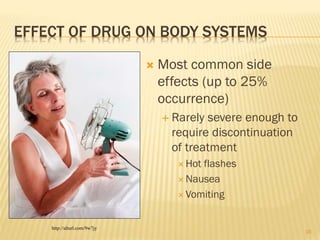
 Most common side
effects (up to 25%
occurrence)
 Rarely severe enough to
require discontinuation
of treatment
 Hot flashes
 Nausea
 Vomiting
http://alturl.com/9w7jy
16
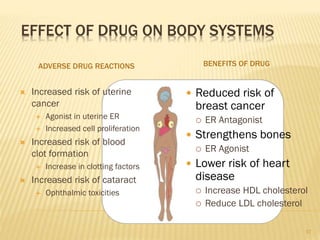
EFFECT OF DRUG ON BODY SYSTEMS
ADVERSE DRUG REACTIONS BENEFITS OF DRUG
 Increased risk of uterine
cancer
 Agonist in uterine ER
 Increased cell proliferation
 Increased risk of blood
clot formation
 Increase in clotting factors
 Increased risk of cataract
 Ophthalmic toxicities
 Reduced risk of
breast cancer
 ER Antagonist
 Strengthens bones
 ER Agonist
 Lower risk of heart
disease
 Increase HDL cholesterol
 Reduce LDL cholesterol
17
EFFECT OF DRUG ON BODY SYSTEMS
 Drug-Drug Interactions
 Coumarin-type anticoagulants (Warfarin)
 Both 99% bound to albumin
 Tamoxifen has a higher affinity for albumin
 Co-administration results in a risk of Warfarin over dose
 Rifampin (TB Antibiotic)
 CYP 34A inducer
 Reduces Tamoxifen’s
 Bioavailability by 86%
 Cmax by 55%
 Prozac (Anti-depressant)
 CYP 2D6 competitor
 Decreases the effect of Tamoxifen
http://alturl.com/apbr2
18
SPECIAL POPULATION STUDY
Brain cancer patients
New Indication
Treatment for malignant glioma
19
ABOUT THE POPULATION
 Rational for Special Population
 High level of cell proliferation in
brain
 Brain cells contain estrogen
receptors
 Proliferative signal transduction
in glioma cells has been shown to
occur through a predominantly
Protein Kinase C dependent
pathway
 P-glycoprotein functions as a
transporter in the blood-brain
barrier
20
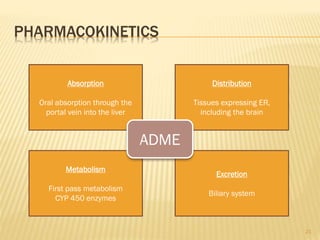
PHARMACOKINETICS
Absorption
Oral absorption through the
portal vein into the liver
Excretion
Biliary system
Metabolism
First pass metabolism
CYP 450 enzymes
Distribution
Tissues expressing ER,
including the brain
ADME
21
PHARMACODYNAMICS
 Tamoxifen is an ER antagonist in the brain
 Prevents transcription
 Cell growth arrest/apoptosis
 Tamoxifen is the only PKC inhibitor small
enough to cross the blood-brain barrier
 Inhibits signal transduction
 Cell growth arrest/apoptosis
 Tamoxifen inhibits P-glycoprotein function
 Increased bioavailability of Tamoxifen
22
REFERENCES
 Avastin (bevacizumab) injection, solution [Genetech, Inc.]. US NLM, NIH, HHS.
Revised 01/2007.
<http://dailymed.nlm.nih.gov/dailymed/drugInfo.cfm?id=53695&CFID=6856876
5&CFTOKEN=c7cde62162e43be5-8E980C43-A853-F363-
B83B961222D86D50&jsessionid=ca301da0de303c387869>
 Clinical Trials: Tamoxifen. US NLM, NIH, HHS.
<http://clinicaltrials.gov/ct2/results?term=tamoxifen>
 Fisher B., Costantino J.P., Wickerham D.L., Redmond C.K., Kavanah M., Cronin
W.M., Vogel V., Robidoux A., Dimitrov N., Atkins J., Daly M., Wieand S., Chiu E.T.,
Ford L., and Wolmark N. 1998. Tamoxifen for prevention of breast cancer: report
of the national surgical adjuvant breast and bowel project p-1 study. Journal of the
National Cancer Institute. 90 (18). 1371-1388
 Kleinsmith L.J., Kerrigan D., and Kelly J. 2010. Understanding cancer and related
topics: understanding esrogen receptors, tamoxifen, and raloxifene. National
Cancer Institute.
 The Merck Index. 13th Edition. Merck & Co., INC. Whitehouse Station, NJ. 2001.
23
REFERENCES
 Lien E.A., Solheim E., and Ueland P.M. 1991. Distribution of tamoxifen and its
metabolites in rat and human tissues during steady-state treatment. Cancer
Research. 51. 4837-4844
 Mackay H.J. and Twelves C.J. 2003. Protein kinase C: a target for anticancer
drugs.Endocrine-Related Cancer. 10. 389-396
 Fisher B., Costantino J.P., Wickerham D.L., Cecchini R.S., Cronin W.M., Robidoux A.,
Bevers T.B., Kavanah M.T., Atkins J.N., Margolese R.G., Runowicz C.D., James J.M.,
Ford L.G., and Wolmark N. 2005. Tamoxifen for the prevention of breast cancer:
current status of the national surgical adjuvant breast and bowel project P-1 study.
Journal of the National Cancer Institute. 97 (22). 1652-1662
 Nolvadex (tamoxifen citrate) Tablet [AstraZeneca Pharmaceuticals LP]. US NLM,
NIH, HHS. Revised 01/2007.
<http://dailymed.nlm.nih.gov/dailymed/drugInfo.cfm?id=3420>
24
REFERENCES
 Schroth W., Goetz M.P., Hamann U., Fasching P.A., Schmidt M., Winter S., Fritz P.,
Simon W., Suman V.J., Ames M.M., Safgren S.L., Kuffel M.J., Ulmer H.U., Strick R.,
Beckmann M.W., Koelbl H., Weinshilboum R.M., Ingle J.N., Eichelbaum M., Schwab
M., and Brauch H. 2009. Association between CYP2D6 polymorphisms and
outcomes among women with early stage breast cancer treated with tamoxifen.
Journal of the American Medical Association. 302 (13). 1429-1436
 Ramachandran C., Khatib Z., Pefkarou A., Fort J., Fonseca H.B., Melnick S.J., and
Escalion E. 2004. Tamoxifen modulation of etoposide sytotoxicity involves inhibition
of protein kinase C activity and insulin-like growth factor II expression in brain tumor
cells. Journal of Neuro-Oncology. 67. 19-28
 Couldwell W.T., Hinton D.R., Surnock A.A., DeGiorgio C.M., Weiner L.P., Apuzzo M.L.J.,
Masri L., Law R.E., and Weiss M.H. 1996. Treatment of recurrent malignant gliomas
with chronic oral high-dose tamoxifen. Clinical Cancer Research. 2. 619-622
 Mandlekar S. and Kong A.N.T. 2001. Mechanisms of Tamoxifen – Induced
apoptosis. Apoptosis. 6. 469-477.
25
26
26
27

Tamoxifen and its anti-cancerous properties

  • 1.
  • 2.
  • 3.
  • 4.
    HISTORY  Originally marketedas a an antifertility drug and developed in the cornerstone treatment for breast cancer.  Approved by the FDA for postmenopausal metastatic breast cancer in 1977 4
  • 5.
    INTRODUCING TAMOXIFEN General Use Breastcancer treatment and prevention Proper Name Tamoxifen Citrate Chemical Formula C26H29NO Chemical Type non-steroidal Selective Estrogen Receptor Modulator (SERM) Formulation Tamoxifen is a fine white powder and delivered orally in pill form 5
  • 6.
    APPROVED INDICATIONS Indication Yearof Approval Metastatic Breast Cancer (postmenopausal) 1977 Adjuvant Breast Cancer (postmenopausal, node-positive) 1986 Metastatic Breast Cancer (premenopausal) 1989 Adjuvant Breast Cancer (postoperative and/or chemotherapy treatment, postmenopausal, node-negative) 1990 Metastatic Breast Cancer (male) 1993 Reduction in Breast Cancer Incidence 1998 Ductal Carcinoma in Situ (DCIS) 2000 6
  • 7.
  • 8.
    ABSORPTION 20 mg TamoxifenOral Dose Cmax 40 ng/mL tmax 5 hours Terminal t1/2 5 -7 days Bioavailability 89% Steady State 1 dose/day 3 months 122 ng/mL 0 5 10 15 20 25 30 35 40 45 0 1 2 3 4 5 10 20 30 40 50 60 70 80 90 100 110 120 DrugConcentration(ng/mL) Time (h) 8
  • 9.
    DISTRIBUTION  Tamoxifen is99% albumin-bound in serum  Volume of Distribution  50 – 60 L/Kg  This represents an extensive distribution to the peripheral tissues  Areas of high concentration  Breast  Lung  Liver  Brain  Bone  Uterus http://www.sciencephoto.com/media/257869/enlarge 9
  • 10.
    METABOLISM  Tamoxifen undergoesfirst- pass metabolism  Tamoxifen is metabolized by CYP enzymes  CYP3A  CYP2C9  CYP2D6  Tamoxifen undergoes enterohepatic circulation  Prolongation of blood levels and fecal excretion Liver CYP-450 GI Tract Renal Excretion Tamoxifen Enterohepatic circulation Biliary Excretion 10
  • 11.
    METABOLISM  Extensive metabolism followingabsorption  Demethylation  Hydroxylation  Conjugation  3 major metabolites are produced  N-desmethyl tamoxifen  4-hydroxy tamoxifen  4-hydroxy-N-desmethyl tamoxifen (endoxifen) 11
  • 12.
    EXCRETION  Primary routeof elimination  Biliary excretion  65% of administered drug is excreted slowly over a 2 week period  Secondary route of elimination  Renal excretion  Less than 1% excreted via urine  Excreted drug properties  70% are polar conjugates  Indicates high level of metabolism 12
  • 13.
    PHARMACODYNAMICS  Estrogen receptors(ER) exist in different tissues  Breast, brain, lung, liver, bone, uterus  Normal Cellular Function  Estrogen binds to ER  Transcription factor synthesis  Cell proliferation 13
  • 14.
    PHARMACODYNAMICS  Selective EstrogenReceptor Modulator (SERM)  A drug that targets estrogen receptors in specific tissues  How Tamoxifen Works  Antagonist in breast and brain  No transcription  Cell growth arrest/apoptosis  Agonist in lung, liver, bone, and uterus  Normal function 14
  • 15.
    EFFECT OF DRUGON BODY SYSTEMS  Tamoxifen also binds and inhibits  Protein Kinase C  Regulates cell growth and differentiation  Calmodulin  Mediates process such as metabolism  P-glycoproteins  Efflux pump  Ca2+ Channels  Signal transduction Tamoxifen can target mutated cancer cells that lack ER Tamoxifen Cell membrane fluidity Calmodulin PKC DNA ER transcription Apoptosis x 15
  • 16.
    EFFECT OF DRUGON BODY SYSTEMS  Most common side effects (up to 25% occurrence)  Rarely severe enough to require discontinuation of treatment  Hot flashes  Nausea  Vomiting http://alturl.com/9w7jy 16
  • 17.
    EFFECT OF DRUGON BODY SYSTEMS ADVERSE DRUG REACTIONS BENEFITS OF DRUG  Increased risk of uterine cancer  Agonist in uterine ER  Increased cell proliferation  Increased risk of blood clot formation  Increase in clotting factors  Increased risk of cataract  Ophthalmic toxicities  Reduced risk of breast cancer  ER Antagonist  Strengthens bones  ER Agonist  Lower risk of heart disease  Increase HDL cholesterol  Reduce LDL cholesterol 17
  • 18.
    EFFECT OF DRUGON BODY SYSTEMS  Drug-Drug Interactions  Coumarin-type anticoagulants (Warfarin)  Both 99% bound to albumin  Tamoxifen has a higher affinity for albumin  Co-administration results in a risk of Warfarin over dose  Rifampin (TB Antibiotic)  CYP 34A inducer  Reduces Tamoxifen’s  Bioavailability by 86%  Cmax by 55%  Prozac (Anti-depressant)  CYP 2D6 competitor  Decreases the effect of Tamoxifen http://alturl.com/apbr2 18
  • 19.
    SPECIAL POPULATION STUDY Braincancer patients New Indication Treatment for malignant glioma 19
  • 20.
    ABOUT THE POPULATION Rational for Special Population  High level of cell proliferation in brain  Brain cells contain estrogen receptors  Proliferative signal transduction in glioma cells has been shown to occur through a predominantly Protein Kinase C dependent pathway  P-glycoprotein functions as a transporter in the blood-brain barrier 20
  • 21.
    PHARMACOKINETICS Absorption Oral absorption throughthe portal vein into the liver Excretion Biliary system Metabolism First pass metabolism CYP 450 enzymes Distribution Tissues expressing ER, including the brain ADME 21
  • 22.
    PHARMACODYNAMICS  Tamoxifen isan ER antagonist in the brain  Prevents transcription  Cell growth arrest/apoptosis  Tamoxifen is the only PKC inhibitor small enough to cross the blood-brain barrier  Inhibits signal transduction  Cell growth arrest/apoptosis  Tamoxifen inhibits P-glycoprotein function  Increased bioavailability of Tamoxifen 22
  • 23.
    REFERENCES  Avastin (bevacizumab)injection, solution [Genetech, Inc.]. US NLM, NIH, HHS. Revised 01/2007. <http://dailymed.nlm.nih.gov/dailymed/drugInfo.cfm?id=53695&CFID=6856876 5&CFTOKEN=c7cde62162e43be5-8E980C43-A853-F363- B83B961222D86D50&jsessionid=ca301da0de303c387869>  Clinical Trials: Tamoxifen. US NLM, NIH, HHS. <http://clinicaltrials.gov/ct2/results?term=tamoxifen>  Fisher B., Costantino J.P., Wickerham D.L., Redmond C.K., Kavanah M., Cronin W.M., Vogel V., Robidoux A., Dimitrov N., Atkins J., Daly M., Wieand S., Chiu E.T., Ford L., and Wolmark N. 1998. Tamoxifen for prevention of breast cancer: report of the national surgical adjuvant breast and bowel project p-1 study. Journal of the National Cancer Institute. 90 (18). 1371-1388  Kleinsmith L.J., Kerrigan D., and Kelly J. 2010. Understanding cancer and related topics: understanding esrogen receptors, tamoxifen, and raloxifene. National Cancer Institute.  The Merck Index. 13th Edition. Merck & Co., INC. Whitehouse Station, NJ. 2001. 23
  • 24.
    REFERENCES  Lien E.A.,Solheim E., and Ueland P.M. 1991. Distribution of tamoxifen and its metabolites in rat and human tissues during steady-state treatment. Cancer Research. 51. 4837-4844  Mackay H.J. and Twelves C.J. 2003. Protein kinase C: a target for anticancer drugs.Endocrine-Related Cancer. 10. 389-396  Fisher B., Costantino J.P., Wickerham D.L., Cecchini R.S., Cronin W.M., Robidoux A., Bevers T.B., Kavanah M.T., Atkins J.N., Margolese R.G., Runowicz C.D., James J.M., Ford L.G., and Wolmark N. 2005. Tamoxifen for the prevention of breast cancer: current status of the national surgical adjuvant breast and bowel project P-1 study. Journal of the National Cancer Institute. 97 (22). 1652-1662  Nolvadex (tamoxifen citrate) Tablet [AstraZeneca Pharmaceuticals LP]. US NLM, NIH, HHS. Revised 01/2007. <http://dailymed.nlm.nih.gov/dailymed/drugInfo.cfm?id=3420> 24
  • 25.
    REFERENCES  Schroth W.,Goetz M.P., Hamann U., Fasching P.A., Schmidt M., Winter S., Fritz P., Simon W., Suman V.J., Ames M.M., Safgren S.L., Kuffel M.J., Ulmer H.U., Strick R., Beckmann M.W., Koelbl H., Weinshilboum R.M., Ingle J.N., Eichelbaum M., Schwab M., and Brauch H. 2009. Association between CYP2D6 polymorphisms and outcomes among women with early stage breast cancer treated with tamoxifen. Journal of the American Medical Association. 302 (13). 1429-1436  Ramachandran C., Khatib Z., Pefkarou A., Fort J., Fonseca H.B., Melnick S.J., and Escalion E. 2004. Tamoxifen modulation of etoposide sytotoxicity involves inhibition of protein kinase C activity and insulin-like growth factor II expression in brain tumor cells. Journal of Neuro-Oncology. 67. 19-28  Couldwell W.T., Hinton D.R., Surnock A.A., DeGiorgio C.M., Weiner L.P., Apuzzo M.L.J., Masri L., Law R.E., and Weiss M.H. 1996. Treatment of recurrent malignant gliomas with chronic oral high-dose tamoxifen. Clinical Cancer Research. 2. 619-622  Mandlekar S. and Kong A.N.T. 2001. Mechanisms of Tamoxifen – Induced apoptosis. Apoptosis. 6. 469-477. 25
  • 26.
  • 27.