TALLY ERP -9
BUSINESS – Business is an innovative
human activity directed to exchange
Of wealth by buying & selling of
Goods & Services in order to earn
profit.
Types of Business – (According to
Ownership )
1. SOLE PROPEITORSHIP
2. PARTNERSHIP
3. JOINT-STOCK COMPANY
ACCOUNT -
 Summary of Transaction
 Account is a Statement where
Business transaction are recorded
TRANSACTION –
 Each & every activity of business
which can be expressed in terms
of money is call Transaction.
Types of Account –
1. PERSONAL ACCOUNT
2. REAL ACCOUNT
3. NOMINAL ACCOUNT
1.PERSONAL ACCOUNT-
Account related to a Natural Person
& Artificial Person /Organization is
known as Personal account .
Ex- RAM A/C , HARI A/C , SBI A/C ,
GMU A/C
A. NATURAL PERSON –
RAM A/C , SHYAM A/C & OTHER
NATURAL PERSON
B. ARTIFICIAL/ORGANIZATIONAL
PERSON
DOEACC A/C , SBI BANK A/C , GMU
A/C , OTHER ARIFICIAL PERSON
REPRESENTATIVE PERSON
PERSONAL ACCOUNT –
Representative person is a natural
person which is appointed to
represent to an organization
artificial person , it takes
responsibilities & bear all the risk
of the organization .
2. REAL ACCOUNT –
Account related to PROPERTY or
ASSETS of business are known as
Real account.
EX- Machinery A/c , Land A/c,
Building A/c , Cash A/c , Furniture
A/c , Purchase A/c
3. NOMINAL ACCOUNT –
Account related to Expenses or
Losses & Incomes or Gain are known
as Nominal Account.
1. Expenses & Losses –
 Salary Account
 Wages Account
 Tax Payable Account
 Telephone Bill Account
 Rent Paid Account
 Postage & Stamps Account
 Drawing Account
 Stationery Account
2. Incomes & Gain
 Rent received
 Commission received
 Interest received
PETTY CASH –
The Particular amount of money
which transfer from main cash to
as petty cash in advance to meet
daily expenses or un-important
expenses of the business.
ACCOUNTING –
Accounting is an art of Recording ,
Classifying, Summarising,
Annalysis of Results of Operation
to Balance at the end .
 Recording – JOURNAL
 Classifying – LEDGER
 Summarising – TRIAL BALANCE
 Annalysis –
 Results of Operation – PROFIT
& LOSS ACCOUNT
 Balance at the end – BALANCE
SHEET
TALLY – TOTAL ACCOUNTING
LEADING LIST YEAR
 It is an accounting application
software which is used for
accounting .
ACCOUNING CONCEPTS :
Accounting concepts are certain
assumption on which accounting
are based on .
1. ACCOUNTING ENTITY/ BUSINESS
ENTITY :
Business & proprietor are two
different person . Accounting is
maintain for the business not for
the proprietor .
2. GOING CONCERN CONCEPT :
Business will be going on future
with out any interruption.
3. ACCONTING PERIOD CONCEPT :
Business will be maintain for a
specified period like : 365 days, 6
months, 1months.
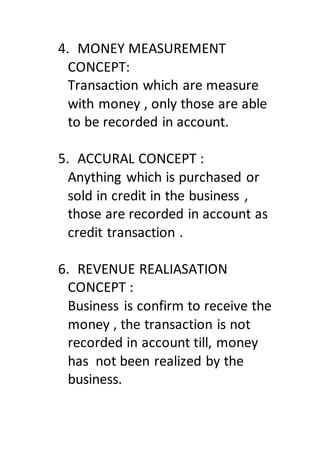
4. MONEY MEASUREMENT
CONCEPT:
Transaction which are measure
with money , only those are able
to be recorded in account.
5. ACCURAL CONCEPT :
Anything which is purchased or
sold in credit in the business ,
those are recorded in account as
credit transaction .
6. REVENUE REALIASATION
CONCEPT :
Business is confirm to receive the
money , the transaction is not
recorded in account till, money
has not been realized by the
business.
7. MATCHING CONCEPT :
Revenue will be matched with the
cost.
DOUBLE ENTRY SYSTEM :
DEBIT – DR (RECEIVED)
CREDIT – CR (PAID)
GOLDEN RULE OF ACCOUNTING :
Invent by LUCASS PACCIOLI
(GERMAN) in 1494
World first ACCOUNTING BOOK –
DE-COMPUTIS-ET-SCRIPTURES
1. PERSONAL ACCOUNT :
DR – The Receiver
CR – The Giver
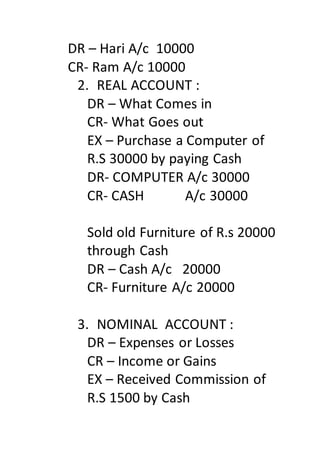
EX- Ram pays Hari R.S 10000
DR – Hari A/c 10000
CR- Ram A/c 10000
2. REAL ACCOUNT :
DR – What Comes in
CR- What Goes out
EX – Purchase a Computer of
R.S 30000 by paying Cash
DR- COMPUTER A/c 30000
CR- CASH A/c 30000
Sold old Furniture of R.s 20000
through Cash
DR – Cash A/c 20000
CR- Furniture A/c 20000
3. NOMINAL ACCOUNT :
DR – Expenses or Losses
CR – Income or Gains
EX – Received Commission of
R.S 1500 by Cash
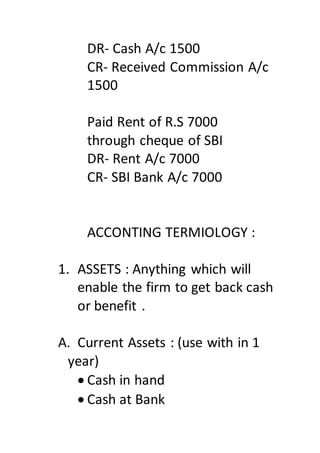
DR- Cash A/c 1500
CR- Received Commission A/c
1500
Paid Rent of R.S 7000
through cheque of SBI
DR- Rent A/c 7000
CR- SBI Bank A/c 7000
ACCONTING TERMIOLOGY :
1. ASSETS : Anything which will
enable the firm to get back cash
or benefit .
A. Current Assets : (use with in 1
year)
 Cash in hand
 Cash at Bank
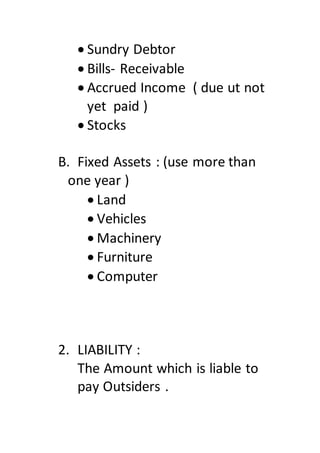
 Sundry Debtor
 Bills- Receivable
 Accrued Income ( due ut not
yet paid )
 Stocks
B. Fixed Assets : (use more than
one year )
 Land
 Vehicles
 Machinery
 Furniture
 Computer
2. LIABILITY :
The Amount which is liable to
pay Outsiders .
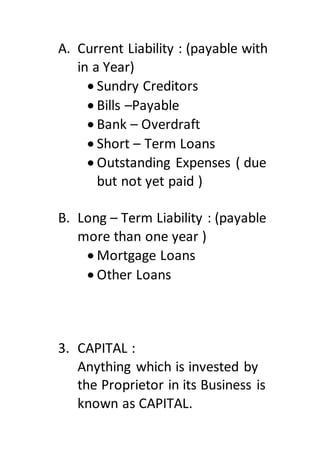
A. Current Liability : (payable with
in a Year)
 Sundry Creditors
 Bills –Payable
 Bank – Overdraft
 Short – Term Loans
 Outstanding Expenses ( due
but not yet paid )
B. Long – Term Liability : (payable
more than one year )
 Mortgage Loans
 Other Loans
3. CAPITAL :
Anything which is invested by
the Proprietor in its Business is
known as CAPITAL.
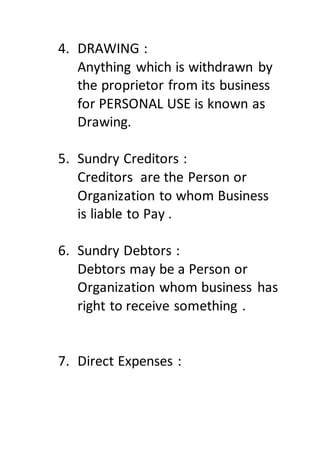
4. DRAWING :
Anything which is withdrawn by
the proprietor from its business
for PERSONAL USE is known as
Drawing.
5. Sundry Creditors :
Creditors are the Person or
Organization to whom Business
is liable to Pay .
6. Sundry Debtors :
Debtors may be a Person or
Organization whom business has
right to receive something .
7. Direct Expenses :
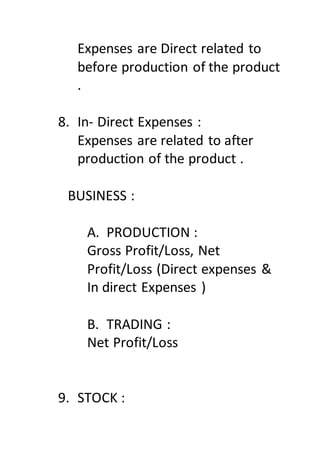
Expenses are Direct related to
before production of the product
.
8. In- Direct Expenses :
Expenses are related to after
production of the product .
BUSINESS :
A. PRODUCTION :
Gross Profit/Loss, Net
Profit/Loss (Direct expenses &
In direct Expenses )
B. TRADING :
Net Profit/Loss
9. STOCK :
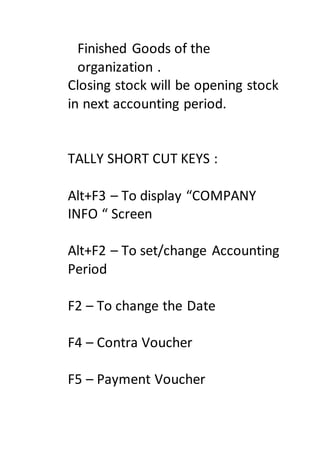
Finished Goods of the
organization .
Closing stock will be opening stock
in next accounting period.
TALLY SHORT CUT KEYS :
Alt+F3 – To display “COMPANY
INFO “ Screen
Alt+F2 – To set/change Accounting
Period
F2 – To change the Date
F4 – Contra Voucher
F5 – Payment Voucher
F6 – Receipt Voucher
F7 – Journal Voucher
F8 – Sale Bill Voucher
F9 – Purchase Bill Voucher
Esc – Cancel the Action
Alt+c – Ledger Creation
 Backspace – Come to back /
change
TALLY – ERP(9.0)
 How to OPEN
a. Double click on TALLY
ICON which may be located
in desktop screen .
b. When it opens a welcome
screen showing you TALLY
POWER OF SIMPLICITY .
c. In this Software first you
have to create a company ,
creation will be available in
COMPANY INFO SCREEN .(
Alt + F3 )
d. Every recording & posting
will be done in GATE WAY
TALLY SCREEN .
ACCOUNTING VOUCHER :
1. CONTRA VOUCHER ( F4) :
In this voucher we record
transactions related to cash
deposit & withdraw from bank .
2. PAYMENT VOUCHER (F5) :
Payment voucher is a voucher
where cash & cheque Payments
are recorded . In this voucher
Cash& Bank a/c are always shown
in credit side .
3. RECEIPT VOUCHER (F6) :
We record transactions related to
Cash & cheques received by he
Business . In this voucher Cah &
Bank a/c are always shown in
Debit side .
4. JOURNAL VOUCHER (F7) :
All type of Non-Cash transactions
are recorded in journal voucher .
ACCONTING PERIOD (Alt + F2) :
Before to start record of
transactions we need to set or
change Accounting Period or
Financial Year . You have to
change the date daily by using F2 .
LEDGER :
CASH & PROFIT LOSS A/C Ledger
are previously available .
1. DIRECT PROCESS to CREATE
LEDGER :
GOT – ACCOUNT INFO – LEDGER –
CREATE
DISPLAY
ALTER
2. SHORT CUT PROCESS ( Alt + c) :
We also create Ledger by direct
use of (Alt + c ) key .
Undergroup :
BANK a/c , Capital a/c , Purchase
a/c , SALES a/c under group same
as account name .
COST CENTRE & COST CATEGORY :
ACTIVATE :
GOT-F11-COMPANY FEATURE -
ACCOUNTING FEATURE
STATUTORY FEATURE
MAINTAIN COST CENTRE
(YES)
MAINTAIN COST CATEGORY
(YES)
Tally erp 9 notes

Tally erp 9 notes

  • 1.
    TALLY ERP -9 BUSINESS– Business is an innovative human activity directed to exchange Of wealth by buying & selling of Goods & Services in order to earn profit. Types of Business – (According to Ownership ) 1. SOLE PROPEITORSHIP 2. PARTNERSHIP 3. JOINT-STOCK COMPANY ACCOUNT -  Summary of Transaction  Account is a Statement where Business transaction are recorded
  • 2.
    TRANSACTION –  Each& every activity of business which can be expressed in terms of money is call Transaction. Types of Account – 1. PERSONAL ACCOUNT 2. REAL ACCOUNT 3. NOMINAL ACCOUNT 1.PERSONAL ACCOUNT- Account related to a Natural Person & Artificial Person /Organization is known as Personal account . Ex- RAM A/C , HARI A/C , SBI A/C , GMU A/C A. NATURAL PERSON –
  • 3.
    RAM A/C ,SHYAM A/C & OTHER NATURAL PERSON B. ARTIFICIAL/ORGANIZATIONAL PERSON DOEACC A/C , SBI BANK A/C , GMU A/C , OTHER ARIFICIAL PERSON REPRESENTATIVE PERSON PERSONAL ACCOUNT – Representative person is a natural person which is appointed to represent to an organization artificial person , it takes responsibilities & bear all the risk of the organization . 2. REAL ACCOUNT –
  • 4.
    Account related toPROPERTY or ASSETS of business are known as Real account. EX- Machinery A/c , Land A/c, Building A/c , Cash A/c , Furniture A/c , Purchase A/c 3. NOMINAL ACCOUNT – Account related to Expenses or Losses & Incomes or Gain are known as Nominal Account. 1. Expenses & Losses –  Salary Account  Wages Account  Tax Payable Account  Telephone Bill Account  Rent Paid Account  Postage & Stamps Account  Drawing Account
  • 5.
     Stationery Account 2.Incomes & Gain  Rent received  Commission received  Interest received PETTY CASH – The Particular amount of money which transfer from main cash to as petty cash in advance to meet daily expenses or un-important expenses of the business. ACCOUNTING – Accounting is an art of Recording , Classifying, Summarising, Annalysis of Results of Operation to Balance at the end .  Recording – JOURNAL
  • 6.
     Classifying –LEDGER  Summarising – TRIAL BALANCE  Annalysis –  Results of Operation – PROFIT & LOSS ACCOUNT  Balance at the end – BALANCE SHEET TALLY – TOTAL ACCOUNTING LEADING LIST YEAR  It is an accounting application software which is used for accounting . ACCOUNING CONCEPTS :
  • 7.
    Accounting concepts arecertain assumption on which accounting are based on . 1. ACCOUNTING ENTITY/ BUSINESS ENTITY : Business & proprietor are two different person . Accounting is maintain for the business not for the proprietor . 2. GOING CONCERN CONCEPT : Business will be going on future with out any interruption. 3. ACCONTING PERIOD CONCEPT : Business will be maintain for a specified period like : 365 days, 6 months, 1months.
  • 8.
    4. MONEY MEASUREMENT CONCEPT: Transactionwhich are measure with money , only those are able to be recorded in account. 5. ACCURAL CONCEPT : Anything which is purchased or sold in credit in the business , those are recorded in account as credit transaction . 6. REVENUE REALIASATION CONCEPT : Business is confirm to receive the money , the transaction is not recorded in account till, money has not been realized by the business.
  • 9.
    7. MATCHING CONCEPT: Revenue will be matched with the cost. DOUBLE ENTRY SYSTEM : DEBIT – DR (RECEIVED) CREDIT – CR (PAID) GOLDEN RULE OF ACCOUNTING : Invent by LUCASS PACCIOLI (GERMAN) in 1494 World first ACCOUNTING BOOK – DE-COMPUTIS-ET-SCRIPTURES 1. PERSONAL ACCOUNT : DR – The Receiver CR – The Giver EX- Ram pays Hari R.S 10000
  • 10.
    DR – HariA/c 10000 CR- Ram A/c 10000 2. REAL ACCOUNT : DR – What Comes in CR- What Goes out EX – Purchase a Computer of R.S 30000 by paying Cash DR- COMPUTER A/c 30000 CR- CASH A/c 30000 Sold old Furniture of R.s 20000 through Cash DR – Cash A/c 20000 CR- Furniture A/c 20000 3. NOMINAL ACCOUNT : DR – Expenses or Losses CR – Income or Gains EX – Received Commission of R.S 1500 by Cash
  • 11.
    DR- Cash A/c1500 CR- Received Commission A/c 1500 Paid Rent of R.S 7000 through cheque of SBI DR- Rent A/c 7000 CR- SBI Bank A/c 7000 ACCONTING TERMIOLOGY : 1. ASSETS : Anything which will enable the firm to get back cash or benefit . A. Current Assets : (use with in 1 year)  Cash in hand  Cash at Bank
  • 12.
     Sundry Debtor Bills- Receivable  Accrued Income ( due ut not yet paid )  Stocks B. Fixed Assets : (use more than one year )  Land  Vehicles  Machinery  Furniture  Computer 2. LIABILITY : The Amount which is liable to pay Outsiders .
  • 13.
    A. Current Liability: (payable with in a Year)  Sundry Creditors  Bills –Payable  Bank – Overdraft  Short – Term Loans  Outstanding Expenses ( due but not yet paid ) B. Long – Term Liability : (payable more than one year )  Mortgage Loans  Other Loans 3. CAPITAL : Anything which is invested by the Proprietor in its Business is known as CAPITAL.
  • 14.
    4. DRAWING : Anythingwhich is withdrawn by the proprietor from its business for PERSONAL USE is known as Drawing. 5. Sundry Creditors : Creditors are the Person or Organization to whom Business is liable to Pay . 6. Sundry Debtors : Debtors may be a Person or Organization whom business has right to receive something . 7. Direct Expenses :
  • 15.
    Expenses are Directrelated to before production of the product . 8. In- Direct Expenses : Expenses are related to after production of the product . BUSINESS : A. PRODUCTION : Gross Profit/Loss, Net Profit/Loss (Direct expenses & In direct Expenses ) B. TRADING : Net Profit/Loss 9. STOCK :
  • 16.
    Finished Goods ofthe organization . Closing stock will be opening stock in next accounting period. TALLY SHORT CUT KEYS : Alt+F3 – To display “COMPANY INFO “ Screen Alt+F2 – To set/change Accounting Period F2 – To change the Date F4 – Contra Voucher F5 – Payment Voucher
  • 17.
    F6 – ReceiptVoucher F7 – Journal Voucher F8 – Sale Bill Voucher F9 – Purchase Bill Voucher Esc – Cancel the Action Alt+c – Ledger Creation  Backspace – Come to back / change TALLY – ERP(9.0)  How to OPEN
  • 18.
    a. Double clickon TALLY ICON which may be located in desktop screen . b. When it opens a welcome screen showing you TALLY POWER OF SIMPLICITY . c. In this Software first you have to create a company , creation will be available in COMPANY INFO SCREEN .( Alt + F3 ) d. Every recording & posting will be done in GATE WAY TALLY SCREEN . ACCOUNTING VOUCHER : 1. CONTRA VOUCHER ( F4) :
  • 19.
    In this voucherwe record transactions related to cash deposit & withdraw from bank . 2. PAYMENT VOUCHER (F5) : Payment voucher is a voucher where cash & cheque Payments are recorded . In this voucher Cash& Bank a/c are always shown in credit side . 3. RECEIPT VOUCHER (F6) : We record transactions related to Cash & cheques received by he Business . In this voucher Cah & Bank a/c are always shown in Debit side . 4. JOURNAL VOUCHER (F7) : All type of Non-Cash transactions are recorded in journal voucher . ACCONTING PERIOD (Alt + F2) :
  • 20.
    Before to startrecord of transactions we need to set or change Accounting Period or Financial Year . You have to change the date daily by using F2 . LEDGER : CASH & PROFIT LOSS A/C Ledger are previously available . 1. DIRECT PROCESS to CREATE LEDGER : GOT – ACCOUNT INFO – LEDGER – CREATE DISPLAY ALTER 2. SHORT CUT PROCESS ( Alt + c) : We also create Ledger by direct use of (Alt + c ) key .
  • 21.
    Undergroup : BANK a/c, Capital a/c , Purchase a/c , SALES a/c under group same as account name . COST CENTRE & COST CATEGORY : ACTIVATE : GOT-F11-COMPANY FEATURE - ACCOUNTING FEATURE STATUTORY FEATURE MAINTAIN COST CENTRE (YES) MAINTAIN COST CATEGORY (YES)