Bullying, which
refers to repeated
behaviour
by someone
intended to hurt
another person
either through
verbal, social
or physical
behaviour, could
include anything
from making
threats, teasing
or name calling,
spreading
rumours or
pushing or
tripping a
person.
Take
bullying
seriously
Jacobs said that victims never forget
the bullying they experienced as a
child but can overcome it.
He said that while bullying has a
negative effect on some victims for
the rest of their lives, others become
motivated to succeed in life.
A child can overcome the effect of
being bullied, provided however,
that the bullying stops.
“Children can also overcome the
effects of bullying if they receive lots
of care, love and even counselling.
Counselling is a great way to get
help.
“School counsellors or educational
psychologists are trained to
help children. Parents, teachers
or children should seek their
assistance,” he said.
While there was a happy ending in
this instance, sadly it is not the case
for a number of other children who
are bullied on a daily basis.
Henning Jacobs, the trauma support
co-ordinator at ER24, stated that
parents must pay attention to their
child’s behaviour to establish if they
are being bullied.
“Parents should be aware that
bullying occurs in every school
grade. The intensity increases with
age. It is vital that steps be taken
immediately to help a child who is
being bullied. It is also imperative
that immediate and effective steps
be taken against the bully or bullies
as their actions, if not stopped,
could continue to affect a victim,”
he said.
Speaking about the effect of
bullying on a victim, Jacobs
said that the child could become
withdrawn or undergo personality
changes. A once bubbly and
happy child may now be quiet and
depressed. There may be a change
in school marks. They may also
experience panic attacks and fear
going to school. “In extreme cases,
the child may resort to suicide.
Bullying can also result in killings.
It is essential that parents have
a close relationship with their
children. Children who are bullied
mostly keep quiet about what is
happening to them due to being
ashamed. However, some speak up.
It depends on the type of home they
live in and the type of relationship
they have with their parents.
Parents and even teachers need to
let children know that it is okay to
come to them for help if they are
being bullied,” said Jacobs. He said
that it is wise to educate children
and discuss bullying with them as
early as possible. Grade R is a good
time to start.
Difference in bullying among
boys, girls
While it used to be a case of
girls displaying more verbal and
emotional bullying and boys
displaying more physical bullying,
this has now changed. “These
days we find that girls also display
physical bullying and girl fights are
common. Boys now display more
emotional bullying than before.
Reasons for bullying, however, do
not differ between boys and girls,”
said Jacobs.
Explaining some of the reasons for
bullying, Jacobs said these include
anything from physical looks,
weight, height and the use of braces. 
“Reasons for bullying also include
the difference in cultures, race
and colour, being poor, speech
impediments or anything that makes
a child stand out negatively to a
bully,” said Jacobs. 
There are various reasons why
children become bullies. They could
be jealous of another child, unhappy
with something in their own lives,
feel a need to impress others around
them and believe that bullying is the
way to do it or they may have a big
ego. Explaining further, Jacobs said,
“Bullies may be insecure about
themselves and use bullying to feel
more powerful and successful than
the person they are bullying. 
“Violence at home, on the television
or TV games also has an effect to
some degree. 
“Bullies can also be victims of
bullying. There are cases for
example, where children are bullied
at home.”
Types of bullying
Bullying, which refers to repeated
behaviour by someone intended to
hurt another person either through
verbal, social or physical behaviour,
could include anything from making
threats, teasing or name calling,
spreading rumours or pushing or
tripping a person.
“Emotional bullying is
automatically part of the trauma
experienced as a result of physical
bullying. No bullying case is only
physical. It is however, possible
to have emotional bullying cases
that do not result in physical
bullying. Children are affected
when they are teased or when nasty
things are said to them.
“Bullying usually starts verbally
and emotionally and usually only
goes over to physical bullying
when the child that gets bullied
stands up for themselves or displays
behaviour that the bully does not
like,” said Jacobs.
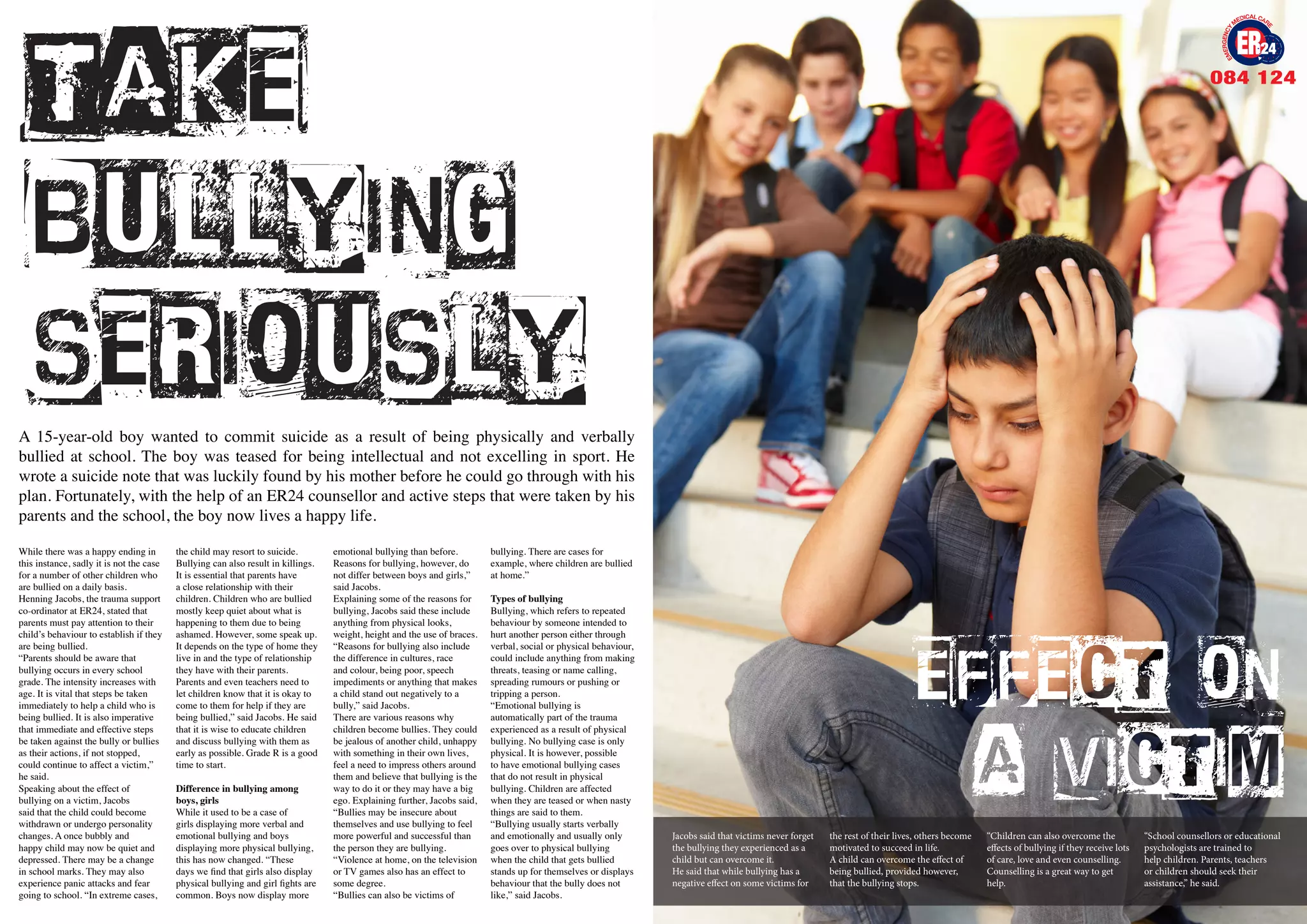
A 15-year-old boy wanted to commit suicide as a result of being physically and verbally
bullied at school. The boy was teased for being intellectual and not excelling in sport. He
wrote a suicide note that was luckily found by his mother before he could go through with his
plan. Fortunately, with the help of an ER24 counsellor and active steps that were taken by his
parents and the school, the boy now lives a happy life.
effect on
a victim

Take bullying seriously

  • 1.
    Bullying, which refers torepeated behaviour by someone intended to hurt another person either through verbal, social or physical behaviour, could include anything from making threats, teasing or name calling, spreading rumours or pushing or tripping a person. Take bullying seriously Jacobs said that victims never forget the bullying they experienced as a child but can overcome it. He said that while bullying has a negative effect on some victims for the rest of their lives, others become motivated to succeed in life. A child can overcome the effect of being bullied, provided however, that the bullying stops. “Children can also overcome the effects of bullying if they receive lots of care, love and even counselling. Counselling is a great way to get help. “School counsellors or educational psychologists are trained to help children. Parents, teachers or children should seek their assistance,” he said. While there was a happy ending in this instance, sadly it is not the case for a number of other children who are bullied on a daily basis. Henning Jacobs, the trauma support co-ordinator at ER24, stated that parents must pay attention to their child’s behaviour to establish if they are being bullied. “Parents should be aware that bullying occurs in every school grade. The intensity increases with age. It is vital that steps be taken immediately to help a child who is being bullied. It is also imperative that immediate and effective steps be taken against the bully or bullies as their actions, if not stopped, could continue to affect a victim,” he said. Speaking about the effect of bullying on a victim, Jacobs said that the child could become withdrawn or undergo personality changes. A once bubbly and happy child may now be quiet and depressed. There may be a change in school marks. They may also experience panic attacks and fear going to school. “In extreme cases, the child may resort to suicide. Bullying can also result in killings. It is essential that parents have a close relationship with their children. Children who are bullied mostly keep quiet about what is happening to them due to being ashamed. However, some speak up. It depends on the type of home they live in and the type of relationship they have with their parents. Parents and even teachers need to let children know that it is okay to come to them for help if they are being bullied,” said Jacobs. He said that it is wise to educate children and discuss bullying with them as early as possible. Grade R is a good time to start. Difference in bullying among boys, girls While it used to be a case of girls displaying more verbal and emotional bullying and boys displaying more physical bullying, this has now changed. “These days we find that girls also display physical bullying and girl fights are common. Boys now display more emotional bullying than before. Reasons for bullying, however, do not differ between boys and girls,” said Jacobs. Explaining some of the reasons for bullying, Jacobs said these include anything from physical looks, weight, height and the use of braces.  “Reasons for bullying also include the difference in cultures, race and colour, being poor, speech impediments or anything that makes a child stand out negatively to a bully,” said Jacobs.  There are various reasons why children become bullies. They could be jealous of another child, unhappy with something in their own lives, feel a need to impress others around them and believe that bullying is the way to do it or they may have a big ego. Explaining further, Jacobs said, “Bullies may be insecure about themselves and use bullying to feel more powerful and successful than the person they are bullying.  “Violence at home, on the television or TV games also has an effect to some degree.  “Bullies can also be victims of bullying. There are cases for example, where children are bullied at home.” Types of bullying Bullying, which refers to repeated behaviour by someone intended to hurt another person either through verbal, social or physical behaviour, could include anything from making threats, teasing or name calling, spreading rumours or pushing or tripping a person. “Emotional bullying is automatically part of the trauma experienced as a result of physical bullying. No bullying case is only physical. It is however, possible to have emotional bullying cases that do not result in physical bullying. Children are affected when they are teased or when nasty things are said to them. “Bullying usually starts verbally and emotionally and usually only goes over to physical bullying when the child that gets bullied stands up for themselves or displays behaviour that the bully does not like,” said Jacobs. A 15-year-old boy wanted to commit suicide as a result of being physically and verbally bullied at school. The boy was teased for being intellectual and not excelling in sport. He wrote a suicide note that was luckily found by his mother before he could go through with his plan. Fortunately, with the help of an ER24 counsellor and active steps that were taken by his parents and the school, the boy now lives a happy life. effect on a victim