Tagore’s The Home
and the World:
Story of the Failure
of the Nationalist
Project
by
University of California , Riverside , USA
HELLO!
I am Bhumika Mahida
I am here because I love to
give presentations.
Subject: IndianEnglish
Literature(pre– Independence)
Topic:The Home andthe world
M.A.Sem3
Department of English M K
Bhavanagar University
2
3
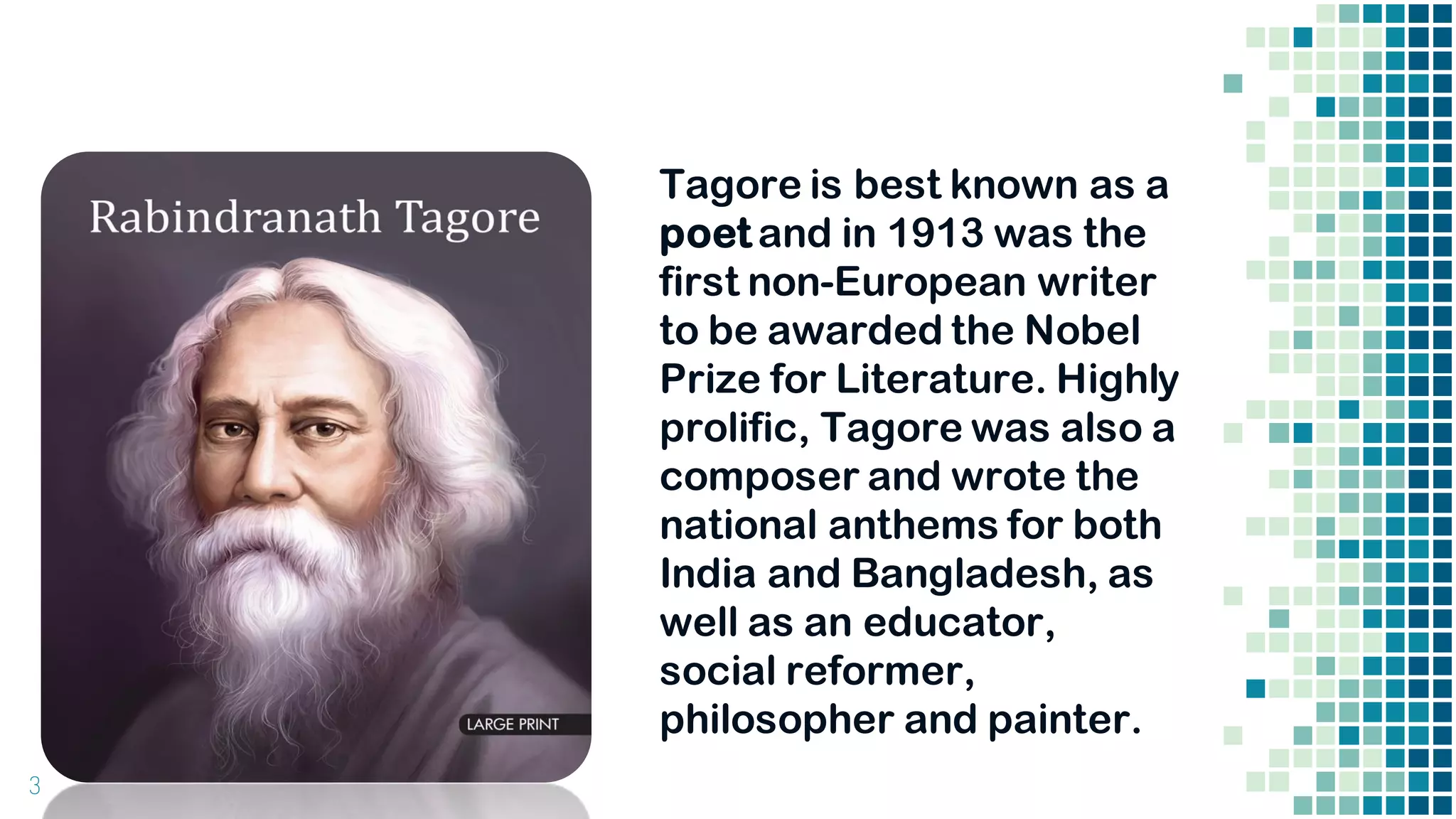
Tagore is best known as a
poet and in 1913 was the
first non-European writer
to be awarded the Nobel
Prize for Literature. Highly
prolific, Tagore was also a
composer and wrote the
national anthems for both
India and Bangladesh, as
well as an educator,
social reformer,
philosopher and painter.
• The Home and the World is a novel that reads
like an allegory on the failure of the Indian
nationalist projects, circling around the issues of
“Home” versus “World.”
• It could be read as an allegory on the failure
of Indian nationalism to accept tradition and
modernity, home and the world, concurrently.
• the novel offers an alternative nationalist
project that could free India from its
obsession with the colonising powers: true
freedom of the nationalist imagination
will be gained by going beyond every form
of ideological prejudice and separation
This article is dedicated to
Prof. Hendrick Maier
The Home and the World
challenges the notion of India as an exclusive
Hindu nation. It questions the
validity of a nationalism that focuses on
emotion rather than on economic self-
sufficiency and social justice. It takes
exception to the aggressive masculinity of
the nationalist project (Mukherjee 618-19;
Rege 50).
• The Home and the World was published ten years after the
vexing partition of Bengal and the beginning of the magic
incantation of “Bande Mataram,” first in Bengali (1915), and
then in English (1919).
• The Swadeshi movement, which emerged in the wake of
the Partition, did not only mobilise Bengal but also spread
throughout India as the “beginning of a truly national
movement and a struggle between the men and methods
that were to lead it”
Mahatma Gandhi gained control over the IndianNational
Congress in the early 1920s, the movement of non-
cooperation gained strong footholds all over India again; the
ideas of Swadeshi were revived; the economic system was
reorganised; and government schools and colleges were
boycotted.
By January 1921 when virtually all the colleges in Calcutta,
the administrative and intellectual centre of Bengal, were
closed, Tagore, unhappy with Gandhi’s “narrowness of
aims,” complained in a letter to Charles Freer Andrews, a
professor at Santiniketan, that the non-cooperation
movement was opposed to his own notions of the nation
“
8
What irony of fate is this,that I should
be preaching cooperation of cultures
between East and West on this side of
the sea justat the moment when the
doctrine of Non-Cooperation is
preached on the other side?
(Tagore, Selected Letters 258)
9
▪ Tagore argued that the radicalism of nationalist self-
reliance, based on the principle of boycott, the central idea of
the Swadeshi movement, “uprootedstudents” and
“temptedthem away from their career before any real
provisionwas made”
(Tagore, SelectedLetters 260)4;
▪ The Home and the World should be read as an alternative to
the spiritof non-cooperation which was “electrical,” “the
spiritof sacrifice [that] was in the very air we breathed”
(Tagore, SelectedLetters 258).
The Woman: Failure in the Home and in the
World
▪ It is the British policy to barbarise Indian culture and decorate it
with Western techniques and modernity – and this is the policy
that shapes the emergence of the Home and the World’s projects
(Chatterjee 10-13).
▪ the subordination of the middle class of Calcutta to the colonial
system “was to be premised upon its cultural leadership of the
indigenous colonized people” (Chatterjee 36)
▪ “The nationalist project was in principle a hegemonic project,”
according to Chatterjee (35).
10
The Men: Failures in the Home and in the World
▪ The two main male characters, Nikhil and Sandip, function as
two possibilities of The Home and the World’s nationalist
projects; they act as core agents of the World by offering
utopianism and rationalism, respectively.
▪ Nikhil suggest the unfeasibility of both rationalist nationalism
and utopian nationalism. Whereas Sandip bases his nationalism
on an extremist belief in individual wisdom, science and passion,
Nikhil devotes his life to the ultimate truth, a complete freedom
of mind and voice.
11
▪ Both characters are haunted by Western
technology and philosophy. Both belong to the
Western educated elite. Both are attached to
the colonial in terms of education,administrative
expertise and economic privileges and detached
from the barbarian and subaltern “supposed
tradition” (Chatterjee 119).
12
13
• starting in 1917, Tagore struggled with the British government
to get permission to invite professors from Germany and
other enemy countries to come and teach at his newly
established school at Santiniketan.
• The fact that Tagore himself translated The Home and the
World and other fragments of his Bengali work into English,
therefore, could also be seen as a way of challenging British
suspicions and to make a more or less direct appeal to
Westernreaders and intellectuals to support his project of an
international school, the universal model of nation, the
concrete embodiment of his “national project.”
References
▪ Mukherjee, Meenakshi. “Epic and Novel in India.” The Novel: History,
Geography, and Culture. Ed. Franco Moretti. New Jersey: Princeton UP, 2007.
596-631.
▪ Chatterjee, Partha. The Nation and Its Fragments. Colonial and Postcolonial
Histories. New Jersey: Princeton UP, 1993.
▪ Tagore, Rabindranath. Selected Letters of Rabindranath Tagore. Ed. Krishna
Dutta and Andrew Robinson. Cambridge: Cambridge UP, 1997.
▪ ---. The Home and the World. Hammondsworth: Penguin Book, 2005.
▪ Uddin, Qazi Nasir. “The Reception of R. Tagore in the United State and Britain
(1913-1941).” MA thesis. U of California, Riverside, 1981.
14
THANKS!
15

Tagore's The Home and The World : Story of the Failure of the Nationalist Project

  • 1.
    Tagore’s The Home andthe World: Story of the Failure of the Nationalist Project by University of California , Riverside , USA
  • 2.
    HELLO! I am BhumikaMahida I am here because I love to give presentations. Subject: IndianEnglish Literature(pre– Independence) Topic:The Home andthe world M.A.Sem3 Department of English M K Bhavanagar University 2
  • 3.
    3 Tagore is bestknown as a poet and in 1913 was the first non-European writer to be awarded the Nobel Prize for Literature. Highly prolific, Tagore was also a composer and wrote the national anthems for both India and Bangladesh, as well as an educator, social reformer, philosopher and painter.
  • 4.
    • The Homeand the World is a novel that reads like an allegory on the failure of the Indian nationalist projects, circling around the issues of “Home” versus “World.” • It could be read as an allegory on the failure of Indian nationalism to accept tradition and modernity, home and the world, concurrently. • the novel offers an alternative nationalist project that could free India from its obsession with the colonising powers: true freedom of the nationalist imagination will be gained by going beyond every form of ideological prejudice and separation This article is dedicated to Prof. Hendrick Maier
  • 5.
    The Home andthe World challenges the notion of India as an exclusive Hindu nation. It questions the validity of a nationalism that focuses on emotion rather than on economic self- sufficiency and social justice. It takes exception to the aggressive masculinity of the nationalist project (Mukherjee 618-19; Rege 50).
  • 6.
    • The Homeand the World was published ten years after the vexing partition of Bengal and the beginning of the magic incantation of “Bande Mataram,” first in Bengali (1915), and then in English (1919). • The Swadeshi movement, which emerged in the wake of the Partition, did not only mobilise Bengal but also spread throughout India as the “beginning of a truly national movement and a struggle between the men and methods that were to lead it”
  • 7.
    Mahatma Gandhi gainedcontrol over the IndianNational Congress in the early 1920s, the movement of non- cooperation gained strong footholds all over India again; the ideas of Swadeshi were revived; the economic system was reorganised; and government schools and colleges were boycotted. By January 1921 when virtually all the colleges in Calcutta, the administrative and intellectual centre of Bengal, were closed, Tagore, unhappy with Gandhi’s “narrowness of aims,” complained in a letter to Charles Freer Andrews, a professor at Santiniketan, that the non-cooperation movement was opposed to his own notions of the nation
  • 8.
    “ 8 What irony offate is this,that I should be preaching cooperation of cultures between East and West on this side of the sea justat the moment when the doctrine of Non-Cooperation is preached on the other side? (Tagore, Selected Letters 258)
  • 9.
    9 ▪ Tagore arguedthat the radicalism of nationalist self- reliance, based on the principle of boycott, the central idea of the Swadeshi movement, “uprootedstudents” and “temptedthem away from their career before any real provisionwas made” (Tagore, SelectedLetters 260)4; ▪ The Home and the World should be read as an alternative to the spiritof non-cooperation which was “electrical,” “the spiritof sacrifice [that] was in the very air we breathed” (Tagore, SelectedLetters 258).
  • 10.
    The Woman: Failurein the Home and in the World ▪ It is the British policy to barbarise Indian culture and decorate it with Western techniques and modernity – and this is the policy that shapes the emergence of the Home and the World’s projects (Chatterjee 10-13). ▪ the subordination of the middle class of Calcutta to the colonial system “was to be premised upon its cultural leadership of the indigenous colonized people” (Chatterjee 36) ▪ “The nationalist project was in principle a hegemonic project,” according to Chatterjee (35). 10
  • 11.
    The Men: Failuresin the Home and in the World ▪ The two main male characters, Nikhil and Sandip, function as two possibilities of The Home and the World’s nationalist projects; they act as core agents of the World by offering utopianism and rationalism, respectively. ▪ Nikhil suggest the unfeasibility of both rationalist nationalism and utopian nationalism. Whereas Sandip bases his nationalism on an extremist belief in individual wisdom, science and passion, Nikhil devotes his life to the ultimate truth, a complete freedom of mind and voice. 11
  • 12.
    ▪ Both charactersare haunted by Western technology and philosophy. Both belong to the Western educated elite. Both are attached to the colonial in terms of education,administrative expertise and economic privileges and detached from the barbarian and subaltern “supposed tradition” (Chatterjee 119). 12
  • 13.
    13 • starting in1917, Tagore struggled with the British government to get permission to invite professors from Germany and other enemy countries to come and teach at his newly established school at Santiniketan. • The fact that Tagore himself translated The Home and the World and other fragments of his Bengali work into English, therefore, could also be seen as a way of challenging British suspicions and to make a more or less direct appeal to Westernreaders and intellectuals to support his project of an international school, the universal model of nation, the concrete embodiment of his “national project.”
  • 14.
    References ▪ Mukherjee, Meenakshi.“Epic and Novel in India.” The Novel: History, Geography, and Culture. Ed. Franco Moretti. New Jersey: Princeton UP, 2007. 596-631. ▪ Chatterjee, Partha. The Nation and Its Fragments. Colonial and Postcolonial Histories. New Jersey: Princeton UP, 1993. ▪ Tagore, Rabindranath. Selected Letters of Rabindranath Tagore. Ed. Krishna Dutta and Andrew Robinson. Cambridge: Cambridge UP, 1997. ▪ ---. The Home and the World. Hammondsworth: Penguin Book, 2005. ▪ Uddin, Qazi Nasir. “The Reception of R. Tagore in the United State and Britain (1913-1941).” MA thesis. U of California, Riverside, 1981. 14
  • 15.