www.internetsociety.org
Tackling Connectivity Diversity:
Protocol Challenges for Constrained Radio
Networks and Devices
Olaf Kolkman, Moderator
Chief Internet Technology Officer
The Internet Society
1
The Internet Society
We are…
2
Not at the IETF
 Taking discussion up a level
 Taking any identified work items to the appropriate
IETF WGs
“On the air”
 Streaming
 Recording
Stopping at 12:45pm so you can all get back to
the IETF…
The Internet Society
Agenda outline
3
Overview
Panelists’ introduction
Framing discussion
Open mic
The Internet Society
The Panel
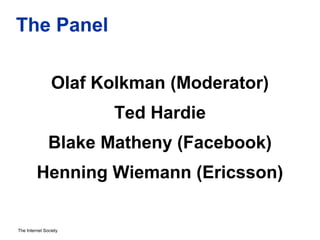
Olaf Kolkman (Moderator)
Ted Hardie
Blake Matheny (Facebook)
Henning Wiemann (Ericsson)
The Internet Society
Today’s discussion
Disconnect between application development
environments and application use environments
 Handsets
 Networks
Does infrastructure need to change?
Is this a transient condition?
Is there a need for better design to cope with
connectivity diversity?
5
The Internet Society
Global Internet Report
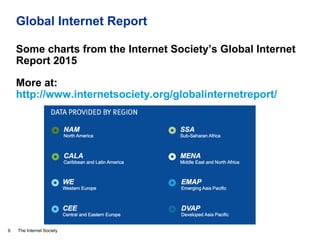
Some charts from the Internet Society’s Global Internet
Report 2015
More at:
http://www.internetsociety.org/globalinternetreport/
6
The Internet Society
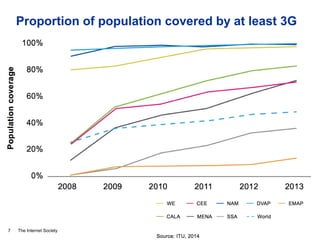
Proportion of population covered by at least 3G
7
The Internet Society8
The Internet Society
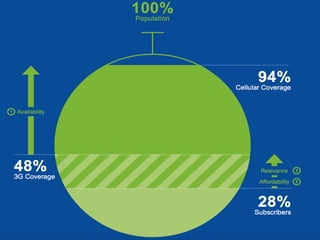
The Digital Divide
9
The Internet Society10
www.internetsociety.org
Panelists’ introduction
11
Characteristics of
Mobile Broadband Connections
… as seen from IP and above
Henning Wiemann
Ericsson Research
3GPP RAN2 Chairman
Characteristics of Mobile Broadband | Public | © Ericsson AB 2015 | 2015-07-20 | Page 13
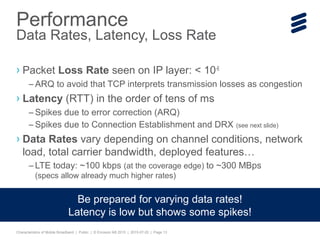
› Packet Loss Rate seen on IP layer: < 10-6
– ARQ to avoid that TCP interprets transmission losses as congestion
› Latency (RTT) in the order of tens of ms
– Spikes due to error correction (ARQ)
– Spikes due to Connection Establishment and DRX (see next slide)
› Data Rates vary depending on channel conditions, network
load, total carrier bandwidth, deployed features…
– LTE today: ~100 kbps (at the coverage edge) to ~300 MBps
(specs allow already much higher rates)
Performance
Data Rates, Latency, Loss Rate
Be prepared for varying data rates!
Latency is low but shows some spikes!
Characteristics of Mobile Broadband | Public | © Ericsson AB 2015 | 2015-07-20 | Page 14
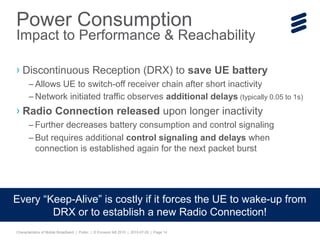
› Discontinuous Reception (DRX) to save UE battery
– Allows UE to switch-off receiver chain after short inactivity
– Network initiated traffic observes additional delays (typically 0.05 to 1s)
› Radio Connection released upon longer inactivity
– Further decreases battery consumption and control signaling
– But requires additional control signaling and delays when
connection is established again for the next packet burst
Power Consumption
Impact to Performance & Reachability
Every “Keep-Alive” is costly if it forces the UE to wake-up from
DRX or to establish a new Radio Connection!
Characteristics of Mobile Broadband | Public | © Ericsson AB 2015 | 2015-07-20 | Page 15
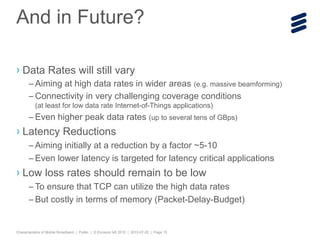
› Data Rates will still vary
– Aiming at high data rates in wider areas (e.g. massive beamforming)
– Connectivity in very challenging coverage conditions
(at least for low data rate Internet-of-Things applications)
– Even higher peak data rates (up to several tens of GBps)
› Latency Reductions
– Aiming initially at a reduction by a factor ~5-10
– Even lower latency is targeted for latency critical applications
› Low loss rates should remain to be low
– To ensure that TCP can utilize the high data rates
– But costly in terms of memory (Packet-Delay-Budget)
And in Future?
www.internetsociety.org
Blake Matheny
Facebook
16
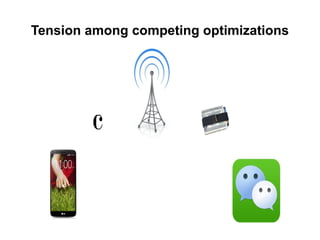
Tension among competing optimizations
Building blocks
Is it better for applications or
systems to use multiple building
block protocols that can be
swapped in and out, or single
protocols with a wide range of
applicability?
The Internet Society
Some aspects to consider
Approaches taken by application developers to deal
with terminal and connectivity diversity
Considerations for protocol developers
The impact of restricted connectivity on user behavior
Design principles that could be extrapolated from the
data and the technical responses to date
Interactions between power management and
connectivity management
The Internet Society
The Panel
Olaf Kolkman (Moderator)
Ted Hardie
Blake Matheny (Facebook)
Henning Wiemann (Ericsson)

Tackling Protocol Diversity: ISOC@IETF Panel at IETF 93

  • 1.
    www.internetsociety.org Tackling Connectivity Diversity: ProtocolChallenges for Constrained Radio Networks and Devices Olaf Kolkman, Moderator Chief Internet Technology Officer The Internet Society 1
  • 2.
    The Internet Society Weare… 2 Not at the IETF  Taking discussion up a level  Taking any identified work items to the appropriate IETF WGs “On the air”  Streaming  Recording Stopping at 12:45pm so you can all get back to the IETF…
  • 3.
    The Internet Society Agendaoutline 3 Overview Panelists’ introduction Framing discussion Open mic
  • 4.
    The Internet Society ThePanel Olaf Kolkman (Moderator) Ted Hardie Blake Matheny (Facebook) Henning Wiemann (Ericsson)
  • 5.
    The Internet Society Today’sdiscussion Disconnect between application development environments and application use environments  Handsets  Networks Does infrastructure need to change? Is this a transient condition? Is there a need for better design to cope with connectivity diversity? 5
  • 6.
    The Internet Society GlobalInternet Report Some charts from the Internet Society’s Global Internet Report 2015 More at: http://www.internetsociety.org/globalinternetreport/ 6
  • 7.
    The Internet Society Proportionof population covered by at least 3G 7
  • 8.
  • 9.
    The Internet Society TheDigital Divide 9
  • 10.
  • 11.
  • 12.
    Characteristics of Mobile BroadbandConnections … as seen from IP and above Henning Wiemann Ericsson Research 3GPP RAN2 Chairman
  • 13.
    Characteristics of MobileBroadband | Public | © Ericsson AB 2015 | 2015-07-20 | Page 13 › Packet Loss Rate seen on IP layer: < 10-6 – ARQ to avoid that TCP interprets transmission losses as congestion › Latency (RTT) in the order of tens of ms – Spikes due to error correction (ARQ) – Spikes due to Connection Establishment and DRX (see next slide) › Data Rates vary depending on channel conditions, network load, total carrier bandwidth, deployed features… – LTE today: ~100 kbps (at the coverage edge) to ~300 MBps (specs allow already much higher rates) Performance Data Rates, Latency, Loss Rate Be prepared for varying data rates! Latency is low but shows some spikes!
  • 14.
    Characteristics of MobileBroadband | Public | © Ericsson AB 2015 | 2015-07-20 | Page 14 › Discontinuous Reception (DRX) to save UE battery – Allows UE to switch-off receiver chain after short inactivity – Network initiated traffic observes additional delays (typically 0.05 to 1s) › Radio Connection released upon longer inactivity – Further decreases battery consumption and control signaling – But requires additional control signaling and delays when connection is established again for the next packet burst Power Consumption Impact to Performance & Reachability Every “Keep-Alive” is costly if it forces the UE to wake-up from DRX or to establish a new Radio Connection!
  • 15.
    Characteristics of MobileBroadband | Public | © Ericsson AB 2015 | 2015-07-20 | Page 15 › Data Rates will still vary – Aiming at high data rates in wider areas (e.g. massive beamforming) – Connectivity in very challenging coverage conditions (at least for low data rate Internet-of-Things applications) – Even higher peak data rates (up to several tens of GBps) › Latency Reductions – Aiming initially at a reduction by a factor ~5-10 – Even lower latency is targeted for latency critical applications › Low loss rates should remain to be low – To ensure that TCP can utilize the high data rates – But costly in terms of memory (Packet-Delay-Budget) And in Future?
  • 16.
  • 17.
  • 18.
  • 19.
    Building blocks Is itbetter for applications or systems to use multiple building block protocols that can be swapped in and out, or single protocols with a wide range of applicability?
  • 20.
    The Internet Society Someaspects to consider Approaches taken by application developers to deal with terminal and connectivity diversity Considerations for protocol developers The impact of restricted connectivity on user behavior Design principles that could be extrapolated from the data and the technical responses to date Interactions between power management and connectivity management
  • 21.
    The Internet Society ThePanel Olaf Kolkman (Moderator) Ted Hardie Blake Matheny (Facebook) Henning Wiemann (Ericsson)

Editor's Notes

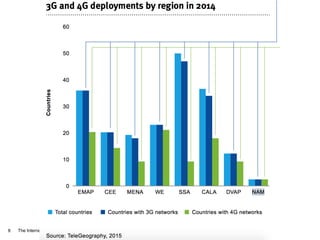
  • #9 Number of countries, most of them have 3 G networks (although not all!) while deployment of 4G networks still needs to be rolled out.
  • #10 This chart shows that while 94% of global population is covered by a cellular network, only 48% have 3G coverage, leaving room to increase availability. Further, only 28% have subscribed to a mobile Internet service, leaving room to increase adoption by focusing on affordability and relevance.
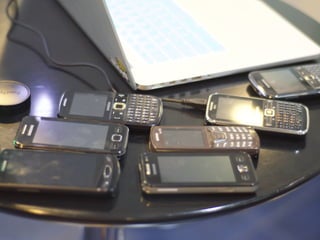
  • #11 And even when there is ubiqutous 4G then there is a deployed base of multiple types of devices.