FULL HD PLASTIC ™ REPORT
ΔL Δa Δb
1,37 2,18
0,64 0,93 1,78
0,78 0,92 1,10
Not reachable induced by glass
fibers
Rev.: A
T=140°C - Roctool - WITHT=80°C - Conventional - WITHOUT
PICTURES OF INJECTED SAMPLES
Ra (µm)
Rate replication from the mold surface (%)
Volume cavity (µm3
)
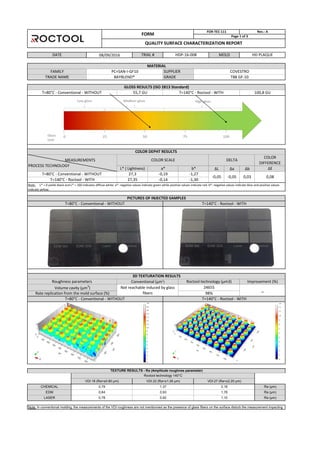
GLOSS RESULTS (ISO 2813 Standard)
T=80°C - Conventional - WITHOUT 55,7 GU 100,8 GUT=140°C - Roctool - WITH
Roctool technology 140°C
VDI 18 (Ra=±0.80 µm)
TRADE NAME BAYBLEND® GRADE T88 GF-10
DATE 08/09/2016 TRIAL # HDP-16-008 MOLD HD PLAQUE
MATERIAL
FAMILY PC+SAN-I-GF10 SUPPLIER COVESTRO
FORM
FOR-TEC-111
Page 1 of 3
QUALITY SURFACE CHARACTERIZATION REPORT
3D TEXTURATION RESULTS
T=80°C - Conventional - WITHOUT T=140°C - Roctool - WITH
Ra (µm)
Ra (µm)
LASER
-0,05 -0,05
T=140°C - Roctool - WITH
COLOR DEPHT RESULTS
Note: In conventional molding, the measurements of the VDI roughness are not mentionned as the presence of glass fibers on the surface disturb the measurement impacting
0,03
DELTACOLOR SCALE
L* ( Lightness)
MEASUREMENTS
PROCESS TECHNOLOGY
T=80°C - Conventional - WITHOUT
27,35 -0,14 -1,30
27,3
a*
-0,19
b*
-1,27
Note: L* = 0 yields black and L* = 100 indicates diffuse white. a*: negative values indicate green while positive values indicate red. b*: negative values indicate blue and positive values
indicate yellow.
EDM
0,08
ΔE
COLOR
DIFFERENCE
CHEMICAL
TEXTURE RESULTS - Ra (Amplitude roughnes parameter)
Conventional (µm3
) Roctool technology (µm3) Improvement (%)Roughness parameters
24655
98%
_
VDI 22 (Ra=±1.26 µm) VDI 27 (Ra=±2.20 µm)
0,79
COMMENTS
FORM
FOR-TEC-111 Rev.: A
Page 2 of 3
QUALITY SURFACE CHARACTERIZATION REPORT
Quality surface characterization:
1) Visible improvement using Roctool technology are observed: glass fibers are covered on the surface, weld line and sink mark are also removed.
2) These improvements are confirmed by the measurements of the gloss with 81% of improvement. Roctool technology allows to get a piano black
part with a perfect surface finish. No significant impact of Roctool on the color depth.
3) The different textured areas hightlight the positive impact on the replication using Roctool technology.
Also, the different roughnesses are well felt when touched. The roughness measurement carried out using optical rugosimeter confirms the above
with repliction rate of up to 98%.
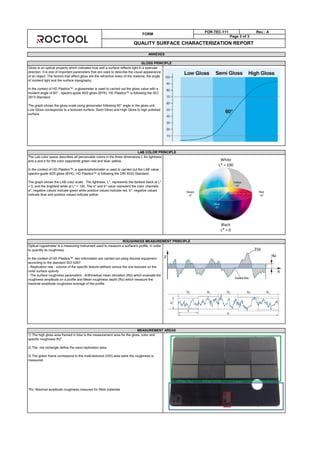
LAB COLOR PRINCIPLE
The Lab color space describes all perceivable colors in the three dimensions L for lightness
and a and b for the color opponents green–red and blue–yellow.
In the context of HD Plastics™, a spectrophotometer is used to carried out the LAB value :
spectro-guide 45/0 gloss (BYK). HD Plastics™ is following the DIN 5033 Standard.
The graph shows the LAB color scale. The lightness, L*, represents the darkest black at L*
= 0, and the brightest white at L* = 100. The a* and b* value represent the color channels.
a*: negative values indicate green while positive values indicate red. b*: negative values
indicate blue and positive values indicate yellow
ROUGHNESS MEASUREMENT PRINCIPLE
Optical rugosimeter is a measuring instrument used to measure a surface's profile, in order
to quantify its roughness.
In the context of HD Plastics™, two information are carried out using Alicona equipment
according to the standard ISO 4287:
- Replication rate : volume of the specific texture defined versus the one textured on the
mold surface quavity
- The surface roughness parameters : Arithmetical mean deviation (Ra) which evaluate the
roughness amplitude on a profile and Mean roughness depth (Rz) which measure the
maximal amplitude roughness average of the profile.
MEASUREMENT AREAS
1) The high gloss area framed in blue is the measurement area for the gloss, color and
specific roughness Rz* .
2) The red rectangle define the nano-replication area.
3) The green frame correspond to the multi-textured (VDI) area were the roughness is
measured.
*Rz: Maximal amplitude roughness mesured for filled materials
FORM
FOR-TEC-111 Rev.: A
Page 3 of 3
QUALITY SURFACE CHARACTERIZATION REPORT
ANNEXES
GLOSS PRINCIPLE
Gloss is an optical property which indicates how well a surface reflects light in a specular
direction. It is one of important parameters that are used to describe the visual appearance
of an object. The factors that affect gloss are the refractive index of the material, the angle
of incident light and the surface topography.
In the context of HD Plastics™, a glossmeter is used to carried out the gloss value with a
incident angle of 60° : spectro-guide 45/0 gloss (BYK). HD Plastics™ is following the ISO
2813 Standard.
The graph shows the gloss scale using glossmeter following 60° angle in the gloss unit.
Low Gloss corresponds to a textured surface, Semi Gloss and High Gloss to high polished
surface.
White
L* = 100
Black
L* = 0
Sensor 1 Sensor 2 Sensor 1 Sensor 2 Sensor 1 Sensor 2 Sensor 1 Sensor 2 Sensor 1 Sensor 2 Sensor 1 Sensor 2
356,2 84,4 796,6 396,6 1198,8 709,2 453,2 237,4 928,4 598 1385,2 950
Sensors
Mold Pressure Avg
Pressure Drop (%)
PRESSURE DROP BETWEEN THE TWO PRESSURE SENSORS
CONVENTIONAL TECHNOLOGY (80°C) ROCTOOL TECHNOLOGY (160°C)
Pressure (Bar) 500 1000 1500 500 1000 1500
100°C 25,0% 17,6% -20,7% -22,6% -26,7%
31,6% 26,9% 30,0% 120°C -25,9% -35,5% -33,3%
Pressure (Bar)
T=160°C - RocTool - WITH (1000 Bar)
120°C
SUPPLIER
15
COVESTRO
16,0% 100°C
500 1000 1500 Flow Length (cm) 5 10
Flow length improvement IMM Pressure improvement
140°C 47,4% 40,3% 41,3% 140°C -34,5% -48,4% -45,0%
FLOW LENGTH MEASUREMENT AT DIFFERENT IMM PRESSURE IMM PRESSURE DROP AT ISO FLOW LENGTH
FORM
FOR-TEC-101 Rev.: A
Page 1 of 2
FLOW AND PRESSURE STUDY REPORT
ROCTOOL TECHNOLOGY IMPROVEMENT VERSUS CONVENTIONAL TECHNOLOGY
TRADE NAME Bayblend® GRADE T88 GF10
PICTURES OF INJECTED SAMPLES
TRIAL # HDP-17-008 MOLD Spiral 1 mm
MATERIAL
FAMILY
08/09/2016DATE
T=80°C - Conventional - WITHOUT (1000 Bar)
PC+SAN-I-GF10
76,31% 50,21% 40,84% 47,62% 35,59% 31,42%
Sensor 1
Sensor 2
Sensor 1
Sensor 2
HDP-17-008 MOLD Spiral 1 mm
Note : All the injection trials and the pressure measurements were carried out according to the protocol defined by RocTool (injection process, 2 heating sides,
cold sprue, mold design).
All pressure data are measured using eDart system (RJG).
FORM
FOR-TEC-101
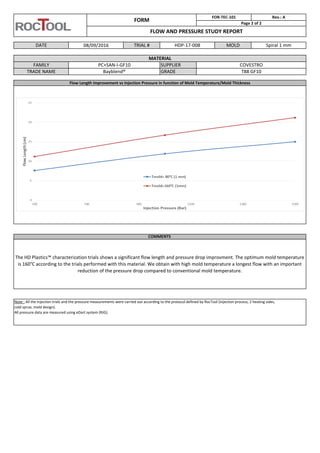
Flow Length improvement vs Injection Pressure in function of Mold Temperature/Mold Thickness
MATERIAL
FAMILY PC+SAN-I-GF10 SUPPLIER COVESTRO
TRADE NAME Bayblend® GRADE T88 GF10
Rev.: A
Page 2 of 2
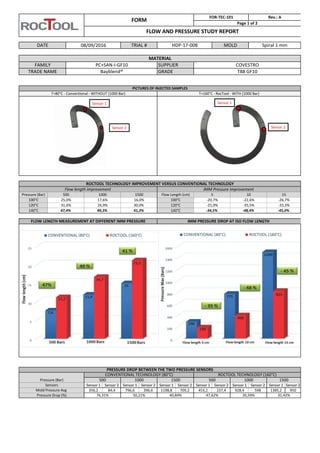
The HD Plastics™ characterization trials shows a significant flow length and pressure drop improvment. The optimum mold temperature
is 160°C according to the trials performed with this material. We obtain with high mold temperature a longest flow with an important
reduction of the pressure drop compared to conventional mold temperature.
COMMENTS
FLOW AND PRESSURE STUDY REPORT
DATE 08/09/2016 TRIAL #

T88 GF-10

  • 1.
    FULL HD PLASTIC™ REPORT
  • 2.
    ΔL Δa Δb 1,372,18 0,64 0,93 1,78 0,78 0,92 1,10 Not reachable induced by glass fibers Rev.: A T=140°C - Roctool - WITHT=80°C - Conventional - WITHOUT PICTURES OF INJECTED SAMPLES Ra (µm) Rate replication from the mold surface (%) Volume cavity (µm3 ) GLOSS RESULTS (ISO 2813 Standard) T=80°C - Conventional - WITHOUT 55,7 GU 100,8 GUT=140°C - Roctool - WITH Roctool technology 140°C VDI 18 (Ra=±0.80 µm) TRADE NAME BAYBLEND® GRADE T88 GF-10 DATE 08/09/2016 TRIAL # HDP-16-008 MOLD HD PLAQUE MATERIAL FAMILY PC+SAN-I-GF10 SUPPLIER COVESTRO FORM FOR-TEC-111 Page 1 of 3 QUALITY SURFACE CHARACTERIZATION REPORT 3D TEXTURATION RESULTS T=80°C - Conventional - WITHOUT T=140°C - Roctool - WITH Ra (µm) Ra (µm) LASER -0,05 -0,05 T=140°C - Roctool - WITH COLOR DEPHT RESULTS Note: In conventional molding, the measurements of the VDI roughness are not mentionned as the presence of glass fibers on the surface disturb the measurement impacting 0,03 DELTACOLOR SCALE L* ( Lightness) MEASUREMENTS PROCESS TECHNOLOGY T=80°C - Conventional - WITHOUT 27,35 -0,14 -1,30 27,3 a* -0,19 b* -1,27 Note: L* = 0 yields black and L* = 100 indicates diffuse white. a*: negative values indicate green while positive values indicate red. b*: negative values indicate blue and positive values indicate yellow. EDM 0,08 ΔE COLOR DIFFERENCE CHEMICAL TEXTURE RESULTS - Ra (Amplitude roughnes parameter) Conventional (µm3 ) Roctool technology (µm3) Improvement (%)Roughness parameters 24655 98% _ VDI 22 (Ra=±1.26 µm) VDI 27 (Ra=±2.20 µm) 0,79
  • 3.
    COMMENTS FORM FOR-TEC-111 Rev.: A Page2 of 3 QUALITY SURFACE CHARACTERIZATION REPORT Quality surface characterization: 1) Visible improvement using Roctool technology are observed: glass fibers are covered on the surface, weld line and sink mark are also removed. 2) These improvements are confirmed by the measurements of the gloss with 81% of improvement. Roctool technology allows to get a piano black part with a perfect surface finish. No significant impact of Roctool on the color depth. 3) The different textured areas hightlight the positive impact on the replication using Roctool technology. Also, the different roughnesses are well felt when touched. The roughness measurement carried out using optical rugosimeter confirms the above with repliction rate of up to 98%.
  • 4.
    LAB COLOR PRINCIPLE TheLab color space describes all perceivable colors in the three dimensions L for lightness and a and b for the color opponents green–red and blue–yellow. In the context of HD Plastics™, a spectrophotometer is used to carried out the LAB value : spectro-guide 45/0 gloss (BYK). HD Plastics™ is following the DIN 5033 Standard. The graph shows the LAB color scale. The lightness, L*, represents the darkest black at L* = 0, and the brightest white at L* = 100. The a* and b* value represent the color channels. a*: negative values indicate green while positive values indicate red. b*: negative values indicate blue and positive values indicate yellow ROUGHNESS MEASUREMENT PRINCIPLE Optical rugosimeter is a measuring instrument used to measure a surface's profile, in order to quantify its roughness. In the context of HD Plastics™, two information are carried out using Alicona equipment according to the standard ISO 4287: - Replication rate : volume of the specific texture defined versus the one textured on the mold surface quavity - The surface roughness parameters : Arithmetical mean deviation (Ra) which evaluate the roughness amplitude on a profile and Mean roughness depth (Rz) which measure the maximal amplitude roughness average of the profile. MEASUREMENT AREAS 1) The high gloss area framed in blue is the measurement area for the gloss, color and specific roughness Rz* . 2) The red rectangle define the nano-replication area. 3) The green frame correspond to the multi-textured (VDI) area were the roughness is measured. *Rz: Maximal amplitude roughness mesured for filled materials FORM FOR-TEC-111 Rev.: A Page 3 of 3 QUALITY SURFACE CHARACTERIZATION REPORT ANNEXES GLOSS PRINCIPLE Gloss is an optical property which indicates how well a surface reflects light in a specular direction. It is one of important parameters that are used to describe the visual appearance of an object. The factors that affect gloss are the refractive index of the material, the angle of incident light and the surface topography. In the context of HD Plastics™, a glossmeter is used to carried out the gloss value with a incident angle of 60° : spectro-guide 45/0 gloss (BYK). HD Plastics™ is following the ISO 2813 Standard. The graph shows the gloss scale using glossmeter following 60° angle in the gloss unit. Low Gloss corresponds to a textured surface, Semi Gloss and High Gloss to high polished surface. White L* = 100 Black L* = 0
  • 5.
    Sensor 1 Sensor2 Sensor 1 Sensor 2 Sensor 1 Sensor 2 Sensor 1 Sensor 2 Sensor 1 Sensor 2 Sensor 1 Sensor 2 356,2 84,4 796,6 396,6 1198,8 709,2 453,2 237,4 928,4 598 1385,2 950 Sensors Mold Pressure Avg Pressure Drop (%) PRESSURE DROP BETWEEN THE TWO PRESSURE SENSORS CONVENTIONAL TECHNOLOGY (80°C) ROCTOOL TECHNOLOGY (160°C) Pressure (Bar) 500 1000 1500 500 1000 1500 100°C 25,0% 17,6% -20,7% -22,6% -26,7% 31,6% 26,9% 30,0% 120°C -25,9% -35,5% -33,3% Pressure (Bar) T=160°C - RocTool - WITH (1000 Bar) 120°C SUPPLIER 15 COVESTRO 16,0% 100°C 500 1000 1500 Flow Length (cm) 5 10 Flow length improvement IMM Pressure improvement 140°C 47,4% 40,3% 41,3% 140°C -34,5% -48,4% -45,0% FLOW LENGTH MEASUREMENT AT DIFFERENT IMM PRESSURE IMM PRESSURE DROP AT ISO FLOW LENGTH FORM FOR-TEC-101 Rev.: A Page 1 of 2 FLOW AND PRESSURE STUDY REPORT ROCTOOL TECHNOLOGY IMPROVEMENT VERSUS CONVENTIONAL TECHNOLOGY TRADE NAME Bayblend® GRADE T88 GF10 PICTURES OF INJECTED SAMPLES TRIAL # HDP-17-008 MOLD Spiral 1 mm MATERIAL FAMILY 08/09/2016DATE T=80°C - Conventional - WITHOUT (1000 Bar) PC+SAN-I-GF10 76,31% 50,21% 40,84% 47,62% 35,59% 31,42% Sensor 1 Sensor 2 Sensor 1 Sensor 2
  • 6.
    HDP-17-008 MOLD Spiral1 mm Note : All the injection trials and the pressure measurements were carried out according to the protocol defined by RocTool (injection process, 2 heating sides, cold sprue, mold design). All pressure data are measured using eDart system (RJG). FORM FOR-TEC-101 Flow Length improvement vs Injection Pressure in function of Mold Temperature/Mold Thickness MATERIAL FAMILY PC+SAN-I-GF10 SUPPLIER COVESTRO TRADE NAME Bayblend® GRADE T88 GF10 Rev.: A Page 2 of 2 The HD Plastics™ characterization trials shows a significant flow length and pressure drop improvment. The optimum mold temperature is 160°C according to the trials performed with this material. We obtain with high mold temperature a longest flow with an important reduction of the pressure drop compared to conventional mold temperature. COMMENTS FLOW AND PRESSURE STUDY REPORT DATE 08/09/2016 TRIAL #