The   Amazing Tyrannosaurus Rex By Nathaniel  Michael Rutter
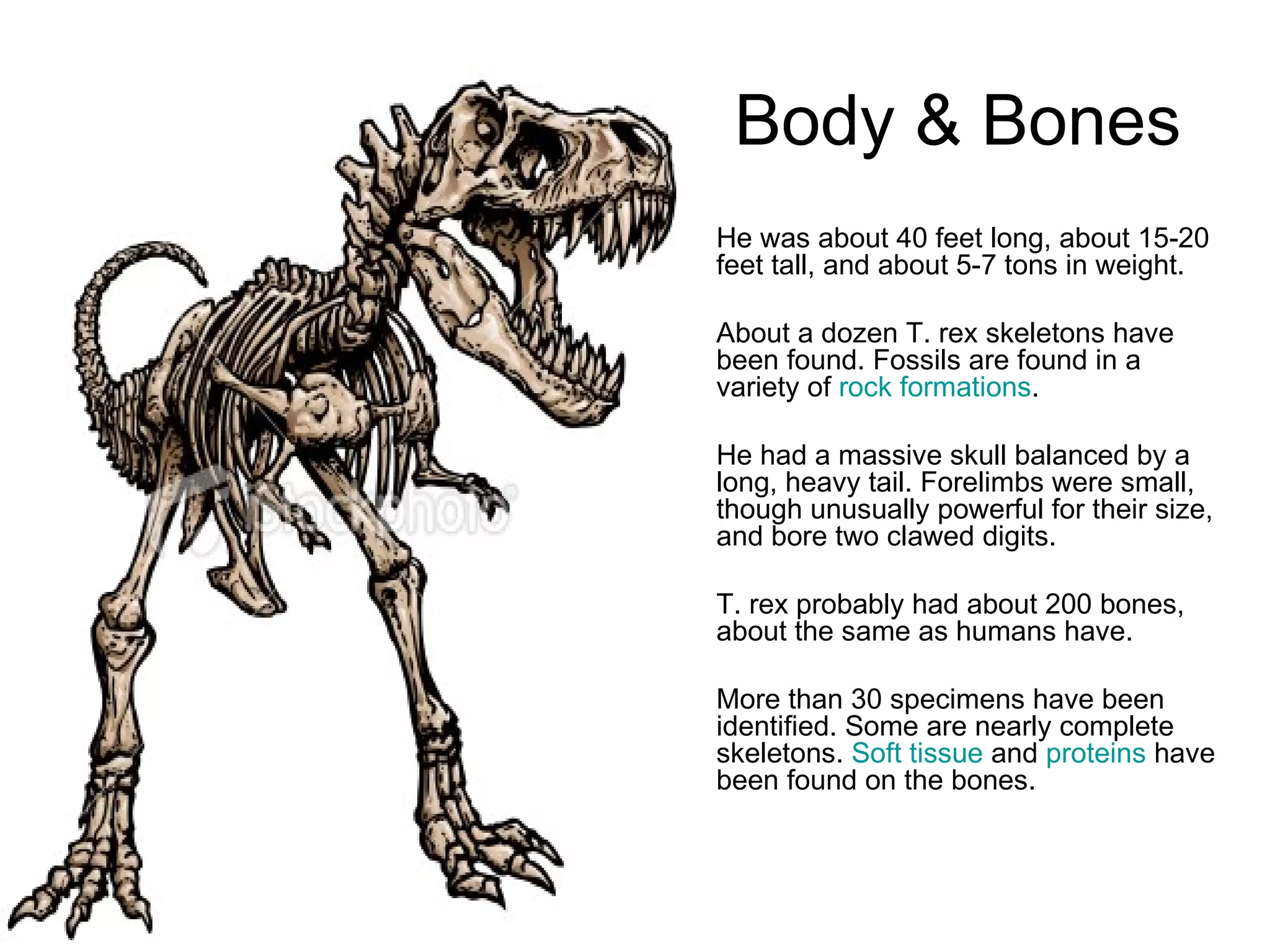
Body & Bones He was about 40 feet long, about 15-20 feet tall, and about 5-7 tons in weight.  About a dozen T. rex skeletons have been found. Fossils are found in a variety of  rock formations .  He had a massive skull balanced by a long, heavy tail. Forelimbs were small, though unusually powerful for their size, and bore two clawed digits. T. rex probably had about 200 bones, about the same as humans have.  More than 30 specimens have been identified. Some are nearly complete skeletons.  Soft tissue  and  proteins  have been found on the bones.
When did he live? Tyrannosaurus  was of the  genus  “ theropod   dinosaur .“ The  species   Tyrannosaurus “rex”  (rex meaning 'king' in Latin) lived throughout what is now western North America. T. rex lived during the late  Cretaceous period , about 85 million to 65 million years ago -- toward the end of the  Mesozoic Era . This was known as the AGE OF REPTILES.  During this time, the Earth was seismically active, and there were many volcanic eruptions. The supercontinent Pangaea had broken up and the subcontinents were  drifting  apart. There were no polar ice caps, the sea level was higher than it is now, and the climate was warmer. These creatures lived at the same time:  Triceratops  (which was probably preyed upon by T. rex),  Ankylosaurus  (an armored herbivore),  Maiasaura  (a plant-eater), Edmontonia (a plated dinosaur),  Anatotitan  (a duck-billed dinosaur),  Pachycephalosaurus (a crested, plant-eating dinosaur),  Parasaurolophus (a duck-billed dinosaur),  Quetzalcoatlus  (a huge flying reptile, not a dinosaur),  Corythosaurus  (a helmet-crested,  duck-billed  dinosaur),  Styracosaurus , and many other fascinating creatures.
How big are his teeth? As big as a car? As a house? As a tree?  FIND OUT NOW >>
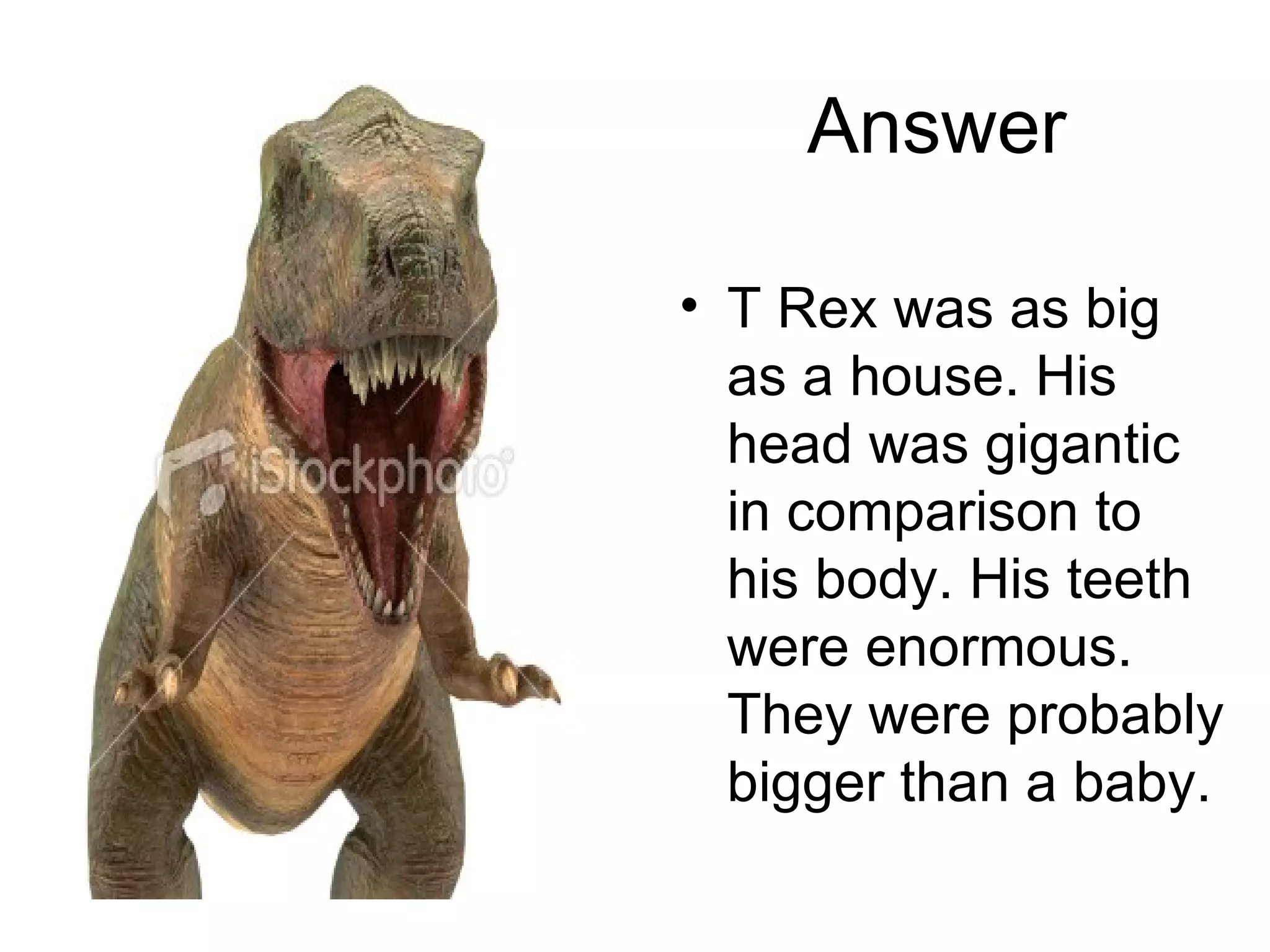
Answer T Rex was as big as a house. His head was gigantic in comparison to his body. His teeth were enormous. They were probably bigger than a baby.
Food: Predator or Scavenger? Tyrannosaurus  was a  bipedal   carnivore .  Because he was a meat-eater and walked on two feet, it probably affected which foods he chose. Tyrannosaurus rex  may have been an  apex predator , preying upon  hadrosaurs  and  ceratopsians , although some experts have suggested it was primarily a  scavenger . This question is still unsolved among  paleontologists .
Was he smart? T. rex was a smart dinosaur. His brain was larger than most other dinosaurs. T. rex's brain was larger than the human brain, but the cerebrum (the part of the brain that we use for thinking) was tiny.  T. rex's brain was long and shaped like a tube. Only very advanced dinosaurs and carnosaurs were probably smarter than T. rex.
Did he run or walk? T. rex walked on two legs. He was bipedal. Its slim, pointed tail provided balance and quick turning while running. It held its tail erect, and did not drag it on the ground.  Because of the many fossils discovered in good condition, scientists are able to determine quite a bit about the creature’s  biomechanics .  T. rex may or may not have been a fast runner.  It was among the last non- avian  dinosaurs to exist. He was not related to today’s birds, and he did not have the capacity to fly. Experts do not agree on the creature’s feeding habits, body shape, and potential speed when walking and running.
EXTINCTION Going, going, gone …
Too big for his own good? Cope's Rule says that creatures evolve to become more massive over time.  Although being bigger increases speed, intelligence and fitness, it means the species is more vulnerable to extinction.
Myths T. rex did not live during the  Jurassic period , as many people think. Instead it lived millions of years later, during the late  Cretaceous period , many millions of years ago. T. rex was not the king of the dinosaurs (but its species name rex does mean king). Dinosaurs didn't have kings or any hierarchy in their species, like today’s mammals often do. It was not necessarily green. No one knows what color it was.  T. rex was not mean. He was just an animal that ate other animals to survive. Reptiles do not have complicated emotions.  T. rex wasn't the biggest dinosaur. There were long-necked plant-eating dinosaurs that were bigger. Also, there were at least two other meat-eating dinosaurs that were bigger than T. rex. T. rex did not eat cave people. The dinosaurs did not live at the same time that cave men did. Primitive people lived 63 million years (63,000,000 million) after T. rex went extinct.  T. rex was not the smartest dinosaur. But he was smart!
Want to know more? Listen to  Ayrowhead’s hit song “King Lizzie” on YouTube. Our B-side song is “Carny,” which is about carnivorous beasts of all types. Visit us and let us know what you think at our fan website  www.ayrowhead.com Copyright 2010 © The Ayrowhead Project

T Rex

  • 1.
    The Amazing Tyrannosaurus Rex By Nathaniel Michael Rutter
  • 2.
    Body & BonesHe was about 40 feet long, about 15-20 feet tall, and about 5-7 tons in weight. About a dozen T. rex skeletons have been found. Fossils are found in a variety of rock formations . He had a massive skull balanced by a long, heavy tail. Forelimbs were small, though unusually powerful for their size, and bore two clawed digits. T. rex probably had about 200 bones, about the same as humans have. More than 30 specimens have been identified. Some are nearly complete skeletons. Soft tissue and proteins have been found on the bones.
  • 3.
    When did helive? Tyrannosaurus was of the genus “ theropod dinosaur .“ The species Tyrannosaurus “rex” (rex meaning 'king' in Latin) lived throughout what is now western North America. T. rex lived during the late Cretaceous period , about 85 million to 65 million years ago -- toward the end of the Mesozoic Era . This was known as the AGE OF REPTILES. During this time, the Earth was seismically active, and there were many volcanic eruptions. The supercontinent Pangaea had broken up and the subcontinents were drifting apart. There were no polar ice caps, the sea level was higher than it is now, and the climate was warmer. These creatures lived at the same time: Triceratops (which was probably preyed upon by T. rex), Ankylosaurus (an armored herbivore), Maiasaura (a plant-eater), Edmontonia (a plated dinosaur), Anatotitan (a duck-billed dinosaur), Pachycephalosaurus (a crested, plant-eating dinosaur), Parasaurolophus (a duck-billed dinosaur), Quetzalcoatlus (a huge flying reptile, not a dinosaur), Corythosaurus (a helmet-crested, duck-billed dinosaur), Styracosaurus , and many other fascinating creatures.
  • 4.
    How big arehis teeth? As big as a car? As a house? As a tree? FIND OUT NOW >>
  • 5.
    Answer T Rexwas as big as a house. His head was gigantic in comparison to his body. His teeth were enormous. They were probably bigger than a baby.
  • 6.
    Food: Predator orScavenger? Tyrannosaurus was a bipedal carnivore . Because he was a meat-eater and walked on two feet, it probably affected which foods he chose. Tyrannosaurus rex may have been an apex predator , preying upon hadrosaurs and ceratopsians , although some experts have suggested it was primarily a scavenger . This question is still unsolved among paleontologists .
  • 7.
    Was he smart?T. rex was a smart dinosaur. His brain was larger than most other dinosaurs. T. rex's brain was larger than the human brain, but the cerebrum (the part of the brain that we use for thinking) was tiny. T. rex's brain was long and shaped like a tube. Only very advanced dinosaurs and carnosaurs were probably smarter than T. rex.
  • 8.
    Did he runor walk? T. rex walked on two legs. He was bipedal. Its slim, pointed tail provided balance and quick turning while running. It held its tail erect, and did not drag it on the ground. Because of the many fossils discovered in good condition, scientists are able to determine quite a bit about the creature’s biomechanics . T. rex may or may not have been a fast runner. It was among the last non- avian dinosaurs to exist. He was not related to today’s birds, and he did not have the capacity to fly. Experts do not agree on the creature’s feeding habits, body shape, and potential speed when walking and running.
  • 9.
  • 10.
    Too big forhis own good? Cope's Rule says that creatures evolve to become more massive over time. Although being bigger increases speed, intelligence and fitness, it means the species is more vulnerable to extinction.
  • 11.
    Myths T. rexdid not live during the Jurassic period , as many people think. Instead it lived millions of years later, during the late Cretaceous period , many millions of years ago. T. rex was not the king of the dinosaurs (but its species name rex does mean king). Dinosaurs didn't have kings or any hierarchy in their species, like today’s mammals often do. It was not necessarily green. No one knows what color it was. T. rex was not mean. He was just an animal that ate other animals to survive. Reptiles do not have complicated emotions. T. rex wasn't the biggest dinosaur. There were long-necked plant-eating dinosaurs that were bigger. Also, there were at least two other meat-eating dinosaurs that were bigger than T. rex. T. rex did not eat cave people. The dinosaurs did not live at the same time that cave men did. Primitive people lived 63 million years (63,000,000 million) after T. rex went extinct. T. rex was not the smartest dinosaur. But he was smart!
  • 12.
    Want to knowmore? Listen to Ayrowhead’s hit song “King Lizzie” on YouTube. Our B-side song is “Carny,” which is about carnivorous beasts of all types. Visit us and let us know what you think at our fan website www.ayrowhead.com Copyright 2010 © The Ayrowhead Project