Systemic
Hypertension
DR. AH JAWID YOUSUFI
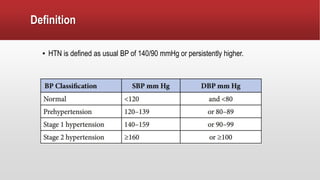
Definition
▪ HTN is defined as usual BP of 140/90 mmHg or persistently higher.
Hypertension and Its risk
▪ Doubles the risk of cardiovascular diseases.
▪ Approximately 7.6 million deaths (13 –15% of the total) and 92 million disability
adjusted life years worldwide
▪ Often is associated with additional cardiovascular disease risk factors.
▪ Antihypertensive therapy clearly reduces the risks of cardiovascular and renal
disease
▪ But large segments of the hypertensive population are either untreated or
inadequately treated.
Mechanisms of Hypertension
▪ Determinants of arterial pressure:
 Cardiac output
▪ Stroke volume
▪ Heart Rate
 Peripheral resistance
• Vascular structure
• Vascular functions
Etiology & Classification
▪ Primary Essential Hypertension
• It is the term applied to the 95% of hypertensive patients.
• Blood pressure results from complex interactions between multiple genetic
and environmental factors.
• Essential hypertension occurs in 10–15% of white adults and 20–30% of
black adults.
• The onset is usually between ages 25 and 50 years; it is uncommon before
age 20 years.
Essential Hypertension
▪ Pathways that underlying hypertension
• Over activation of the sympathetic nervous and renin–angiotensin– aldosterone
systems.
• Blunting of the pressure-natriuresis relationship.
• Variation in cardiovascular and renal development.
• Elevated intracellular sodium and calcium levels.
▪ Predisposing factors
▪ Genetic factors
▪ Age
▪ Race
▪ Family history
▪ Environmental factors
Conti…
▪ Environmental factors
• Obesity
• Sleep apnea
• Increased salt intake
• Cigarette smoking
• Exercise
• Polycythemia
• NSAIDs
• Low potassium intake
• Vit D deficiency
• Stress
• Alcohol intake
Secondary Hypertension
▪ Approximately 5% of patients have hypertension secondary to identifiable specific
causes.
▪ Secondary hypertension should be suspected in patients in whom:
o Hypertension develops at an early age or after the age of 50 years.
o In those, previously well controlled who become refractory to treatment.
▪ Secondary HTN causes
o Genetic syndromes
o Kidney disease
o Renal vascular disease
o Primary hyperaldosteronism
o Cushing syndrome
o Pheochromocytoma
o Coarctation of the aorta
o Hypertension associated with pregnancy
o Hypercalcemia and medications.
Conti…
▪ Genetic causes
 Glucocorticoid remediable aldosteronism
 Syndrome of apparent mineralocorticoid excess
 Hypertension exacerbated in pregnancy
 Liddle syndrome
▪ Kidney disease: Renal parenchymal disease is the most common cause of
secondary hypertension.
 Increased intravascular volume
 Increased activity of the renin–angiotensin–aldosterone system
Conti…
▪ Renal vascular hypertension: Renal artery stenosis is present in 1–2% of
hypertensive patients. The most common cause is:
 Atherosclerosis
 Excessive renin release
Renal vascular hypertension should be suspected in the following
circumstances:
 The documented onset is before age 20 or after age 50 years.
 Hypertension is resistant to three or more drugs.
 Epigastric or renal artery bruits.
 Atherosclerotic disease of the aorta or peripheral arteries.
 An abrupt increase (more than 25%) in the level of serum creatinine after
administration of angiotensin-converting enzyme (ACE) inhibitors.
Conti…
▪ Primary Hyperaldosteronism: should be considered in people with resistant
hypertension.
 Blood pressures consistently greater than 150/100 mm Hg
 Hypokalemia
 Family history of hyperaldosteronism
 Plasma aldosterone concentration is elevated
▪ Cushing syndrome: Hypertension occurs in about 80% of patients with
spontaneous Cushing syndrome.
 Glucocorticoid may act through salt and water retention (via mineralocorticoid
effects)
 Increased angiotensinogen levels
 Permissive effects in the regulation of vascular tone
Conti…
▪ Pheochromocytoma
 Uncommon, 0.1% of all patients with hypertension, two individuals per million
population.
 Blood pressure elevation caused by the catecholamine.
▪ Coarctation of the aorta
▪ Hypertension associated with pregnancy
Clinical Findings
▪ The clinical and laboratory findings are mainly referable to involvement of the
target organs: heart, brain, kidneys, eyes, and peripheral arteries.
▪ Symptoms
▪ Mild to moderate primary (essential) hypertension is largely asymptomatic for
many years.
▪ The most frequent symptom, headache, is also very nonspecific.
▪ Accelerated hypertension is associated with somnolence, confusion, visual
disturbances, and nausea and vomiting (Hypertensive Encephalopathy).
▪ Secondary HTN symptoms maybe exist.
▪ Complication symptoms
Conti…
▪ Signs
 Physical findings depend on the cause of hypertension, its duration and severity
 Blood pressure
 Left ventricular heave indicates severe hypertrophy
 Radial-femoral delay suggests coarctation of the aorta
▪ Laboratory Findings: Recommended testing includes:
 Hemoglobin
 Urinalysis and serum creatinine
 Fasting blood sugar level
 Plasma lipids
 Serum electrolytes
 Serum uric acid
Conti…
▪ Electrocardiography and Chest Radiographs
 Left ventricular hypertrophy
 Chest radiograph is not necessary in the workup for uncomplicated hypertension.
▪ Echocardiography
 Echocardiography should be to evaluate patients with clinical symptoms or signs of
cardiac disease.
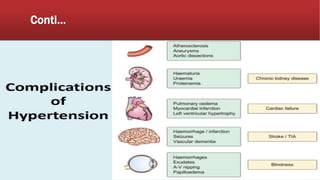
Complications of Untreated Hypertension
▪ Hypertensive Cardiovascular Disease
▪ Hypertensive Cerebrovascular Disease and Dementia
▪ Hypertensive Kidney Disease
▪ Aortic Dissection
▪ Retinas
▪ Metabolic syndrome
▪ Aneurysms
Conti…
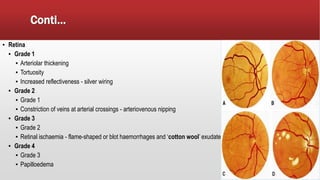
▪ Retina
▪ Grade 1
▪ Arteriolar thickening
▪ Tortuosity
▪ Increased reflectiveness - silver wiring
▪ Grade 2
▪ Grade 1
▪ Constriction of veins at arterial crossings - arteriovenous nipping
▪ Grade 3
▪ Grade 2
▪ Retinal ischaemia - flame-shaped or blot haemorrhages and ‘cotton wool’ exudates
▪ Grade 4
▪ Grade 3
▪ Papilloedema
Conti…

Systemic Hypertension

  • 1.
  • 2.
    Definition ▪ HTN isdefined as usual BP of 140/90 mmHg or persistently higher.
  • 3.
    Hypertension and Itsrisk ▪ Doubles the risk of cardiovascular diseases. ▪ Approximately 7.6 million deaths (13 –15% of the total) and 92 million disability adjusted life years worldwide ▪ Often is associated with additional cardiovascular disease risk factors. ▪ Antihypertensive therapy clearly reduces the risks of cardiovascular and renal disease ▪ But large segments of the hypertensive population are either untreated or inadequately treated.
  • 4.
    Mechanisms of Hypertension ▪Determinants of arterial pressure:  Cardiac output ▪ Stroke volume ▪ Heart Rate  Peripheral resistance • Vascular structure • Vascular functions
  • 5.
    Etiology & Classification ▪Primary Essential Hypertension • It is the term applied to the 95% of hypertensive patients. • Blood pressure results from complex interactions between multiple genetic and environmental factors. • Essential hypertension occurs in 10–15% of white adults and 20–30% of black adults. • The onset is usually between ages 25 and 50 years; it is uncommon before age 20 years.
  • 6.
    Essential Hypertension ▪ Pathwaysthat underlying hypertension • Over activation of the sympathetic nervous and renin–angiotensin– aldosterone systems. • Blunting of the pressure-natriuresis relationship. • Variation in cardiovascular and renal development. • Elevated intracellular sodium and calcium levels. ▪ Predisposing factors ▪ Genetic factors ▪ Age ▪ Race ▪ Family history ▪ Environmental factors
  • 7.
    Conti… ▪ Environmental factors •Obesity • Sleep apnea • Increased salt intake • Cigarette smoking • Exercise • Polycythemia • NSAIDs • Low potassium intake • Vit D deficiency • Stress • Alcohol intake
  • 8.
    Secondary Hypertension ▪ Approximately5% of patients have hypertension secondary to identifiable specific causes. ▪ Secondary hypertension should be suspected in patients in whom: o Hypertension develops at an early age or after the age of 50 years. o In those, previously well controlled who become refractory to treatment. ▪ Secondary HTN causes o Genetic syndromes o Kidney disease o Renal vascular disease o Primary hyperaldosteronism o Cushing syndrome o Pheochromocytoma o Coarctation of the aorta o Hypertension associated with pregnancy o Hypercalcemia and medications.
  • 9.
    Conti… ▪ Genetic causes Glucocorticoid remediable aldosteronism  Syndrome of apparent mineralocorticoid excess  Hypertension exacerbated in pregnancy  Liddle syndrome ▪ Kidney disease: Renal parenchymal disease is the most common cause of secondary hypertension.  Increased intravascular volume  Increased activity of the renin–angiotensin–aldosterone system
  • 10.
    Conti… ▪ Renal vascularhypertension: Renal artery stenosis is present in 1–2% of hypertensive patients. The most common cause is:  Atherosclerosis  Excessive renin release Renal vascular hypertension should be suspected in the following circumstances:  The documented onset is before age 20 or after age 50 years.  Hypertension is resistant to three or more drugs.  Epigastric or renal artery bruits.  Atherosclerotic disease of the aorta or peripheral arteries.  An abrupt increase (more than 25%) in the level of serum creatinine after administration of angiotensin-converting enzyme (ACE) inhibitors.
  • 11.
    Conti… ▪ Primary Hyperaldosteronism:should be considered in people with resistant hypertension.  Blood pressures consistently greater than 150/100 mm Hg  Hypokalemia  Family history of hyperaldosteronism  Plasma aldosterone concentration is elevated ▪ Cushing syndrome: Hypertension occurs in about 80% of patients with spontaneous Cushing syndrome.  Glucocorticoid may act through salt and water retention (via mineralocorticoid effects)  Increased angiotensinogen levels  Permissive effects in the regulation of vascular tone
  • 12.
    Conti… ▪ Pheochromocytoma  Uncommon,0.1% of all patients with hypertension, two individuals per million population.  Blood pressure elevation caused by the catecholamine. ▪ Coarctation of the aorta ▪ Hypertension associated with pregnancy
  • 13.
    Clinical Findings ▪ Theclinical and laboratory findings are mainly referable to involvement of the target organs: heart, brain, kidneys, eyes, and peripheral arteries. ▪ Symptoms ▪ Mild to moderate primary (essential) hypertension is largely asymptomatic for many years. ▪ The most frequent symptom, headache, is also very nonspecific. ▪ Accelerated hypertension is associated with somnolence, confusion, visual disturbances, and nausea and vomiting (Hypertensive Encephalopathy). ▪ Secondary HTN symptoms maybe exist. ▪ Complication symptoms
  • 14.
    Conti… ▪ Signs  Physicalfindings depend on the cause of hypertension, its duration and severity  Blood pressure  Left ventricular heave indicates severe hypertrophy  Radial-femoral delay suggests coarctation of the aorta ▪ Laboratory Findings: Recommended testing includes:  Hemoglobin  Urinalysis and serum creatinine  Fasting blood sugar level  Plasma lipids  Serum electrolytes  Serum uric acid
  • 15.
    Conti… ▪ Electrocardiography andChest Radiographs  Left ventricular hypertrophy  Chest radiograph is not necessary in the workup for uncomplicated hypertension. ▪ Echocardiography  Echocardiography should be to evaluate patients with clinical symptoms or signs of cardiac disease.
  • 16.
    Complications of UntreatedHypertension ▪ Hypertensive Cardiovascular Disease ▪ Hypertensive Cerebrovascular Disease and Dementia ▪ Hypertensive Kidney Disease ▪ Aortic Dissection ▪ Retinas ▪ Metabolic syndrome ▪ Aneurysms
  • 17.
    Conti… ▪ Retina ▪ Grade1 ▪ Arteriolar thickening ▪ Tortuosity ▪ Increased reflectiveness - silver wiring ▪ Grade 2 ▪ Grade 1 ▪ Constriction of veins at arterial crossings - arteriovenous nipping ▪ Grade 3 ▪ Grade 2 ▪ Retinal ischaemia - flame-shaped or blot haemorrhages and ‘cotton wool’ exudates ▪ Grade 4 ▪ Grade 3 ▪ Papilloedema
  • 18.