+
THE THERAC-25
- A SOFTWARE FATAL FAILURE
Kpea, Aagbara Saturday
SYSM 6309
Spring ’12
UT-Dallas
+
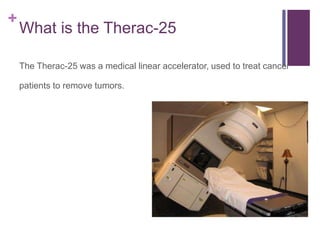
What is the Therac-25
The Therac-25 was a medical linear accelerator, used to treat cancer
patients to remove tumors.
+Background Information
 Early1970’s, AECL (Atomic Energy of Canada Limited)and a French
Company (CGR) collaborate to build Medical Linear Accelerators
(linacs).
 They develop Therac-6, and Therac-20.
 AECL and CGR end their working relationship in 1981.
 In 1976, AECL develops the revolutionary "double pass" accelerator
which leads to the development of Therac-25.
 In March, 1983, AECL performs a safety analysis of Therac-25 which
apparently excludes an analysis of software.
+
Background info …
 July 29,1983, the Canadian Consulate General announces the
introduction of the new "Therac 25" Machine manufactured by AECL
Medical, a division of Atomic Energy of Canada Limited.
 Medical linear accelerators (linacs) known generally as “Therac-25”.
+ How Therac-25 works:
Generating an Electron Beam
 Linear accelerator works just like the computer monitor
 The electrons are accelerated by the gun in the back of the monitor
and directed at the inside of the screen
 A medical linear accelerator produces a beam of electrons about
1,000 times more powerful than the standard computer monitor
 Medical linear accelerators accelerate electrons to create high-
energy beams that can destroy tumors with minimal impact on
surrounding healthy tissue
 The Therac-25 is designed to fold beam back and forth in order to
produce long acceleration to fit into smaller space
+
Getting the Beam into the Body
 Shallow tissue is treated with accelerated electrons
Scanning magnets placed in the way of the beam;
the spread of the beam (and thus its power) could
be controlled by a magnetic fields generated by
these magnets
 Deeper tissue is treated with X-ray photons
The X-ray beam is flattened by a device in the
machine to direct the appropriate intensity to the
patient.
 Beams kill (or retard the growth of) the cancerous tissues
+ Accident with Therac-25
 At East Texas Cancer Center in Tyler, Texas, a
patient complains of a bright flash of light, heard a frying, buzzing
sound, and felt a thump and heat like an electric shock.
 This indicates radiation overdose by Therac-25 machines after
cancer treatment session
 A few days after the unit was put back into operation, another patient
complained that his face felt like it was on fire.
 Another potential overdose of radiation beam by Therac-25.
 Both patients died after 4months and 3 weeks respectively due to
administered overdose of radiation
+
Accidents with Therac-25 … contd
 At Yakima Valley, Washington in January 1987, another
incident of overdose with Therac-25 occurred
 Performed two film exposures
 Patient developed severe striped burns after treatments, an
indication of overdose
 Patient died in April as a result
+Reasons for the cause of the accidents
At Texas facility;
 Operator selected x-rays by mistake, used cursor keys to change to electrons
 Machine tripped with “Malfunction 54”
 – Documentation explains this is “dose input 2” error
 Operator saw “beam ready” proceeded; machine tripped again
At Washington facility;
 Operator used hand controls to rotate table to field-light position & check
alignment
 Operator set machine but forgot to remove film
 Operator turned beam on, machine showed no dose and displayed fleeting
message
 Operator proceeded from pause; After another machine pause, operator
reentered room
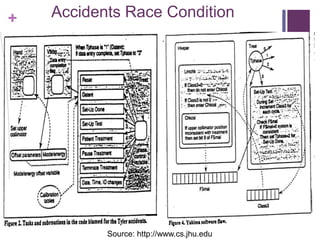
+ Accidents Race Condition
Source: http://www.cs.jhu.edu
+ Root Cause Analysis of the Accidents
 Software code was not independently reviewed.
 AECL did not consider the design of the software during its assessment of how
the machine might produce the desired results and what failure modes existed. –
No proper risk assessment followed.
 The system noticed that something was wrong and halted the X-ray beam, but
merely displayed the word "MALFUNCTION" followed by a number from 1 to 64.
The user manual did not explain or even address the error codes, so the
operator pressed the P key to override the warning and proceed anyway.
 AECL personnel, as well as machine operators, initially did not believe
complaints. This was likely due to overconfidence
 AECL had never tested the Therac-25 with the combination of software and
hardware until it was assembled at the hospital.
 The problem was a race condition produced by a flaw in the software
programming.
 Management inadequacies and lack of procedures for following through on all
reported incident.
 The engineer had reused software from older models. These models had
hardware interlocks that masked their software defects
+ Requirements Issues
 Error messages provided by Therac-25 monitor are not helpful to
operators
 Machine pauses treatment but does not indicate reason why
 The equipment control task did not properly synchronize with the
operator interface task, so that race conditions occurred if the operator
changed the setup too quickly.
 Software is required to monitor several activities simultaneously in real
time
 Interaction with operator
 Monitoring input and editing changes from an operator
 Updating the screen to show the current status of machine
 There were no independent checks that the software was operating
correctly (verification)
+
Requirements Issues … contd
 Traceability matrix: ways to get information about errors, i.e.,
software audit trails should be designed into the software from
the beginning.
 The software should be subjected to extensive testing and
formal analysis at the module and software level.
 System testing alone is not adequate; verification would be
very valuable.
 Involve users at all phases of product development
+ Corrective Action Plan
Documentation should not be an
afterthought.
Software quality assurance practices and
standards should be established.
Designs should be kept simple and ensure
user-friendly interfaces
+
Lessons
 Complacency
 Assumption that problem was understood without adequate
evidence
 Sole reliance on software for safety
 Systems engineering practices need proper coordination
+ References
 The Therac-25 Accidents (PDF), by Nancy G. Leveson (the 1995
update of the IEEE Computer article)
 http://en.wikipedia.org/wiki/Therac-25
 Jacky, Johathan. "Programmed for Disaster." The Sciences 29
(1989) : 22-27.
 Leveson, Nancy G., and Clark S. Turner. "An Investigation of the
Therac-25 Accidents." Computer July 1993 : 18-41.

SYSM6309_Therac-25_Software Fatal Failure.pptx

  • 1.
    + THE THERAC-25 - ASOFTWARE FATAL FAILURE Kpea, Aagbara Saturday SYSM 6309 Spring ’12 UT-Dallas
  • 2.
    + What is theTherac-25 The Therac-25 was a medical linear accelerator, used to treat cancer patients to remove tumors.
  • 3.
    +Background Information  Early1970’s,AECL (Atomic Energy of Canada Limited)and a French Company (CGR) collaborate to build Medical Linear Accelerators (linacs).  They develop Therac-6, and Therac-20.  AECL and CGR end their working relationship in 1981.  In 1976, AECL develops the revolutionary "double pass" accelerator which leads to the development of Therac-25.  In March, 1983, AECL performs a safety analysis of Therac-25 which apparently excludes an analysis of software.
  • 4.
    + Background info … July 29,1983, the Canadian Consulate General announces the introduction of the new "Therac 25" Machine manufactured by AECL Medical, a division of Atomic Energy of Canada Limited.  Medical linear accelerators (linacs) known generally as “Therac-25”.
  • 5.
    + How Therac-25works: Generating an Electron Beam  Linear accelerator works just like the computer monitor  The electrons are accelerated by the gun in the back of the monitor and directed at the inside of the screen  A medical linear accelerator produces a beam of electrons about 1,000 times more powerful than the standard computer monitor  Medical linear accelerators accelerate electrons to create high- energy beams that can destroy tumors with minimal impact on surrounding healthy tissue  The Therac-25 is designed to fold beam back and forth in order to produce long acceleration to fit into smaller space
  • 6.
    + Getting the Beaminto the Body  Shallow tissue is treated with accelerated electrons Scanning magnets placed in the way of the beam; the spread of the beam (and thus its power) could be controlled by a magnetic fields generated by these magnets  Deeper tissue is treated with X-ray photons The X-ray beam is flattened by a device in the machine to direct the appropriate intensity to the patient.  Beams kill (or retard the growth of) the cancerous tissues
  • 7.
    + Accident withTherac-25  At East Texas Cancer Center in Tyler, Texas, a patient complains of a bright flash of light, heard a frying, buzzing sound, and felt a thump and heat like an electric shock.  This indicates radiation overdose by Therac-25 machines after cancer treatment session  A few days after the unit was put back into operation, another patient complained that his face felt like it was on fire.  Another potential overdose of radiation beam by Therac-25.  Both patients died after 4months and 3 weeks respectively due to administered overdose of radiation
  • 8.
    + Accidents with Therac-25… contd  At Yakima Valley, Washington in January 1987, another incident of overdose with Therac-25 occurred  Performed two film exposures  Patient developed severe striped burns after treatments, an indication of overdose  Patient died in April as a result
  • 9.
    +Reasons for thecause of the accidents At Texas facility;  Operator selected x-rays by mistake, used cursor keys to change to electrons  Machine tripped with “Malfunction 54”  – Documentation explains this is “dose input 2” error  Operator saw “beam ready” proceeded; machine tripped again At Washington facility;  Operator used hand controls to rotate table to field-light position & check alignment  Operator set machine but forgot to remove film  Operator turned beam on, machine showed no dose and displayed fleeting message  Operator proceeded from pause; After another machine pause, operator reentered room
  • 10.
    + Accidents RaceCondition Source: http://www.cs.jhu.edu
  • 11.
    + Root CauseAnalysis of the Accidents  Software code was not independently reviewed.  AECL did not consider the design of the software during its assessment of how the machine might produce the desired results and what failure modes existed. – No proper risk assessment followed.  The system noticed that something was wrong and halted the X-ray beam, but merely displayed the word "MALFUNCTION" followed by a number from 1 to 64. The user manual did not explain or even address the error codes, so the operator pressed the P key to override the warning and proceed anyway.  AECL personnel, as well as machine operators, initially did not believe complaints. This was likely due to overconfidence  AECL had never tested the Therac-25 with the combination of software and hardware until it was assembled at the hospital.  The problem was a race condition produced by a flaw in the software programming.  Management inadequacies and lack of procedures for following through on all reported incident.  The engineer had reused software from older models. These models had hardware interlocks that masked their software defects
  • 12.
    + Requirements Issues Error messages provided by Therac-25 monitor are not helpful to operators  Machine pauses treatment but does not indicate reason why  The equipment control task did not properly synchronize with the operator interface task, so that race conditions occurred if the operator changed the setup too quickly.  Software is required to monitor several activities simultaneously in real time  Interaction with operator  Monitoring input and editing changes from an operator  Updating the screen to show the current status of machine  There were no independent checks that the software was operating correctly (verification)
  • 13.
    + Requirements Issues …contd  Traceability matrix: ways to get information about errors, i.e., software audit trails should be designed into the software from the beginning.  The software should be subjected to extensive testing and formal analysis at the module and software level.  System testing alone is not adequate; verification would be very valuable.  Involve users at all phases of product development
  • 14.
    + Corrective ActionPlan Documentation should not be an afterthought. Software quality assurance practices and standards should be established. Designs should be kept simple and ensure user-friendly interfaces
  • 15.
    + Lessons  Complacency  Assumptionthat problem was understood without adequate evidence  Sole reliance on software for safety  Systems engineering practices need proper coordination
  • 16.
    + References  TheTherac-25 Accidents (PDF), by Nancy G. Leveson (the 1995 update of the IEEE Computer article)  http://en.wikipedia.org/wiki/Therac-25  Jacky, Johathan. "Programmed for Disaster." The Sciences 29 (1989) : 22-27.  Leveson, Nancy G., and Clark S. Turner. "An Investigation of the Therac-25 Accidents." Computer July 1993 : 18-41.