Requirements Modeling
with SysML
Pascal Roques
IEEE SysCon 2013 Tutorial
April 15th, 2013
• Senior Consultant & Trainer,
25 years of experience in modeling
 SADT, OMT, UML, SysML
• OMG Certified on UML2 and SysML
• Co-founder of association
• Author of UML best-sellers in France
• … and of the first French
SysML book
pascal.roques@prfc.fr
The Speaker: Pascal Roques
2
What is SysML?
3
• SysML™ is a general-purpose graphical
modeling language for specifying,
analyzing, designing, and verifying
complex systems that may include
hardware, software, information,
personnel, procedures, and facilities
• It is a specialized UML profile targeted to
system engineering
Why Model?
4
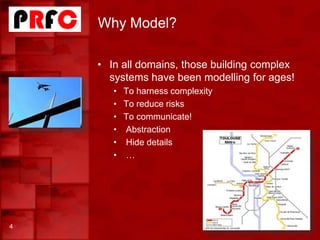
• In all domains, those building complex
systems have been modelling for ages!
• To harness complexity
• To reduce risks
• To communicate!
• Abstraction
• Hide details
• …
Reference: INCOSE
5
• www.incose.org
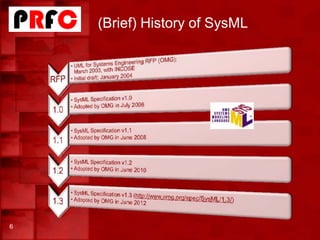
(Brief) History of SysML
6
SysML Stakeholders
7
• American Systems, BAE SYSTEMS, Boeing, Deere &
Company, EADS Astrium, Eurostep, Israel Aircraft
Industries, Lockheed Martin, Motorola, NIST, Northrop
Grumman, oose.de, Raytheon, THALES
Industry
• ARTiSAN, EmbeddedPlus, Gentleware, IBM, I-Logix,
Mentor Graphics, PivotPoint Technology, SparxSystems,
Telelogic, Vitech
Tool Vendors
• AP-233, INCOSE, Georgia Institute of Technology, etc.
• In France: l’AFIS
Others
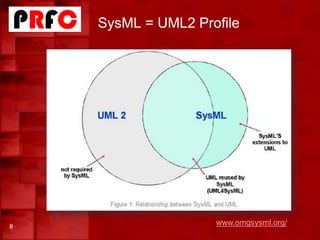
SysML = UML2 Profile
8
www.omgsysml.org/
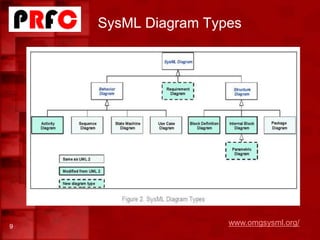
SysML Diagram Types
9
www.omgsysml.org/
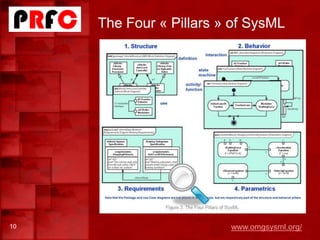
The Four « Pillars » of SysML
10 www.omgsysml.org/
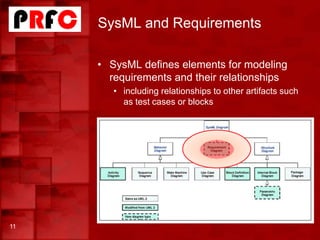
SysML and Requirements
11
• SysML defines elements for modeling
requirements and their relationships
• including relationships to other artifacts such
as test cases or blocks
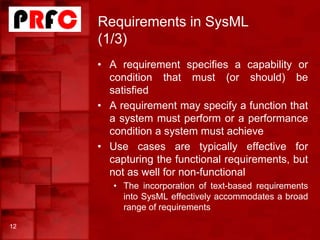
Requirements in SysML
(1/3)
• A requirement specifies a capability or
condition that must (or should) be
satisfied
• A requirement may specify a function that
a system must perform or a performance
condition a system must achieve
• Use cases are typically effective for
capturing the functional requirements, but
not as well for non-functional
• The incorporation of text-based requirements
into SysML effectively accommodates a broad
range of requirements
12
Requirements in SysML
(2/3)
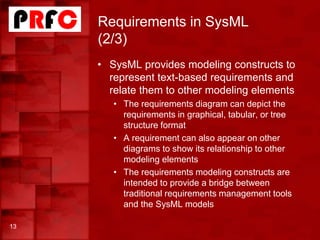
• SysML provides modeling constructs to
represent text-based requirements and
relate them to other modeling elements
• The requirements diagram can depict the
requirements in graphical, tabular, or tree
structure format
• A requirement can also appear on other
diagrams to show its relationship to other
modeling elements
• The requirements modeling constructs are
intended to provide a bridge between
traditional requirements management tools
and the SysML models
13
Requirements in SysML
(3/3)
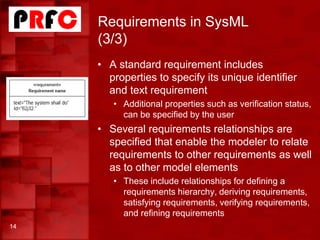
• A standard requirement includes
properties to specify its unique identifier
and text requirement
• Additional properties such as verification status,
can be specified by the user
• Several requirements relationships are
specified that enable the modeler to relate
requirements to other requirements as well
as to other model elements
• These include relationships for defining a
requirements hierarchy, deriving requirements,
satisfying requirements, verifying requirements,
and refining requirements
14
Composite Requirement
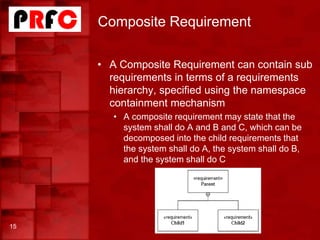
• A Composite Requirement can contain sub
requirements in terms of a requirements
hierarchy, specified using the namespace
containment mechanism
• A composite requirement may state that the
system shall do A and B and C, which can be
decomposed into the child requirements that
the system shall do A, the system shall do B,
and the system shall do C
15
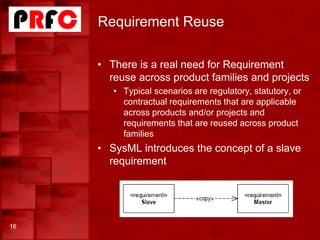
Requirement Reuse
• There is a real need for Requirement
reuse across product families and projects
• Typical scenarios are regulatory, statutory, or
contractual requirements that are applicable
across products and/or projects and
requirements that are reused across product
families
• SysML introduces the concept of a slave
requirement
16
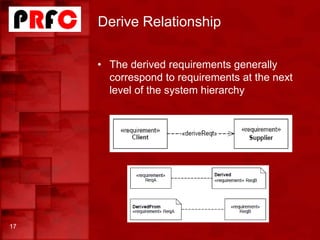
Derive Relationship
• The derived requirements generally
correspond to requirements at the next
level of the system hierarchy
17
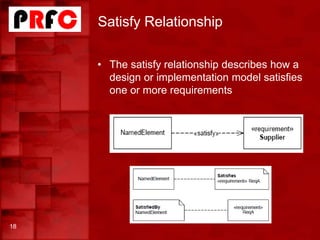
Satisfy Relationship
• The satisfy relationship describes how a
design or implementation model satisfies
one or more requirements
18
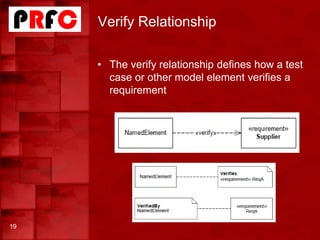
Verify Relationship
• The verify relationship defines how a test
case or other model element verifies a
requirement
19
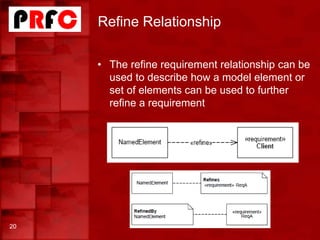
Refine Relationship
• The refine requirement relationship can be
used to describe how a model element or
set of elements can be used to further
refine a requirement
20
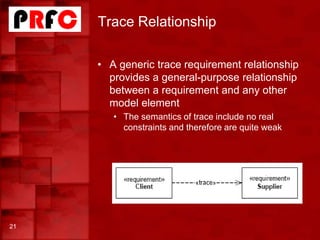
Trace Relationship
• A generic trace requirement relationship
provides a general-purpose relationship
between a requirement and any other
model element
• The semantics of trace include no real
constraints and therefore are quite weak
21
Warning: Arrow direction!
• Most requirement relationships in SysML
are based on the UML dependency
• The arrow points from the dependent model
element (client) to the independent model
element (supplier)
• In SysML, the arrowhead direction is
opposite of what has typically been used
for requirements flow-down where the
higher-level requirement points to the
lower-level requirement
22
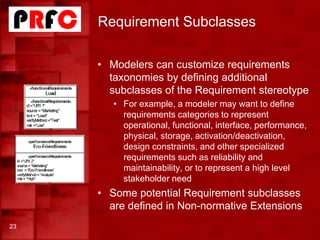
Requirement Subclasses
• Modelers can customize requirements
taxonomies by defining additional
subclasses of the Requirement stereotype
• For example, a modeler may want to define
requirements categories to represent
operational, functional, interface, performance,
physical, storage, activation/deactivation,
design constraints, and other specialized
requirements such as reliability and
maintainability, or to represent a high level
stakeholder need
• Some potential Requirement subclasses
are defined in Non-normative Extensions
23
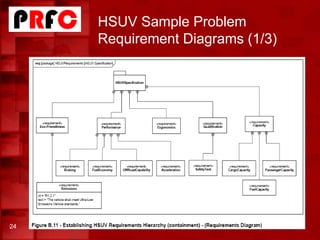
HSUV Sample Problem
Requirement Diagrams (1/3)
24
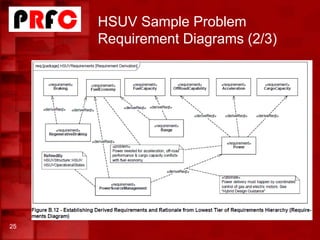
HSUV Sample Problem
Requirement Diagrams (2/3)
25
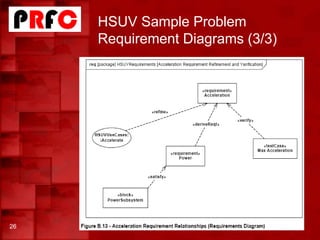
HSUV Sample Problem
Requirement Diagrams (3/3)
26
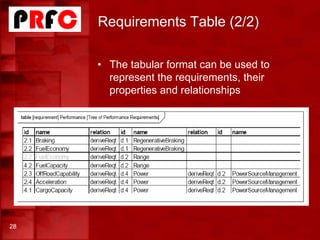
Requirements Table (1/2)
• The requirement diagram has a distinct
disadvantage when viewing large numbers
of requirements
• The traditional method of viewing requirements
in textual documents is a more compact
representation than viewing them in a diagram
• SysML embraces the concept of displaying
results of model queries in tables as well
as using tables as a data input
mechanism, but the specifics of generating
tables is left to the tool implementer
27
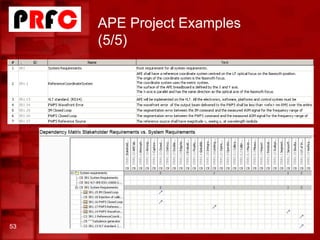
Requirements Table (2/2)
• The tabular format can be used to
represent the requirements, their
properties and relationships
28
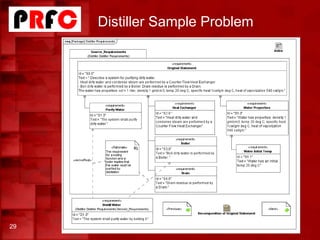
Distiller Sample Problem
29
Requirement Packages
• Requirements can be organized into a
package structure
• A typical structure may include a top-level
package for all requirements
• Each nested package within this package may
contain requirements from different
specifications (system, subsystem, component,
etc.)
• Each specification package contains the text-
based requirements for that specification
• This package structure corresponds to a typical
specification tree that is a useful artifact for
describing the scope of requirements for a
project
30
Other Ways to Represent
“Requirements”
• Nearly all SysML diagram types can
represent Requirements!
• Use Case Diagram
• Sequence Diagram
• State Diagram
• Activity Diagram
• Block Definition Diagram
• Internal Block Diagram
• Parametric Diagram
31
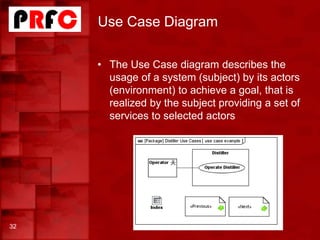
Use Case Diagram
• The Use Case diagram describes the
usage of a system (subject) by its actors
(environment) to achieve a goal, that is
realized by the subject providing a set of
services to selected actors
32
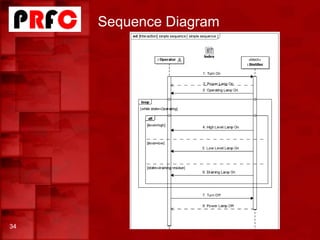
Sequence Diagram
• The Sequence diagram describes the flow
of control between actors and systems
(blocks) or between parts of a system
• This diagram represents the sending and
receiving of messages between the
interacting entities called lifelines, where
time is represented along the vertical axis
33
Sequence Diagram
34
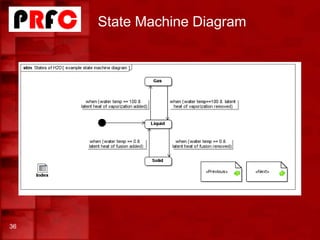
State Machine Diagram
• The StateMachine package defines a set
of concepts that can be used for modeling
discrete behavior through finite state
transition systems
• The state machine represents behavior
as the state history of an object in terms
of its transitions and states
35
State Machine Diagram
36
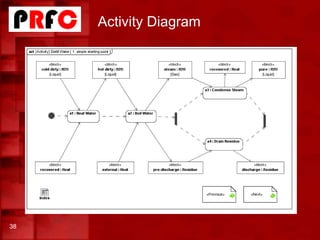
Activity Diagram
• Activity modeling emphasizes the inputs,
outputs, sequences, and conditions for
coordinating other behaviors. It provides
a flexible link to blocks owning those
behaviors
37
Activity Diagram
38
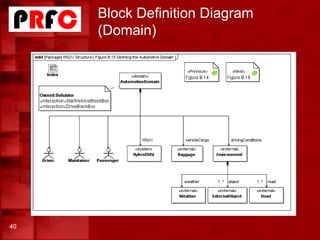
Block Definition Diagram
• The Block Definition Diagram defines
features of blocks and relationships
between blocks such as associations,
generalizations, and dependencies
• It captures the definition of blocks in
terms of properties and operations, and
relationships such as a system hierarchy
or a system classification tree
39
Block Definition Diagram
(Domain)
40
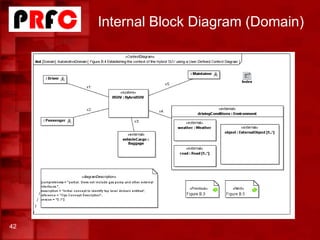
Internal Block Diagram (Domain)
• The Internal Block Diagram captures the
internal structure of a block in terms of
properties and connectors between
properties
• A block can include properties to specify
its values, parts, and references to other
blocks
• Ports are a special class of property used
to specify allowable types of interactions
between blocks
41
Internal Block Diagram (Domain)
42
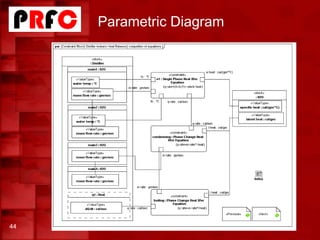
Parametric Diagram
• Parametric diagrams include usages of
constraint blocks to constrain the
properties of another block
• The usage of a constraint binds the
parameters of the constraint, such as F,
m, and a, to specific properties of a block,
such as a mass, that provide values for
the parameters
43
Parametric Diagram
44
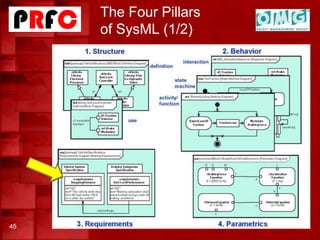
The Four Pillars
of SysML (1/2)
45
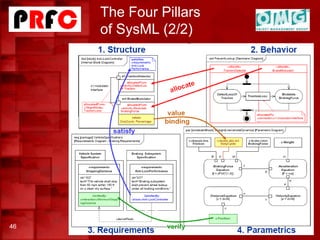
The Four Pillars
of SysML (2/2)
46
Industrial Feedback (1)
47
• In 2009, MagicDraw R&D decided to
migrate from Document-driven to Model-
driven Requirement Engineering using
SysML
• Advantages:
• Much better teamwork and version
management capabilities
• More formal/structured descriptions of the
requirements
• Maintain the information about already
implemented functionality
• Traceability to the architecture and test cases
Industrial Feedback (2)
48
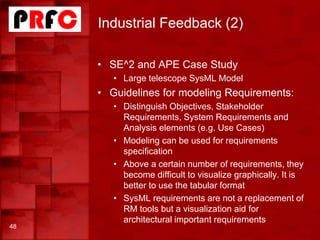
• SE^2 and APE Case Study
• Large telescope SysML Model
• Guidelines for modeling Requirements:
• Distinguish Objectives, Stakeholder
Requirements, System Requirements and
Analysis elements (e.g. Use Cases)
• Modeling can be used for requirements
specification
• Above a certain number of requirements, they
become difficult to visualize graphically. It is
better to use the tabular format
• SysML requirements are not a replacement of
RM tools but a visualization aid for
architectural important requirements
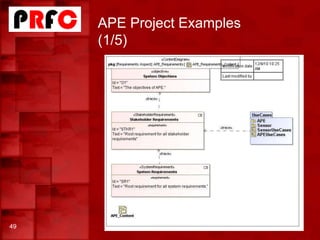
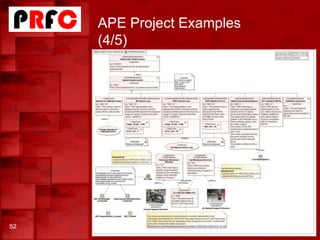
APE Project Examples
(1/5)
49
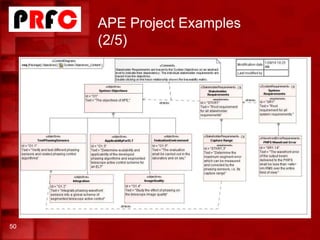
APE Project Examples
(2/5)
50
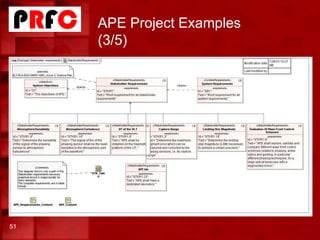
APE Project Examples
(3/5)
51
APE Project Examples
(4/5)
52
APE Project Examples
(5/5)
53
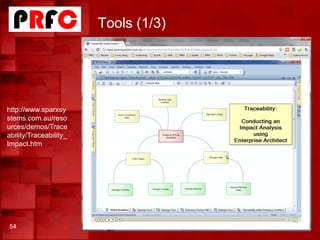
Tools (1/3)
54
http://www.sparxsy
stems.com.au/reso
urces/demos/Trace
ability/Traceability_
Impact.htm
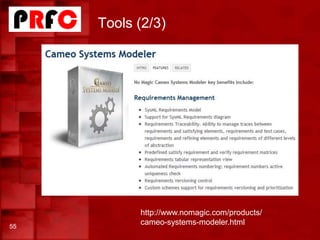
Tools (2/3)
55
http://www.nomagic.com/products/
cameo-systems-modeler.html
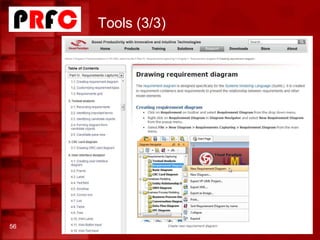
Tools (3/3)
56
Conclusion (1/3)
57
• A Requirements Model can provide
information that helps determine if the
requirements meet their desired attributes
• SysML requirements modeling provides a
‘link’ between the text requirements and
the rest of the model elements
• … But for the moment, SysML
requirements are not a complete
replacement of RM tools
Conclusion (2/3)
58
• SysML Requirement modeling concept
should not remain just a buzz!
• It can be a real breakthrough for people
who do not master yet a tooled
Requirements Management process
• It can be also valuable for people used to
Requirements Management tools
• Models can help a lot to formalize requirements
(state machines, block diagrams, etc.)
• Diagrams are a very powerful communication
tool between all stakeholders
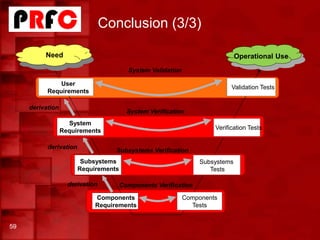
Conclusion (3/3)
59
Validation Tests
System Validation
User
Requirements
Need Operational Use
derivation
Components
Requirements
Components
Tests
Components Verification
Subsystems
Requirements
Subsystems
Tests
Subsystems Verification
derivation
System
Requirements Verification Tests
System Verification
derivation
Additional Resources…
• Websites:
• www.omgsysml.org/
• www.incose.org/
• http://mbse.gfse.de/index.html
• Books:
• P. Roques, SysML par l’exemple,
2009, Eyrolles
• S. Friedenthal, A. Moore, and R. Steiner, A
Practical Guide to SysML, 2011, OMG Press
• T. Weilkiens, Systems Engineering with
SysML/UML: Modeling, Analysis, Design, 2008,
OMG Press
60

SysCon 2013 SysML & Requirements

  • 1.
    Requirements Modeling with SysML PascalRoques IEEE SysCon 2013 Tutorial April 15th, 2013
  • 2.
    • Senior Consultant& Trainer, 25 years of experience in modeling  SADT, OMT, UML, SysML • OMG Certified on UML2 and SysML • Co-founder of association • Author of UML best-sellers in France • … and of the first French SysML book pascal.roques@prfc.fr The Speaker: Pascal Roques 2
  • 3.
    What is SysML? 3 •SysML™ is a general-purpose graphical modeling language for specifying, analyzing, designing, and verifying complex systems that may include hardware, software, information, personnel, procedures, and facilities • It is a specialized UML profile targeted to system engineering
  • 4.
    Why Model? 4 • Inall domains, those building complex systems have been modelling for ages! • To harness complexity • To reduce risks • To communicate! • Abstraction • Hide details • …
  • 5.
  • 6.
  • 7.
    SysML Stakeholders 7 • AmericanSystems, BAE SYSTEMS, Boeing, Deere & Company, EADS Astrium, Eurostep, Israel Aircraft Industries, Lockheed Martin, Motorola, NIST, Northrop Grumman, oose.de, Raytheon, THALES Industry • ARTiSAN, EmbeddedPlus, Gentleware, IBM, I-Logix, Mentor Graphics, PivotPoint Technology, SparxSystems, Telelogic, Vitech Tool Vendors • AP-233, INCOSE, Georgia Institute of Technology, etc. • In France: l’AFIS Others
  • 8.
    SysML = UML2Profile 8 www.omgsysml.org/
  • 9.
  • 10.
    The Four «Pillars » of SysML 10 www.omgsysml.org/
  • 11.
    SysML and Requirements 11 •SysML defines elements for modeling requirements and their relationships • including relationships to other artifacts such as test cases or blocks
  • 12.
    Requirements in SysML (1/3) •A requirement specifies a capability or condition that must (or should) be satisfied • A requirement may specify a function that a system must perform or a performance condition a system must achieve • Use cases are typically effective for capturing the functional requirements, but not as well for non-functional • The incorporation of text-based requirements into SysML effectively accommodates a broad range of requirements 12
  • 13.
    Requirements in SysML (2/3) •SysML provides modeling constructs to represent text-based requirements and relate them to other modeling elements • The requirements diagram can depict the requirements in graphical, tabular, or tree structure format • A requirement can also appear on other diagrams to show its relationship to other modeling elements • The requirements modeling constructs are intended to provide a bridge between traditional requirements management tools and the SysML models 13
  • 14.
    Requirements in SysML (3/3) •A standard requirement includes properties to specify its unique identifier and text requirement • Additional properties such as verification status, can be specified by the user • Several requirements relationships are specified that enable the modeler to relate requirements to other requirements as well as to other model elements • These include relationships for defining a requirements hierarchy, deriving requirements, satisfying requirements, verifying requirements, and refining requirements 14
  • 15.
    Composite Requirement • AComposite Requirement can contain sub requirements in terms of a requirements hierarchy, specified using the namespace containment mechanism • A composite requirement may state that the system shall do A and B and C, which can be decomposed into the child requirements that the system shall do A, the system shall do B, and the system shall do C 15
  • 16.
    Requirement Reuse • Thereis a real need for Requirement reuse across product families and projects • Typical scenarios are regulatory, statutory, or contractual requirements that are applicable across products and/or projects and requirements that are reused across product families • SysML introduces the concept of a slave requirement 16
  • 17.
    Derive Relationship • Thederived requirements generally correspond to requirements at the next level of the system hierarchy 17
  • 18.
    Satisfy Relationship • Thesatisfy relationship describes how a design or implementation model satisfies one or more requirements 18
  • 19.
    Verify Relationship • Theverify relationship defines how a test case or other model element verifies a requirement 19
  • 20.
    Refine Relationship • Therefine requirement relationship can be used to describe how a model element or set of elements can be used to further refine a requirement 20
  • 21.
    Trace Relationship • Ageneric trace requirement relationship provides a general-purpose relationship between a requirement and any other model element • The semantics of trace include no real constraints and therefore are quite weak 21
  • 22.
    Warning: Arrow direction! •Most requirement relationships in SysML are based on the UML dependency • The arrow points from the dependent model element (client) to the independent model element (supplier) • In SysML, the arrowhead direction is opposite of what has typically been used for requirements flow-down where the higher-level requirement points to the lower-level requirement 22
  • 23.
    Requirement Subclasses • Modelerscan customize requirements taxonomies by defining additional subclasses of the Requirement stereotype • For example, a modeler may want to define requirements categories to represent operational, functional, interface, performance, physical, storage, activation/deactivation, design constraints, and other specialized requirements such as reliability and maintainability, or to represent a high level stakeholder need • Some potential Requirement subclasses are defined in Non-normative Extensions 23
  • 24.
  • 25.
  • 26.
  • 27.
    Requirements Table (1/2) •The requirement diagram has a distinct disadvantage when viewing large numbers of requirements • The traditional method of viewing requirements in textual documents is a more compact representation than viewing them in a diagram • SysML embraces the concept of displaying results of model queries in tables as well as using tables as a data input mechanism, but the specifics of generating tables is left to the tool implementer 27
  • 28.
    Requirements Table (2/2) •The tabular format can be used to represent the requirements, their properties and relationships 28
  • 29.
  • 30.
    Requirement Packages • Requirementscan be organized into a package structure • A typical structure may include a top-level package for all requirements • Each nested package within this package may contain requirements from different specifications (system, subsystem, component, etc.) • Each specification package contains the text- based requirements for that specification • This package structure corresponds to a typical specification tree that is a useful artifact for describing the scope of requirements for a project 30
  • 31.
    Other Ways toRepresent “Requirements” • Nearly all SysML diagram types can represent Requirements! • Use Case Diagram • Sequence Diagram • State Diagram • Activity Diagram • Block Definition Diagram • Internal Block Diagram • Parametric Diagram 31
  • 32.
    Use Case Diagram •The Use Case diagram describes the usage of a system (subject) by its actors (environment) to achieve a goal, that is realized by the subject providing a set of services to selected actors 32
  • 33.
    Sequence Diagram • TheSequence diagram describes the flow of control between actors and systems (blocks) or between parts of a system • This diagram represents the sending and receiving of messages between the interacting entities called lifelines, where time is represented along the vertical axis 33
  • 34.
  • 35.
    State Machine Diagram •The StateMachine package defines a set of concepts that can be used for modeling discrete behavior through finite state transition systems • The state machine represents behavior as the state history of an object in terms of its transitions and states 35
  • 36.
  • 37.
    Activity Diagram • Activitymodeling emphasizes the inputs, outputs, sequences, and conditions for coordinating other behaviors. It provides a flexible link to blocks owning those behaviors 37
  • 38.
  • 39.
    Block Definition Diagram •The Block Definition Diagram defines features of blocks and relationships between blocks such as associations, generalizations, and dependencies • It captures the definition of blocks in terms of properties and operations, and relationships such as a system hierarchy or a system classification tree 39
  • 40.
  • 41.
    Internal Block Diagram(Domain) • The Internal Block Diagram captures the internal structure of a block in terms of properties and connectors between properties • A block can include properties to specify its values, parts, and references to other blocks • Ports are a special class of property used to specify allowable types of interactions between blocks 41
  • 42.
  • 43.
    Parametric Diagram • Parametricdiagrams include usages of constraint blocks to constrain the properties of another block • The usage of a constraint binds the parameters of the constraint, such as F, m, and a, to specific properties of a block, such as a mass, that provide values for the parameters 43
  • 44.
  • 45.
    The Four Pillars ofSysML (1/2) 45
  • 46.
    The Four Pillars ofSysML (2/2) 46
  • 47.
    Industrial Feedback (1) 47 •In 2009, MagicDraw R&D decided to migrate from Document-driven to Model- driven Requirement Engineering using SysML • Advantages: • Much better teamwork and version management capabilities • More formal/structured descriptions of the requirements • Maintain the information about already implemented functionality • Traceability to the architecture and test cases
  • 48.
    Industrial Feedback (2) 48 •SE^2 and APE Case Study • Large telescope SysML Model • Guidelines for modeling Requirements: • Distinguish Objectives, Stakeholder Requirements, System Requirements and Analysis elements (e.g. Use Cases) • Modeling can be used for requirements specification • Above a certain number of requirements, they become difficult to visualize graphically. It is better to use the tabular format • SysML requirements are not a replacement of RM tools but a visualization aid for architectural important requirements
  • 49.
  • 50.
  • 51.
  • 52.
  • 53.
  • 54.
  • 55.
  • 56.
  • 57.
    Conclusion (1/3) 57 • ARequirements Model can provide information that helps determine if the requirements meet their desired attributes • SysML requirements modeling provides a ‘link’ between the text requirements and the rest of the model elements • … But for the moment, SysML requirements are not a complete replacement of RM tools
  • 58.
    Conclusion (2/3) 58 • SysMLRequirement modeling concept should not remain just a buzz! • It can be a real breakthrough for people who do not master yet a tooled Requirements Management process • It can be also valuable for people used to Requirements Management tools • Models can help a lot to formalize requirements (state machines, block diagrams, etc.) • Diagrams are a very powerful communication tool between all stakeholders
  • 59.
    Conclusion (3/3) 59 Validation Tests SystemValidation User Requirements Need Operational Use derivation Components Requirements Components Tests Components Verification Subsystems Requirements Subsystems Tests Subsystems Verification derivation System Requirements Verification Tests System Verification derivation
  • 60.
    Additional Resources… • Websites: •www.omgsysml.org/ • www.incose.org/ • http://mbse.gfse.de/index.html • Books: • P. Roques, SysML par l’exemple, 2009, Eyrolles • S. Friedenthal, A. Moore, and R. Steiner, A Practical Guide to SysML, 2011, OMG Press • T. Weilkiens, Systems Engineering with SysML/UML: Modeling, Analysis, Design, 2008, OMG Press 60