This document discusses mapping concepts from the Structured Analysis and Design Technique (SADT) modeling language to the Systems Modeling Language (SysML). SADT uses boxes and arrows to model systems through top-down functional breakdowns. SysML is a more expressive modeling language that can represent structural, behavioral, and other aspects of complex systems using nine different diagram types. While SADT is simpler, SysML provides more capabilities for modeling complex systems. A mapping from SADT models to SysML is possible, though some theoretical challenges remain around representing SADT functions as structural blocks or behavioral activities in SysML.
Introduction of the presentation from SADT to SysML and the speaker’s background.
Discusses SADT as a diagrammatic notation for systems analysis, its historical context, and enhancements made with ASA for dynamic descriptions.
Introduction to SysML as a general-purpose modeling language for complex systems analysis, design, and verification.
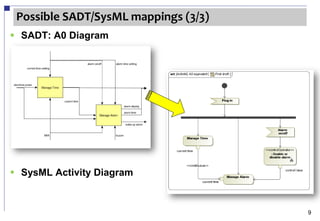
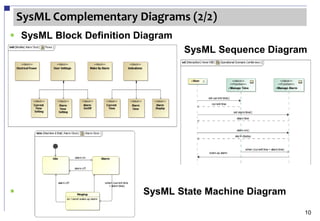
Overview of the mapping between SADT diagrams (Context and A0 Diagrams) and corresponding SysML diagrams (Internal Block, Activity Diagrams). Details on SysML complementary diagrams including Block Definition, Use Case, Sequence, and State Machine diagrams.
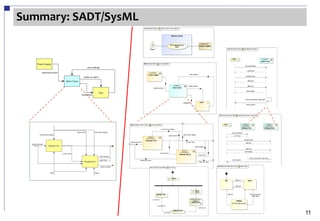
A summary table comparing SADT and SysML aspects.
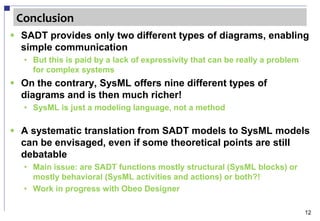
Conclusions about the expressivity of SysML compared to SADT and potential for systematic translation between the two models.
From SADT toSysML:
formulation of an embedding
pascal.roques@gmail.com ICSSEA , 07/12/2010
2.
Speaker: Pascal Roques
Senior Consultant, >20 years modeling experience
• SADT,
• OMT, UML, SysML
Co-founder and chairman of
Author of several best-seller UML books in French
… and of the first French SysML book
2
3.
The past: SADTand ASA™ (1/2)
SADT: Structured Analysis and Design Technique
• Diagrammatic notation designed specifically to help people describe
and understand systems
• Boxes and arrows
with informal semantics
• Top-down functional breakdown
• Received extensive use starting in 1973 by the US Air Force
Integrated Computer Aided Manufacturing program
• In 1981, IDEF0 formalism was published, based on SADT
3
4.
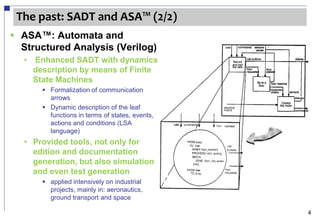
The past: SADTand ASA™ (2/2)
ASA™: Automata and
Structured Analysis (Verilog)
• Enhanced SADT with dynamics
description by means of Finite
State Machines
Formalization of communication
arrows
Dynamic description of the leaf
functions in terms of states, events,
actions and conditions (LSA
language)
• Provided tools, not only for
edition and documentation
generation, but also simulation
and even test generation
applied intensively on industrial
projects, mainly in: aeronautics,
ground transport and space
4
5.
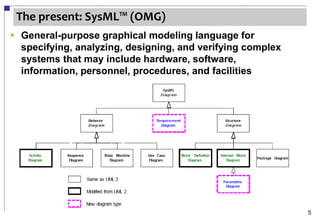
The present: SysML™(OMG)
General-purpose graphical modeling language for
specifying, analyzing, designing, and verifying complex
systems that may include hardware, software,
information, personnel, procedures, and facilities
5
6.
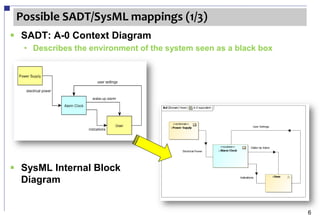
Possible SADT/SysML mappings(1/3)
SADT: A-0 Context Diagram
• Describes the environment of the system seen as a black box
SysML Internal Block
Diagram
6
7.
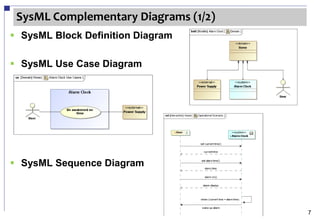
SysML Complementary Diagrams(1/2)
SysML Block Definition Diagram
SysML Use Case Diagram
SysML Sequence Diagram
7
8.
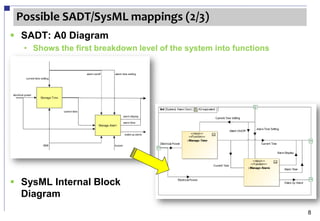
Possible SADT/SysML mappings(2/3)
SADT: A0 Diagram
• Shows the first breakdown level of the system into functions
SysML Internal Block
Diagram
8
Conclusion
SADT providesonly two different types of diagrams, enabling
simple communication
• But this is paid by a lack of expressivity that can be really a problem
for complex systems
On the contrary, SysML offers nine different types of
diagrams and is then much richer!
• SysML is just a modeling language, not a method
A systematic translation from SADT models to SysML models
can be envisaged, even if some theoretical points are still
debatable
• Main issue: are SADT functions mostly structural (SysML blocks) or
mostly behavioral (SysML activities and actions) or both?!
• Work in progress with Obeo Designer
12