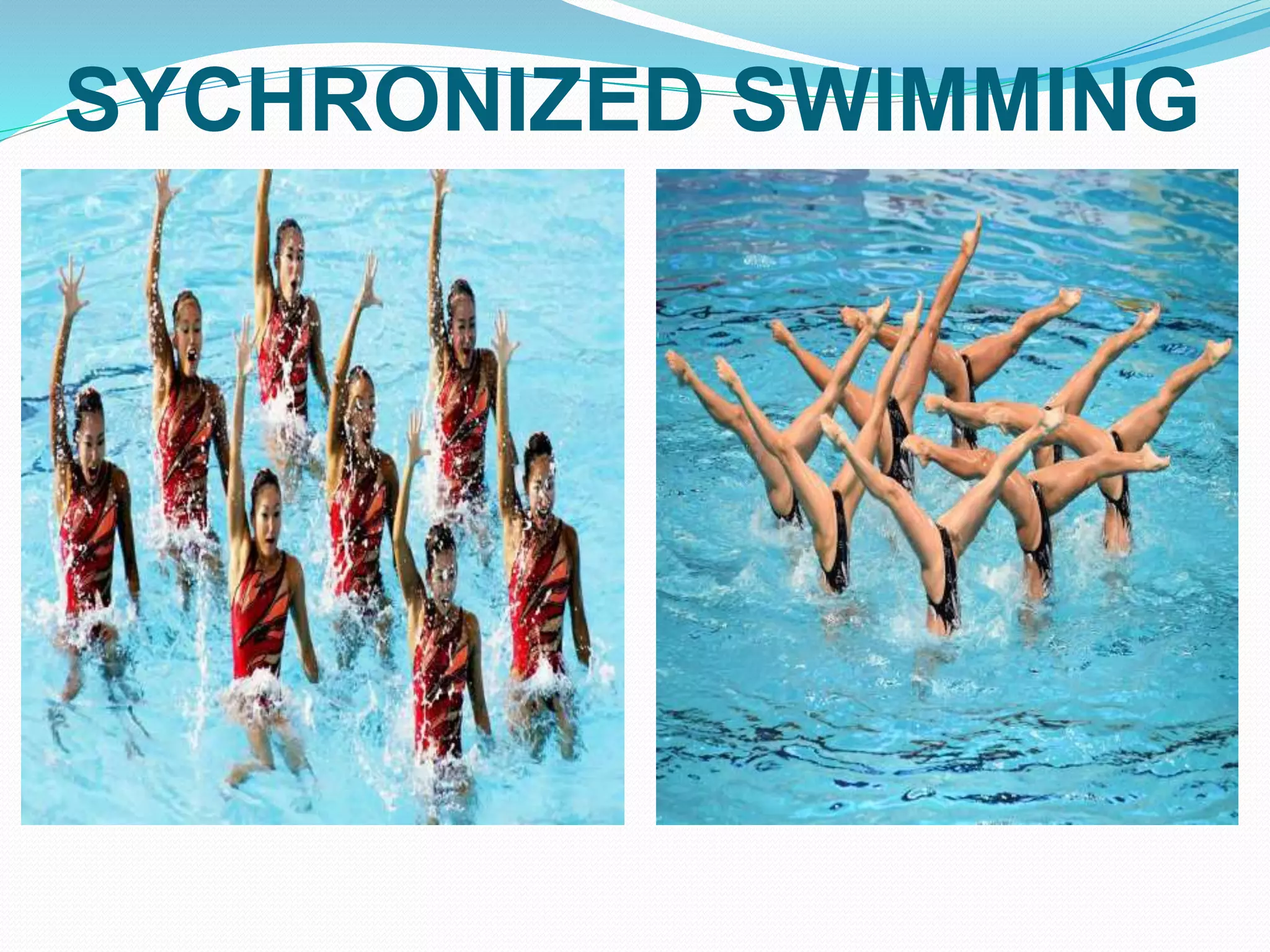
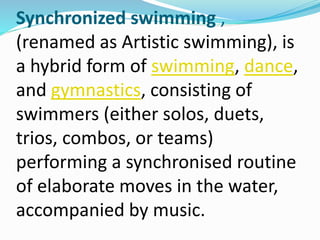
SYCHRONIZED SWIMMING
Synchronized swimming ,
(renamed as Artistic swimming), is
a hybrid form of swimming, dance,
and gymnastics, consisting of
swimmers (either solos, duets,
trios, combos, or teams)
performing a synchronised routine
of elaborate moves in the water,
accompanied by music.
 Synchronized swimming demands advanced water skills, and
requires great strength, endurance, flexibility, grace, artistry
and precise timing, as well as exceptional breath control
when upside down underwater. During routines, swimmers
are required to not touch the bottom of the pool.
 Following the addition of a new mixed-pair event, FINA
World Aquatics competitions are open to men since the 16th
2015 championships in Kazan, and the other international,
national and provincial/state competitions allow male
competitors in every event. However, men are currently still
barred from competing in the Olympics. Both USA
Synchro and Synchro Canada allow men to compete with
women. Most European countries allow men to compete also,
France even allows male only podiums, according to the
number of participants. In the past decade more men are
becoming involved in the sport and a global biannual
competition called Men's Cup has been steadily growing.
 Competitors show off their strength, flexibility, and
aerobic endurance required to perform difficult
routines. Swimmers perform two routines for the
judges, one technical and one free, as well as age group
routines and figures.
 Synchronized swimming is both an individual and
team sport. Swimmers compete individually during
figures, and then as a team during the routine. Figures
are made up of a combination of skills and positions
that often require control, strength, and flexibility.
Swimmers are ranked individually for this part of the
competition. The routine involves teamwork and
synchronization. It is choreographed to music and
often has a theme.
History
 At the turn of the 20th century, synchronised swimming was known
as water ballet. The first recorded competition was in 1891 in Berlin,
Germany. Many swim clubs were formed around that time, and the sport
simultaneously developed in Canada. As well as existing as a sport, it
often constituted a popular addition to Music Hall evenings, in the larger
variety theatres of London or Glasgow which were equipped with huge
on-stage water tanks for the purpose.
 In 1907, Australian Annette Kellerman popularized the sport when she
performed in a glass tank as an underwater ballerina (the first water
ballet in a glass tank) in the New York Hippodrome.[1] After
experimenting with various diving actions and stunts in the
water, Katherine Curtis started one of the first water ballet clubs at the
University of Chicago, where the team began executing strokes, "tricks,"
and floating formations. On May 27, 1939, the first U.S. synchronized
swimming competition took place at Wright Junior College between
Wright and the Chicago Teachers' College.
 In 1933 and 1934, Katherine Whitney
Curtis organized a show, "The Kay Curtis
Modern Mermaids", for the World
Exhibition in Chicago. The announcer,
Norman Ross, introduced the sport as
"synchronized swimming" for the first time.
The term eventually became standardized
through the AAU, but Curtis still used the
term "rhythmic swimming" in her
book, Rhythmic Swimming: A Source Book
of Synchronized Swimming and Water
Pageantry (Minneapolis: Burgess Publishing
Co., 1936).
 The first Olympic demonstration was at the 1952
Olympic Games, where the Helsinki officials
welcomed Kay Curtis and lit a torch in her honor.
Curtis died in 1980, but synchronised swimming did
not become an official Olympic sport until the
1984 Summer Olympic Games.[8] It was not until 1968
that synchronised swimming became officially
recognized by FINAas the fourth water sport next
to swimming, platform diving and water polo.
 From 1984 through 1992, the Summer Olympic Games
featured solo and duet competitions, but they were
both dropped in 1996 in favor of team competition. At
the 2000 Olympic Games, however, the duet
competition was restored and is now featured
alongside the team competition.
Basic Skills
 Sculls
Sculls (hand movements used to propel the body) are the most
essential part to synchronised swimming. Commonly used sculls
include support scull, stationary scull, propeller scull, alligator
scull, torpedo scull, split scull, barrel scull, spinning scull and
paddle scull. The support scull is used most often to support the
body while a swimmer is performing upside down.
 Eggbeater
The "eggbeater kick" is another important skill of synchronised
swimming. It is a form of treading water that allows for stability
and height above the water while leaving the hands free to
perform arm motions. An average eggbeater height is usually
around collarbone level. Eggbeater is used in all "arm" sections, a
piece of choreography in which the swimmer is upright, often with
one or both arms in the air. Another variation is a body boost,
which is executed through an eggbeater buildup and a strong whip
kick, propelling the swimmer out of the water vertically. A body
boost can raise a swimmer out of the water to hip level.
LIFTS
 A lift is when members of the team propel another
teammate relatively high out of the water. They are
quite common in routines of older age groups and
higher skill levels. There are many variations on lifts,
often dubbed "highlights". These can include partner
lifts, float patterns or other areas of unique, artistic
choreography intended to impress the judges and
audience
Parts of a successful lift
There are three parts to every lift in synchronized swimming: The
top (or "flyer"), the base, and the pushers.
 The Flyer is usually the smallest member of the team.
Flyers must be agile and flexible, with a preferable
gymnastics background if they are jumping off the lift.
 The Base tends to be of average size. She should have
good leg strength and a solid core (when performing a
platform lift, a strong core and length is essential).
 The rest of the team will be underneath the chair or
plank. They are usually strong and powerful, as their
job is to support the Chair/Plank and supply the force
needed for the flyer to execute her job.
 Types of lifts
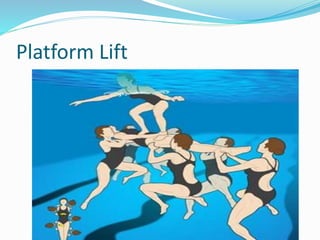
 The Platform Lift is the oldest form. In a platform, the Plank
lays out in a back layout position underwater. The top sets in
a squatting position on her torso and stands once the lift
reaches the surface. The remaining teammates use eggbeater
to hold the platform and the top out of the water.
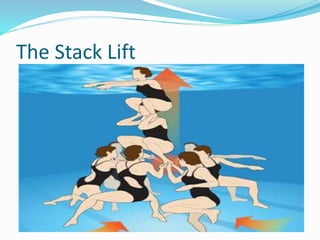
 The Stack Lift is a more modern version of the platform. The
base sets up in a squatting position a few feet underwater, with
the pushers holding her legs and feet. The top then climbs
onto the shoulders of the base. As the lift rises, pushers extend
their arms while the base and top extend their legs to achieve
maximum height. A common addition to a stack lift is a
rotation while it descends.
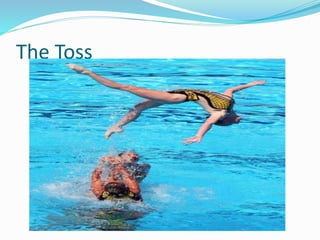
 A Toss is set up exactly like a stack lift. However, when the lift
reaches its full height, the "flyer" on top of the lift will jump off
of her teammate's shoulders, usually performing some sort of
acrobatic movement or position. This is a very difficult lift and
should only be attempted by experienced swimmers.
Platform Lift
The Stack Lift
The Toss
Position
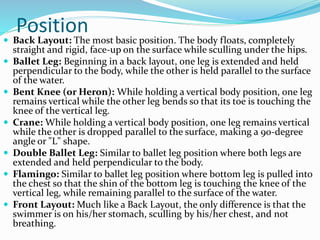
 Back Layout: The most basic position. The body floats, completely
straight and rigid, face-up on the surface while sculling under the hips.
 Ballet Leg: Beginning in a back layout, one leg is extended and held
perpendicular to the body, while the other is held parallel to the surface
of the water.
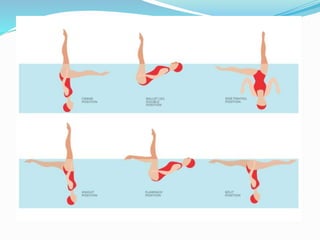
 Bent Knee (or Heron): While holding a vertical body position, one leg
remains vertical while the other leg bends so that its toe is touching the
knee of the vertical leg.
 Crane: While holding a vertical body position, one leg remains vertical
while the other is dropped parallel to the surface, making a 90-degree
angle or "L" shape.
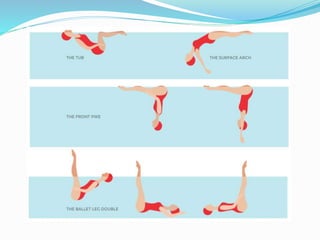
 Double Ballet Leg: Similar to ballet leg position where both legs are
extended and held perpendicular to the body.
 Flamingo: Similar to ballet leg position where bottom leg is pulled into
the chest so that the shin of the bottom leg is touching the knee of the
vertical leg, while remaining parallel to the surface of the water.
 Front Layout: Much like a Back Layout, the only difference is that the
swimmer is on his/her stomach, sculling by his/her chest, and not
breathing.
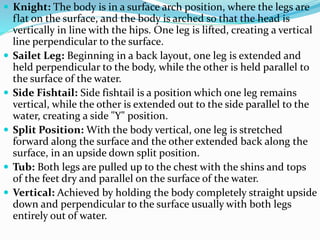
 Knight: The body is in a surface arch position, where the legs are
flat on the surface, and the body is arched so that the head is
vertically in line with the hips. One leg is lifted, creating a vertical
line perpendicular to the surface.
 Sailet Leg: Beginning in a back layout, one leg is extended and
held perpendicular to the body, while the other is held parallel to
the surface of the water.
 Side Fishtail: Side fishtail is a position which one leg remains
vertical, while the other is extended out to the side parallel to the
water, creating a side "Y" position.
 Split Position: With the body vertical, one leg is stretched
forward along the surface and the other extended back along the
surface, in an upside down split position.
 Tub: Both legs are pulled up to the chest with the shins and tops
of the feet dry and parallel on the surface of the water.
 Vertical: Achieved by holding the body completely straight upside
down and perpendicular to the surface usually with both legs
entirely out of water.
 Routine
 Routines are composed of "figures" (leg movements), arm sections
and highlights. Swimmers are synchronized both to each other
and to the music. During a routine swimmers can never use the
bottom of the pool for support, but rather depend on sculling
motions with the arms, and eggbeater kick to keep afloat. After
the performance, the swimmers are judged and scored on their
performance based on technical merit and artistic impression.
Technical skill, patterns, shapes, choreography, and
synchronization are all critical to achieving a high score.
 Technical vs. free routines
 Depending on the competition level, swimmers will perform a
"technical" routine with predetermined elements that must be
performed in a specific order. The technical routine acts as a
replacement for the figure event, and is usually used only in senior
and collegiate level meets. In addition to the technical routine, the
swimmers will perform a longer "free" routine, which has no
requirements and is a chance for the swimmers to get creative and
innovative with their choreography.
 Length of routines
 The type of routine and competition level determines
the length of routines. Routines typically last two and a
half to five minutes, the shortest being solos, with
length added as the number of swimmers is increased
(duets, trios, teams, and combos). Age and skill level are
other important factors in determining the required
routine length.
 Scoring
 Routines are scored on a scale of 100, with points for
artistic impression, execution, and difficulty. In group
routines a group consists of 8 competitors for World
Championships and FINA events, each missing
participant brings penalty points to the team. A group
can consist of a minimum of 4 competitors and a
maximum of 10 (for Free Combination).

Synchronized swimming

  • 1.
  • 2.
    Synchronized swimming , (renamedas Artistic swimming), is a hybrid form of swimming, dance, and gymnastics, consisting of swimmers (either solos, duets, trios, combos, or teams) performing a synchronised routine of elaborate moves in the water, accompanied by music.
  • 3.
     Synchronized swimmingdemands advanced water skills, and requires great strength, endurance, flexibility, grace, artistry and precise timing, as well as exceptional breath control when upside down underwater. During routines, swimmers are required to not touch the bottom of the pool.  Following the addition of a new mixed-pair event, FINA World Aquatics competitions are open to men since the 16th 2015 championships in Kazan, and the other international, national and provincial/state competitions allow male competitors in every event. However, men are currently still barred from competing in the Olympics. Both USA Synchro and Synchro Canada allow men to compete with women. Most European countries allow men to compete also, France even allows male only podiums, according to the number of participants. In the past decade more men are becoming involved in the sport and a global biannual competition called Men's Cup has been steadily growing.
  • 4.
     Competitors showoff their strength, flexibility, and aerobic endurance required to perform difficult routines. Swimmers perform two routines for the judges, one technical and one free, as well as age group routines and figures.  Synchronized swimming is both an individual and team sport. Swimmers compete individually during figures, and then as a team during the routine. Figures are made up of a combination of skills and positions that often require control, strength, and flexibility. Swimmers are ranked individually for this part of the competition. The routine involves teamwork and synchronization. It is choreographed to music and often has a theme.
  • 5.
    History  At theturn of the 20th century, synchronised swimming was known as water ballet. The first recorded competition was in 1891 in Berlin, Germany. Many swim clubs were formed around that time, and the sport simultaneously developed in Canada. As well as existing as a sport, it often constituted a popular addition to Music Hall evenings, in the larger variety theatres of London or Glasgow which were equipped with huge on-stage water tanks for the purpose.  In 1907, Australian Annette Kellerman popularized the sport when she performed in a glass tank as an underwater ballerina (the first water ballet in a glass tank) in the New York Hippodrome.[1] After experimenting with various diving actions and stunts in the water, Katherine Curtis started one of the first water ballet clubs at the University of Chicago, where the team began executing strokes, "tricks," and floating formations. On May 27, 1939, the first U.S. synchronized swimming competition took place at Wright Junior College between Wright and the Chicago Teachers' College.
  • 6.
     In 1933and 1934, Katherine Whitney Curtis organized a show, "The Kay Curtis Modern Mermaids", for the World Exhibition in Chicago. The announcer, Norman Ross, introduced the sport as "synchronized swimming" for the first time. The term eventually became standardized through the AAU, but Curtis still used the term "rhythmic swimming" in her book, Rhythmic Swimming: A Source Book of Synchronized Swimming and Water Pageantry (Minneapolis: Burgess Publishing Co., 1936).
  • 7.
     The firstOlympic demonstration was at the 1952 Olympic Games, where the Helsinki officials welcomed Kay Curtis and lit a torch in her honor. Curtis died in 1980, but synchronised swimming did not become an official Olympic sport until the 1984 Summer Olympic Games.[8] It was not until 1968 that synchronised swimming became officially recognized by FINAas the fourth water sport next to swimming, platform diving and water polo.  From 1984 through 1992, the Summer Olympic Games featured solo and duet competitions, but they were both dropped in 1996 in favor of team competition. At the 2000 Olympic Games, however, the duet competition was restored and is now featured alongside the team competition.
  • 8.
    Basic Skills  Sculls Sculls(hand movements used to propel the body) are the most essential part to synchronised swimming. Commonly used sculls include support scull, stationary scull, propeller scull, alligator scull, torpedo scull, split scull, barrel scull, spinning scull and paddle scull. The support scull is used most often to support the body while a swimmer is performing upside down.  Eggbeater The "eggbeater kick" is another important skill of synchronised swimming. It is a form of treading water that allows for stability and height above the water while leaving the hands free to perform arm motions. An average eggbeater height is usually around collarbone level. Eggbeater is used in all "arm" sections, a piece of choreography in which the swimmer is upright, often with one or both arms in the air. Another variation is a body boost, which is executed through an eggbeater buildup and a strong whip kick, propelling the swimmer out of the water vertically. A body boost can raise a swimmer out of the water to hip level.
  • 9.
    LIFTS  A liftis when members of the team propel another teammate relatively high out of the water. They are quite common in routines of older age groups and higher skill levels. There are many variations on lifts, often dubbed "highlights". These can include partner lifts, float patterns or other areas of unique, artistic choreography intended to impress the judges and audience
  • 10.
    Parts of asuccessful lift There are three parts to every lift in synchronized swimming: The top (or "flyer"), the base, and the pushers.  The Flyer is usually the smallest member of the team. Flyers must be agile and flexible, with a preferable gymnastics background if they are jumping off the lift.  The Base tends to be of average size. She should have good leg strength and a solid core (when performing a platform lift, a strong core and length is essential).  The rest of the team will be underneath the chair or plank. They are usually strong and powerful, as their job is to support the Chair/Plank and supply the force needed for the flyer to execute her job.
  • 11.
     Types oflifts  The Platform Lift is the oldest form. In a platform, the Plank lays out in a back layout position underwater. The top sets in a squatting position on her torso and stands once the lift reaches the surface. The remaining teammates use eggbeater to hold the platform and the top out of the water.  The Stack Lift is a more modern version of the platform. The base sets up in a squatting position a few feet underwater, with the pushers holding her legs and feet. The top then climbs onto the shoulders of the base. As the lift rises, pushers extend their arms while the base and top extend their legs to achieve maximum height. A common addition to a stack lift is a rotation while it descends.  A Toss is set up exactly like a stack lift. However, when the lift reaches its full height, the "flyer" on top of the lift will jump off of her teammate's shoulders, usually performing some sort of acrobatic movement or position. This is a very difficult lift and should only be attempted by experienced swimmers.
  • 12.
  • 13.
  • 14.
  • 15.
    Position  Back Layout:The most basic position. The body floats, completely straight and rigid, face-up on the surface while sculling under the hips.  Ballet Leg: Beginning in a back layout, one leg is extended and held perpendicular to the body, while the other is held parallel to the surface of the water.  Bent Knee (or Heron): While holding a vertical body position, one leg remains vertical while the other leg bends so that its toe is touching the knee of the vertical leg.  Crane: While holding a vertical body position, one leg remains vertical while the other is dropped parallel to the surface, making a 90-degree angle or "L" shape.  Double Ballet Leg: Similar to ballet leg position where both legs are extended and held perpendicular to the body.  Flamingo: Similar to ballet leg position where bottom leg is pulled into the chest so that the shin of the bottom leg is touching the knee of the vertical leg, while remaining parallel to the surface of the water.  Front Layout: Much like a Back Layout, the only difference is that the swimmer is on his/her stomach, sculling by his/her chest, and not breathing.
  • 16.
     Knight: Thebody is in a surface arch position, where the legs are flat on the surface, and the body is arched so that the head is vertically in line with the hips. One leg is lifted, creating a vertical line perpendicular to the surface.  Sailet Leg: Beginning in a back layout, one leg is extended and held perpendicular to the body, while the other is held parallel to the surface of the water.  Side Fishtail: Side fishtail is a position which one leg remains vertical, while the other is extended out to the side parallel to the water, creating a side "Y" position.  Split Position: With the body vertical, one leg is stretched forward along the surface and the other extended back along the surface, in an upside down split position.  Tub: Both legs are pulled up to the chest with the shins and tops of the feet dry and parallel on the surface of the water.  Vertical: Achieved by holding the body completely straight upside down and perpendicular to the surface usually with both legs entirely out of water.
  • 19.
     Routine  Routinesare composed of "figures" (leg movements), arm sections and highlights. Swimmers are synchronized both to each other and to the music. During a routine swimmers can never use the bottom of the pool for support, but rather depend on sculling motions with the arms, and eggbeater kick to keep afloat. After the performance, the swimmers are judged and scored on their performance based on technical merit and artistic impression. Technical skill, patterns, shapes, choreography, and synchronization are all critical to achieving a high score.  Technical vs. free routines  Depending on the competition level, swimmers will perform a "technical" routine with predetermined elements that must be performed in a specific order. The technical routine acts as a replacement for the figure event, and is usually used only in senior and collegiate level meets. In addition to the technical routine, the swimmers will perform a longer "free" routine, which has no requirements and is a chance for the swimmers to get creative and innovative with their choreography.
  • 20.
     Length ofroutines  The type of routine and competition level determines the length of routines. Routines typically last two and a half to five minutes, the shortest being solos, with length added as the number of swimmers is increased (duets, trios, teams, and combos). Age and skill level are other important factors in determining the required routine length.  Scoring  Routines are scored on a scale of 100, with points for artistic impression, execution, and difficulty. In group routines a group consists of 8 competitors for World Championships and FINA events, each missing participant brings penalty points to the team. A group can consist of a minimum of 4 competitors and a maximum of 10 (for Free Combination).