














Physics
in
Swimming
Presented by :-
Nishank Verma
Acceleration
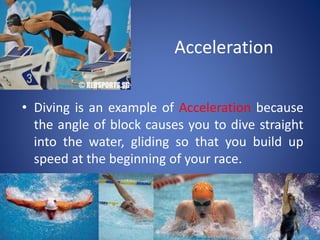
• Diving is an example of Acceleration because
the angle of block causes you to dive straight
into the water, gliding so that you build up
speed at the beginning of your race.
Momentum
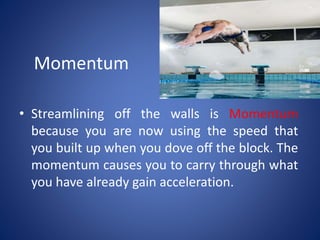
• Streamlining off the walls is Momentum
because you are now using the speed that
you built up when you dove off the block. The
momentum causes you to carry through what
you have already gain acceleration.
Force
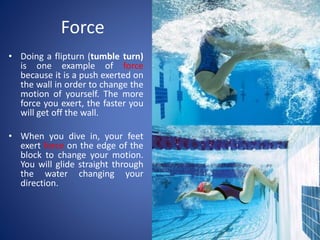
• Doing a flipturn (tumble turn)
is one example of force
because it is a push exerted on
the wall in order to change the
motion of yourself. The more
force you exert, the faster you
will get off the wall.
• When you dive in, your feet
exert force on the edge of the
block to change your motion.
You will glide straight through
the water changing your
direction.
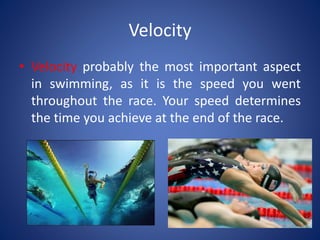
Velocity
• Velocity probably the most important aspect
in swimming, as it is the speed you went
throughout the race. Your speed determines
the time you achieve at the end of the race.
First law of motion
• Newton’s first law of motion explains that once
you start swimming, you remain at a constant
speed unless you physically stop moving your
arms and legs or start moving them faster.
• Newton’s first law is also the reason why after
you are finished with your race or set at practice,
you stay at the wall unless you purposely push off
and start again.
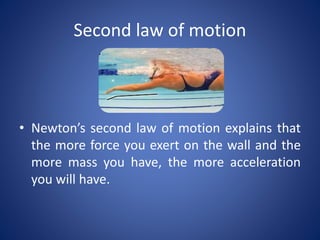
Second law of motion
• Newton’s second law of motion explains that
the more force you exert on the wall and the
more mass you have, the more acceleration
you will have.
Third law of motion
• Swimming backstroke is an example of newton’s
third law of motion, because when you push the
water backward and behind you, your body
moves forward in the opposite direction.
• Swimming breastroke is also an example of
newton’s third law of motion, because as you
push your hands downward, you propel your
body up and forward in opposite Directions.
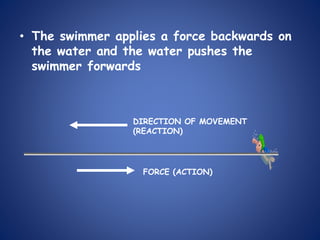
• The swimmer applies a force backwards on
the water and the water pushes the
swimmer forwards
FORCE (ACTION)
DIRECTION OF MOVEMENT
(REACTION)
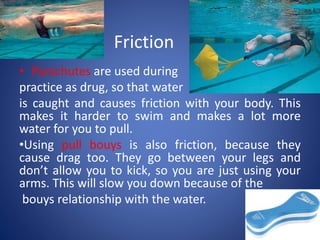
Friction
• Parachutes are used during
practice as drug, so that water
is caught and causes friction with your body. This
makes it harder to swim and makes a lot more
water for you to pull.
•Using pull bouys is also friction, because they
cause drag too. They go between your legs and
don’t allow you to kick, so you are just using your
arms. This will slow you down because of the
bouys relationship with the water.
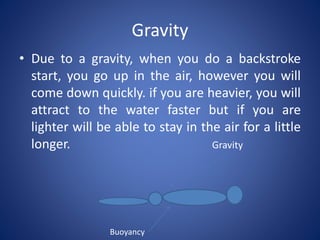
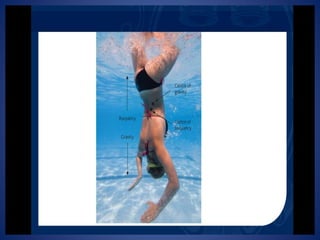
Gravity
• Due to a gravity, when you do a backstroke
start, you go up in the air, however you will
come down quickly. if you are heavier, you will
attract to the water faster but if you are
lighter will be able to stay in the air for a little
longer. Gravity
Buoyancy
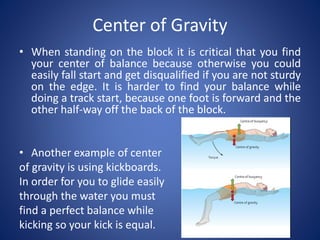
Center of Gravity
• When standing on the block it is critical that you find
your center of balance because otherwise you could
easily fall start and get disqualified if you are not sturdy
on the edge. It is harder to find your balance while
doing a track start, because one foot is forward and the
other half-way off the back of the block.
• Another example of center
of gravity is using kickboards.
In order for you to glide easily
through the water you must
find a perfect balance while
kicking so your kick is equal.
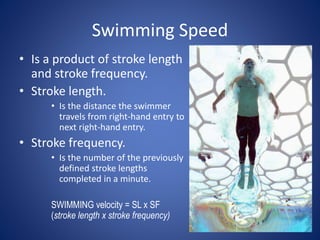
Swimming Speed
• Is a product of stroke length
and stroke frequency.
• Stroke length.
• Is the distance the swimmer
travels from right-hand entry to
next right-hand entry.
• Stroke frequency.
• Is the number of the previously
defined stroke lengths
completed in a minute.
SWIMMING velocity = SL x SF
(stroke length x stroke frequency)
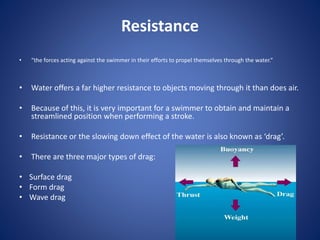
Resistance
• “the forces acting against the swimmer in their efforts to propel themselves through the water.”
• Water offers a far higher resistance to objects moving through it than does air.
• Because of this, it is very important for a swimmer to obtain and maintain a
streamlined position when performing a stroke.
• Resistance or the slowing down effect of the water is also known as ‘drag’.
• There are three major types of drag:
• Surface drag
• Form drag
• Wave drag
Surface Drag (or skin friction resistance)
• When swimming, the water must move around your
body and limbs
• A thin layer of water next to the body actually sticks to it,
and moves with it causing up to 30% resistance.
• The overall effect of this is a considerable drag on the
forward progress of the swimmer.
• How to overcome?
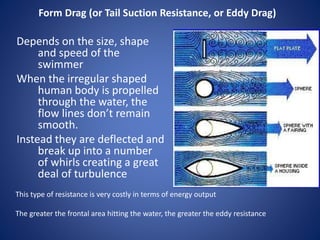
Form Drag (or Tail Suction Resistance, or Eddy Drag)
Depends on the size, shape
and speed of the
swimmer
When the irregular shaped
human body is propelled
through the water, the
flow lines don’t remain
smooth.
Instead they are deflected and
break up into a number
of whirls creating a great
deal of turbulence
This type of resistance is very costly in terms of energy output
The greater the frontal area hitting the water, the greater the eddy resistance
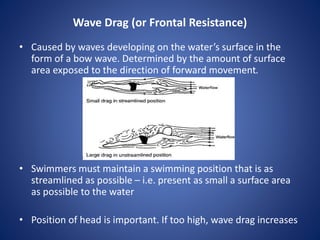
Wave Drag (or Frontal Resistance)
• Caused by waves developing on the water’s surface in the
form of a bow wave. Determined by the amount of surface
area exposed to the direction of forward movement.
• Swimmers must maintain a swimming position that is as
streamlined as possible – i.e. present as small a surface area
as possible to the water
• Position of head is important. If too high, wave drag increases
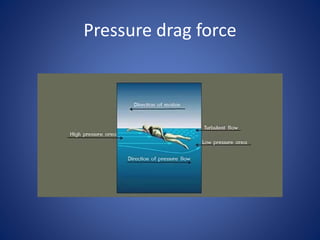
Pressure drag force
Streamlining
• Coefficient of drag = index
of how much drag an object
can experience
 Magnitude is dependent on shape and orientation of
the object relative to the fluid flow
• Streamlining is used to reduce COD by facilitating the
flow of the fluid around the swimmer
 It specifically reduces surface drag by assisting the fluid
flow remain laminar for longer, which decreases the
turbulent flow.
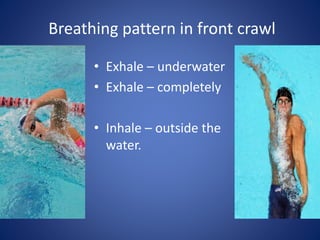
Breathing pattern in front crawl
• Exhale – underwater
• Exhale – completely
• Inhale – outside the
water.
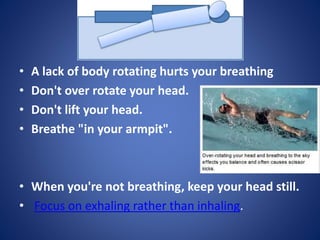
• A lack of body rotating hurts your breathing
• Don't over rotate your head.
• Don't lift your head.
• Breathe "in your armpit".
• When you're not breathing, keep your head still.
• Focus on exhaling rather than inhaling.
Butterfly - How to Breathe
• Inhaling
• While swimming butterfly, breathing is initiated by kicking a little bit
harder during the second dolphin kick. This makes your upper body rise a
little bit higher above the water surface during the body undulation.
Inhaling occurs as soon as the mouth clears the water and the arms start
their recovery forward.
• Look downward and slightly forward while breathing in.
• To avoid straining the neck and to keep a steady rhythm, it is best to keep
a neutral head position while breathing in. Try to look downward and only
a little bit forward rather than toward the end of the lane.
• Exhaling
• Exhaling starts as soon as the head drops back into the water and
continues until the head and shoulders rise above the water surface again
during the next breathing stroke cycle.
• Breathing Frequency
• Not every stroke cycle needs to be a breathing one. A common trade-off
used while swimming butterfly is to have a breathing stroke cycle followed
by a non-breathing one. This is generally considered a good trade-off
between the need of consuming oxygen and the increased effort
necessary to lift the head and shoulders higher above the water surface.
• Breathing to the Side
• Some butterfly swimmers turn their head sideways to inhale. The idea is
that it allows them to keep their head closer to the water surface and less
energy is used to lift the head and shoulders above the water surface.
• However, more amplitude in the body wave is not necessarily a bad thing.
When the chest move downwards in the water it transforms the vertical
movement in a forward momentum. So additional amplitude in the body
undulation might also translate into more forward momentum and
increased velocity.
• Furthermore, turning your head sideways to breathe increases the strain
on the neck and also often disrupts the symmetry of the stroke.
Kinematics & Kinetics
KINEMATICS
Stroke cycle kinematics
• Swimming velocity can be described by its independent
variables: stroke length (SL) and stroke frequency (SF).
SL is defined as being the horizontal distance that the
body travels during a full stroke cycle. SF is defined as
being the number of full stroke cycles performed
within a unit of time (strokes.min-1) or Hertz (Hz).
• Increases or decreases in Velocity are determined by
combined increases or decreases in SF and SL,
respectively
• For Craig and Pendergast (1979) the Front Crawl has the
greatest SL and SF in comparison to remaining
swimming techniques.
• Authors suggested similar behavior for the Backstroke
except that at a given SF, the SL and v were less than for
the Front Crawl.
• At Butterfly stroke, increases of the v were related
almost entirely to increases in SF, except at the highest
v.
• At Breaststroke increasing v was also associated with
increasing in SF, but the SL decreased more than in the
other swim strokes (Craig an Pendergast, 1979).
• Throughout an event, the decrease of v is mainly
related to the decrease of SL in all swim strokes (Hay
& Guimarães, 1983). There is a “zig-zag” pattern for
SF during inter-lap. The maximum SF on regular basis
happens at the final lap (Letzelter & Freitag, 1983).
• Comparing the swim strokes by distance, there is a
trend for SF and v decrease and a slightly
maintenance of SL with increasing distances (Jesus et
al., 2011; Chollet et al., 1996). Swimmer must have a
high SL and, therefore, v should be manipulated
changing the SF (Craig & Pendergast, 1979).
• SI is considered as an estimator for overall swimming
efficiency (Costill et al., 1985). This index assumes that,
at a given v, the swimmer with greater SL has the most
efficient swimming technique.
• Front Crawl is the one with the highest SI, followed by
Backstroke, Butterfly and Breaststroke (Sánchez &
Arellando, 2002).
Limbs kinematics
• Stroke mechanics variables, including the SF and the SL
are dependent from the limb’s kinematics.
• Deschodt et al. (1996) observed a significant
relationship between the hip velocity and the horizontal
and vertical motion of the upper limbs. As the upper
limb’s velocity increased, the horizontal velocity of the
swimmers increased as well. Therefore, it can be argued
that upper limbs velocity has a major influence in
swimming performance.
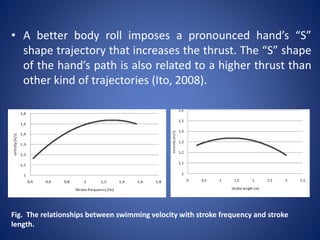
• A better body roll imposes a pronounced hand’s “S”
shape trajectory that increases the thrust. The “S” shape
of the hand’s path is also related to a higher thrust than
other kind of trajectories (Ito, 2008).
Fig. The relationships between swimming velocity with stroke frequency and stroke
length.
• At Breaststroke, the timing between the upper and
lower limbs is a major concern. A significant relationship
between upper and lower limbs coordination with swim
velocity was verified (Chollet et al., 1999).
• Tourny et al. (1992) suggested that higher velocities
might be achieved reducing the gliding phase.
• At Butterfly stroke, main kinematic aspects are the trunk
angle, the arm’s full extension during the upsweep and
the emphasis in the second kick.
• Higher trunk angle with horizontal plane will increase
the projected surface area and the drag force. To
decrease it some butterfliers breathe to the side
(Barbosa et al., 1999).
• Butterfliers with increased velocities present a higher
extension of the elbow at the upsweep, in order to
increase the duration of this propulsive phase (Togashi
& Nomura, 1992).
• Increase of kick frequency, combined with the increase
of the knee’s angle during the downbeat, seems to be
the best way to increase the swimmer’s velocity
(Arellano et al.,2003).
• So, higher swim velocities are achieved increasing the
partial duration and the propulsive force during the final
actions of the underwater curvilinear trajectories.
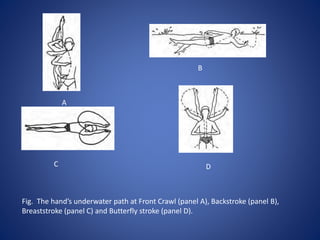
Fig. The hand’s underwater path at Front Crawl (panel A), Backstroke (panel B),
Breaststroke (panel C) and Butterfly stroke (panel D).
A
B
C D
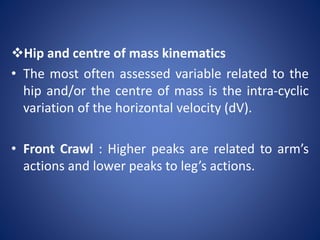
Hip and centre of mass kinematics
• The most often assessed variable related to the
hip and/or the centre of mass is the intra-cyclic
variation of the horizontal velocity (dV).
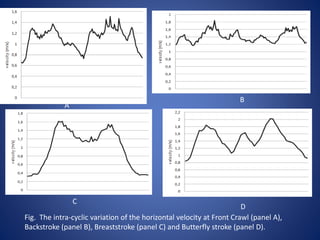
• Front Crawl : Higher peaks are related to arm’s
actions and lower peaks to leg’s actions.
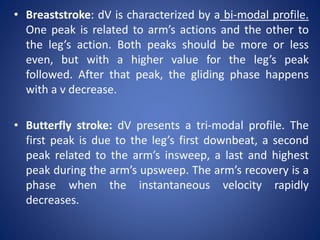
• Breaststroke: dV is characterized by a bi-modal profile.
One peak is related to arm’s actions and the other to
the leg’s action. Both peaks should be more or less
even, but with a higher value for the leg’s peak
followed. After that peak, the gliding phase happens
with a v decrease.
• Butterfly stroke: dV presents a tri-modal profile. The
first peak is due to the leg’s first downbeat, a second
peak related to the arm’s insweep, a last and highest
peak during the arm’s upsweep. The arm’s recovery is a
phase when the instantaneous velocity rapidly
decreases.
Fig. The intra-cyclic variation of the horizontal velocity at Front Crawl (panel A),
Backstroke (panel B), Breaststroke (panel C) and Butterfly stroke (panel D).
A
B
C
D
KINETICS
Kinetics analysis in swimming has addressed to
understand two main topics of interest: (i) the
propulsive force generated by the propelling segments
and; (ii) the drag forces resisting forward motion, since
the interaction between both forces will influence the
swimmer’s speed.
• Propulsive force
• Force coefficients measured as a function of angle of
attack showed that forearm drag was essentially
constant and forearm lift was almost zero. Moreover,
hand drag presented the minimum value near angles
of attack of 0º and 180º and the maximum value was
obtained near 90⁰, when the model is nearly
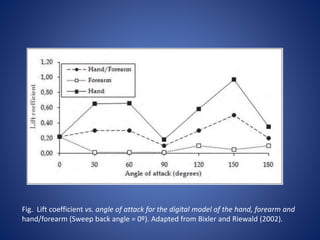
perpendicular to the flow. Hand lift was almost null
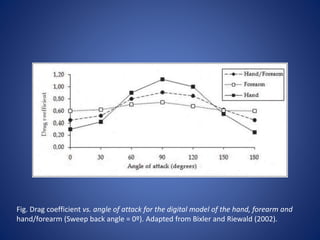
at 95º and peaked near 60º and 150º.
Fig. Drag coefficient vs. angle of attack for the digital model of the hand, forearm and
hand/forearm (Sweep back angle = 0º). Adapted from Bixler and Riewald (2002).
• When the sweep back angle is considered, it is
interesting to notice that more lift force is generated
when the little finger leads the motion than when the
thumb leads (Bixler & Riewald, 2002; Silva et al., 2008).
• In Front Crawl swimming, it was found (Hollander et al.,
1988; Deschodt, 1999) that about 85 to 90% of
propulsion is produced by the arms’ movements.
• Marinho et al. (2009) found, for a sweep back angle
of 0º, that the position with the the abducted
presented higher values than the positions with the
thumb partially abducted and adducted at angles of
attack of 0º and 45º. At an angle of attack of 90º, the
position with the thumb adducted presented the
highest value of resultant force.
Fig. Lift coefficient vs. angle of attack for the digital model of the hand, forearm and
hand/forearm (Sweep back angle = 0º). Adapted from Bixler and Riewald (2002).
Drag force: Regarding the hydrodynamic drag, this
force can be defined as an external force that acts in the
swimmer’s body parallel but in the opposite direction of
his movement direction.
• The hydrodynamic drag resisting forward motion (D) can
be expressed by Newton’s equation:
D = ½ CD ρ S v2
• Where ρ represents the fluid density, CD represents the
drag coefficient, S represents the projection surface of
the swimmer and v represents the swimming velocity.
• girls have lower drag values than boys, which can be also
related to the lower velocities achieved by the first ones.
• Bixler et al. (2007) using numerical simulation techniques
found that friction drag represented about 25% of total
drag when the swimmer is gliding underwater.
• form and wave drag represent the major part of total
hydrodynamic drag, thus swimmers must emphasize the
most hydrodynamic postures during swimming when
gliding underwater there is a tremendous reduction of
this drag component.
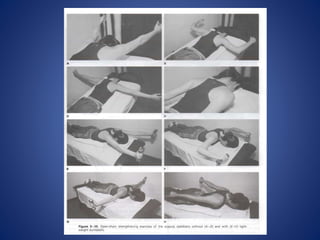
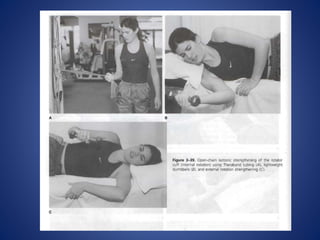
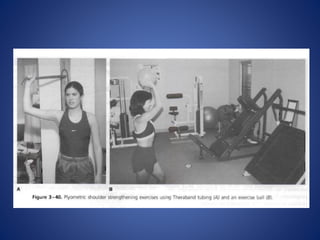
Rehabilitation (non-operative)
Rehabilitation
(after Operative Rx)
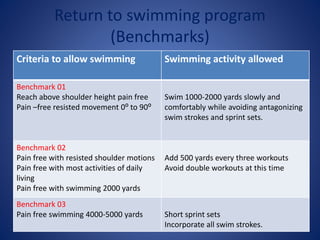
Return to swimming program
(Benchmarks)
Criteria to allow swimming Swimming activity allowed
Benchmark 01
Reach above shoulder height pain free
Pain –free resisted movement 0⁰ to 90⁰
Swim 1000-2000 yards slowly and
comfortably while avoiding antagonizing
swim strokes and sprint sets.
Benchmark 02
Pain free with resisted shoulder motions
Pain free with most activities of daily
living
Pain free with swimming 2000 yards
Add 500 yards every three workouts
Avoid double workouts at this time
Benchmark 03
Pain free swimming 4000-5000 yards Short sprint sets
Incorporate all swim strokes.
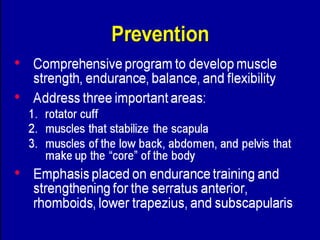
Prevention
Prevention
• Education
- Athlete / Coach
• Progressive training loads
• In-built Recovery periods
• Limit non-sport demands
• Minimize psychological stressors
• Ensure optimal nutritional status.
Responsive to change
Contd…
• Correct postural / muscular imbalances
- Muscle / Ligament Length
- Endurance
• Optimize Core Stability
• Attention to technique / biomechanics
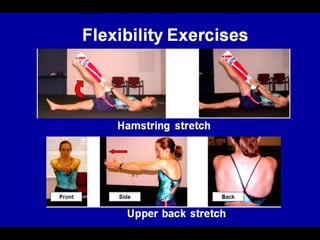
• Stretching *BEWARE*
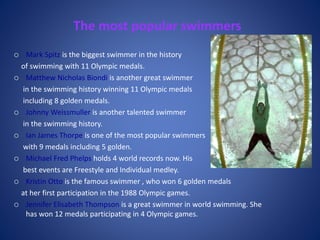
The most popular swimmers
 Mark Spitz is the biggest swimmer in the history
of swimming with 11 Olympic medals.
 Matthew Nicholas Biondi is another great swimmer
in the swimming history winning 11 Olympic medals
including 8 golden medals.
 Johnny Weissmuller is another talented swimmer
in the swimming history.
 Ian James Thorpe is one of the most popular swimmers
with 9 medals including 5 golden.
 Michael Fred Phelps holds 4 world records now. His
best events are Freestyle and Individual medley.
 Kristin Otto is the famous swimmer , who won 6 golden medals
at her first participation in the 1988 Olympic games.
 Jennifer Elisabeth Thompson is a great swimmer in world swimming. She
has won 12 medals participating in 4 Olympic games.
Physics In Swimming

Physics In Swimming

  • 1.
  • 2.
    Acceleration • Diving isan example of Acceleration because the angle of block causes you to dive straight into the water, gliding so that you build up speed at the beginning of your race.
  • 3.
    Momentum • Streamlining offthe walls is Momentum because you are now using the speed that you built up when you dove off the block. The momentum causes you to carry through what you have already gain acceleration.
  • 4.
    Force • Doing aflipturn (tumble turn) is one example of force because it is a push exerted on the wall in order to change the motion of yourself. The more force you exert, the faster you will get off the wall. • When you dive in, your feet exert force on the edge of the block to change your motion. You will glide straight through the water changing your direction.
  • 5.
    Velocity • Velocity probablythe most important aspect in swimming, as it is the speed you went throughout the race. Your speed determines the time you achieve at the end of the race.
  • 6.
    First law ofmotion • Newton’s first law of motion explains that once you start swimming, you remain at a constant speed unless you physically stop moving your arms and legs or start moving them faster. • Newton’s first law is also the reason why after you are finished with your race or set at practice, you stay at the wall unless you purposely push off and start again.
  • 7.
    Second law ofmotion • Newton’s second law of motion explains that the more force you exert on the wall and the more mass you have, the more acceleration you will have.
  • 8.
    Third law ofmotion • Swimming backstroke is an example of newton’s third law of motion, because when you push the water backward and behind you, your body moves forward in the opposite direction. • Swimming breastroke is also an example of newton’s third law of motion, because as you push your hands downward, you propel your body up and forward in opposite Directions.
  • 9.
    • The swimmerapplies a force backwards on the water and the water pushes the swimmer forwards FORCE (ACTION) DIRECTION OF MOVEMENT (REACTION)
  • 10.
    Friction • Parachutes areused during practice as drug, so that water is caught and causes friction with your body. This makes it harder to swim and makes a lot more water for you to pull. •Using pull bouys is also friction, because they cause drag too. They go between your legs and don’t allow you to kick, so you are just using your arms. This will slow you down because of the bouys relationship with the water.
  • 11.
    Gravity • Due toa gravity, when you do a backstroke start, you go up in the air, however you will come down quickly. if you are heavier, you will attract to the water faster but if you are lighter will be able to stay in the air for a little longer. Gravity Buoyancy
  • 12.
    Center of Gravity •When standing on the block it is critical that you find your center of balance because otherwise you could easily fall start and get disqualified if you are not sturdy on the edge. It is harder to find your balance while doing a track start, because one foot is forward and the other half-way off the back of the block. • Another example of center of gravity is using kickboards. In order for you to glide easily through the water you must find a perfect balance while kicking so your kick is equal.
  • 14.
    Swimming Speed • Isa product of stroke length and stroke frequency. • Stroke length. • Is the distance the swimmer travels from right-hand entry to next right-hand entry. • Stroke frequency. • Is the number of the previously defined stroke lengths completed in a minute. SWIMMING velocity = SL x SF (stroke length x stroke frequency)
  • 15.
    Resistance • “the forcesacting against the swimmer in their efforts to propel themselves through the water.” • Water offers a far higher resistance to objects moving through it than does air. • Because of this, it is very important for a swimmer to obtain and maintain a streamlined position when performing a stroke. • Resistance or the slowing down effect of the water is also known as ‘drag’. • There are three major types of drag: • Surface drag • Form drag • Wave drag
  • 16.
    Surface Drag (orskin friction resistance) • When swimming, the water must move around your body and limbs • A thin layer of water next to the body actually sticks to it, and moves with it causing up to 30% resistance. • The overall effect of this is a considerable drag on the forward progress of the swimmer. • How to overcome?
  • 17.
    Form Drag (orTail Suction Resistance, or Eddy Drag) Depends on the size, shape and speed of the swimmer When the irregular shaped human body is propelled through the water, the flow lines don’t remain smooth. Instead they are deflected and break up into a number of whirls creating a great deal of turbulence This type of resistance is very costly in terms of energy output The greater the frontal area hitting the water, the greater the eddy resistance
  • 18.
    Wave Drag (orFrontal Resistance) • Caused by waves developing on the water’s surface in the form of a bow wave. Determined by the amount of surface area exposed to the direction of forward movement. • Swimmers must maintain a swimming position that is as streamlined as possible – i.e. present as small a surface area as possible to the water • Position of head is important. If too high, wave drag increases
  • 19.
  • 20.
    Streamlining • Coefficient ofdrag = index of how much drag an object can experience  Magnitude is dependent on shape and orientation of the object relative to the fluid flow • Streamlining is used to reduce COD by facilitating the flow of the fluid around the swimmer  It specifically reduces surface drag by assisting the fluid flow remain laminar for longer, which decreases the turbulent flow.
  • 21.
    Breathing pattern infront crawl • Exhale – underwater • Exhale – completely • Inhale – outside the water.
  • 22.
    • A lackof body rotating hurts your breathing • Don't over rotate your head. • Don't lift your head. • Breathe "in your armpit". • When you're not breathing, keep your head still. • Focus on exhaling rather than inhaling.
  • 23.
    Butterfly - Howto Breathe • Inhaling • While swimming butterfly, breathing is initiated by kicking a little bit harder during the second dolphin kick. This makes your upper body rise a little bit higher above the water surface during the body undulation. Inhaling occurs as soon as the mouth clears the water and the arms start their recovery forward. • Look downward and slightly forward while breathing in. • To avoid straining the neck and to keep a steady rhythm, it is best to keep a neutral head position while breathing in. Try to look downward and only a little bit forward rather than toward the end of the lane. • Exhaling • Exhaling starts as soon as the head drops back into the water and continues until the head and shoulders rise above the water surface again during the next breathing stroke cycle.
  • 24.
    • Breathing Frequency •Not every stroke cycle needs to be a breathing one. A common trade-off used while swimming butterfly is to have a breathing stroke cycle followed by a non-breathing one. This is generally considered a good trade-off between the need of consuming oxygen and the increased effort necessary to lift the head and shoulders higher above the water surface. • Breathing to the Side • Some butterfly swimmers turn their head sideways to inhale. The idea is that it allows them to keep their head closer to the water surface and less energy is used to lift the head and shoulders above the water surface. • However, more amplitude in the body wave is not necessarily a bad thing. When the chest move downwards in the water it transforms the vertical movement in a forward momentum. So additional amplitude in the body undulation might also translate into more forward momentum and increased velocity. • Furthermore, turning your head sideways to breathe increases the strain on the neck and also often disrupts the symmetry of the stroke.
  • 25.
  • 26.
    KINEMATICS Stroke cycle kinematics •Swimming velocity can be described by its independent variables: stroke length (SL) and stroke frequency (SF). SL is defined as being the horizontal distance that the body travels during a full stroke cycle. SF is defined as being the number of full stroke cycles performed within a unit of time (strokes.min-1) or Hertz (Hz). • Increases or decreases in Velocity are determined by combined increases or decreases in SF and SL, respectively
  • 27.
    • For Craigand Pendergast (1979) the Front Crawl has the greatest SL and SF in comparison to remaining swimming techniques. • Authors suggested similar behavior for the Backstroke except that at a given SF, the SL and v were less than for the Front Crawl. • At Butterfly stroke, increases of the v were related almost entirely to increases in SF, except at the highest v. • At Breaststroke increasing v was also associated with increasing in SF, but the SL decreased more than in the other swim strokes (Craig an Pendergast, 1979).
  • 28.
    • Throughout anevent, the decrease of v is mainly related to the decrease of SL in all swim strokes (Hay & Guimarães, 1983). There is a “zig-zag” pattern for SF during inter-lap. The maximum SF on regular basis happens at the final lap (Letzelter & Freitag, 1983). • Comparing the swim strokes by distance, there is a trend for SF and v decrease and a slightly maintenance of SL with increasing distances (Jesus et al., 2011; Chollet et al., 1996). Swimmer must have a high SL and, therefore, v should be manipulated changing the SF (Craig & Pendergast, 1979).
  • 29.
    • SI isconsidered as an estimator for overall swimming efficiency (Costill et al., 1985). This index assumes that, at a given v, the swimmer with greater SL has the most efficient swimming technique. • Front Crawl is the one with the highest SI, followed by Backstroke, Butterfly and Breaststroke (Sánchez & Arellando, 2002).
  • 30.
    Limbs kinematics • Strokemechanics variables, including the SF and the SL are dependent from the limb’s kinematics. • Deschodt et al. (1996) observed a significant relationship between the hip velocity and the horizontal and vertical motion of the upper limbs. As the upper limb’s velocity increased, the horizontal velocity of the swimmers increased as well. Therefore, it can be argued that upper limbs velocity has a major influence in swimming performance.
  • 31.
    • A betterbody roll imposes a pronounced hand’s “S” shape trajectory that increases the thrust. The “S” shape of the hand’s path is also related to a higher thrust than other kind of trajectories (Ito, 2008). Fig. The relationships between swimming velocity with stroke frequency and stroke length.
  • 32.
    • At Breaststroke,the timing between the upper and lower limbs is a major concern. A significant relationship between upper and lower limbs coordination with swim velocity was verified (Chollet et al., 1999). • Tourny et al. (1992) suggested that higher velocities might be achieved reducing the gliding phase. • At Butterfly stroke, main kinematic aspects are the trunk angle, the arm’s full extension during the upsweep and the emphasis in the second kick.
  • 33.
    • Higher trunkangle with horizontal plane will increase the projected surface area and the drag force. To decrease it some butterfliers breathe to the side (Barbosa et al., 1999). • Butterfliers with increased velocities present a higher extension of the elbow at the upsweep, in order to increase the duration of this propulsive phase (Togashi & Nomura, 1992).
  • 34.
    • Increase ofkick frequency, combined with the increase of the knee’s angle during the downbeat, seems to be the best way to increase the swimmer’s velocity (Arellano et al.,2003). • So, higher swim velocities are achieved increasing the partial duration and the propulsive force during the final actions of the underwater curvilinear trajectories.
  • 35.
    Fig. The hand’sunderwater path at Front Crawl (panel A), Backstroke (panel B), Breaststroke (panel C) and Butterfly stroke (panel D). A B C D
  • 36.
    Hip and centreof mass kinematics • The most often assessed variable related to the hip and/or the centre of mass is the intra-cyclic variation of the horizontal velocity (dV). • Front Crawl : Higher peaks are related to arm’s actions and lower peaks to leg’s actions.
  • 37.
    • Breaststroke: dVis characterized by a bi-modal profile. One peak is related to arm’s actions and the other to the leg’s action. Both peaks should be more or less even, but with a higher value for the leg’s peak followed. After that peak, the gliding phase happens with a v decrease. • Butterfly stroke: dV presents a tri-modal profile. The first peak is due to the leg’s first downbeat, a second peak related to the arm’s insweep, a last and highest peak during the arm’s upsweep. The arm’s recovery is a phase when the instantaneous velocity rapidly decreases.
  • 38.
    Fig. The intra-cyclicvariation of the horizontal velocity at Front Crawl (panel A), Backstroke (panel B), Breaststroke (panel C) and Butterfly stroke (panel D). A B C D
  • 39.
    KINETICS Kinetics analysis inswimming has addressed to understand two main topics of interest: (i) the propulsive force generated by the propelling segments and; (ii) the drag forces resisting forward motion, since the interaction between both forces will influence the swimmer’s speed.
  • 40.
    • Propulsive force •Force coefficients measured as a function of angle of attack showed that forearm drag was essentially constant and forearm lift was almost zero. Moreover, hand drag presented the minimum value near angles of attack of 0º and 180º and the maximum value was obtained near 90⁰, when the model is nearly perpendicular to the flow. Hand lift was almost null at 95º and peaked near 60º and 150º.
  • 42.
    Fig. Drag coefficientvs. angle of attack for the digital model of the hand, forearm and hand/forearm (Sweep back angle = 0º). Adapted from Bixler and Riewald (2002).
  • 43.
    • When thesweep back angle is considered, it is interesting to notice that more lift force is generated when the little finger leads the motion than when the thumb leads (Bixler & Riewald, 2002; Silva et al., 2008). • In Front Crawl swimming, it was found (Hollander et al., 1988; Deschodt, 1999) that about 85 to 90% of propulsion is produced by the arms’ movements.
  • 44.
    • Marinho etal. (2009) found, for a sweep back angle of 0º, that the position with the the abducted presented higher values than the positions with the thumb partially abducted and adducted at angles of attack of 0º and 45º. At an angle of attack of 90º, the position with the thumb adducted presented the highest value of resultant force.
  • 45.
    Fig. Lift coefficientvs. angle of attack for the digital model of the hand, forearm and hand/forearm (Sweep back angle = 0º). Adapted from Bixler and Riewald (2002).
  • 46.
    Drag force: Regardingthe hydrodynamic drag, this force can be defined as an external force that acts in the swimmer’s body parallel but in the opposite direction of his movement direction. • The hydrodynamic drag resisting forward motion (D) can be expressed by Newton’s equation: D = ½ CD ρ S v2 • Where ρ represents the fluid density, CD represents the drag coefficient, S represents the projection surface of the swimmer and v represents the swimming velocity.
  • 47.
    • girls havelower drag values than boys, which can be also related to the lower velocities achieved by the first ones. • Bixler et al. (2007) using numerical simulation techniques found that friction drag represented about 25% of total drag when the swimmer is gliding underwater. • form and wave drag represent the major part of total hydrodynamic drag, thus swimmers must emphasize the most hydrodynamic postures during swimming when gliding underwater there is a tremendous reduction of this drag component.
  • 48.
  • 57.
  • 61.
    Return to swimmingprogram (Benchmarks) Criteria to allow swimming Swimming activity allowed Benchmark 01 Reach above shoulder height pain free Pain –free resisted movement 0⁰ to 90⁰ Swim 1000-2000 yards slowly and comfortably while avoiding antagonizing swim strokes and sprint sets. Benchmark 02 Pain free with resisted shoulder motions Pain free with most activities of daily living Pain free with swimming 2000 yards Add 500 yards every three workouts Avoid double workouts at this time Benchmark 03 Pain free swimming 4000-5000 yards Short sprint sets Incorporate all swim strokes.
  • 62.
  • 63.
    Prevention • Education - Athlete/ Coach • Progressive training loads • In-built Recovery periods • Limit non-sport demands • Minimize psychological stressors • Ensure optimal nutritional status. Responsive to change
  • 64.
    Contd… • Correct postural/ muscular imbalances - Muscle / Ligament Length - Endurance • Optimize Core Stability • Attention to technique / biomechanics • Stretching *BEWARE*
  • 72.
    The most popularswimmers  Mark Spitz is the biggest swimmer in the history of swimming with 11 Olympic medals.  Matthew Nicholas Biondi is another great swimmer in the swimming history winning 11 Olympic medals including 8 golden medals.  Johnny Weissmuller is another talented swimmer in the swimming history.  Ian James Thorpe is one of the most popular swimmers with 9 medals including 5 golden.  Michael Fred Phelps holds 4 world records now. His best events are Freestyle and Individual medley.  Kristin Otto is the famous swimmer , who won 6 golden medals at her first participation in the 1988 Olympic games.  Jennifer Elisabeth Thompson is a great swimmer in world swimming. She has won 12 medals participating in 4 Olympic games.