Re-designing Beginning German instruction through Blended LearningAdam GacsMiglenaNikolovaUniversity of Illinois at Chicago
UIC Blended Learning Initiative: Increasing Access and Opportunity“Integrates online with traditional face-to-face classroom activities in a planned, pedagogically valuable manner where 25 - 74% of instruction occurs online.” (Blake, 2009; Graham, 2006; MacDonald 2008).
Reducing from 4 to 3 contact hours per weekBenefits:flexible scheduling options, increased access to high demand coursesopportunity for greater student-to-faculty and student-to-student interaction
Pedagogical reasons for blendingDifferent, more engaging ways to present materialBetter preparation, monitoring student progress more closely -> more effective use of classroom timeConsistent delivery of learning materials across sectionsRepeated practice opportunitiesIndividualized instruction, immediate feedbackBuilt-in review of earlier materials
What can be done equally well or better online?PreparationExposure to target culture, more authentic, motivating materialsIntroducing new vocabulary in context Delivering self-paced tutorials on principles of language learning, dictionary use, vocabulary learning, etc.Reading comprehension activitiesFollow-ups to extend learningCommunicative, meaningful language use outside the classroomPronunciation practice/communication strategies (fluency/speech acts)Writing for fluency, mass writing, collaborative writingDiscuss cultural differencesWhat are students expected to do? How is this different from previous instruction?What are the goals?
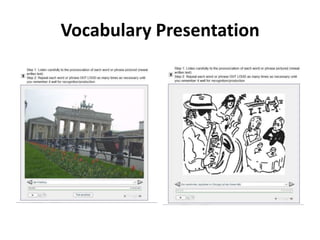
Vocabulary Presentation
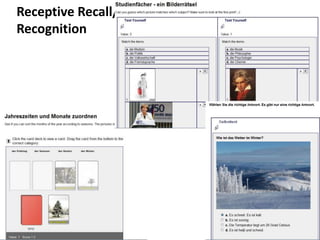
Receptive Recall/Recognition
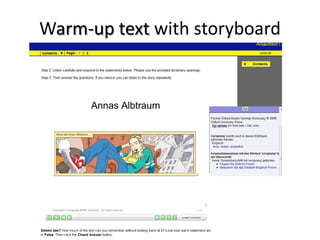
Warm-up text with storyboard
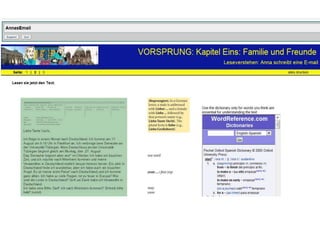
Reading (A)
Follow-up materials to expand classroom instructionBlogs (writing/reading)Wimba Voice tools (speaking)
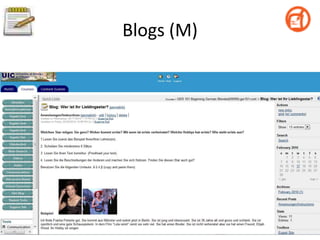
Blogs (M)
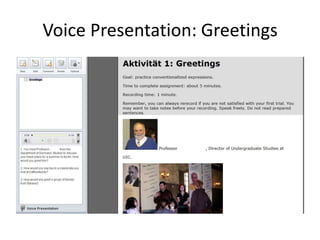
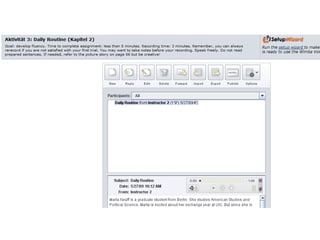
Voice Presentation: Greetings
ConclusionConstantly revise/update the developed materials, reflect technology advancementsOnly possible to develop  and implement in collaboration and with support of campus initiatives,  instructional technology consultantsBL might result in higher student success rate by increasing motivation, access, and learning opportunities
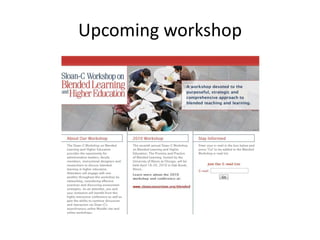
Upcoming workshop

Sympos2010

  • 1.
    Re-designing Beginning Germaninstruction through Blended LearningAdam GacsMiglenaNikolovaUniversity of Illinois at Chicago
  • 2.
    UIC Blended LearningInitiative: Increasing Access and Opportunity“Integrates online with traditional face-to-face classroom activities in a planned, pedagogically valuable manner where 25 - 74% of instruction occurs online.” (Blake, 2009; Graham, 2006; MacDonald 2008).
  • 3.
    Reducing from 4to 3 contact hours per weekBenefits:flexible scheduling options, increased access to high demand coursesopportunity for greater student-to-faculty and student-to-student interaction
  • 4.
    Pedagogical reasons forblendingDifferent, more engaging ways to present materialBetter preparation, monitoring student progress more closely -> more effective use of classroom timeConsistent delivery of learning materials across sectionsRepeated practice opportunitiesIndividualized instruction, immediate feedbackBuilt-in review of earlier materials
  • 5.
    What can bedone equally well or better online?PreparationExposure to target culture, more authentic, motivating materialsIntroducing new vocabulary in context Delivering self-paced tutorials on principles of language learning, dictionary use, vocabulary learning, etc.Reading comprehension activitiesFollow-ups to extend learningCommunicative, meaningful language use outside the classroomPronunciation practice/communication strategies (fluency/speech acts)Writing for fluency, mass writing, collaborative writingDiscuss cultural differencesWhat are students expected to do? How is this different from previous instruction?What are the goals?
  • 6.
  • 7.
  • 8.
  • 9.
  • 10.
    Follow-up materials toexpand classroom instructionBlogs (writing/reading)Wimba Voice tools (speaking)
  • 11.
  • 12.
  • 15.
    ConclusionConstantly revise/update thedeveloped materials, reflect technology advancementsOnly possible to develop and implement in collaboration and with support of campus initiatives, instructional technology consultantsBL might result in higher student success rate by increasing motivation, access, and learning opportunities
  • 16.

Editor's Notes

  • #2 Prof.Rott thank youFeedback welcomed
  • #3 National trend to create blended learning foreign language programs. Integrating computer-based learning units/e-learning content to either complement tot enhance F2F classroom instructionSince 2005Funded by SloanGoal: integration in 80 degree programs by end of 2010
  • #4 (materials kept online are easier to access, distribute, and reproduce. Teachers can easily modify and upgrade materials)
  • #5 Quia etc. provide fill-in-the blank but few examples of BL programs which use communicative language use and up-do-date cultural materialNot creating extra material but expanding on textbook content
  • #6 Contextualized vocabulary introduction by topicsContextualized vocabulary introduction progressing from presentation (pronunciation/visuals/written) to receptive recall (matching, true/false) and ending with production Presentation (pronunciation, visuals, written text, personalization)Recognition (matching, true/ false, multiple choice)Productive task (short answer)
  • #7 Variety, motivation
  • #8 Our textbook features a wealth of comprehensible input, visual contextualization.3 main texts per chapter (spoken/written): Warm-up text (read along + listen), Absprungtext (authentic readings), target text (authentic conversations, listening only, no scripts)Warm-up texts: provides basic linguistic and cultural input for the chapter. Power of image conveys the meaning.Created with SoftChalk (web lesson editor). When Ss come to class they do output-oriented activitiesReading tasks (focus on vocabulary and grammar in context)Students focus on pronunciation and intonation, answer comprehension questions adapted from textbook, notice chunks of languageStep 1: Study the pictures first, then listen to text. You should not read the first time you hear the text.Step 2: Listen and respond to statements belowStep 3: Answer comprehension questions.
  • #9 Textbook material adapted (Absprungtext)Focus on intonation and pronunciation. Text and audio to develop intonation on the discourse level. Listen to the text and read along (Step 1) Step 2: Read text on your own.Step 3: Take notes of time expressions.Focus on collocations/specific group of expressions, taking notesResources available: Glosses, dictionary, self-tests, reading journal
  • #11 Students write for a larger audience (the writing is not intended to be read only by the instructor)Practice fluency/accuracyStudents are exposed to additional written input which is meaningful, interestingStudents engage in collaborative learning (write comments and engage in dialogues)Community building (getting to know other learners/ classmates)
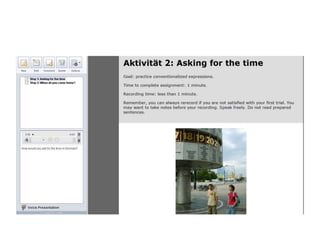
  • #12 To practice conventionalized expressions/speech acts (greetings, leave takings, asking for time, inviting). Rerecording possible, speak freely, do not read prepared sentences.Both of these require extra practice, benefits from time spent on planning/revising
  • #14 to develop fluency. Listen to/read prompt by instructor and record a response between (1-3 mins). Note taking allowed. Creative language useSs benefit from repeated listen, individual feedback, possibility of peer feedback