Renal Denervation in Patients with
Uncontrolled Hypertension: Results
of the SYMPLICITY HTN 3 Trial
Deepak L. Bhatt, M.D., M.P.H., David E. Kandzari, M.D.,
William W. O’Neill, M.D., Ralph D'Agostino, Ph.D., John
M. Flack, M.D., M.P.H., Barry T. Katzen, M.D., Martin B.
Leon, M.D., Minglei Liu, Ph.D., Laura Mauri, M.D., M.Sc.,
Manuela Negoita, M.D., Sidney A. Cohen, M.D., Ph.D.,
Suzanne Oparil, M.D., Krishna Rocha-Singh, M.D.,
Raymond R. Townsend, M.D., George L. Bakris, M.D.,
for the SYMPLICITY HTN-3 Investigators
Trial Objectives
• SYMPLICITY HTN-3 is the first prospective, multi-center,
randomized, blinded, sham controlled study to evaluate
both the safety and efficacy of percutaneous renal artery
denervation in patients with severe treatment-resistant
hypertension.
• The trial included 535 patients enrolled by 88 participating
US centers.
Bhatt DL, Kandzari DE, O’Neill WW, et al...Bakris GL. N Engl J Med 2014
Mount Sinai
New York, NY
Weill
New York, NY
Langone
New York, NY
Columbia University
New York, NY
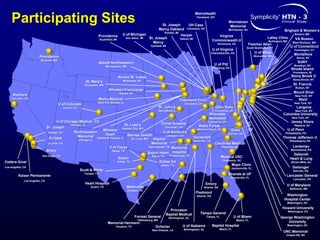
Participating Sites
Cedars-Sinai
Los Angeles, CA
Providence
Spokane, WA
Methodist
Houston, TX
Baylor
Dallas, TX
Aurora St. Lukes
Milwaukee, WI
U of Michigan
Ann Arbor, MI
Harper
Detroit, MI
Riverside
Methodist
Columbus, OH
U of Pitt
Pittsburg, PA
UH Case
Cleveland, OH
U of Maryland
Baltimore, MD
Geisinger
Danville, PA
Vanderbilt
Nashville, TN
Piedmont
Atlanta, GA
U of Miami
Miami, FL
Baptist Hospital
Miami, FL
Duke
Durham, NC
Morristown
Memorial
Morristown, NJ
Montefiore
Bronx, NY
SUNY
Brooklyn, NY
U of Connecticut
Farmington, CT
Brigham & Women’s
Boston, MA
Memorial Hermann
Houston, TX
Ohio State
Columbus, OH
Emory
Atlanta, GA
Kaiser Permanente
Los Angeles, CA
Washington
Hospital Center
Washington, DC
Stanford
Palo Alto, CA
Dallas VA
Dallas, TX
U of Texas
Dallas, TX
Howard University
Washington, DC
George Washington
University
Washington, DC
Cleveland Clinic
Cleveland, OH
Jersey Shore
Neptune, NJ
Shands at UF
Gainesville, FL
Virginia
Commonweath U
Richmond, VA
St. Joseph
Mercy
Ypsilanti, MI
Northwestern
Memorial
Chicago, IL
Baylor Heart
Plano, TX
U of Alabama
Birmingham, AL
Lancaster General
Lancaster, PA
Scott & White
Temple, TX
Mayo Clinic
Jacksonville, FL
Tampa General
Tampa, FL
MetroHealth
Cleveland, OH
St. Joseph
Orange, CA
Scripps
La Jolla, CA
Sharp
San Diego, CA
Heart Hospital
Austin, TX
Christ Hospital
Cincinnati, OH
Ochsner
New Orleans, LA
U of Kentucky
Lexington, KY
Carolinas Medical
Charlotte, NC
U of Colorado
Aurora, CO
Fletcher Allen
South Burlington, VT
Barnes Jewish
St. Louis, MO
Forrest General
Hattiesburg, MS
Abbott Northwestern
Minneapolis, MN
Wheaton Franciscan
Racine, WI
St. Francis
Roslyn, NY
Stony Brook U
Stony Brook, NY
Lahey Clinic
Burlington, MA
U of Mass
Worcester, MA
Providence
Southfield, MI
Mercy Medical
West Des Moines, IA
St. John’s
Springfield, IL
MIdwest
Heart
Oakbrook Terrace, IL
St. Mary’s
Rochester, MN
St. Luke’s
Kansas City, MO
St. Joseph
Mercy Oakland
Pontiac, MI
VA Boston
West Roxbury, MA
U of Penn
Philadelphia, PA
Thomas Jefferson U
Philadelphia, PA
Deborah
Heart & Lung
Brown Mills, NJ
Memorial
Hospital
Chatanooga, TN
Princeton
Baptist Medical
Birmingham, AL
Lankenau
Wynnewood, PA
Baptist
Memorial
Germantown, TN
Medical USC
Charleston, SC
Wake Forest
Winston-Salem, NC
UNC Memorial
Chapel Hill, NC
Rhode Island
Providence, RI
U of Virginia
Charlottesville, VA
U of Chicago Medical Ctr
Chicago, IL
Key Inclusion Criteria
• Age ≥18 and ≤80 years at time of randomization
• Stable medication regimen including full tolerated doses of
3 or more antihypertensive medications of different classes,
including a diuretic (with no changes for a minimum of 2
weeks prior to screening) and no expected changes for at
least 6 months
• Office SBP ≥160 mm Hg based on an average of 3 blood
pressure readings measured at both an initial and a
confirmatory screening visit
• Written informed consent
Bhatt DL, Kandzari DE, O’Neill WW, et al...Bakris GL. N Engl J Med 2014
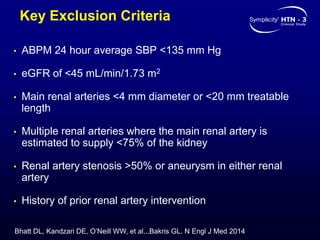
Key Exclusion Criteria
• ABPM 24 hour average SBP <135 mm Hg
• eGFR of <45 mL/min/1.73 m2
• Main renal arteries <4 mm diameter or <20 mm treatable
length
• Multiple renal arteries where the main renal artery is
estimated to supply <75% of the kidney
• Renal artery stenosis >50% or aneurysm in either renal
artery
• History of prior renal artery intervention
Bhatt DL, Kandzari DE, O’Neill WW, et al...Bakris GL. N Engl J Med 2014
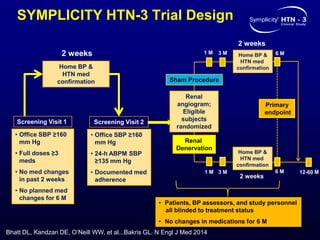
SYMPLICITY HTN-3 Trial Design
• Office SBP ≥160
mm Hg
• Full doses ≥3
meds
• No med changes
in past 2 weeks
• No planned med
changes for 6 M
Home BP &
HTN med
confirmation
• Office SBP ≥160
mm Hg
• 24-h ABPM SBP
≥135 mm Hg
• Documented med
adherence
Screening Visit 1 Screening Visit 2
Renal
angiogram;
Eligible
subjects
randomized
Home BP &
HTN med
confirmation
Home BP &
HTN med
confirmation
Primary
endpoint
2 weeks
2 weeks
Sham Procedure
Renal
Denervation
1 M
1 M 3 M
3 M 6 M
6 M 12-60 M
• Patients, BP assessors, and study personnel
all blinded to treatment status
• No changes in medications for 6 M
2 weeks
Bhatt DL, Kandzari DE, O’Neill WW, et al...Bakris GL. N Engl J Med 2014
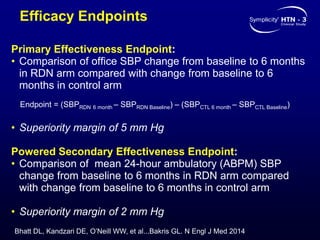
Efficacy Endpoints
Primary Effectiveness Endpoint:
• Comparison of office SBP change from baseline to 6 months
in RDN arm compared with change from baseline to 6
months in control arm
Endpoint = (SBPRDN 6 month – SBPRDN Baseline) – (SBPCTL 6 month – SBPCTL Baseline)
• Superiority margin of 5 mm Hg
Powered Secondary Effectiveness Endpoint:
• Comparison of mean 24-hour ambulatory (ABPM) SBP
change from baseline to 6 months in RDN arm compared
with change from baseline to 6 months in control arm
• Superiority margin of 2 mm Hg
Bhatt DL, Kandzari DE, O’Neill WW, et al...Bakris GL. N Engl J Med 2014
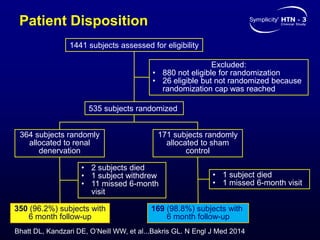
Patient Disposition
1441 subjects assessed for eligibility
Excluded:
• 880 not eligible for randomization
• 26 eligible but not randomized because
randomization cap was reached
535 subjects randomized
364 subjects randomly
allocated to renal
denervation
171 subjects randomly
allocated to sham
control
350 (96.2%) subjects with
6 month follow-up
169 (98.8%) subjects with
6 month follow-up
• 1 subject died
• 1 missed 6-month visit
• 2 subjects died
• 1 subject withdrew
• 11 missed 6-month
visit
Bhatt DL, Kandzari DE, O’Neill WW, et al...Bakris GL. N Engl J Med 2014
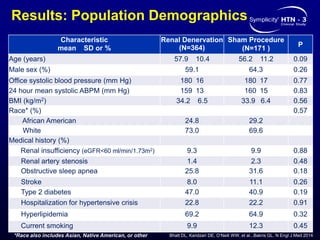
Results: Population Demographics
Characteristic
mean SD or %
Renal Denervation
(N=364)
Sham Procedure
(N=171 )
P
Age (years) 57.9 10.4 56.2 11.2 0.09
Male sex (%) 59.1 64.3 0.26
Office systolic blood pressure (mm Hg) 180 16 180 17 0.77
24 hour mean systolic ABPM (mm Hg) 159 13 160 15 0.83
BMI (kg/m2) 34.2 6.5 33.9 6.4 0.56
Race* (%) 0.57
African American 24.8 29.2
White 73.0 69.6
Medical history (%)
Renal insufficiency (eGFR<60 ml/min/1.73m2) 9.3 9.9 0.88
Renal artery stenosis 1.4 2.3 0.48
Obstructive sleep apnea 25.8 31.6 0.18
Stroke 8.0 11.1 0.26
Type 2 diabetes 47.0 40.9 0.19
Hospitalization for hypertensive crisis 22.8 22.2 0.91
Hyperlipidemia 69.2 64.9 0.32
Current smoking 9.9 12.3 0.45
*Race also includes Asian, Native American, or other Bhatt DL, Kandzari DE, O’Neill WW, et al...Bakris GL. N Engl J Med 2014
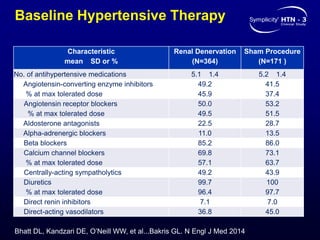
Baseline Hypertensive Therapy
Characteristic
mean SD or %
Renal Denervation
(N=364)
Sham Procedure
(N=171 )
No. of antihypertensive medications 5.1 1.4 5.2 1.4
Angiotensin-converting enzyme inhibitors
% at max tolerated dose
49.2
45.9
41.5
37.4
Angiotensin receptor blockers
% at max tolerated dose
50.0
49.5
53.2
51.5
Aldosterone antagonists 22.5 28.7
Alpha-adrenergic blockers 11.0 13.5
Beta blockers 85.2 86.0
Calcium channel blockers
% at max tolerated dose
69.8
57.1
73.1
63.7
Centrally-acting sympatholytics 49.2 43.9
Diuretics
% at max tolerated dose
99.7
96.4
100
97.7
Direct renin inhibitors 7.1 7.0
Direct-acting vasodilators 36.8 45.0
Bhatt DL, Kandzari DE, O’Neill WW, et al...Bakris GL. N Engl J Med 2014
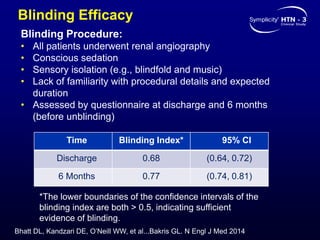
Blinding Efficacy
Time Blinding Index* 95% CI
Discharge 0.68 (0.64, 0.72)
6 Months 0.77 (0.74, 0.81)
*The lower boundaries of the confidence intervals of the
blinding index are both > 0.5, indicating sufficient
evidence of blinding.
Blinding Procedure:
• All patients underwent renal angiography
• Conscious sedation
• Sensory isolation (e.g., blindfold and music)
• Lack of familiarity with procedural details and expected
duration
• Assessed by questionnaire at discharge and 6 months
(before unblinding)
Bhatt DL, Kandzari DE, O’Neill WW, et al...Bakris GL. N Engl J Med 2014
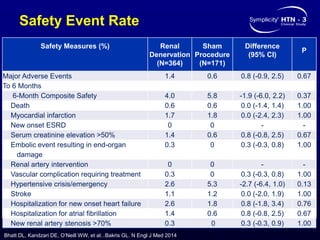
Safety Event Rate
Safety Measures (%) Renal
Denervation
(N=364)
Sham
Procedure
(N=171)
Difference
(95% CI)
P
Major Adverse Events 1.4 0.6 0.8 (-0.9, 2.5) 0.67
To 6 Months
6-Month Composite Safety 4.0 5.8 -1.9 (-6.0, 2.2) 0.37
Death 0.6 0.6 0.0 (-1.4, 1.4) 1.00
Myocardial infarction 1.7 1.8 0.0 (-2.4, 2.3) 1.00
New onset ESRD 0 0 - -
Serum creatinine elevation >50% 1.4 0.6 0.8 (-0.8, 2.5) 0.67
Embolic event resulting in end-organ
damage
0.3 0 0.3 (-0.3, 0.8) 1.00
Renal artery intervention 0 0 - -
Vascular complication requiring treatment 0.3 0 0.3 (-0.3, 0.8) 1.00
Hypertensive crisis/emergency 2.6 5.3 -2.7 (-6.4, 1.0) 0.13
Stroke 1.1 1.2 0.0 (-2.0, 1.9) 1.00
Hospitalization for new onset heart failure 2.6 1.8 0.8 (-1.8, 3.4) 0.76
Hospitalization for atrial fibrillation 1.4 0.6 0.8 (-0.8, 2.5) 0.67
New renal artery stenosis >70% 0.3 0 0.3 (-0.3, 0.9) 1.00
Bhatt DL, Kandzari DE, O’Neill WW, et al...Bakris GL. N Engl J Med 2014
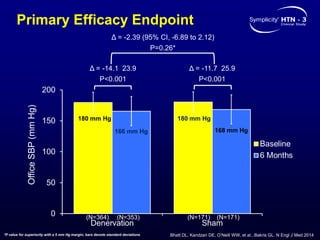
Primary Efficacy Endpoint
Δ = -14.1 23.9
P<0.001
Δ = -11.7 25.9
P<0.001
Δ = -2.39 (95% CI, -6.89 to 2.12)
P=0.26*
(N=364) (N=171)
OfficeSBP(mmHg)
(N=353) (N=171)
180 mm Hg
166 mm Hg
180 mm Hg
168 mm Hg
*P value for superiority with a 5 mm Hg margin; bars denote standard deviations Bhatt DL, Kandzari DE, O’Neill WW, et al...Bakris GL. N Engl J Med 2014
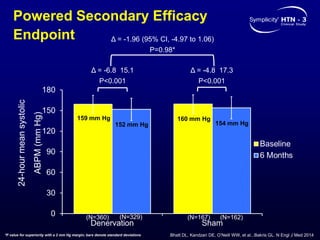
Powered Secondary Efficacy
Endpoint
Δ = -6.8 15.1
P<0.001
Δ = -4.8 17.3
P<0.001
Δ = -1.96 (95% CI, -4.97 to 1.06)
P=0.98*
(N=360) (N=167)
24-hourmeansystolic
ABPM(mmHg)
(N=329) (N=162)
159 mm Hg
152 mm Hg
160 mm Hg
154 mm Hg
*P value for superiority with a 2 mm Hg margin; bars denote standard deviations Bhatt DL, Kandzari DE, O’Neill WW, et al...Bakris GL. N Engl J Med 2014
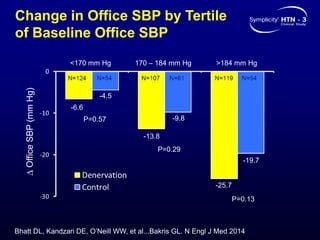
Change in Office SBP by Tertile
of Baseline Office SBP∆OfficeSBP(mmHg)
<170 mm Hg 170 – 184 mm Hg >184 mm Hg
-6.6
-25.7
-13.8
-4.5
-9.8
-19.7
P=0.57
P=0.13
P=0.29
Bhatt DL, Kandzari DE, O’Neill WW, et al...Bakris GL. N Engl J Med 2014
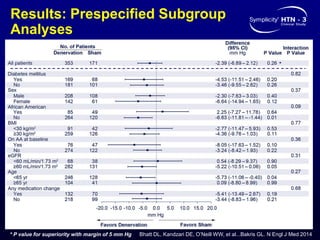
Results: Prespecified Subgroup
Analyses
*
* P value for superiority with margin of 5 mm Hg Bhatt DL, Kandzari DE, O’Neill WW, et al...Bakris GL. N Engl J Med 2014
Conclusions
• In a prospective, multicenter, randomized, blinded, sham
controlled trial of patients with uncontrolled resistant
hypertension, percutaneous renal denervation was safe
but not associated with significant additional reductions in
office or ambulatory blood pressure.
• These results underscore the importance of blinding and
sham controls in evaluations of new devices.
• Further study in rigorously designed clinical trials will be
necessary to confirm previously reported benefits of renal
denervation in patients with resistant hypertension or to
validate alternate methods of renal denervation.
Bhatt DL, Kandzari DE, O’Neill WW, et al...Bakris GL. N Engl J Med 2014

Symplicity htn3 acc14

  • 1.
    Renal Denervation inPatients with Uncontrolled Hypertension: Results of the SYMPLICITY HTN 3 Trial Deepak L. Bhatt, M.D., M.P.H., David E. Kandzari, M.D., William W. O’Neill, M.D., Ralph D'Agostino, Ph.D., John M. Flack, M.D., M.P.H., Barry T. Katzen, M.D., Martin B. Leon, M.D., Minglei Liu, Ph.D., Laura Mauri, M.D., M.Sc., Manuela Negoita, M.D., Sidney A. Cohen, M.D., Ph.D., Suzanne Oparil, M.D., Krishna Rocha-Singh, M.D., Raymond R. Townsend, M.D., George L. Bakris, M.D., for the SYMPLICITY HTN-3 Investigators
  • 2.
    Trial Objectives • SYMPLICITYHTN-3 is the first prospective, multi-center, randomized, blinded, sham controlled study to evaluate both the safety and efficacy of percutaneous renal artery denervation in patients with severe treatment-resistant hypertension. • The trial included 535 patients enrolled by 88 participating US centers. Bhatt DL, Kandzari DE, O’Neill WW, et al...Bakris GL. N Engl J Med 2014
  • 3.
    Mount Sinai New York,NY Weill New York, NY Langone New York, NY Columbia University New York, NY Participating Sites Cedars-Sinai Los Angeles, CA Providence Spokane, WA Methodist Houston, TX Baylor Dallas, TX Aurora St. Lukes Milwaukee, WI U of Michigan Ann Arbor, MI Harper Detroit, MI Riverside Methodist Columbus, OH U of Pitt Pittsburg, PA UH Case Cleveland, OH U of Maryland Baltimore, MD Geisinger Danville, PA Vanderbilt Nashville, TN Piedmont Atlanta, GA U of Miami Miami, FL Baptist Hospital Miami, FL Duke Durham, NC Morristown Memorial Morristown, NJ Montefiore Bronx, NY SUNY Brooklyn, NY U of Connecticut Farmington, CT Brigham & Women’s Boston, MA Memorial Hermann Houston, TX Ohio State Columbus, OH Emory Atlanta, GA Kaiser Permanente Los Angeles, CA Washington Hospital Center Washington, DC Stanford Palo Alto, CA Dallas VA Dallas, TX U of Texas Dallas, TX Howard University Washington, DC George Washington University Washington, DC Cleveland Clinic Cleveland, OH Jersey Shore Neptune, NJ Shands at UF Gainesville, FL Virginia Commonweath U Richmond, VA St. Joseph Mercy Ypsilanti, MI Northwestern Memorial Chicago, IL Baylor Heart Plano, TX U of Alabama Birmingham, AL Lancaster General Lancaster, PA Scott & White Temple, TX Mayo Clinic Jacksonville, FL Tampa General Tampa, FL MetroHealth Cleveland, OH St. Joseph Orange, CA Scripps La Jolla, CA Sharp San Diego, CA Heart Hospital Austin, TX Christ Hospital Cincinnati, OH Ochsner New Orleans, LA U of Kentucky Lexington, KY Carolinas Medical Charlotte, NC U of Colorado Aurora, CO Fletcher Allen South Burlington, VT Barnes Jewish St. Louis, MO Forrest General Hattiesburg, MS Abbott Northwestern Minneapolis, MN Wheaton Franciscan Racine, WI St. Francis Roslyn, NY Stony Brook U Stony Brook, NY Lahey Clinic Burlington, MA U of Mass Worcester, MA Providence Southfield, MI Mercy Medical West Des Moines, IA St. John’s Springfield, IL MIdwest Heart Oakbrook Terrace, IL St. Mary’s Rochester, MN St. Luke’s Kansas City, MO St. Joseph Mercy Oakland Pontiac, MI VA Boston West Roxbury, MA U of Penn Philadelphia, PA Thomas Jefferson U Philadelphia, PA Deborah Heart & Lung Brown Mills, NJ Memorial Hospital Chatanooga, TN Princeton Baptist Medical Birmingham, AL Lankenau Wynnewood, PA Baptist Memorial Germantown, TN Medical USC Charleston, SC Wake Forest Winston-Salem, NC UNC Memorial Chapel Hill, NC Rhode Island Providence, RI U of Virginia Charlottesville, VA U of Chicago Medical Ctr Chicago, IL
  • 4.
    Key Inclusion Criteria •Age ≥18 and ≤80 years at time of randomization • Stable medication regimen including full tolerated doses of 3 or more antihypertensive medications of different classes, including a diuretic (with no changes for a minimum of 2 weeks prior to screening) and no expected changes for at least 6 months • Office SBP ≥160 mm Hg based on an average of 3 blood pressure readings measured at both an initial and a confirmatory screening visit • Written informed consent Bhatt DL, Kandzari DE, O’Neill WW, et al...Bakris GL. N Engl J Med 2014
  • 5.
    Key Exclusion Criteria •ABPM 24 hour average SBP <135 mm Hg • eGFR of <45 mL/min/1.73 m2 • Main renal arteries <4 mm diameter or <20 mm treatable length • Multiple renal arteries where the main renal artery is estimated to supply <75% of the kidney • Renal artery stenosis >50% or aneurysm in either renal artery • History of prior renal artery intervention Bhatt DL, Kandzari DE, O’Neill WW, et al...Bakris GL. N Engl J Med 2014
  • 6.
    SYMPLICITY HTN-3 TrialDesign • Office SBP ≥160 mm Hg • Full doses ≥3 meds • No med changes in past 2 weeks • No planned med changes for 6 M Home BP & HTN med confirmation • Office SBP ≥160 mm Hg • 24-h ABPM SBP ≥135 mm Hg • Documented med adherence Screening Visit 1 Screening Visit 2 Renal angiogram; Eligible subjects randomized Home BP & HTN med confirmation Home BP & HTN med confirmation Primary endpoint 2 weeks 2 weeks Sham Procedure Renal Denervation 1 M 1 M 3 M 3 M 6 M 6 M 12-60 M • Patients, BP assessors, and study personnel all blinded to treatment status • No changes in medications for 6 M 2 weeks Bhatt DL, Kandzari DE, O’Neill WW, et al...Bakris GL. N Engl J Med 2014
  • 7.
    Efficacy Endpoints Primary EffectivenessEndpoint: • Comparison of office SBP change from baseline to 6 months in RDN arm compared with change from baseline to 6 months in control arm Endpoint = (SBPRDN 6 month – SBPRDN Baseline) – (SBPCTL 6 month – SBPCTL Baseline) • Superiority margin of 5 mm Hg Powered Secondary Effectiveness Endpoint: • Comparison of mean 24-hour ambulatory (ABPM) SBP change from baseline to 6 months in RDN arm compared with change from baseline to 6 months in control arm • Superiority margin of 2 mm Hg Bhatt DL, Kandzari DE, O’Neill WW, et al...Bakris GL. N Engl J Med 2014
  • 8.
    Patient Disposition 1441 subjectsassessed for eligibility Excluded: • 880 not eligible for randomization • 26 eligible but not randomized because randomization cap was reached 535 subjects randomized 364 subjects randomly allocated to renal denervation 171 subjects randomly allocated to sham control 350 (96.2%) subjects with 6 month follow-up 169 (98.8%) subjects with 6 month follow-up • 1 subject died • 1 missed 6-month visit • 2 subjects died • 1 subject withdrew • 11 missed 6-month visit Bhatt DL, Kandzari DE, O’Neill WW, et al...Bakris GL. N Engl J Med 2014
  • 9.
    Results: Population Demographics Characteristic meanSD or % Renal Denervation (N=364) Sham Procedure (N=171 ) P Age (years) 57.9 10.4 56.2 11.2 0.09 Male sex (%) 59.1 64.3 0.26 Office systolic blood pressure (mm Hg) 180 16 180 17 0.77 24 hour mean systolic ABPM (mm Hg) 159 13 160 15 0.83 BMI (kg/m2) 34.2 6.5 33.9 6.4 0.56 Race* (%) 0.57 African American 24.8 29.2 White 73.0 69.6 Medical history (%) Renal insufficiency (eGFR<60 ml/min/1.73m2) 9.3 9.9 0.88 Renal artery stenosis 1.4 2.3 0.48 Obstructive sleep apnea 25.8 31.6 0.18 Stroke 8.0 11.1 0.26 Type 2 diabetes 47.0 40.9 0.19 Hospitalization for hypertensive crisis 22.8 22.2 0.91 Hyperlipidemia 69.2 64.9 0.32 Current smoking 9.9 12.3 0.45 *Race also includes Asian, Native American, or other Bhatt DL, Kandzari DE, O’Neill WW, et al...Bakris GL. N Engl J Med 2014
  • 10.
    Baseline Hypertensive Therapy Characteristic meanSD or % Renal Denervation (N=364) Sham Procedure (N=171 ) No. of antihypertensive medications 5.1 1.4 5.2 1.4 Angiotensin-converting enzyme inhibitors % at max tolerated dose 49.2 45.9 41.5 37.4 Angiotensin receptor blockers % at max tolerated dose 50.0 49.5 53.2 51.5 Aldosterone antagonists 22.5 28.7 Alpha-adrenergic blockers 11.0 13.5 Beta blockers 85.2 86.0 Calcium channel blockers % at max tolerated dose 69.8 57.1 73.1 63.7 Centrally-acting sympatholytics 49.2 43.9 Diuretics % at max tolerated dose 99.7 96.4 100 97.7 Direct renin inhibitors 7.1 7.0 Direct-acting vasodilators 36.8 45.0 Bhatt DL, Kandzari DE, O’Neill WW, et al...Bakris GL. N Engl J Med 2014
  • 11.
    Blinding Efficacy Time BlindingIndex* 95% CI Discharge 0.68 (0.64, 0.72) 6 Months 0.77 (0.74, 0.81) *The lower boundaries of the confidence intervals of the blinding index are both > 0.5, indicating sufficient evidence of blinding. Blinding Procedure: • All patients underwent renal angiography • Conscious sedation • Sensory isolation (e.g., blindfold and music) • Lack of familiarity with procedural details and expected duration • Assessed by questionnaire at discharge and 6 months (before unblinding) Bhatt DL, Kandzari DE, O’Neill WW, et al...Bakris GL. N Engl J Med 2014
  • 12.
    Safety Event Rate SafetyMeasures (%) Renal Denervation (N=364) Sham Procedure (N=171) Difference (95% CI) P Major Adverse Events 1.4 0.6 0.8 (-0.9, 2.5) 0.67 To 6 Months 6-Month Composite Safety 4.0 5.8 -1.9 (-6.0, 2.2) 0.37 Death 0.6 0.6 0.0 (-1.4, 1.4) 1.00 Myocardial infarction 1.7 1.8 0.0 (-2.4, 2.3) 1.00 New onset ESRD 0 0 - - Serum creatinine elevation >50% 1.4 0.6 0.8 (-0.8, 2.5) 0.67 Embolic event resulting in end-organ damage 0.3 0 0.3 (-0.3, 0.8) 1.00 Renal artery intervention 0 0 - - Vascular complication requiring treatment 0.3 0 0.3 (-0.3, 0.8) 1.00 Hypertensive crisis/emergency 2.6 5.3 -2.7 (-6.4, 1.0) 0.13 Stroke 1.1 1.2 0.0 (-2.0, 1.9) 1.00 Hospitalization for new onset heart failure 2.6 1.8 0.8 (-1.8, 3.4) 0.76 Hospitalization for atrial fibrillation 1.4 0.6 0.8 (-0.8, 2.5) 0.67 New renal artery stenosis >70% 0.3 0 0.3 (-0.3, 0.9) 1.00 Bhatt DL, Kandzari DE, O’Neill WW, et al...Bakris GL. N Engl J Med 2014
  • 13.
    Primary Efficacy Endpoint Δ= -14.1 23.9 P<0.001 Δ = -11.7 25.9 P<0.001 Δ = -2.39 (95% CI, -6.89 to 2.12) P=0.26* (N=364) (N=171) OfficeSBP(mmHg) (N=353) (N=171) 180 mm Hg 166 mm Hg 180 mm Hg 168 mm Hg *P value for superiority with a 5 mm Hg margin; bars denote standard deviations Bhatt DL, Kandzari DE, O’Neill WW, et al...Bakris GL. N Engl J Med 2014
  • 14.
    Powered Secondary Efficacy Endpoint Δ= -6.8 15.1 P<0.001 Δ = -4.8 17.3 P<0.001 Δ = -1.96 (95% CI, -4.97 to 1.06) P=0.98* (N=360) (N=167) 24-hourmeansystolic ABPM(mmHg) (N=329) (N=162) 159 mm Hg 152 mm Hg 160 mm Hg 154 mm Hg *P value for superiority with a 2 mm Hg margin; bars denote standard deviations Bhatt DL, Kandzari DE, O’Neill WW, et al...Bakris GL. N Engl J Med 2014
  • 15.
    Change in OfficeSBP by Tertile of Baseline Office SBP∆OfficeSBP(mmHg) <170 mm Hg 170 – 184 mm Hg >184 mm Hg -6.6 -25.7 -13.8 -4.5 -9.8 -19.7 P=0.57 P=0.13 P=0.29 Bhatt DL, Kandzari DE, O’Neill WW, et al...Bakris GL. N Engl J Med 2014
  • 16.
    Results: Prespecified Subgroup Analyses * *P value for superiority with margin of 5 mm Hg Bhatt DL, Kandzari DE, O’Neill WW, et al...Bakris GL. N Engl J Med 2014
  • 17.
    Conclusions • In aprospective, multicenter, randomized, blinded, sham controlled trial of patients with uncontrolled resistant hypertension, percutaneous renal denervation was safe but not associated with significant additional reductions in office or ambulatory blood pressure. • These results underscore the importance of blinding and sham controls in evaluations of new devices. • Further study in rigorously designed clinical trials will be necessary to confirm previously reported benefits of renal denervation in patients with resistant hypertension or to validate alternate methods of renal denervation. Bhatt DL, Kandzari DE, O’Neill WW, et al...Bakris GL. N Engl J Med 2014
  • 18.
    Bhatt DL, KandzariDE, O’Neill WW, et al...Bakris GL. N Engl J Med 2014

Editor's Notes

  • #14 Baseline – Denervation 179.7 ± 16.16 Mo – Denervation 165.6 ± 23.6Baseline – Sham 180.2 ± 16.86 mo – Sham 168.4 ± 28.6
  • #15 Baseline – Denervation 179.7 ± 16.16 Mo – Denervation 165.6 ± 23.6Baseline – Sham 180.2 ± 16.86 mo – Sham 168.4 ± 28.6