1
Consensus Documents on
Catheter-based Renal
Denervation
Josep Redon. MD, PhD, FAHA
Scientific Director
Research Foundation and Research Institute
INCLIVA. University of Valencia
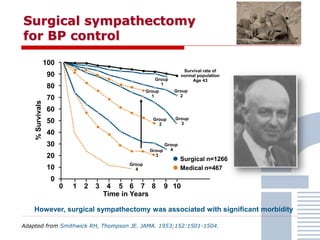
Surgical sympathectomy
for BP control
However, surgical sympathectomy was associated with significant morbidity
100
90
80
70
60
50
40
30
20
10
0
0 2 3 4 5 6 7 8 9 101
Time in Years
%Survivals
Surgical n=1266
Medical n=467
Group
3
Group
3
Group
1
Group
2
Group
4
Group
1
Group
2
Group
4
Survival rate of
normal population
Age 43
• Group 1:
Patients with persistently
elevated BP, minimal/no
eyeground changes nor
abnormalities in cerebral,
cardiac, or renal nerves
• Groups 2-4:
Patients with
increasing amounts of
cardiovascular disease
Adapted from Smithwick RH, Thompson JE. JAMA. 1953;152:1501-1504.
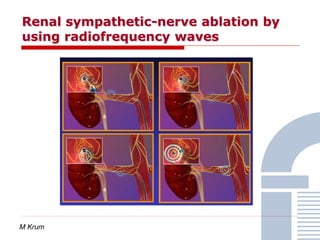
Renal sympathetic-nerve ablation by
using radiofrequency waves
M Krum
Consensus documents on
catheter-based RDN
Discrepancies?
Final thoughts
How many?
Domains covered
Consensus documents on
catheter-based RDN
Discrepancies?
Final thoughts
How many?
Domains covered
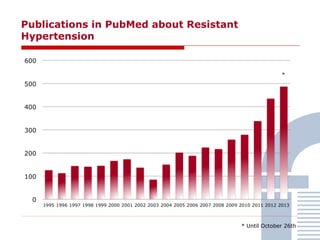
Publications in PubMed about Resistant
Hypertension
* Until October 26th
*
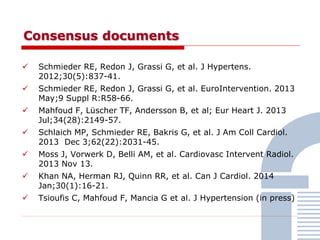
Consensus documents
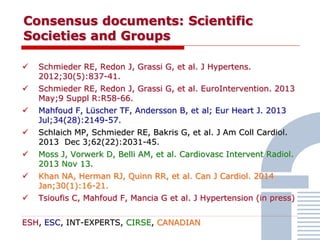
 Schmieder RE, Redon J, Grassi G, et al. J Hypertens.
2012;30(5):837-41.
 Schmieder RE, Redon J, Grassi G, et al. EuroIntervention. 2013
May;9 Suppl R:R58-66.
 Mahfoud F, Lüscher TF, Andersson B, et al; Eur Heart J. 2013
Jul;34(28):2149-57.
 Schlaich MP, Schmieder RE, Bakris G, et al. J Am Coll Cardiol.
2013 Dec 3;62(22):2031-45.
 Moss J, Vorwerk D, Belli AM, et al. Cardiovasc Intervent Radiol.
2013 Nov 13.
 Khan NA, Herman RJ, Quinn RR, et al. Can J Cardiol. 2014
Jan;30(1):16-21.
 Tsioufis C, Mahfoud F, Mancia G et al. J Hypertension (in press)
Consensus documents: Scientific
Societies and Groups
 Schmieder RE, Redon J, Grassi G, et al. J Hypertens.
2012;30(5):837-41.
 Schmieder RE, Redon J, Grassi G, et al. EuroIntervention. 2013
May;9 Suppl R:R58-66.
 Mahfoud F, Lüscher TF, Andersson B, et al; Eur Heart J. 2013
Jul;34(28):2149-57.
 Schlaich MP, Schmieder RE, Bakris G, et al. J Am Coll Cardiol.
2013 Dec 3;62(22):2031-45.
 Moss J, Vorwerk D, Belli AM, et al. Cardiovasc Intervent Radiol.
2013 Nov 13.
 Khan NA, Herman RJ, Quinn RR, et al. Can J Cardiol. 2014
Jan;30(1):16-21.
 Tsioufis C, Mahfoud F, Mancia G et al. J Hypertension (in press)
ESH, ESC, INT-EXPERTS, CIRSE, CANADIAN
Consensus documents: General
Guidelines
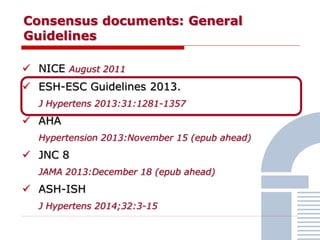
 NICE August 2011
 ESH-ESC Guidelines 2013.
J Hypertens 2013:31:1281-1357
 AHA
Hypertension 2013:November 15 (epub ahead)
 JNC 8
JAMA 2013:December 18 (epub ahead)
 ASH-ISH
J Hypertens 2014;32:3-15
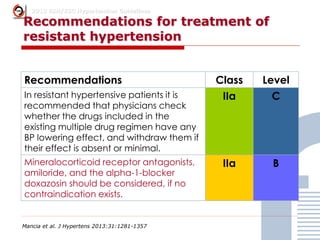
2013 ESH/ESC Hypertension Guidelines
Recommendations for treatment of
resistant hypertension
Mancia et al. J Hypertens 2013:31:1281-1357
Recommendations Class Level
In resistant hypertensive patients it is
recommended that physicians check
whether the drugs included in the
existing multiple drug regimen have any
BP lowering effect, and withdraw them if
their effect is absent or minimal.
IIa C
Mineralocorticoid receptor antagonists,
amiloride, and the alpha-1-blocker
doxazosin should be considered, if no
contraindication exists.
IIa B
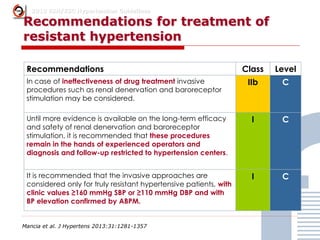
2013 ESH/ESC Hypertension Guidelines
Recommendations Class Level
In case of ineffectiveness of drug treatment invasive
procedures such as renal denervation and baroreceptor
stimulation may be considered.
IIb C
Until more evidence is available on the long-term efficacy
and safety of renal denervation and baroreceptor
stimulation, it is recommended that these procedures
remain in the hands of experienced operators and
diagnosis and follow-up restricted to hypertension centers.
I C
It is recommended that the invasive approaches are
considered only for truly resistant hypertensive patients, with
clinic values ≥160 mmHg SBP or ≥110 mmHg DBP and with
BP elevation confirmed by ABPM.
I C
Recommendations for treatment of
resistant hypertension
Mancia et al. J Hypertens 2013:31:1281-1357
Consensus documents on
catheter-based RDN
Discrepancies?
Final thoughts
How many?
Domains covered
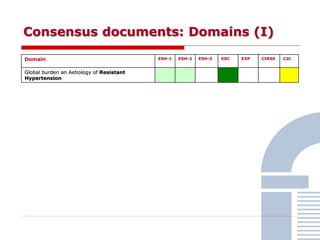
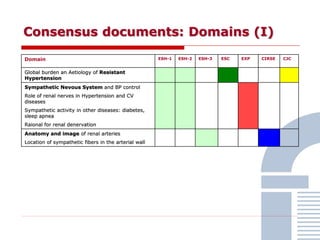
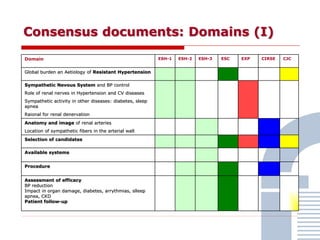
Consensus documents: Domains (I)
Domain ESH-1 ESH-2 ESH-3 ESC EXP CIRSE CJC
Global burden an Aetiology of Resistant
Hypertension
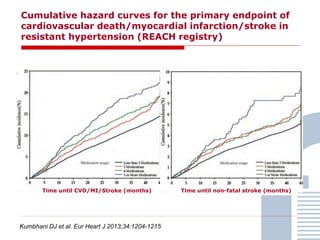
Cumulative hazard curves for the primary endpoint of
cardiovascular death/myocardial infarction/stroke in
resistant hypertension (REACH registry)
Kumbhani DJ et al. Eur Heart J 2013;34:1204-1215
Time until CVD/MI/Stroke (months) Time until non-fatal stroke (months)
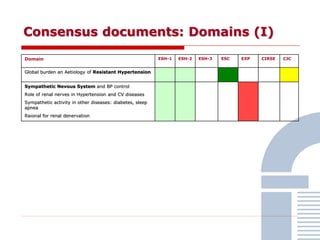
Consensus documents: Domains (I)
Domain ESH-1 ESH-2 ESH-3 ESC EXP CIRSE CJC
Global burden an Aetiology of Resistant Hypertension
Sympathetic Nevous System and BP control
Role of renal nerves in Hypertension and CV diseases
Sympathetic activity in other diseases: diabetes, sleep
apnea
Raional for renal denervation
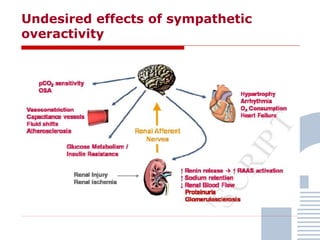
Undesired effects of sympathetic
overactivity
Consensus documents: Domains (I)
Domain ESH-1 ESH-2 ESH-3 ESC EXP CIRSE CJC
Global burden an Aetiology of Resistant
Hypertension
Sympathetic Nevous System and BP control
Role of renal nerves in Hypertension and CV
diseases
Sympathetic activity in other diseases: diabetes,
sleep apnea
Raional for renal denervation
Anatomy and image of renal arteries
Location of sympathetic fibers in the arterial wall
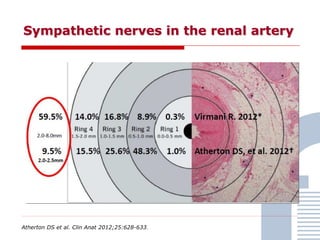
Sympathetic nerves in the renal artery
Atherton DS et al. Clin Anat 2012;25:628-633.
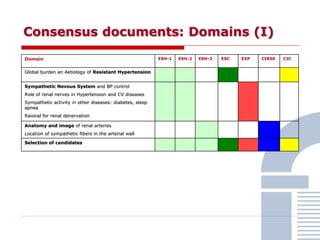
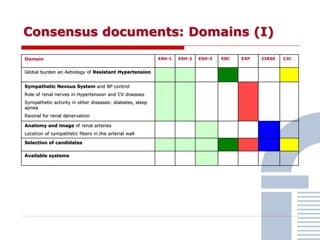
Consensus documents: Domains (I)
Domain ESH-1 ESH-2 ESH-3 ESC EXP CIRSE CJC
Global burden an Aetiology of Resistant Hypertension
Sympathetic Nevous System and BP control
Role of renal nerves in Hypertension and CV diseases
Sympathetic activity in other diseases: diabetes, sleep
apnea
Raional for renal denervation
Anatomy and image of renal arteries
Location of sympathetic fibers in the arterial wall
Selection of candidates
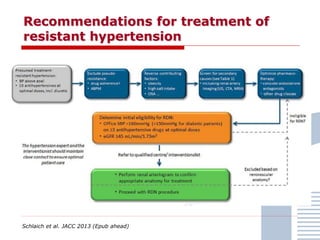
Recommendations for treatment of
resistant hypertension
Schlaich et al. JACC 2013 (Epub ahead)
Consensus documents: Domains (I)
Domain ESH-1 ESH-2 ESH-3 ESC EXP CIRSE CJC
Global burden an Aetiology of Resistant Hypertension
Sympathetic Nevous System and BP control
Role of renal nerves in Hypertension and CV diseases
Sympathetic activity in other diseases: diabetes, sleep
apnea
Raional for renal denervation
Anatomy and image of renal arteries
Location of sympathetic fibers in the arterial wall
Selection of candidates
Available systems
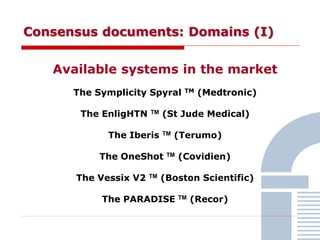
Consensus documents: Domains (I)
Available systems in the market
The Symplicity Spyral TM (Medtronic)
The EnligHTN TM (St Jude Medical)
The Iberis TM (Terumo)
The OneShot TM (Covidien)
The Vessix V2 TM (Boston Scientific)
The PARADISE TM (Recor)
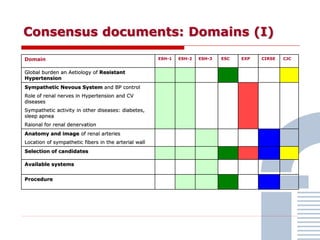
Consensus documents: Domains (I)
Domain ESH-1 ESH-2 ESH-3 ESC EXP CIRSE CJC
Global burden an Aetiology of Resistant
Hypertension
Sympathetic Nevous System and BP control
Role of renal nerves in Hypertension and CV
diseases
Sympathetic activity in other diseases: diabetes,
sleep apnea
Raional for renal denervation
Anatomy and image of renal arteries
Location of sympathetic fibers in the arterial wall
Selection of candidates
Available systems
Procedure
Consensus documents: Domains (I)
Domain ESH-1 ESH-2 ESH-3 ESC EXP CIRSE CJC
Global burden an Aetiology of Resistant Hypertension
Sympathetic Nevous System and BP control
Role of renal nerves in Hypertension and CV diseases
Sympathetic activity in other diseases: diabetes, sleep
apnea
Raional for renal denervation
Anatomy and image of renal arteries
Location of sympathetic fibers in the arterial wall
Selection of candidates
Available systems
Procedure
Assessment of efficacy
BP reduction
Impact in organ damage, diabetes, arrythmias, slleep
apnea, CKD
Patient follow-up
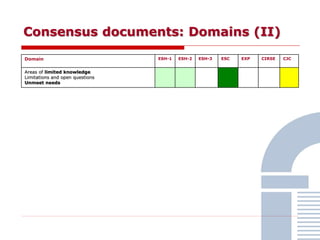
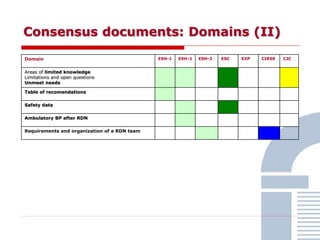
Consensus documents: Domains (II)
Domain ESH-1 ESH-2 ESH-3 ESC EXP CIRSE CJC
Areas of limited knowledge
Limitations and open questions
Unmeet needs
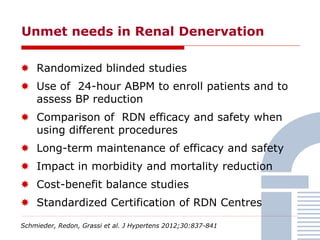
 Randomized blinded studies
 Use of 24-hour ABPM to enroll patients and to
assess BP reduction
 Comparison of RDN efficacy and safety when
using different procedures
 Long-term maintenance of efficacy and safety
 Impact in morbidity and mortality reduction
 Cost-benefit balance studies
 Standardized Certification of RDN Centres
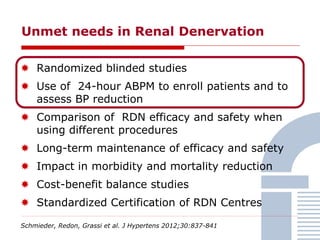
Unmet needs in Renal Denervation
Schmieder, Redon, Grassi et al. J Hypertens 2012;30:837-841
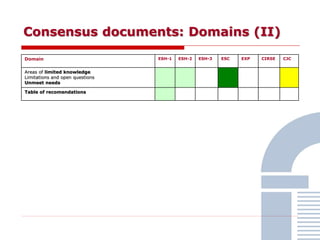
Consensus documents: Domains (II)
Domain ESH-1 ESH-2 ESH-3 ESC EXP CIRSE CJC
Areas of limited knowledge
Limitations and open questions
Unmeet needs
Table of recomendations
Today Recommendations in Renal
Denervation
Schmider, Redon, Grassi et al. J Hypertens 2012;30:837-841
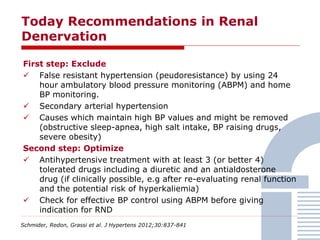
First step: Exclude
 False resistant hypertension (peudoresistance) by using 24
hour ambulatory blood pressure monitoring (ABPM) and home
BP monitoring.
 Secondary arterial hypertension
 Causes which maintain high BP values and might be removed
(obstructive sleep-apnea, high salt intake, BP raising drugs,
severe obesity)
Second step: Optimize
 Antihypertensive treatment with at least 3 (or better 4)
tolerated drugs including a diuretic and an antialdosterone
drug (if clinically possible, e.g after re-evaluating renal function
and the potential risk of hyperkaliemia)
 Check for effective BP control using ABPM before giving
indication for RND
Today Recommendations in Renal
Denervation
Schmider, Redon, Grassi et al. J Hypertens 2012;30:837-841
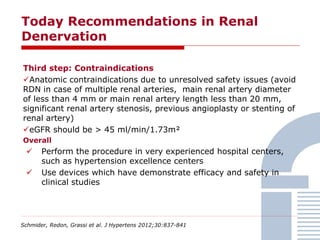
Third step: Contraindications
Anatomic contraindications due to unresolved safety issues (avoid
RDN in case of multiple renal arteries, main renal artery diameter
of less than 4 mm or main renal artery length less than 20 mm,
significant renal artery stenosis, previous angioplasty or stenting of
renal artery)
eGFR should be > 45 ml/min/1.73m²
Overall
 Perform the procedure in very experienced hospital centers,
such as hypertension excellence centers
 Use devices which have demonstrate efficacy and safety in
clinical studies
Consensus documents: Domains (II)
Domain ESH-1 ESH-2 ESH-3 ESC EXP CIRSE CJC
Areas of limited knowledge
Limitations and open questions
Unmeet needs
Table of recomendations
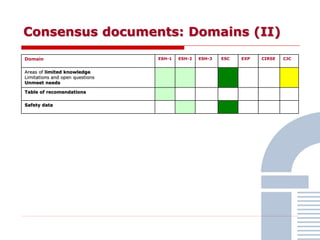
Safety data
Consensus documents: Domains (II)
Domain ESH-1 ESH-2 ESH-3 ESC EXP CIRSE CJC
Areas of limited knowledge
Limitations and open questions
Unmeet needs
Table of recomendations
Safety data
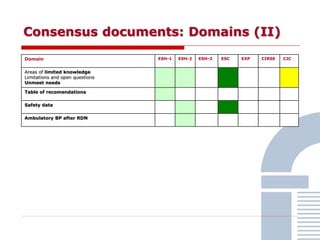
Ambulatory BP after RDN
Consensus documents: Domains (II)
Domain ESH-1 ESH-2 ESH-3 ESC EXP CIRSE CJC
Areas of limited knowledge
Limitations and open questions
Unmeet needs
Table of recomendations
Safety data
Ambulatory BP after RDN
Requirements and organization of a RDN team
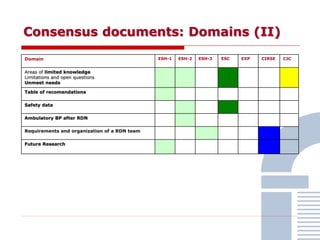
Consensus documents: Domains (II)
Domain ESH-1 ESH-2 ESH-3 ESC EXP CIRSE CJC
Areas of limited knowledge
Limitations and open questions
Unmeet needs
Table of recomendations
Safety data
Ambulatory BP after RDN
Requirements and organization of a RDN team
Future Research
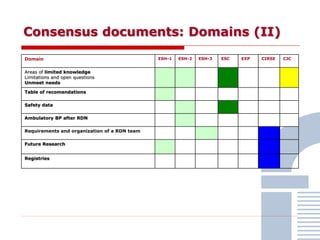
Consensus documents: Domains (II)
Domain ESH-1 ESH-2 ESH-3 ESC EXP CIRSE CJC
Areas of limited knowledge
Limitations and open questions
Unmeet needs
Table of recomendations
Safety data
Ambulatory BP after RDN
Requirements and organization of a RDN team
Future Research
Registries
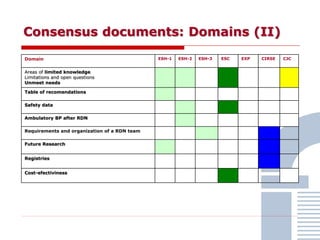
Consensus documents: Domains (II)
Domain ESH-1 ESH-2 ESH-3 ESC EXP CIRSE CJC
Areas of limited knowledge
Limitations and open questions
Unmeet needs
Table of recomendations
Safety data
Ambulatory BP after RDN
Requirements and organization of a RDN team
Future Research
Registries
Cost-efectiviness
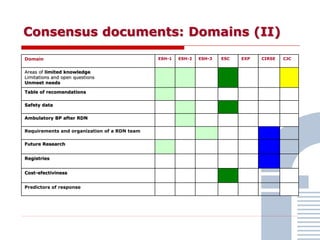
Consensus documents: Domains (II)
Domain ESH-1 ESH-2 ESH-3 ESC EXP CIRSE CJC
Areas of limited knowledge
Limitations and open questions
Unmeet needs
Table of recomendations
Safety data
Ambulatory BP after RDN
Requirements and organization of a RDN team
Future Research
Registries
Cost-efectiviness
Predictors of response
Consensus documents on
catheter-based RDN
Discrepancies?
Final thoughts
How many?
Domains covered
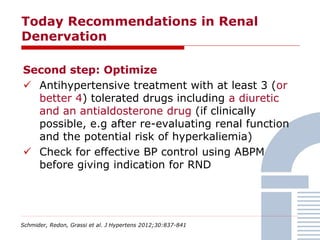
Today Recommendations in Renal
Denervation
Schmider, Redon, Grassi et al. J Hypertens 2012;30:837-841
Second step: Optimize
 Antihypertensive treatment with at least 3 (or
better 4) tolerated drugs including a diuretic
and an antialdosterone drug (if clinically
possible, e.g after re-evaluating renal function
and the potential risk of hyperkaliemia)
 Check for effective BP control using ABPM
before giving indication for RND
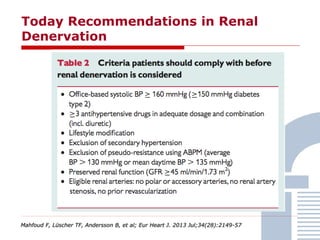
Today Recommendations in Renal
Denervation
Mahfoud F, Lüscher TF, Andersson B, et al; Eur Heart J. 2013 Jul;34(28):2149-57
Consensus documents on
catheter-based RDN
Discrepancies?
Final thoughts
How many?
Domains covered
 Randomized blinded studies
 Use of 24-hour ABPM to enroll patients and to
assess BP reduction
 Comparison of RDN efficacy and safety when
using different procedures
 Long-term maintenance of efficacy and safety
 Impact in morbidity and mortality reduction
 Cost-benefit balance studies
 Standardized Certification of RDN Centres
Unmet needs in Renal Denervation
Schmieder, Redon, Grassi et al. J Hypertens 2012;30:837-841
Consensus documents on catheter-based renal denervation - Dr. Josep Redón i Mas

Consensus documents on catheter-based renal denervation - Dr. Josep Redón i Mas

  • 1.
    1 Consensus Documents on Catheter-basedRenal Denervation Josep Redon. MD, PhD, FAHA Scientific Director Research Foundation and Research Institute INCLIVA. University of Valencia
  • 2.
    Surgical sympathectomy for BPcontrol However, surgical sympathectomy was associated with significant morbidity 100 90 80 70 60 50 40 30 20 10 0 0 2 3 4 5 6 7 8 9 101 Time in Years %Survivals Surgical n=1266 Medical n=467 Group 3 Group 3 Group 1 Group 2 Group 4 Group 1 Group 2 Group 4 Survival rate of normal population Age 43 • Group 1: Patients with persistently elevated BP, minimal/no eyeground changes nor abnormalities in cerebral, cardiac, or renal nerves • Groups 2-4: Patients with increasing amounts of cardiovascular disease Adapted from Smithwick RH, Thompson JE. JAMA. 1953;152:1501-1504.
  • 3.
    Renal sympathetic-nerve ablationby using radiofrequency waves M Krum
  • 4.
    Consensus documents on catheter-basedRDN Discrepancies? Final thoughts How many? Domains covered
  • 5.
    Consensus documents on catheter-basedRDN Discrepancies? Final thoughts How many? Domains covered
  • 6.
    Publications in PubMedabout Resistant Hypertension * Until October 26th *
  • 7.
    Consensus documents  SchmiederRE, Redon J, Grassi G, et al. J Hypertens. 2012;30(5):837-41.  Schmieder RE, Redon J, Grassi G, et al. EuroIntervention. 2013 May;9 Suppl R:R58-66.  Mahfoud F, Lüscher TF, Andersson B, et al; Eur Heart J. 2013 Jul;34(28):2149-57.  Schlaich MP, Schmieder RE, Bakris G, et al. J Am Coll Cardiol. 2013 Dec 3;62(22):2031-45.  Moss J, Vorwerk D, Belli AM, et al. Cardiovasc Intervent Radiol. 2013 Nov 13.  Khan NA, Herman RJ, Quinn RR, et al. Can J Cardiol. 2014 Jan;30(1):16-21.  Tsioufis C, Mahfoud F, Mancia G et al. J Hypertension (in press)
  • 8.
    Consensus documents: Scientific Societiesand Groups  Schmieder RE, Redon J, Grassi G, et al. J Hypertens. 2012;30(5):837-41.  Schmieder RE, Redon J, Grassi G, et al. EuroIntervention. 2013 May;9 Suppl R:R58-66.  Mahfoud F, Lüscher TF, Andersson B, et al; Eur Heart J. 2013 Jul;34(28):2149-57.  Schlaich MP, Schmieder RE, Bakris G, et al. J Am Coll Cardiol. 2013 Dec 3;62(22):2031-45.  Moss J, Vorwerk D, Belli AM, et al. Cardiovasc Intervent Radiol. 2013 Nov 13.  Khan NA, Herman RJ, Quinn RR, et al. Can J Cardiol. 2014 Jan;30(1):16-21.  Tsioufis C, Mahfoud F, Mancia G et al. J Hypertension (in press) ESH, ESC, INT-EXPERTS, CIRSE, CANADIAN
  • 9.
    Consensus documents: General Guidelines NICE August 2011  ESH-ESC Guidelines 2013. J Hypertens 2013:31:1281-1357  AHA Hypertension 2013:November 15 (epub ahead)  JNC 8 JAMA 2013:December 18 (epub ahead)  ASH-ISH J Hypertens 2014;32:3-15
  • 10.
    2013 ESH/ESC HypertensionGuidelines Recommendations for treatment of resistant hypertension Mancia et al. J Hypertens 2013:31:1281-1357 Recommendations Class Level In resistant hypertensive patients it is recommended that physicians check whether the drugs included in the existing multiple drug regimen have any BP lowering effect, and withdraw them if their effect is absent or minimal. IIa C Mineralocorticoid receptor antagonists, amiloride, and the alpha-1-blocker doxazosin should be considered, if no contraindication exists. IIa B
  • 11.
    2013 ESH/ESC HypertensionGuidelines Recommendations Class Level In case of ineffectiveness of drug treatment invasive procedures such as renal denervation and baroreceptor stimulation may be considered. IIb C Until more evidence is available on the long-term efficacy and safety of renal denervation and baroreceptor stimulation, it is recommended that these procedures remain in the hands of experienced operators and diagnosis and follow-up restricted to hypertension centers. I C It is recommended that the invasive approaches are considered only for truly resistant hypertensive patients, with clinic values ≥160 mmHg SBP or ≥110 mmHg DBP and with BP elevation confirmed by ABPM. I C Recommendations for treatment of resistant hypertension Mancia et al. J Hypertens 2013:31:1281-1357
  • 12.
    Consensus documents on catheter-basedRDN Discrepancies? Final thoughts How many? Domains covered
  • 13.
    Consensus documents: Domains(I) Domain ESH-1 ESH-2 ESH-3 ESC EXP CIRSE CJC Global burden an Aetiology of Resistant Hypertension
  • 14.
    Cumulative hazard curvesfor the primary endpoint of cardiovascular death/myocardial infarction/stroke in resistant hypertension (REACH registry) Kumbhani DJ et al. Eur Heart J 2013;34:1204-1215 Time until CVD/MI/Stroke (months) Time until non-fatal stroke (months)
  • 15.
    Consensus documents: Domains(I) Domain ESH-1 ESH-2 ESH-3 ESC EXP CIRSE CJC Global burden an Aetiology of Resistant Hypertension Sympathetic Nevous System and BP control Role of renal nerves in Hypertension and CV diseases Sympathetic activity in other diseases: diabetes, sleep apnea Raional for renal denervation
  • 16.
    Undesired effects ofsympathetic overactivity
  • 17.
    Consensus documents: Domains(I) Domain ESH-1 ESH-2 ESH-3 ESC EXP CIRSE CJC Global burden an Aetiology of Resistant Hypertension Sympathetic Nevous System and BP control Role of renal nerves in Hypertension and CV diseases Sympathetic activity in other diseases: diabetes, sleep apnea Raional for renal denervation Anatomy and image of renal arteries Location of sympathetic fibers in the arterial wall
  • 18.
    Sympathetic nerves inthe renal artery Atherton DS et al. Clin Anat 2012;25:628-633.
  • 19.
    Consensus documents: Domains(I) Domain ESH-1 ESH-2 ESH-3 ESC EXP CIRSE CJC Global burden an Aetiology of Resistant Hypertension Sympathetic Nevous System and BP control Role of renal nerves in Hypertension and CV diseases Sympathetic activity in other diseases: diabetes, sleep apnea Raional for renal denervation Anatomy and image of renal arteries Location of sympathetic fibers in the arterial wall Selection of candidates
  • 20.
    Recommendations for treatmentof resistant hypertension Schlaich et al. JACC 2013 (Epub ahead)
  • 21.
    Consensus documents: Domains(I) Domain ESH-1 ESH-2 ESH-3 ESC EXP CIRSE CJC Global burden an Aetiology of Resistant Hypertension Sympathetic Nevous System and BP control Role of renal nerves in Hypertension and CV diseases Sympathetic activity in other diseases: diabetes, sleep apnea Raional for renal denervation Anatomy and image of renal arteries Location of sympathetic fibers in the arterial wall Selection of candidates Available systems
  • 22.
    Consensus documents: Domains(I) Available systems in the market The Symplicity Spyral TM (Medtronic) The EnligHTN TM (St Jude Medical) The Iberis TM (Terumo) The OneShot TM (Covidien) The Vessix V2 TM (Boston Scientific) The PARADISE TM (Recor)
  • 23.
    Consensus documents: Domains(I) Domain ESH-1 ESH-2 ESH-3 ESC EXP CIRSE CJC Global burden an Aetiology of Resistant Hypertension Sympathetic Nevous System and BP control Role of renal nerves in Hypertension and CV diseases Sympathetic activity in other diseases: diabetes, sleep apnea Raional for renal denervation Anatomy and image of renal arteries Location of sympathetic fibers in the arterial wall Selection of candidates Available systems Procedure
  • 24.
    Consensus documents: Domains(I) Domain ESH-1 ESH-2 ESH-3 ESC EXP CIRSE CJC Global burden an Aetiology of Resistant Hypertension Sympathetic Nevous System and BP control Role of renal nerves in Hypertension and CV diseases Sympathetic activity in other diseases: diabetes, sleep apnea Raional for renal denervation Anatomy and image of renal arteries Location of sympathetic fibers in the arterial wall Selection of candidates Available systems Procedure Assessment of efficacy BP reduction Impact in organ damage, diabetes, arrythmias, slleep apnea, CKD Patient follow-up
  • 25.
    Consensus documents: Domains(II) Domain ESH-1 ESH-2 ESH-3 ESC EXP CIRSE CJC Areas of limited knowledge Limitations and open questions Unmeet needs
  • 26.
     Randomized blindedstudies  Use of 24-hour ABPM to enroll patients and to assess BP reduction  Comparison of RDN efficacy and safety when using different procedures  Long-term maintenance of efficacy and safety  Impact in morbidity and mortality reduction  Cost-benefit balance studies  Standardized Certification of RDN Centres Unmet needs in Renal Denervation Schmieder, Redon, Grassi et al. J Hypertens 2012;30:837-841
  • 27.
    Consensus documents: Domains(II) Domain ESH-1 ESH-2 ESH-3 ESC EXP CIRSE CJC Areas of limited knowledge Limitations and open questions Unmeet needs Table of recomendations
  • 28.
    Today Recommendations inRenal Denervation Schmider, Redon, Grassi et al. J Hypertens 2012;30:837-841 First step: Exclude  False resistant hypertension (peudoresistance) by using 24 hour ambulatory blood pressure monitoring (ABPM) and home BP monitoring.  Secondary arterial hypertension  Causes which maintain high BP values and might be removed (obstructive sleep-apnea, high salt intake, BP raising drugs, severe obesity) Second step: Optimize  Antihypertensive treatment with at least 3 (or better 4) tolerated drugs including a diuretic and an antialdosterone drug (if clinically possible, e.g after re-evaluating renal function and the potential risk of hyperkaliemia)  Check for effective BP control using ABPM before giving indication for RND
  • 29.
    Today Recommendations inRenal Denervation Schmider, Redon, Grassi et al. J Hypertens 2012;30:837-841 Third step: Contraindications Anatomic contraindications due to unresolved safety issues (avoid RDN in case of multiple renal arteries, main renal artery diameter of less than 4 mm or main renal artery length less than 20 mm, significant renal artery stenosis, previous angioplasty or stenting of renal artery) eGFR should be > 45 ml/min/1.73m² Overall  Perform the procedure in very experienced hospital centers, such as hypertension excellence centers  Use devices which have demonstrate efficacy and safety in clinical studies
  • 30.
    Consensus documents: Domains(II) Domain ESH-1 ESH-2 ESH-3 ESC EXP CIRSE CJC Areas of limited knowledge Limitations and open questions Unmeet needs Table of recomendations Safety data
  • 31.
    Consensus documents: Domains(II) Domain ESH-1 ESH-2 ESH-3 ESC EXP CIRSE CJC Areas of limited knowledge Limitations and open questions Unmeet needs Table of recomendations Safety data Ambulatory BP after RDN
  • 32.
    Consensus documents: Domains(II) Domain ESH-1 ESH-2 ESH-3 ESC EXP CIRSE CJC Areas of limited knowledge Limitations and open questions Unmeet needs Table of recomendations Safety data Ambulatory BP after RDN Requirements and organization of a RDN team
  • 33.
    Consensus documents: Domains(II) Domain ESH-1 ESH-2 ESH-3 ESC EXP CIRSE CJC Areas of limited knowledge Limitations and open questions Unmeet needs Table of recomendations Safety data Ambulatory BP after RDN Requirements and organization of a RDN team Future Research
  • 34.
    Consensus documents: Domains(II) Domain ESH-1 ESH-2 ESH-3 ESC EXP CIRSE CJC Areas of limited knowledge Limitations and open questions Unmeet needs Table of recomendations Safety data Ambulatory BP after RDN Requirements and organization of a RDN team Future Research Registries
  • 35.
    Consensus documents: Domains(II) Domain ESH-1 ESH-2 ESH-3 ESC EXP CIRSE CJC Areas of limited knowledge Limitations and open questions Unmeet needs Table of recomendations Safety data Ambulatory BP after RDN Requirements and organization of a RDN team Future Research Registries Cost-efectiviness
  • 36.
    Consensus documents: Domains(II) Domain ESH-1 ESH-2 ESH-3 ESC EXP CIRSE CJC Areas of limited knowledge Limitations and open questions Unmeet needs Table of recomendations Safety data Ambulatory BP after RDN Requirements and organization of a RDN team Future Research Registries Cost-efectiviness Predictors of response
  • 37.
    Consensus documents on catheter-basedRDN Discrepancies? Final thoughts How many? Domains covered
  • 38.
    Today Recommendations inRenal Denervation Schmider, Redon, Grassi et al. J Hypertens 2012;30:837-841 Second step: Optimize  Antihypertensive treatment with at least 3 (or better 4) tolerated drugs including a diuretic and an antialdosterone drug (if clinically possible, e.g after re-evaluating renal function and the potential risk of hyperkaliemia)  Check for effective BP control using ABPM before giving indication for RND
  • 39.
    Today Recommendations inRenal Denervation Mahfoud F, Lüscher TF, Andersson B, et al; Eur Heart J. 2013 Jul;34(28):2149-57
  • 40.
    Consensus documents on catheter-basedRDN Discrepancies? Final thoughts How many? Domains covered
  • 41.
     Randomized blindedstudies  Use of 24-hour ABPM to enroll patients and to assess BP reduction  Comparison of RDN efficacy and safety when using different procedures  Long-term maintenance of efficacy and safety  Impact in morbidity and mortality reduction  Cost-benefit balance studies  Standardized Certification of RDN Centres Unmet needs in Renal Denervation Schmieder, Redon, Grassi et al. J Hypertens 2012;30:837-841