Renal Denervation
Current evidence and new
technical developments
OA Dr. med Massimiliano Fusaro
fusaro@dhm.mhn.de
Deutsches Herzzentrum and 1. Medizinische Klinik, Klinikum rechts der Isar
Technische Universität - Munich, GERMANY

SITE 2013
Barcelona, 9 May 2013
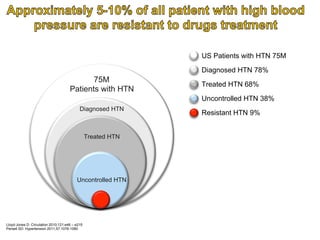
US Patients with HTN 75M
Diagnosed HTN 78%

75M
Patients with HTN

Treated HTN 68%
Uncontrolled HTN 38%

Diagnosed HTN

Treated HTN

Uncontrolled HTN

Lloyd-Jones D: Circulation 2010;121:e46 – e215
Persell SD: Hypertension 2011;57:1076-1080

Resistant HTN 9%
 
• 
• 
• 

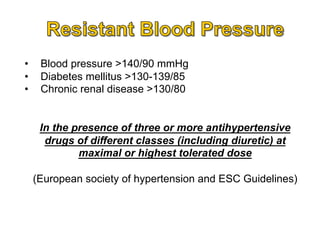
Blood pressure >140/90 mmHg
Diabetes mellitus >130-139/85
Chronic renal disease >130/80

In the presence of three or more antihypertensive
drugs of different classes (including diuretic) at
maximal or highest tolerated dose
(European society of hypertension and ESC Guidelines)


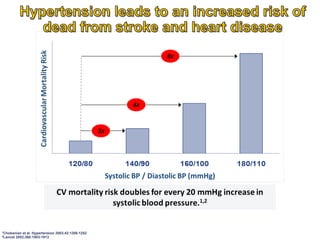
1Chobanian
2Lancet

et al. Hypertension 2003;42:1206-1252
2002;360:1903-1913
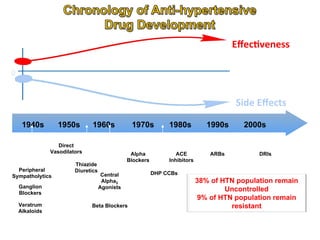
Effec&veness	
  
0

Side	
  Effects	
  
1940s

1950s

1960s

Direct
Vasodilators
Peripheral
Sympatholytics
Ganglion
Blockers
Veratrum
Alkaloids

Thiazide
Diuretics

1970s

Alpha
Blockers
Central
Alpha2
Agonists

Beta Blockers

1980s

1990s

ACE
Inhibitors

ARBs

2000s

DRIs

DHP CCBs

38% of HTN population remain
Uncontrolled
9% of HTN population remain
resistant
Denerva&on	
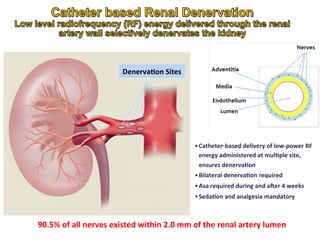
  Sites	
  

• Catheter-­‐based	
  delivery	
  of	
  low-­‐power	
  RF	
  
energy	
  administered	
  at	
  mul&ple	
  site,	
  
ensures	
  denerva&on	
  
• Bilateral	
  denerva&on	
  required	
  
• Asa	
  required	
  during	
  and	
  aKer	
  4	
  weeks	
  
• Seda&on	
  and	
  analgesia	
  mandatory	
  

90.5%	
  of	
  all	
  nerves	
  existed	
  within	
  2.0	
  mm	
  of	
  the	
  renal	
  artery	
  lumen	
  
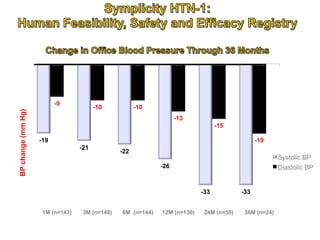
BP change (mm Hg)

-9

-10

-10
-13
-15

-19

-19
-21

-22

Systolic BP
-26

Diastolic BP

-33
1M (n=143)

3M (n=148)

6M (n=144)

12M (n=130)

24M (n=59)

-33
36M (n=24)
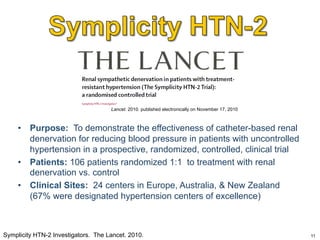
Lancet. 2010. published electronically on November 17, 2010

•  Purpose: To demonstrate the effectiveness of catheter-based renal
denervation for reducing blood pressure in patients with uncontrolled
hypertension in a prospective, randomized, controlled, clinical trial
•  Patients: 106 patients randomized 1:1 to treatment with renal
denervation vs. control
•  Clinical Sites: 24 centers in Europe, Australia, & New Zealand
(67% were designated hypertension centers of excellence)

Symplicity HTN-2 Investigators. The Lancet. 2010.

11
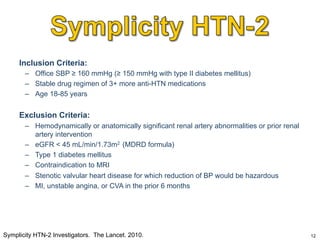
Inclusion Criteria:
–  Office SBP ≥ 160 mmHg (≥ 150 mmHg with type II diabetes mellitus)
–  Stable drug regimen of 3+ more anti-HTN medications
–  Age 18-85 years

Exclusion Criteria:
–  Hemodynamically or anatomically significant renal artery abnormalities or prior renal
artery intervention
–  eGFR < 45 mL/min/1.73m2 (MDRD formula)
–  Type 1 diabetes mellitus
–  Contraindication to MRI
–  Stenotic valvular heart disease for which reduction of BP would be hazardous
–  MI, unstable angina, or CVA in the prior 6 months

Symplicity HTN-2 Investigators. The Lancet. 2010.

12
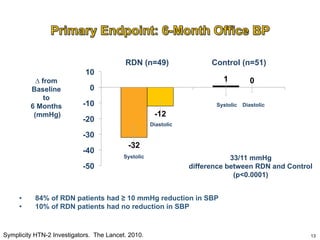
RDN (n=49)

Control (n=51)

10
∆ from
Baseline
to
6 Months
(mmHg)

1

0

Systolic

Diastolic

0
-10
-12

-20

Diastolic

-30
-40

-32
Systolic

-50

• 
• 

33/11 mmHg
difference between RDN and Control
(p<0.0001)

84% of RDN patients had ≥ 10 mmHg reduction in SBP
10% of RDN patients had no reduction in SBP

Symplicity HTN-2 Investigators. The Lancet. 2010.

13
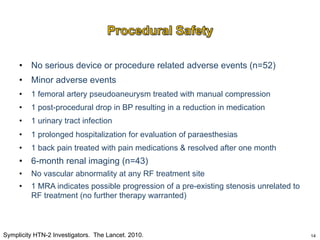
•  No serious device or procedure related adverse events (n=52)
•  Minor adverse events
• 

1 femoral artery pseudoaneurysm treated with manual compression

• 

1 post-procedural drop in BP resulting in a reduction in medication

• 

1 urinary tract infection

• 

1 prolonged hospitalization for evaluation of paraesthesias

• 

1 back pain treated with pain medications & resolved after one month

•  6-month renal imaging (n=43)
• 

No vascular abnormality at any RF treatment site

• 

1 MRA indicates possible progression of a pre-existing stenosis unrelated to
RF treatment (no further therapy warranted)

Symplicity HTN-2 Investigators. The Lancet. 2010.

14
Mahfoud F et al. Eur Heart J 2013
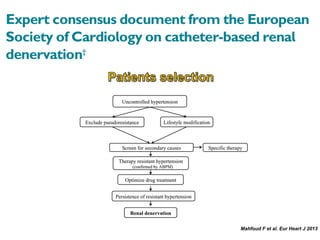
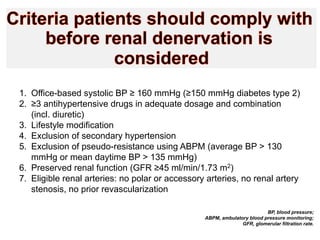
1.  Office-based systolic BP ≥ 160 mmHg (≥150 mmHg diabetes type 2)
2.  ≥3 antihypertensive drugs in adequate dosage and combination
(incl. diuretic)
3.  Lifestyle modification
4.  Exclusion of secondary hypertension
5.  Exclusion of pseudo-resistance using ABPM (average BP > 130
mmHg or mean daytime BP > 135 mmHg)
6.  Preserved renal function (GFR ≥45 ml/min/1.73 m2)
7.  Eligible renal arteries: no polar or accessory arteries, no renal artery
stenosis, no prior revascularization
BP, blood pressure;
ABPM, ambulatory blood pressure monitoring;
GFR, glomerular filtration rate.
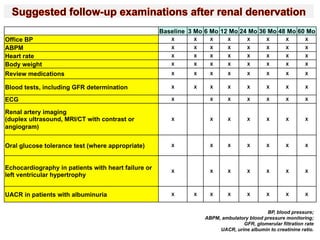
Baseline 3 Mo 6 Mo 12 Mo 24 Mo 36 Mo 48 Mo 60 Mo
Office BP
ABPM
Heart rate
Body weight

X

X

X

X

X

X

X

X

X

X

X

X

X

X

X

X

X

X

X

X

X

X

X

X

X

X

X

X

X

X

X

X

Review medications

X

X

X

X

X

X

X

X

Blood tests, including GFR determination

X

X

X

X

X

X

X

X

ECG

X

X

X

X

X

X

X

Renal artery imaging
(duplex ultrasound, MRI/CT with contrast or
angiogram)

X

X

X

X

X

X

X

Oral glucose tolerance test (where appropriate)

X

X

X

X

X

X

X

Echocardiography in patients with heart failure or
left ventricular hypertrophy

X

X

X

X

X

X

X

UACR in patients with albuminuria

X

X

X

X

X

X

X

X

BP, blood pressure;
ABPM, ambulatory blood pressure monitoring;
GFR, glomerular filtration rate
UACR, urine albumin to creatinine ratio.
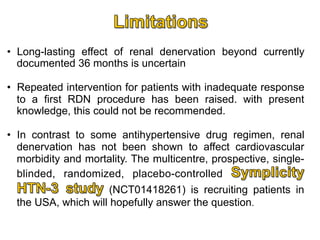
•  Long-lasting effect of renal denervation beyond currently
documented 36 months is uncertain
•  Repeated intervention for patients with inadequate response
to a first RDN procedure has been raised. with present
knowledge, this could not be recommended.
•  In contrast to some antihypertensive drug regimen, renal
denervation has not been shown to affect cardiovascular
morbidity and mortality. The multicentre, prospective, singleblinded, randomized, placebo-controlled
(NCT01418261) is recruiting patients in
the USA, which will hopefully answer the question.
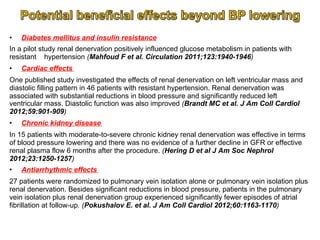
• 

Diabetes mellitus and insulin resistance

In a pilot study renal denervation positively influenced glucose metabolism in patients with
resistant hypertension (Mahfoud F et al. Circulation 2011;123:1940-1946)
• 

Cardiac effects

One published study investigated the effects of renal denervation on left ventricular mass and
diastolic filling pattern in 46 patients with resistant hypertension. Renal denervation was
associated with substantial reductions in blood pressure and significantly reduced left
ventricular mass. Diastolic function was also improved (Brandt MC et al. J Am Coll Cardiol
2012;59:901-909)
• 

Chronic kidney disease

In 15 patients with moderate-to-severe chronic kidney renal denervation was effective in terms
of blood pressure lowering and there was no evidence of a further decline in GFR or effective
renal plasma flow 6 months after the procedure. (Hering D et al J Am Soc Nephrol
2012;23:1250-1257)
• 

Antiarrhythmic effects

27 patients were randomized to pulmonary vein isolation alone or pulmonary vein isolation plus
renal denervation. Besides significant reductions in blood pressure, patients in the pulmonary
vein isolation plus renal denervation group experienced significantly fewer episodes of atrial
fibrillation at follow-up. (Pokushalov E. et al. J Am Coll Cardiol 2012;60:1163-1170)
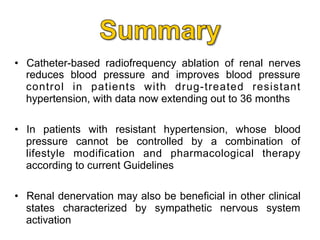
•  Catheter-based radiofrequency ablation of renal nerves
reduces blood pressure and improves blood pressure
control in patients with drug-treated resistant
hypertension, with data now extending out to 36 months
•  In patients with resistant hypertension, whose blood
pressure cannot be controlled by a combination of
lifestyle modification and pharmacological therapy
according to current Guidelines
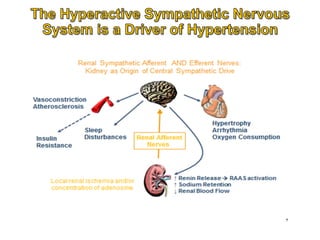
•  Renal denervation may also be beneficial in other clinical
states characterized by sympathetic nervous system
activation

Fusaro - Renal Denervation, current evidence and new technical developments

  • 1.
    Renal Denervation Current evidenceand new technical developments OA Dr. med Massimiliano Fusaro fusaro@dhm.mhn.de Deutsches Herzzentrum and 1. Medizinische Klinik, Klinikum rechts der Isar Technische Universität - Munich, GERMANY SITE 2013 Barcelona, 9 May 2013
  • 3.
    US Patients withHTN 75M Diagnosed HTN 78% 75M Patients with HTN Treated HTN 68% Uncontrolled HTN 38% Diagnosed HTN Treated HTN Uncontrolled HTN Lloyd-Jones D: Circulation 2010;121:e46 – e215 Persell SD: Hypertension 2011;57:1076-1080 Resistant HTN 9%
  • 4.
      •  •  •  Blood pressure >140/90mmHg Diabetes mellitus >130-139/85 Chronic renal disease >130/80 In the presence of three or more antihypertensive drugs of different classes (including diuretic) at maximal or highest tolerated dose (European society of hypertension and ESC Guidelines)  
  • 5.
    1Chobanian 2Lancet et al. Hypertension2003;42:1206-1252 2002;360:1903-1913
  • 7.
    Effec&veness   0 Side  Effects   1940s 1950s 1960s Direct Vasodilators Peripheral Sympatholytics Ganglion Blockers Veratrum Alkaloids Thiazide Diuretics 1970s Alpha Blockers Central Alpha2 Agonists Beta Blockers 1980s 1990s ACE Inhibitors ARBs 2000s DRIs DHP CCBs 38% of HTN population remain Uncontrolled 9% of HTN population remain resistant
  • 8.
    Denerva&on  Sites   • Catheter-­‐based  delivery  of  low-­‐power  RF   energy  administered  at  mul&ple  site,   ensures  denerva&on   • Bilateral  denerva&on  required   • Asa  required  during  and  aKer  4  weeks   • Seda&on  and  analgesia  mandatory   90.5%  of  all  nerves  existed  within  2.0  mm  of  the  renal  artery  lumen  
  • 10.
    BP change (mmHg) -9 -10 -10 -13 -15 -19 -19 -21 -22 Systolic BP -26 Diastolic BP -33 1M (n=143) 3M (n=148) 6M (n=144) 12M (n=130) 24M (n=59) -33 36M (n=24)
  • 11.
    Lancet. 2010. publishedelectronically on November 17, 2010 •  Purpose: To demonstrate the effectiveness of catheter-based renal denervation for reducing blood pressure in patients with uncontrolled hypertension in a prospective, randomized, controlled, clinical trial •  Patients: 106 patients randomized 1:1 to treatment with renal denervation vs. control •  Clinical Sites: 24 centers in Europe, Australia, & New Zealand (67% were designated hypertension centers of excellence) Symplicity HTN-2 Investigators. The Lancet. 2010. 11
  • 12.
    Inclusion Criteria: –  OfficeSBP ≥ 160 mmHg (≥ 150 mmHg with type II diabetes mellitus) –  Stable drug regimen of 3+ more anti-HTN medications –  Age 18-85 years Exclusion Criteria: –  Hemodynamically or anatomically significant renal artery abnormalities or prior renal artery intervention –  eGFR < 45 mL/min/1.73m2 (MDRD formula) –  Type 1 diabetes mellitus –  Contraindication to MRI –  Stenotic valvular heart disease for which reduction of BP would be hazardous –  MI, unstable angina, or CVA in the prior 6 months Symplicity HTN-2 Investigators. The Lancet. 2010. 12
  • 13.
    RDN (n=49) Control (n=51) 10 ∆from Baseline to 6 Months (mmHg) 1 0 Systolic Diastolic 0 -10 -12 -20 Diastolic -30 -40 -32 Systolic -50 •  •  33/11 mmHg difference between RDN and Control (p<0.0001) 84% of RDN patients had ≥ 10 mmHg reduction in SBP 10% of RDN patients had no reduction in SBP Symplicity HTN-2 Investigators. The Lancet. 2010. 13
  • 14.
    •  No seriousdevice or procedure related adverse events (n=52) •  Minor adverse events •  1 femoral artery pseudoaneurysm treated with manual compression •  1 post-procedural drop in BP resulting in a reduction in medication •  1 urinary tract infection •  1 prolonged hospitalization for evaluation of paraesthesias •  1 back pain treated with pain medications & resolved after one month •  6-month renal imaging (n=43) •  No vascular abnormality at any RF treatment site •  1 MRA indicates possible progression of a pre-existing stenosis unrelated to RF treatment (no further therapy warranted) Symplicity HTN-2 Investigators. The Lancet. 2010. 14
  • 15.
    Mahfoud F etal. Eur Heart J 2013
  • 16.
    1.  Office-based systolicBP ≥ 160 mmHg (≥150 mmHg diabetes type 2) 2.  ≥3 antihypertensive drugs in adequate dosage and combination (incl. diuretic) 3.  Lifestyle modification 4.  Exclusion of secondary hypertension 5.  Exclusion of pseudo-resistance using ABPM (average BP > 130 mmHg or mean daytime BP > 135 mmHg) 6.  Preserved renal function (GFR ≥45 ml/min/1.73 m2) 7.  Eligible renal arteries: no polar or accessory arteries, no renal artery stenosis, no prior revascularization BP, blood pressure; ABPM, ambulatory blood pressure monitoring; GFR, glomerular filtration rate.
  • 17.
    Baseline 3 Mo6 Mo 12 Mo 24 Mo 36 Mo 48 Mo 60 Mo Office BP ABPM Heart rate Body weight X X X X X X X X X X X X X X X X X X X X X X X X X X X X X X X X Review medications X X X X X X X X Blood tests, including GFR determination X X X X X X X X ECG X X X X X X X Renal artery imaging (duplex ultrasound, MRI/CT with contrast or angiogram) X X X X X X X Oral glucose tolerance test (where appropriate) X X X X X X X Echocardiography in patients with heart failure or left ventricular hypertrophy X X X X X X X UACR in patients with albuminuria X X X X X X X X BP, blood pressure; ABPM, ambulatory blood pressure monitoring; GFR, glomerular filtration rate UACR, urine albumin to creatinine ratio.
  • 18.
    •  Long-lasting effectof renal denervation beyond currently documented 36 months is uncertain •  Repeated intervention for patients with inadequate response to a first RDN procedure has been raised. with present knowledge, this could not be recommended. •  In contrast to some antihypertensive drug regimen, renal denervation has not been shown to affect cardiovascular morbidity and mortality. The multicentre, prospective, singleblinded, randomized, placebo-controlled (NCT01418261) is recruiting patients in the USA, which will hopefully answer the question.
  • 19.
    •  Diabetes mellitus andinsulin resistance In a pilot study renal denervation positively influenced glucose metabolism in patients with resistant hypertension (Mahfoud F et al. Circulation 2011;123:1940-1946) •  Cardiac effects One published study investigated the effects of renal denervation on left ventricular mass and diastolic filling pattern in 46 patients with resistant hypertension. Renal denervation was associated with substantial reductions in blood pressure and significantly reduced left ventricular mass. Diastolic function was also improved (Brandt MC et al. J Am Coll Cardiol 2012;59:901-909) •  Chronic kidney disease In 15 patients with moderate-to-severe chronic kidney renal denervation was effective in terms of blood pressure lowering and there was no evidence of a further decline in GFR or effective renal plasma flow 6 months after the procedure. (Hering D et al J Am Soc Nephrol 2012;23:1250-1257) •  Antiarrhythmic effects 27 patients were randomized to pulmonary vein isolation alone or pulmonary vein isolation plus renal denervation. Besides significant reductions in blood pressure, patients in the pulmonary vein isolation plus renal denervation group experienced significantly fewer episodes of atrial fibrillation at follow-up. (Pokushalov E. et al. J Am Coll Cardiol 2012;60:1163-1170)
  • 20.
    •  Catheter-based radiofrequencyablation of renal nerves reduces blood pressure and improves blood pressure control in patients with drug-treated resistant hypertension, with data now extending out to 36 months •  In patients with resistant hypertension, whose blood pressure cannot be controlled by a combination of lifestyle modification and pharmacological therapy according to current Guidelines •  Renal denervation may also be beneficial in other clinical states characterized by sympathetic nervous system activation