Symmetrical Components
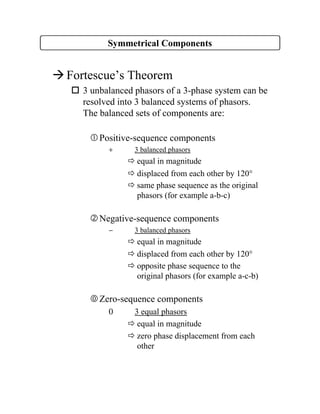
à Fortescue’s Theorem
o 3 unbalanced phasors of a 3-phase system can be
resolved into 3 balanced systems of phasors.
The balanced sets of components are:
•Positive-sequence components
+ 3 balanced phasors
ð equal in magnitude
ð displaced from each other by 120°
ð same phase sequence as the original
phasors (for example a-b-c)
‚Negative-sequence components
− 3 balanced phasors
ð equal in magnitude
ð displaced from each other by 120°
ð opposite phase sequence to the
original phasors (for example a-c-b)
€Zero-sequence components
0 3 equal phasors
ð equal in magnitude
ð zero phase displacement from each
other
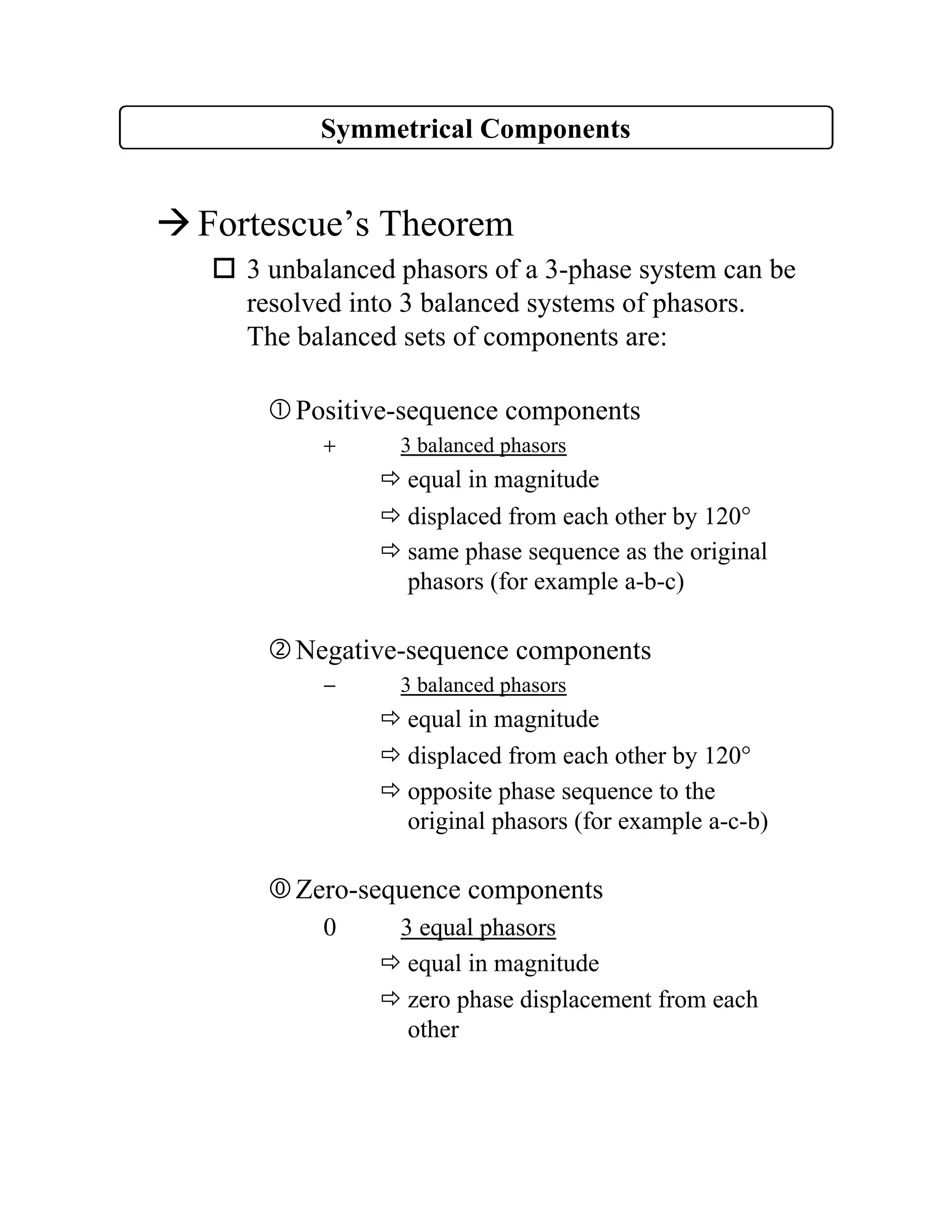
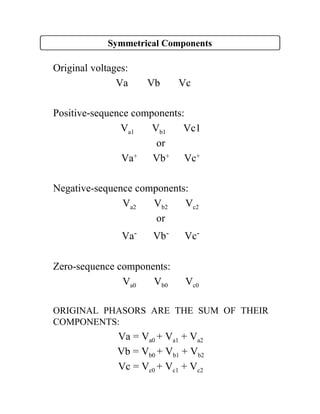
Symmetrical Components
Original voltages:
Va Vb Vc
Positive-sequence components:
Va1 Vb1 Vc1
or
Va+ Vb+ Vc+
Negative-sequence components:
Va2 Vb2 Vc2
or
Va- Vb- Vc-
Zero-sequence components:
Va0 Vb0 Vc0
ORIGINAL PHASORS ARE THE SUM OF THEIR
COMPONENTS:
Va = Va0 + Va1 + Va2
Vb = Vb0 + Vb1 + Vb2
Vc = Vc0 + Vc1 + Vc2
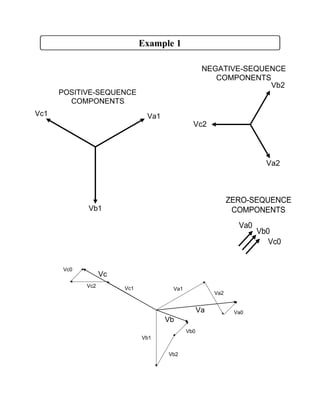
Example 1
Va1
Vb1
Vc1
POSITIVE-SEQUENCE
COMPONENTS
NEGATIVE-SEQUENCE
COMPONENTS
Va2
Vb2
Vc2
Va0
Vb0
Vc0
ZERO-SEQUENCE
COMPONENTS
Va1
Vb1
Vc1
Vc2
Vc0
Va2
Va0
Vb2
Vb0
Va
Vb
Vc
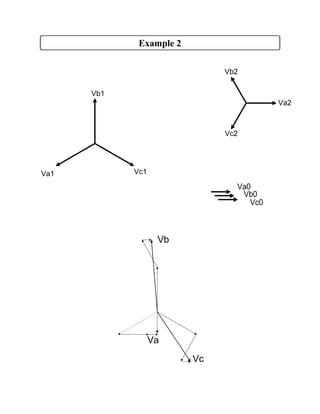
Example 2
Va1
Vb1
Vc1
Va2
Vb2
Vc2
Va0
Vb0
Vc0
Va
Vb
Vc
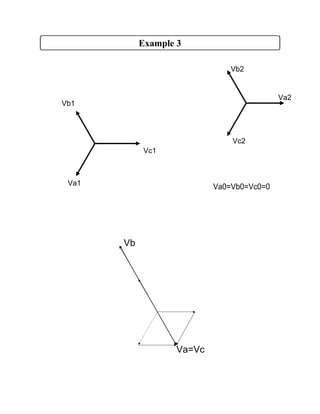
Example 3
Va1
Vb1
Vc1
Va2
Vb2
Vc2
Va0=Vb0=Vc0=0
Va=Vc
Vb
Operators
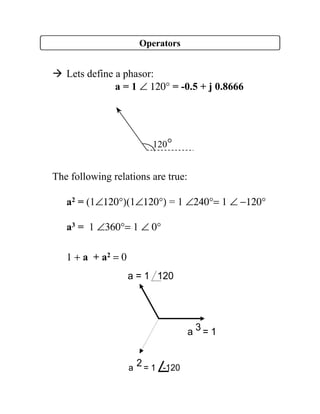
à Lets define a phasor:
a = 1 ∠ 120° = -0.5 + j 0.8666
The following relations are true:
a2 = (1∠120°)(1∠120°) = 1 ∠240°= 1 ∠ −120°
a3 = 1 ∠360°= 1 ∠ 0°
1 + a + a2 = 0
120°
a 3 = 1
a 2 = 1 -120
a = 1 120
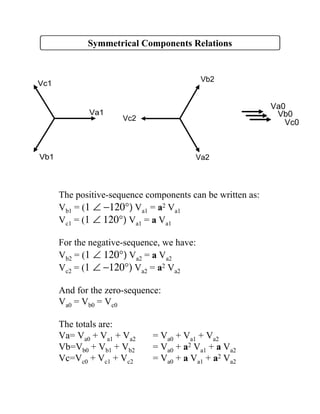
Symmetrical Components Relations
Va1
Vc1
Vb1
The positive-sequence components can be written as:
Vb1 = (1 ∠ −120°) Va1 = a2 Va1
Vc1 = (1 ∠ 120°) Va1 = a Va1
For the negative-sequence, we have:
Vb2 = (1 ∠ 120°) Va2 = a Va2
Vc2 = (1 ∠ −120°) Va2 = a2 Va2
And for the zero-sequence:
Va0 = Vb0 = Vc0
The totals are:
Va= Va0 + Va1 + Va2 = Va0 + Va1 + Va2
Vb=Vb0 + Vb1 + Vb2 = Va0 + a2 Va1 + a Va2
Vc=Vc0 + Vc1 + Vc2 = Va0 + a Va1 + a2 Va2
Va2
Vb2
Vc2
Va0
Vb0
Vc0
Symmetrical Components Relations
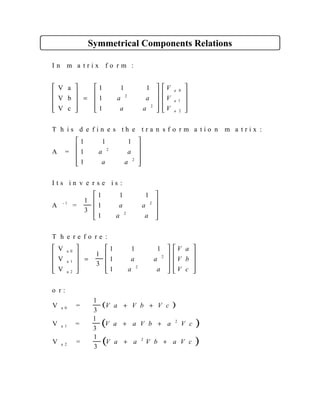
I n m a t r i x f o r m :
V a
V b
V c
T h i s d e f i n e s t h e t r a n s f o r m a t i o n m a t r i x :
A =
I t s i n v e r s e i s :
A =
1
3
T h e r e f o r e :
V
V
V
1
3
- 1
a 0
a 1
a 2










=


















































=





1 1 1
1
1
1 1 1
1
1
1 1 1
1
1
1 1 1
1
1
2
2
0
1
2
2
2
2
2
2
2
a a
a a
V
V
V
a a
a a
a a
a a
a a
a a
a
a
a
( )
( )
( )















+ +
+ +
+ +
V a
V b
V c
V a V b V c
V a a V b a V c
V a a V b a V c
o r :
V =
1
3
V =
1
3
V =
1
3
a 0
a 1
a 2
2
2
Example
Ia=10 A.
Ib=-Ia
Ic=0
[ ]
[ ]
[ ]
Ia =10 0 A. Ib = 10 180 A. Ic = 0 A.
Ia0 =
1
3
10 0 10 180
Ia1=
1
3
10 0 10 180
Ia2 =
1
3
10 0 10 180
Ib0 = Ia0 = 0
Ib1=
Ib2 =
Ic0 = Ia0 = 0
Ic1=
∠ ° ∠ °
∠ °+ ∠ °+ =
∠ °+ ∠ ° ∠ ° + = ∠ − °
∠ °+ ∠ ° ∠ − ° + = ∠ °
∠ − °− °= ∠ − °
∠ + °+ °= ∠ + °
∠ − °+
0 0
1 120 0 578 30
1 120 0 578 30
578 30 120 578 150
578 30 120 578 150
578 30
( )( ) .
( )( ) .
. .
. .
. 120 578 90
578 30 120 578 90
°= ∠ + °
∠ + °− °= ∠ − °
.
. .
Ic2 =
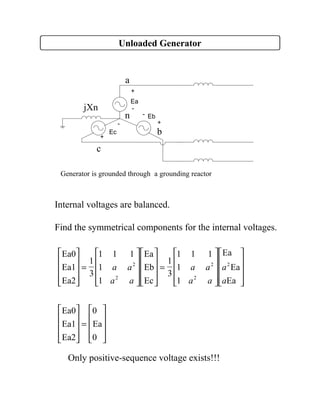
Unloaded Generator
a
b
c
n
Ea
Eb
Ec
+
+
+
-
-
-
Internal voltages are balanced.
Find the symmetrical components for the internal voltages.
Ea0
Ea1
Ea2
Ea
Eb
Ec
Ea
Ea
Ea
Ea0
Ea1
Ea2
0
Ea
0










=




















=






























=










1
3
1 1 1
1
1
1
3
1 1 1
1
1
2
2
2
2
2
a a
a a
a a
a a
a
a
Only positive-sequence voltage exists!!!
jXn
Generator is grounded through a grounding reactor
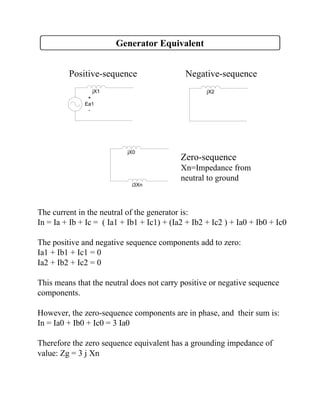
Generator Equivalent
jX1
+
Ea1
-
Positive-sequence
jX2
Negative-sequence
jX0
j3Xn
Zero-sequence
Xn=Impedance from
neutral to ground
The current in the neutral of the generator is:
In = Ia + Ib + Ic = ( Ia1 + Ib1 + Ic1) + (Ia2 + Ib2 + Ic2 ) + Ia0 + Ib0 + Ic0
The positive and negative sequence components add to zero:
Ia1 + Ib1 + Ic1 = 0
Ia2 + Ib2 + Ic2 = 0
This means that the neutral does not carry positive or negative sequence
components.
However, the zero-sequence components are in phase, and their sum is:
In = Ia0 + Ib0 + Ic0 = 3 Ia0
Therefore the zero sequence equivalent has a grounding impedance of
value: Zg = 3 j Xn
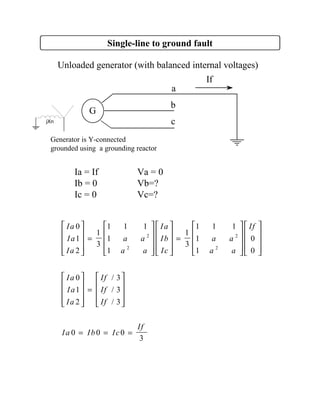
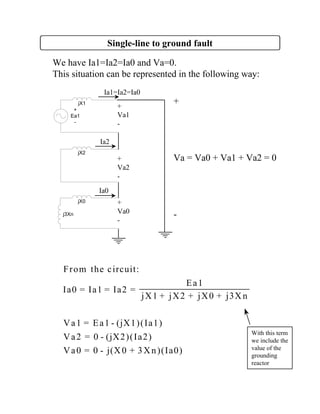
Single-line to ground fault
Unloaded generator (with balanced internal voltages)
a
b
c
G
Generator is Y-connected
grounded using a grounding reactor
If
Ia = If Va = 0
Ib = 0 Vb=?
Ic = 0 Vc=?
Ia
Ia
Ia
a a
a a
Ia
Ib
Ic
a a
a a
If
Ia
Ia
Ia
If
If
If
Ia Ib Ic
If
0
1
2
1
3
1 1 1
1
1
1
3
1 1 1
1
1
0
0
0
1
2
3
3
3
0 0 0
3
2
2
2
2










=




















=






























=










= = =
/
/
/
jXn
Single-line to ground fault
jX1
+
Ea1
-
jX2
jX0
j3Xn
Ia1=Ia2=Ia0
Ia2
Ia0
+
Va = Va0 + Va1 + Va2 = 0
-
+
Va1
-
+
Va2
-
+
Va0
-
We have Ia1=Ia2=Ia0 and Va=0.
This situation can be represented in the following way:
From the circuit:
Ia0 = Ia1 = Ia2 =
Ea1
jX1 + jX2 + jX0 + j3Xn
Va1 = Ea1 - (jX1)(Ia1)
Va2 = 0 - (jX2)(Ia2)
Va0 = 0 - j(X0 + 3Xn)(Ia0)
With this term
we include the
value of the
grounding
reactor
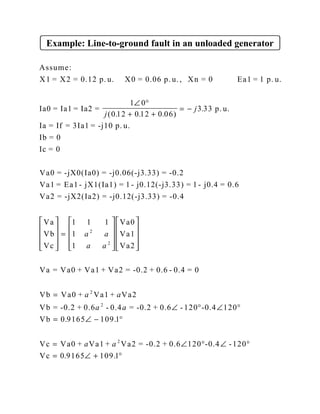
Example: Line-to-ground fault in an unloaded generator
Assume:
X1 = X2 = 0.12 p. u. X0 = 0.06 p. u., Xn = 0 Ea1 = 1 p. u.
Ia0 = Ia1 = Ia2 =
1
p. u.
Ia = If = 3Ia1 = -j10 p. u.
Ib = 0
Ic = 0
Va0 = -jX0(Ia0) = -j0.06(-j3.33) = -0.2
Va1 = Ea1 - jX1(Ia1) = 1 - j0.12(-j3.33) = 1 - j0.4 = 0.6
Va2 = -jX2(Ia2) = -j0.12(-j3.33) = -0.4
Va
Vb
Vc
Va0
Va1
Va2
∠ °
+ +
= −










=















0
0 12 0 12 0 06
3 33
1 1 1
1
1
2
2
j
j
a a
a a
( . . . )
.





=
∠ ° ∠ °
= ∠ − °
= ∠ ° ∠ °
= ∠ + °
Va = Va0 + Va1 + Va2 = -0.2 + 0.6 - 0.4 = 0
Vb Va0 + Va1 + Va2
Vb = -0.2 + 0.6 - 0.4 = -0.2 + 0.6 - 120 -0.4 120
Vb
Vc Va0 + Va1 + Va2 = -0.2 + 0.6 120 -0.4 -120
Vc
a a
a a
a a
2
2
2
0 9165 109 1
0 9165 109 1
. .
. .
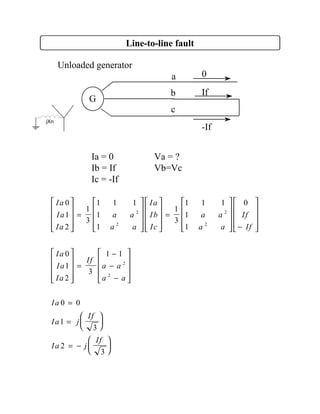
Line-to-line fault
a
b
c
G
Unloaded generator
If
Ia = 0 Va = ?
Ib = If Vb=Vc
Ic = -If
Ia
Ia
Ia
a a
a a
Ia
Ib
Ic
a a
a a
If
If
Ia
Ia
Ia
If
a a
a a
Ia
Ia j
If
Ia j
0
1
2
1
3
1 1 1
1
1
1
3
1 1 1
1
1
0
0
1
2
3
1 1
0 0
1
3
2
2
2
2
2
2
2










=




















=









 −




















=
−
−
−










=
=






= −
If
3






-If
0
jXn
+
Va1
-
+
Va2
-
+
Va0
-
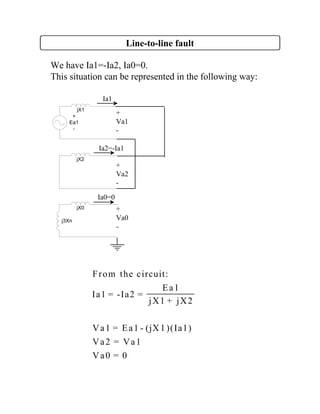
Line-to-line fault
jX1
+
Ea1
-
jX2
jX0
j3Xn
Ia1
Ia2=-Ia1
Ia0=0
We have Ia1=-Ia2, Ia0=0.
This situation can be represented in the following way:
From the circuit:
Ia1 = -Ia2 =
Ea1
jX1 + jX2
Va1 = Ea1 - (jX1)(Ia1)
Va2 = Va1
Va0 = 0
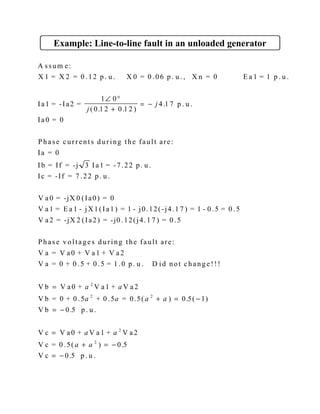
Example: Line-to-line fault in an unloaded generator
A ssum e:
X 1 = X 2 = 0 .12 p. u . X 0 = 0 .06 p. u . , X n = 0 E a 1 = 1 p . u .
Ia1 = -Ia2 =
1
p . u .
Ia0 = 0
Phase currents during the fault are:
Ia = 0
Ib = If = -j 3 Ia1 = -7.22 p. u .
Ic = -If = 7 .22 p. u .
V a 0 = -jX 0 (Ia0) = 0
V a 1 = E a 1 - jX1(Ia1) = 1 - j0.12(-j4.1 7 ) = 1 - 0 .5 = 0 .5
V a 2 = -jX 2 (Ia2) = -j0 .12(j4.1 7 ) = 0 .5
Phase voltages during the fault are:
V a = V a 0 + V a 1 + V a 2
V a = 0 + 0 .5 + 0 .5 = 1 .0 p. u . D id not change!!!
V b V a 0 + V a 1 + V a 2
∠ °
+
= −
=
0
0 1 2 0 1 2
4 1 7
2
j
j
a a
( . . )
.
V b = 0 + 0 .5 + 0 .5 = .5(
V b p . u .
V c V a 0 + V a 1 + V a 2
V c = 0 .5(
V c p . u .
a a a a
a a
a a
2 2
2
2
0 0 5 1
0 5
0 5
0 5
+ = −
= −
=
+ = −
= −
) . ( )
.
) .
.
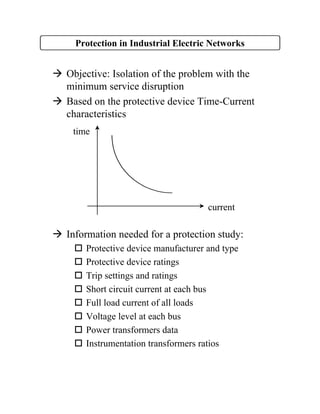
à Objective: Isolation of the problem with the
minimum service disruption
à Based on the protective device Time-Current
characteristics
à Information needed for a protection study:
o Protective device manufacturer and type
o Protective device ratings
o Trip settings and ratings
o Short circuit current at each bus
o Full load current of all loads
o Voltage level at each bus
o Power transformers data
o Instrumentation transformers ratios
Protection in Industrial Electric Networks
time
current
Coordination of the Protection

symm_UBritishColumbia.pdf

  • 1.
    Symmetrical Components à Fortescue’sTheorem o 3 unbalanced phasors of a 3-phase system can be resolved into 3 balanced systems of phasors. The balanced sets of components are: •Positive-sequence components + 3 balanced phasors ð equal in magnitude ð displaced from each other by 120° ð same phase sequence as the original phasors (for example a-b-c) ‚Negative-sequence components − 3 balanced phasors ð equal in magnitude ð displaced from each other by 120° ð opposite phase sequence to the original phasors (for example a-c-b) €Zero-sequence components 0 3 equal phasors ð equal in magnitude ð zero phase displacement from each other
  • 2.
    Symmetrical Components Original voltages: VaVb Vc Positive-sequence components: Va1 Vb1 Vc1 or Va+ Vb+ Vc+ Negative-sequence components: Va2 Vb2 Vc2 or Va- Vb- Vc- Zero-sequence components: Va0 Vb0 Vc0 ORIGINAL PHASORS ARE THE SUM OF THEIR COMPONENTS: Va = Va0 + Va1 + Va2 Vb = Vb0 + Vb1 + Vb2 Vc = Vc0 + Vc1 + Vc2
  • 3.
  • 4.
  • 5.
  • 6.
    Operators à Lets definea phasor: a = 1 ∠ 120° = -0.5 + j 0.8666 The following relations are true: a2 = (1∠120°)(1∠120°) = 1 ∠240°= 1 ∠ −120° a3 = 1 ∠360°= 1 ∠ 0° 1 + a + a2 = 0 120° a 3 = 1 a 2 = 1 -120 a = 1 120
  • 7.
    Symmetrical Components Relations Va1 Vc1 Vb1 Thepositive-sequence components can be written as: Vb1 = (1 ∠ −120°) Va1 = a2 Va1 Vc1 = (1 ∠ 120°) Va1 = a Va1 For the negative-sequence, we have: Vb2 = (1 ∠ 120°) Va2 = a Va2 Vc2 = (1 ∠ −120°) Va2 = a2 Va2 And for the zero-sequence: Va0 = Vb0 = Vc0 The totals are: Va= Va0 + Va1 + Va2 = Va0 + Va1 + Va2 Vb=Vb0 + Vb1 + Vb2 = Va0 + a2 Va1 + a Va2 Vc=Vc0 + Vc1 + Vc2 = Va0 + a Va1 + a2 Va2 Va2 Vb2 Vc2 Va0 Vb0 Vc0
  • 8.
    Symmetrical Components Relations In m a t r i x f o r m : V a V b V c T h i s d e f i n e s t h e t r a n s f o r m a t i o n m a t r i x : A = I t s i n v e r s e i s : A = 1 3 T h e r e f o r e : V V V 1 3 - 1 a 0 a 1 a 2           =                                                   =      1 1 1 1 1 1 1 1 1 1 1 1 1 1 1 1 1 1 1 1 2 2 0 1 2 2 2 2 2 2 2 a a a a V V V a a a a a a a a a a a a a a a ( ) ( ) ( )                + + + + + + V a V b V c V a V b V c V a a V b a V c V a a V b a V c o r : V = 1 3 V = 1 3 V = 1 3 a 0 a 1 a 2 2 2
  • 9.
    Example Ia=10 A. Ib=-Ia Ic=0 [ ] [] [ ] Ia =10 0 A. Ib = 10 180 A. Ic = 0 A. Ia0 = 1 3 10 0 10 180 Ia1= 1 3 10 0 10 180 Ia2 = 1 3 10 0 10 180 Ib0 = Ia0 = 0 Ib1= Ib2 = Ic0 = Ia0 = 0 Ic1= ∠ ° ∠ ° ∠ °+ ∠ °+ = ∠ °+ ∠ ° ∠ ° + = ∠ − ° ∠ °+ ∠ ° ∠ − ° + = ∠ ° ∠ − °− °= ∠ − ° ∠ + °+ °= ∠ + ° ∠ − °+ 0 0 1 120 0 578 30 1 120 0 578 30 578 30 120 578 150 578 30 120 578 150 578 30 ( )( ) . ( )( ) . . . . . . 120 578 90 578 30 120 578 90 °= ∠ + ° ∠ + °− °= ∠ − ° . . . Ic2 =
  • 10.
    Unloaded Generator a b c n Ea Eb Ec + + + - - - Internal voltagesare balanced. Find the symmetrical components for the internal voltages. Ea0 Ea1 Ea2 Ea Eb Ec Ea Ea Ea Ea0 Ea1 Ea2 0 Ea 0           =                     =                               =           1 3 1 1 1 1 1 1 3 1 1 1 1 1 2 2 2 2 2 a a a a a a a a a a Only positive-sequence voltage exists!!! jXn Generator is grounded through a grounding reactor
  • 11.
    Generator Equivalent jX1 + Ea1 - Positive-sequence jX2 Negative-sequence jX0 j3Xn Zero-sequence Xn=Impedance from neutralto ground The current in the neutral of the generator is: In = Ia + Ib + Ic = ( Ia1 + Ib1 + Ic1) + (Ia2 + Ib2 + Ic2 ) + Ia0 + Ib0 + Ic0 The positive and negative sequence components add to zero: Ia1 + Ib1 + Ic1 = 0 Ia2 + Ib2 + Ic2 = 0 This means that the neutral does not carry positive or negative sequence components. However, the zero-sequence components are in phase, and their sum is: In = Ia0 + Ib0 + Ic0 = 3 Ia0 Therefore the zero sequence equivalent has a grounding impedance of value: Zg = 3 j Xn
  • 12.
    Single-line to groundfault Unloaded generator (with balanced internal voltages) a b c G Generator is Y-connected grounded using a grounding reactor If Ia = If Va = 0 Ib = 0 Vb=? Ic = 0 Vc=? Ia Ia Ia a a a a Ia Ib Ic a a a a If Ia Ia Ia If If If Ia Ib Ic If 0 1 2 1 3 1 1 1 1 1 1 3 1 1 1 1 1 0 0 0 1 2 3 3 3 0 0 0 3 2 2 2 2           =                     =                               =           = = = / / / jXn
  • 13.
    Single-line to groundfault jX1 + Ea1 - jX2 jX0 j3Xn Ia1=Ia2=Ia0 Ia2 Ia0 + Va = Va0 + Va1 + Va2 = 0 - + Va1 - + Va2 - + Va0 - We have Ia1=Ia2=Ia0 and Va=0. This situation can be represented in the following way: From the circuit: Ia0 = Ia1 = Ia2 = Ea1 jX1 + jX2 + jX0 + j3Xn Va1 = Ea1 - (jX1)(Ia1) Va2 = 0 - (jX2)(Ia2) Va0 = 0 - j(X0 + 3Xn)(Ia0) With this term we include the value of the grounding reactor
  • 14.
    Example: Line-to-ground faultin an unloaded generator Assume: X1 = X2 = 0.12 p. u. X0 = 0.06 p. u., Xn = 0 Ea1 = 1 p. u. Ia0 = Ia1 = Ia2 = 1 p. u. Ia = If = 3Ia1 = -j10 p. u. Ib = 0 Ic = 0 Va0 = -jX0(Ia0) = -j0.06(-j3.33) = -0.2 Va1 = Ea1 - jX1(Ia1) = 1 - j0.12(-j3.33) = 1 - j0.4 = 0.6 Va2 = -jX2(Ia2) = -j0.12(-j3.33) = -0.4 Va Vb Vc Va0 Va1 Va2 ∠ ° + + = −           =                0 0 12 0 12 0 06 3 33 1 1 1 1 1 2 2 j j a a a a ( . . . ) .      = ∠ ° ∠ ° = ∠ − ° = ∠ ° ∠ ° = ∠ + ° Va = Va0 + Va1 + Va2 = -0.2 + 0.6 - 0.4 = 0 Vb Va0 + Va1 + Va2 Vb = -0.2 + 0.6 - 0.4 = -0.2 + 0.6 - 120 -0.4 120 Vb Vc Va0 + Va1 + Va2 = -0.2 + 0.6 120 -0.4 -120 Vc a a a a a a 2 2 2 0 9165 109 1 0 9165 109 1 . . . .
  • 15.
    Line-to-line fault a b c G Unloaded generator If Ia= 0 Va = ? Ib = If Vb=Vc Ic = -If Ia Ia Ia a a a a Ia Ib Ic a a a a If If Ia Ia Ia If a a a a Ia Ia j If Ia j 0 1 2 1 3 1 1 1 1 1 1 3 1 1 1 1 1 0 0 1 2 3 1 1 0 0 1 3 2 2 2 2 2 2 2           =                     =           −                     = − − −           = =       = − If 3       -If 0 jXn
  • 16.
    + Va1 - + Va2 - + Va0 - Line-to-line fault jX1 + Ea1 - jX2 jX0 j3Xn Ia1 Ia2=-Ia1 Ia0=0 We haveIa1=-Ia2, Ia0=0. This situation can be represented in the following way: From the circuit: Ia1 = -Ia2 = Ea1 jX1 + jX2 Va1 = Ea1 - (jX1)(Ia1) Va2 = Va1 Va0 = 0
  • 17.
    Example: Line-to-line faultin an unloaded generator A ssum e: X 1 = X 2 = 0 .12 p. u . X 0 = 0 .06 p. u . , X n = 0 E a 1 = 1 p . u . Ia1 = -Ia2 = 1 p . u . Ia0 = 0 Phase currents during the fault are: Ia = 0 Ib = If = -j 3 Ia1 = -7.22 p. u . Ic = -If = 7 .22 p. u . V a 0 = -jX 0 (Ia0) = 0 V a 1 = E a 1 - jX1(Ia1) = 1 - j0.12(-j4.1 7 ) = 1 - 0 .5 = 0 .5 V a 2 = -jX 2 (Ia2) = -j0 .12(j4.1 7 ) = 0 .5 Phase voltages during the fault are: V a = V a 0 + V a 1 + V a 2 V a = 0 + 0 .5 + 0 .5 = 1 .0 p. u . D id not change!!! V b V a 0 + V a 1 + V a 2 ∠ ° + = − = 0 0 1 2 0 1 2 4 1 7 2 j j a a ( . . ) . V b = 0 + 0 .5 + 0 .5 = .5( V b p . u . V c V a 0 + V a 1 + V a 2 V c = 0 .5( V c p . u . a a a a a a a a 2 2 2 2 0 0 5 1 0 5 0 5 0 5 + = − = − = + = − = − ) . ( ) . ) . .
  • 18.
    à Objective: Isolationof the problem with the minimum service disruption à Based on the protective device Time-Current characteristics à Information needed for a protection study: o Protective device manufacturer and type o Protective device ratings o Trip settings and ratings o Short circuit current at each bus o Full load current of all loads o Voltage level at each bus o Power transformers data o Instrumentation transformers ratios Protection in Industrial Electric Networks time current
  • 19.