
Symmetry means an attribute of a shape or
relation; exact reflection of form on opposite sides
of a dividing line or plane.
Symmetry occurs not only in geometry, but also
in other branches of mathematics. It is actually the
same as invariance: the property that something
does not change under a set of transformations.
In the case of symmetric functions, the value of the output is
invariant under permutations of variables. For
example(a − b)(b − c)(c − a) = 10
A symmetric matrix, seen as a symmetric function of the
row- and column number, is an example. The second order
partial derivatives of a suitably smooth function, seen as a
function of the two indexes, is another example.
A high-level concept related to symmetry is mathematical
duality.
A relation is symmetric if and only if the corresponding
boolean-valued function is a symmetric function.
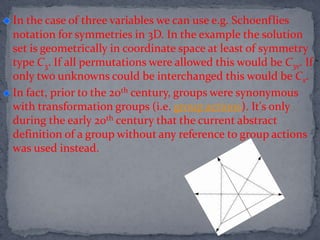
In the case of three variables we can use e.g. Schoenflies
notation for symmetries in 3D. In the example the solution
set is geometrically in coordinate space at least of symmetry
type C3. If all permutations were allowed this would be C3v. If
only two unknowns could be interchanged this would be Cs.
In fact, prior to the 20th century, groups were synonymous
with transformation groups (i.e. group actions). It's only
during the early 20th century that the current abstract
definition of a group without any reference to group actions
was used instead.
A symmetry of a differential equation is a transformation
that leaves the differential equation invariant, knowledge of
such symmetries may help solve the differential equation.
Symmetries may be found by solving a related set of ordinary
differential equations . Solving these equations is often much
simpler than solving the original differential equations.
Two objects are symmetric to each other with respect to a
given group of operations if one is obtained from the other by
one of the operations. It is an equivalence relation.
 The idea of randomness suggests a probability distribution
  with "maximum symmetry" with respect to all outcomes.
 A function of two variables is skew-symmetric if f(y, x) =
  −f(x, y). The property implies f(x, x) = 0 (except in fields of
  characteristic two). A skew-symmetric matrix, seen as a
  function of the row- and column number.
 In probability theory, from a symmetry in stochastic events, a
  corresponding symmetry of the probability distribution may
  be derived. For example, due to the approximate symmetry of
  a die each outcome of tossing one, in the sample space {1, 2,
  3, 4, 5, 6}, has approximately the same probability.
symmetry

symmetry

  • 2.
    Symmetry means anattribute of a shape or relation; exact reflection of form on opposite sides of a dividing line or plane. Symmetry occurs not only in geometry, but also in other branches of mathematics. It is actually the same as invariance: the property that something does not change under a set of transformations.
  • 3.
    In the caseof symmetric functions, the value of the output is invariant under permutations of variables. For example(a − b)(b − c)(c − a) = 10 A symmetric matrix, seen as a symmetric function of the row- and column number, is an example. The second order partial derivatives of a suitably smooth function, seen as a function of the two indexes, is another example. A high-level concept related to symmetry is mathematical duality. A relation is symmetric if and only if the corresponding boolean-valued function is a symmetric function.
  • 4.
    In the caseof three variables we can use e.g. Schoenflies notation for symmetries in 3D. In the example the solution set is geometrically in coordinate space at least of symmetry type C3. If all permutations were allowed this would be C3v. If only two unknowns could be interchanged this would be Cs. In fact, prior to the 20th century, groups were synonymous with transformation groups (i.e. group actions). It's only during the early 20th century that the current abstract definition of a group without any reference to group actions was used instead.
  • 5.
    A symmetry ofa differential equation is a transformation that leaves the differential equation invariant, knowledge of such symmetries may help solve the differential equation. Symmetries may be found by solving a related set of ordinary differential equations . Solving these equations is often much simpler than solving the original differential equations. Two objects are symmetric to each other with respect to a given group of operations if one is obtained from the other by one of the operations. It is an equivalence relation.
  • 6.
     The ideaof randomness suggests a probability distribution with "maximum symmetry" with respect to all outcomes.  A function of two variables is skew-symmetric if f(y, x) = −f(x, y). The property implies f(x, x) = 0 (except in fields of characteristic two). A skew-symmetric matrix, seen as a function of the row- and column number.  In probability theory, from a symmetry in stochastic events, a corresponding symmetry of the probability distribution may be derived. For example, due to the approximate symmetry of a die each outcome of tossing one, in the sample space {1, 2, 3, 4, 5, 6}, has approximately the same probability.