
Symbolic Rules
Extraction From Trained
   Neural Networks

                                Koushal Kumar
                                   M .Tech CSE
                            Mob: +918968939621

26/5/2012   Koushal Kumar   1
What are Artificial Neural Networks?
• Artificial Neural Networks are powerful
  computational systems consisting of many
  simple processing elements connected together
  to perform tasks analogously to biological
  brains.
• They are massively parallel, which makes them
  efficient, robust, fault tolerant and noise tolerant
• They can learn from training data and generalize
  to new situations.
26/5/2012        Koushal Kumar         2
The limitation of Neural Network

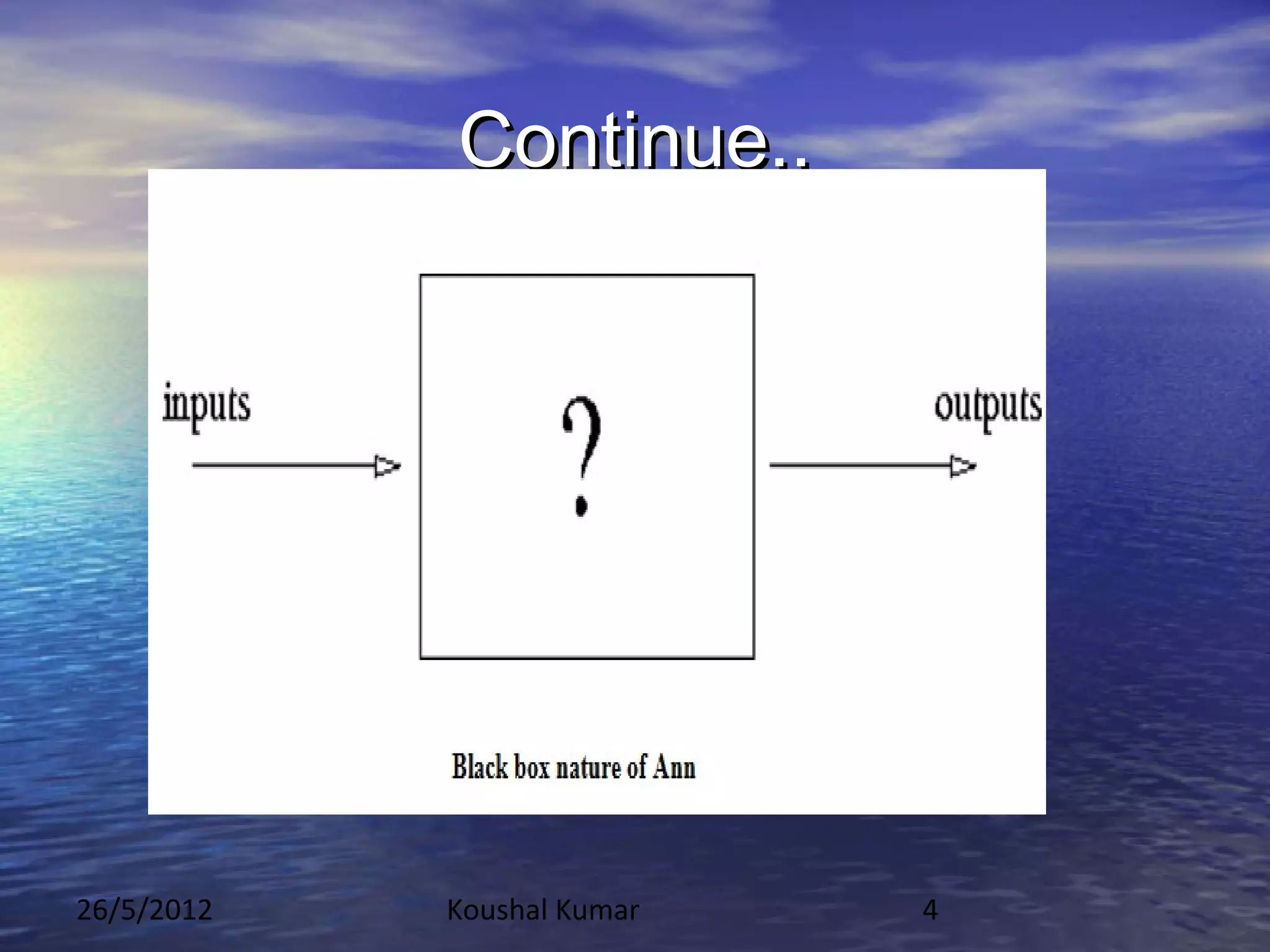
The major criticism against Neural Network is that decision
given by neural networks is difficult to understand by a
human being. Reasons for this are

Knowledge in Neural Networks are stored as real values
parameters (weights and bias) of networks

Neural Networks are unable to explain its internal
processing how they come to particular decision

This behavior makes Neural Networks Black Box in
Nature
 26/5/2012         Koushal Kumar            3
Continue..


26/5/2012   Koushal Kumar   4
Rules extraction From Neural
              Networks.
So to overcome the       Black Box nature of Neural
Networks we need to extract rules from Neural
Networks so that the user can gain a better
understanding of the decision process. following types
of rules can be extracted from neural networks

I) M OF N types rules

II) Fuzzy rules
    26/5/2012      Koushal Kumar         5
continue..
 III) IF THEN RULES
 IV) Decision Rules

 V) First order logic rules

 From all above types of rules IF THEN RULES
 and Decision rules are easy to understand then
 others kind of rules.


26/5/2012         Koushal Kumar    6
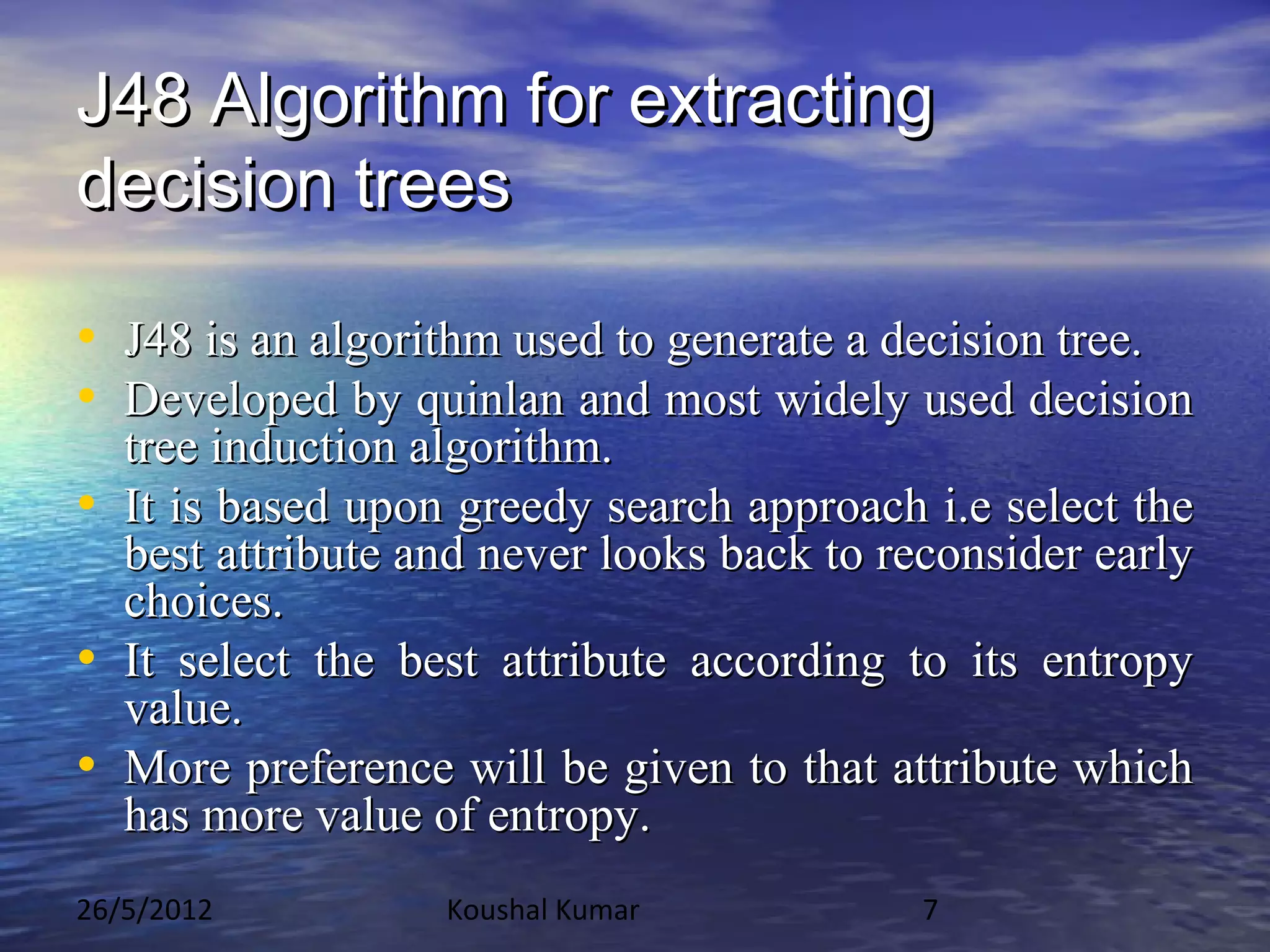
J48 Algorithm for extracting
decision trees

• J48 is an algorithm used to generate a decision tree.
• Developed by quinlan and most widely used decision
    tree induction algorithm.
•   It is based upon greedy search approach i.e select the
    best attribute and never looks back to reconsider early
    choices.
•   It select the best attribute according to its entropy
    value.
•   More preference will be given to that attribute which
    has more value of entropy.
26/5/2012           Koushal Kumar           7
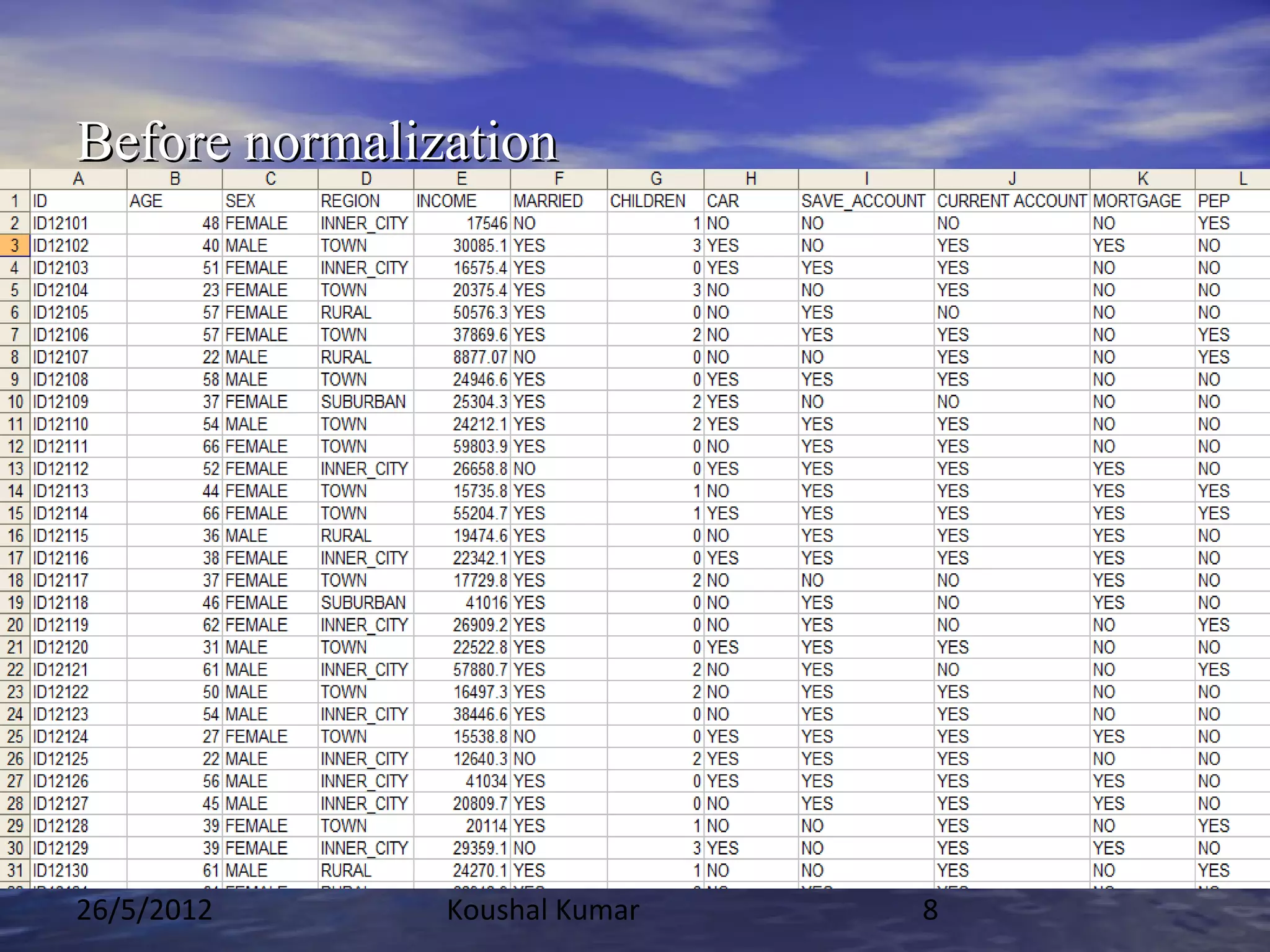
Before normalization


26/5/2012      Koushal Kumar   8
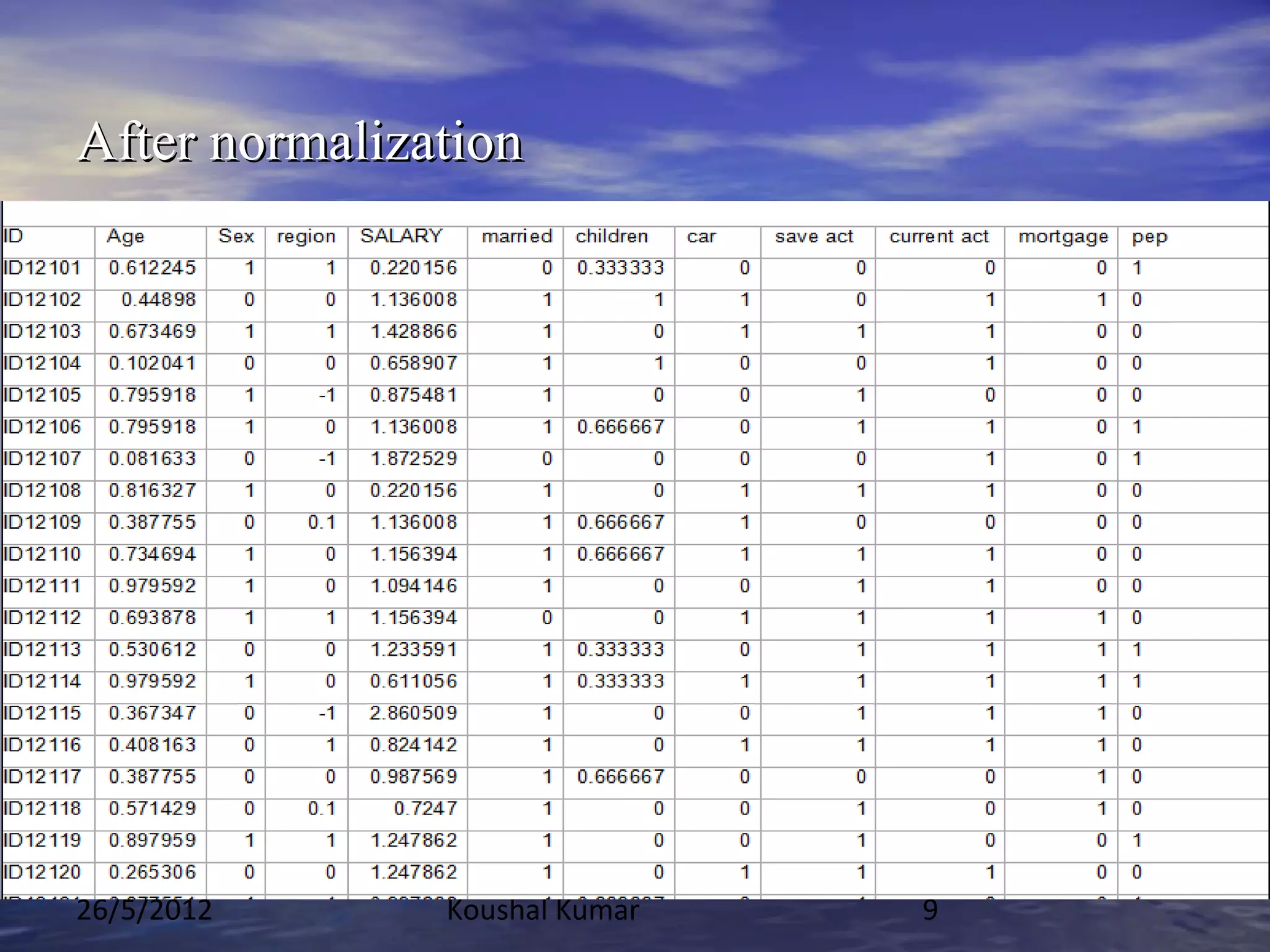
After normalization


26/5/2012      Koushal Kumar   9
MATLAB Simulator

•    Matlab stands for matrix laboratory.
•    It integrate computation, visualization, and
     programming in an easy-to-use environment.
•     MATLAB is a package that has been purpose-
     designed to make computations easy, fast and
     reliable.
•    Matlab can be used in math and computation,
     algorithm development, simulation purposes.
•    MATLAB is a powerful system that can plot graphs
     and perform a large variety of calculations with
     numbers.
    26/5/2012       Koushal Kumar       10
Weka simulator

• WEKA is abbreviation of Waikato Environment for
    Knowledge Analysis.
•   Weka is open source simulator with machine learning
    algorithms.
•   The Weka workbench contains a collection of
    visualization tools and algorithms for data analysis
    and predictive modelling.


26/5/2012          Koushal Kumar           11
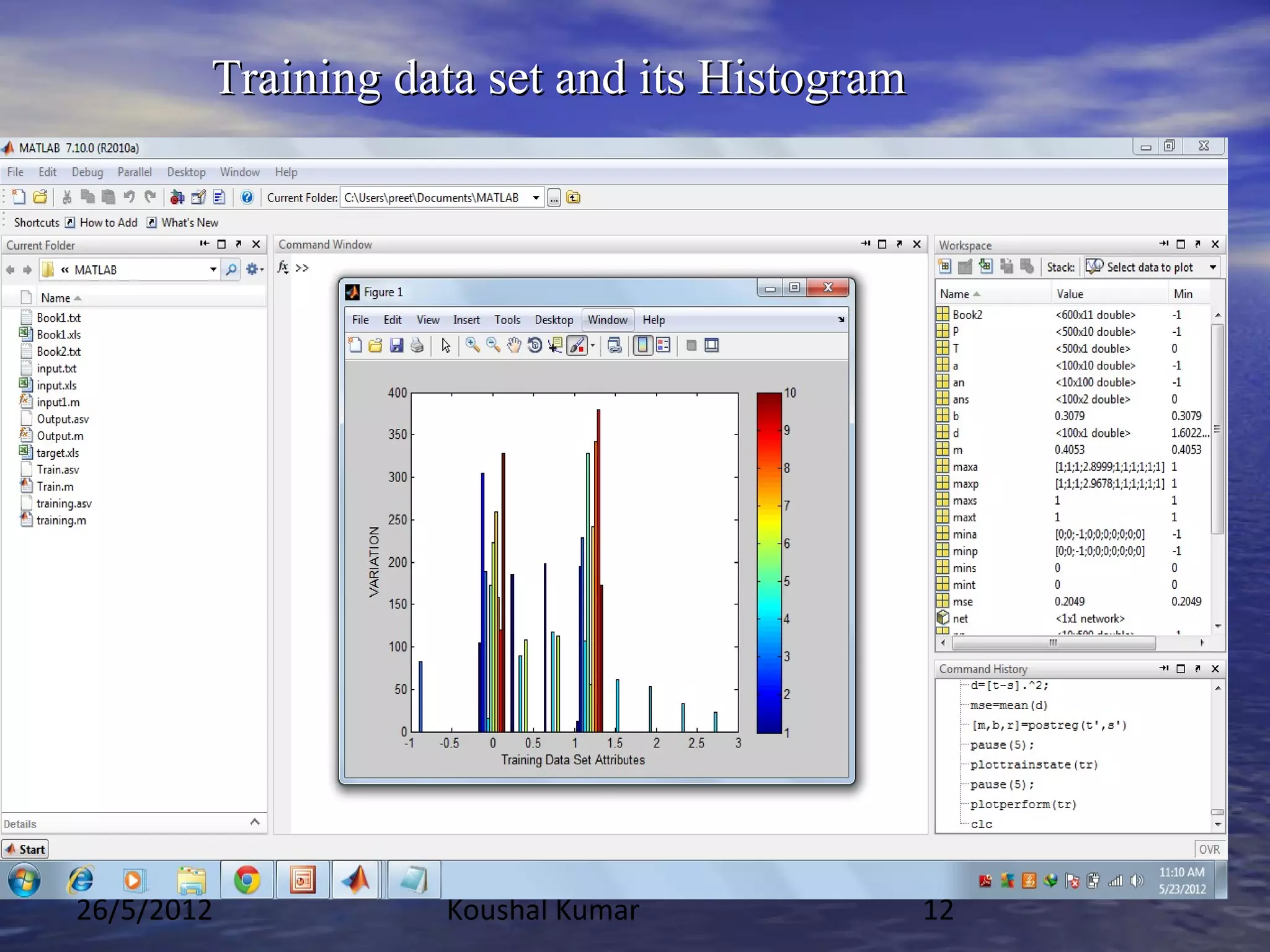
Training data set and its Histogram


26/5/2012          Koushal Kumar              12
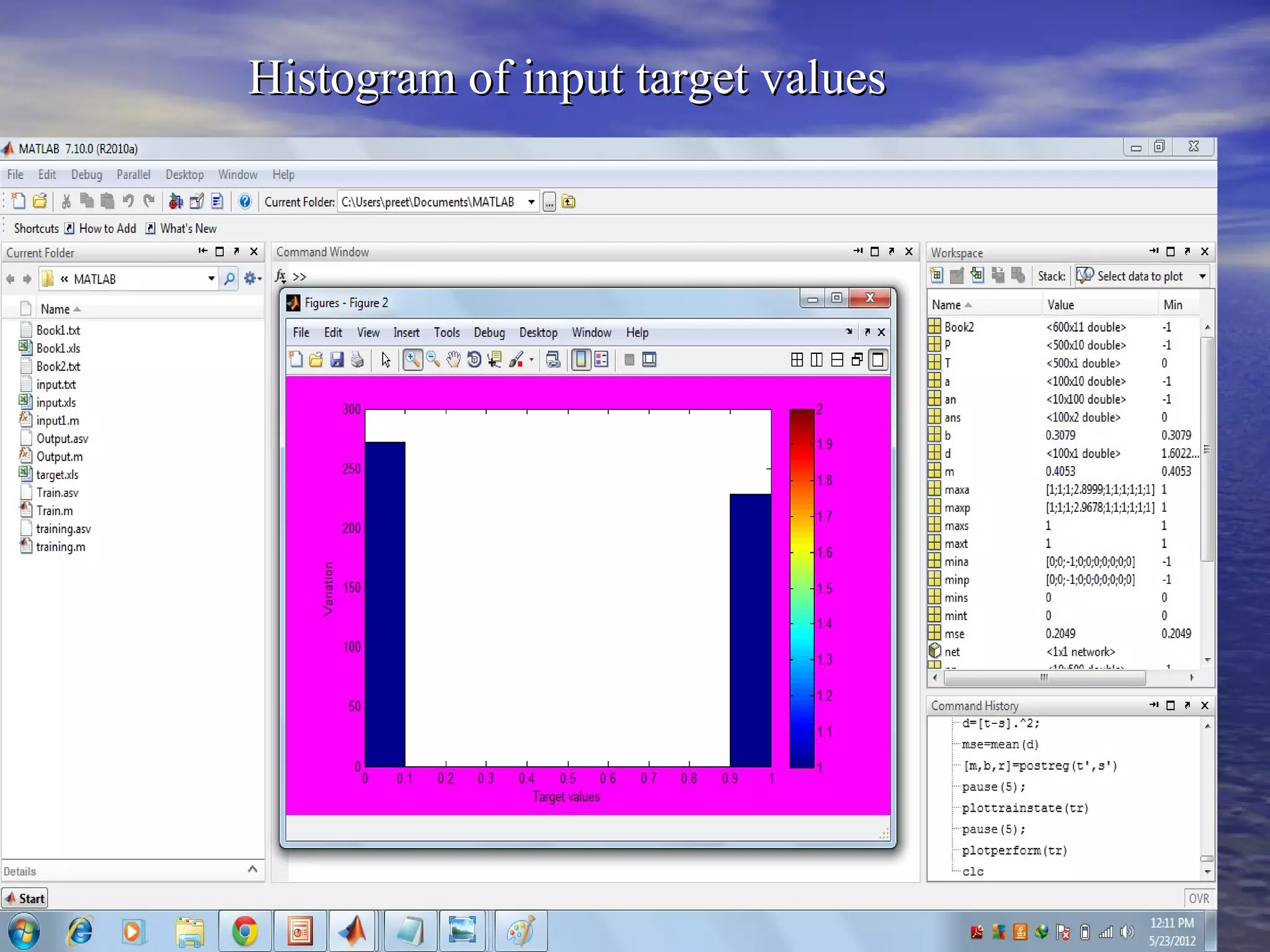
Histogram of input target values


26/5/2012            Koushal Kumar             13
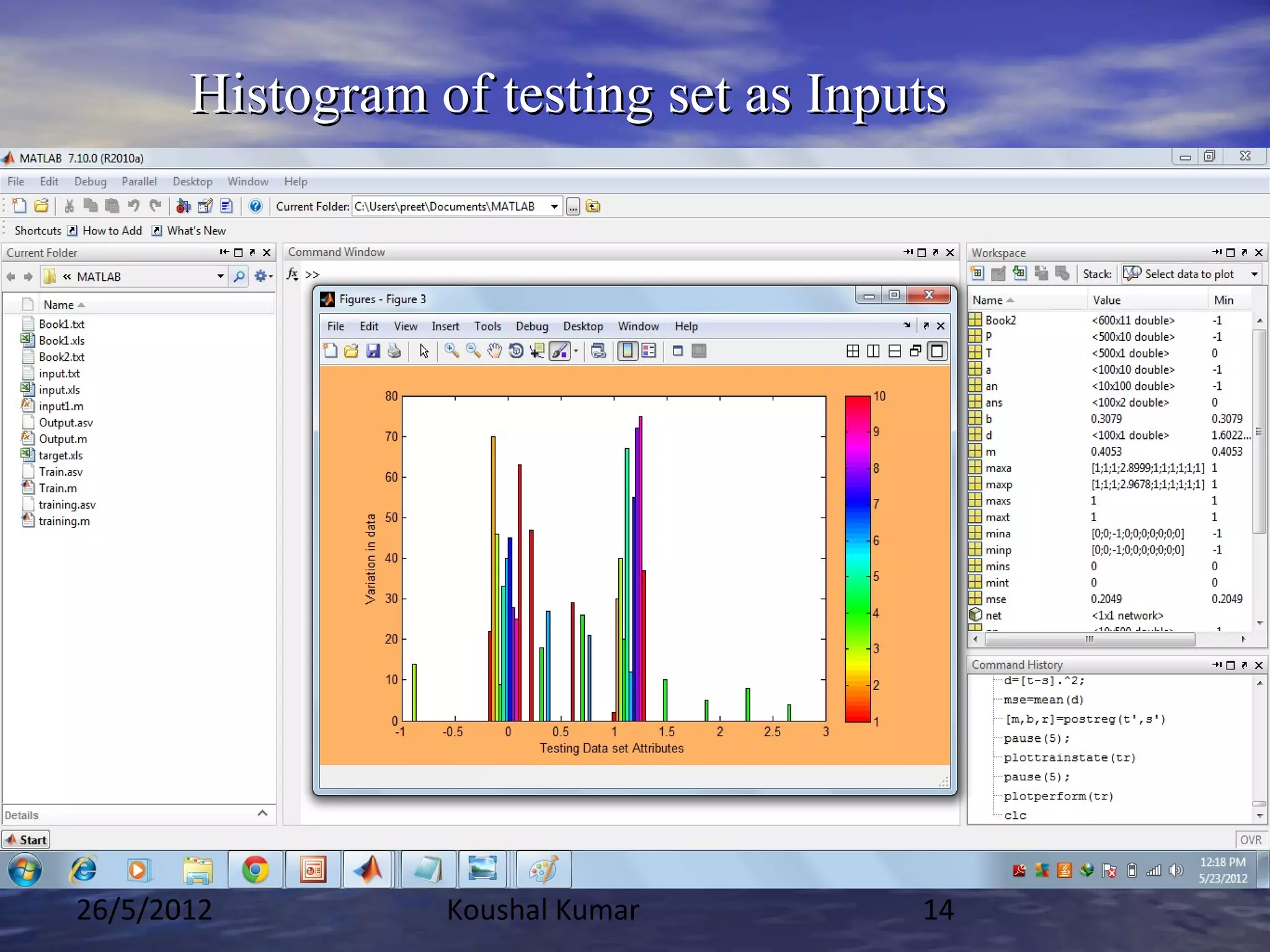
Histogram of testing set as Inputs


26/5/2012         Koushal Kumar        14
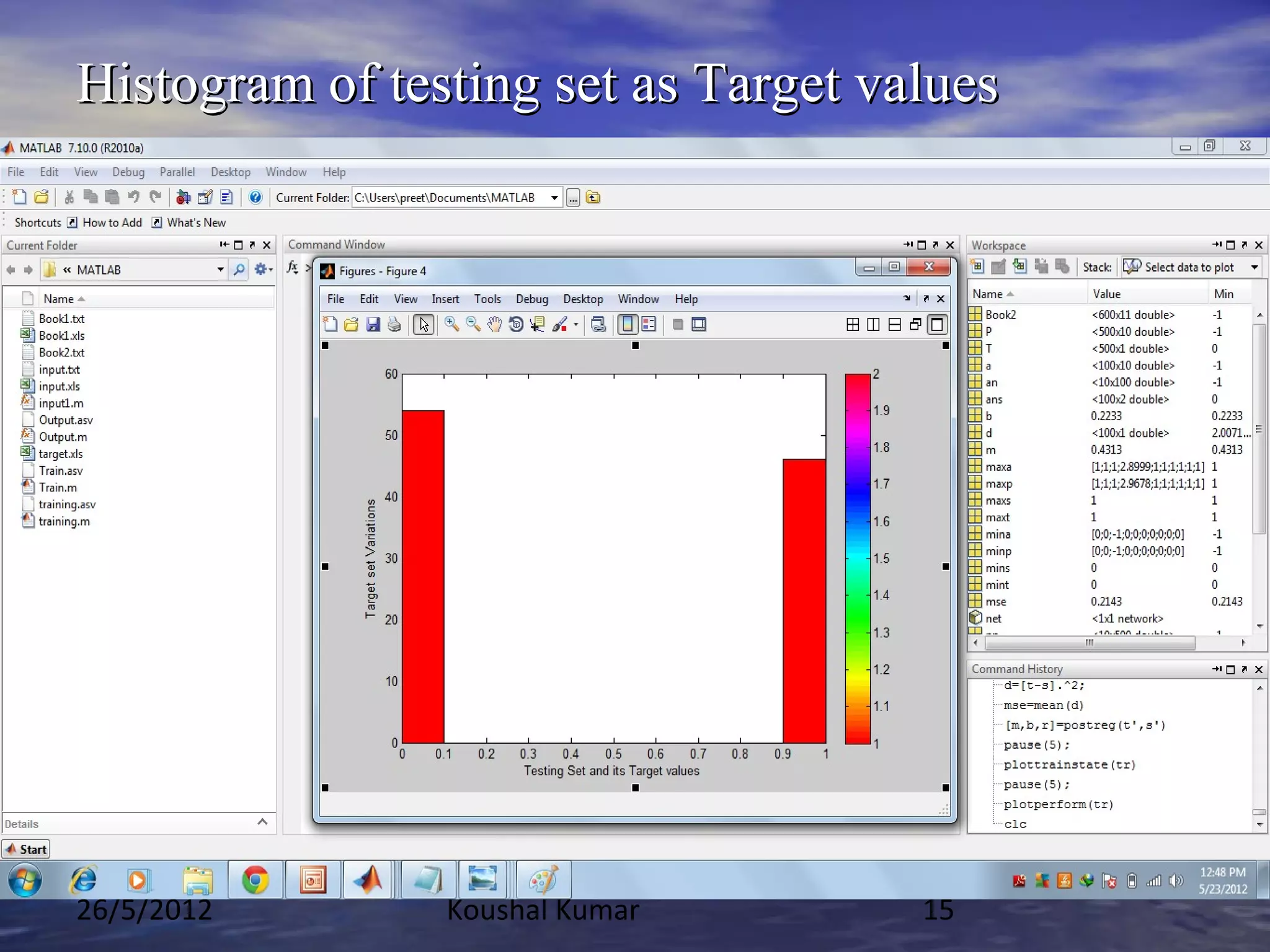
Histogram of testing set as Target values


26/5/2012       Koushal Kumar        15
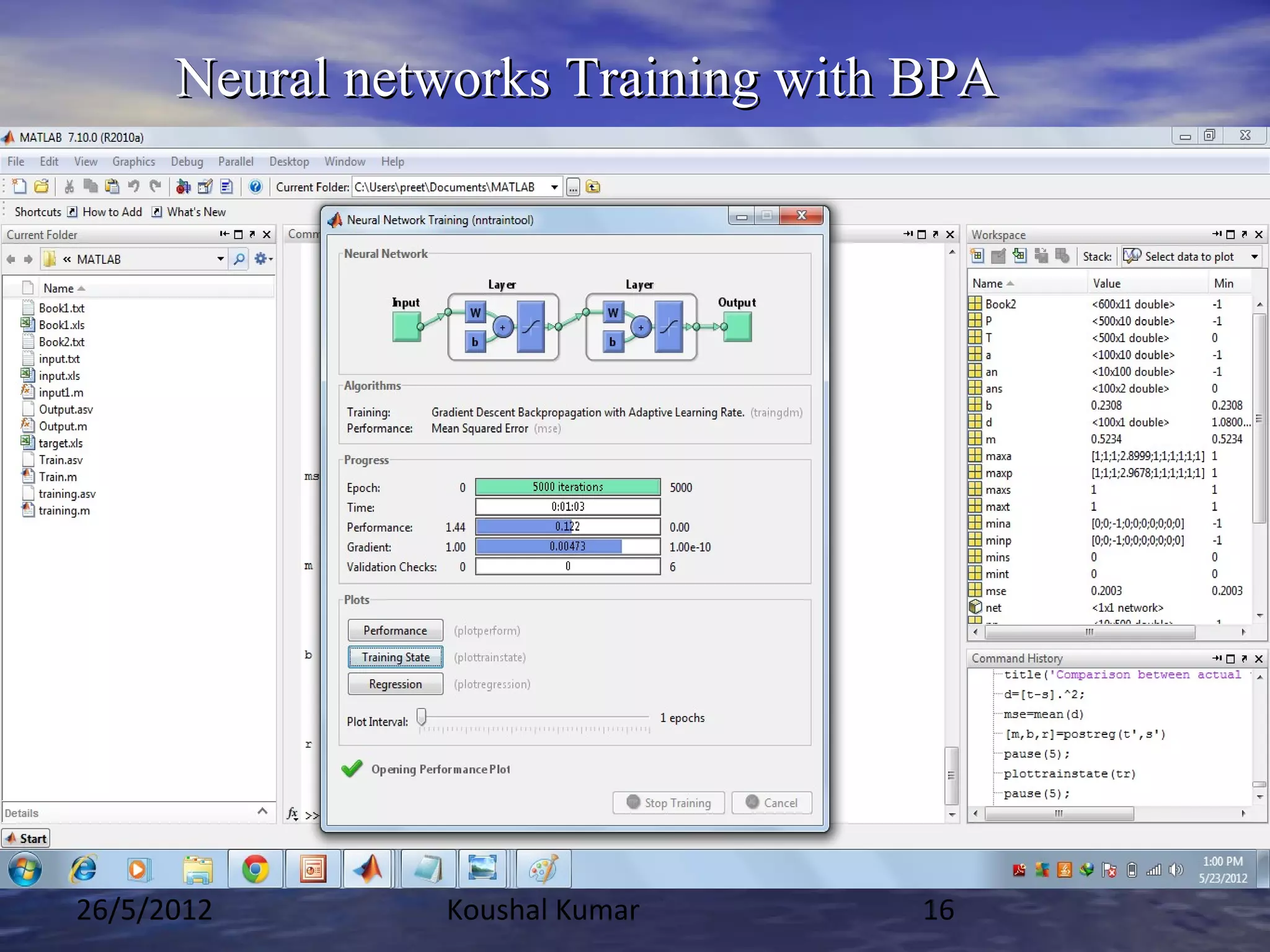
Neural networks Training with BPA


26/5/2012       Koushal Kumar      16
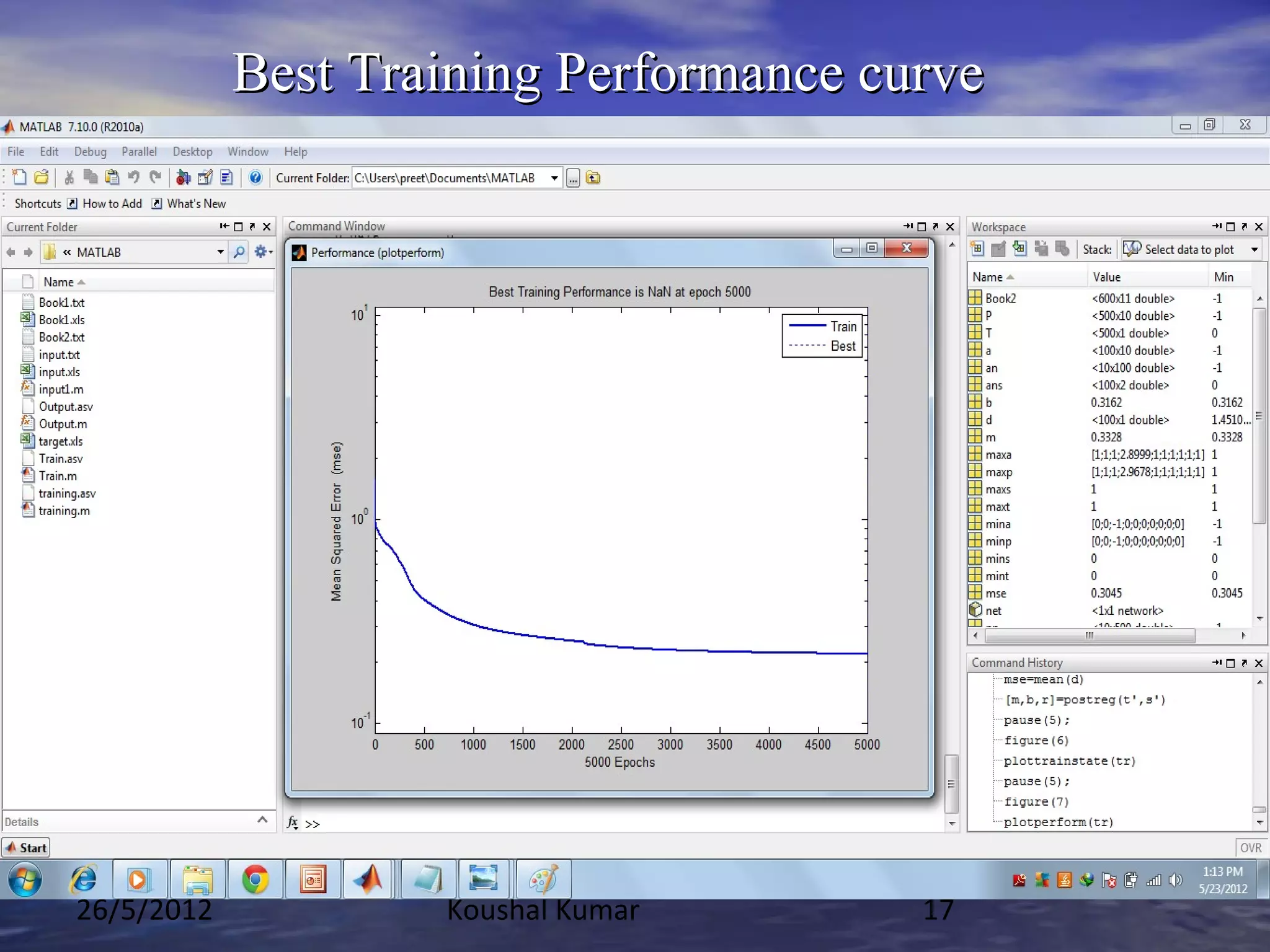
Best Training Performance curve


26/5/2012           Koushal Kumar       17
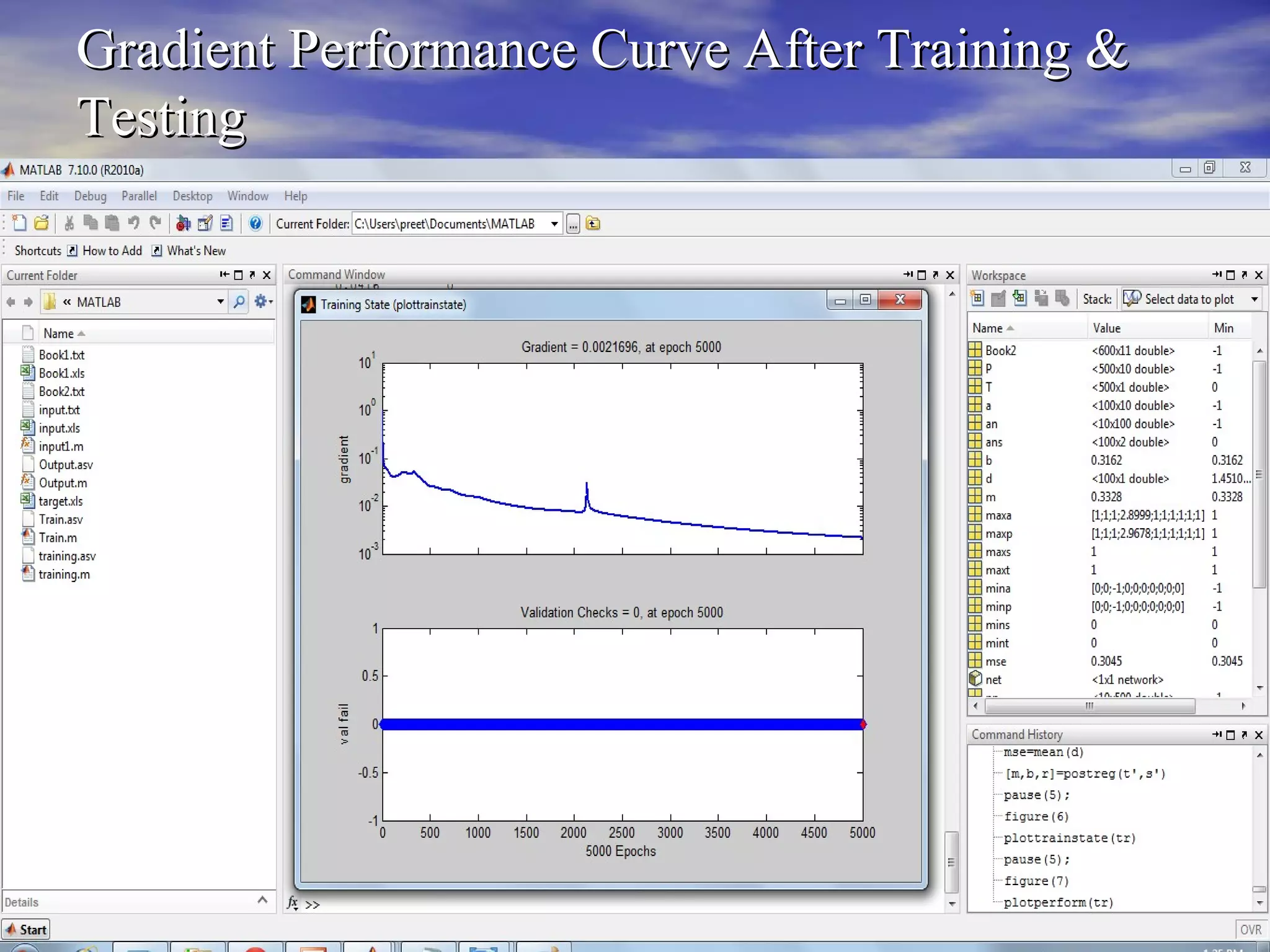
Gradient Performance Curve After Training &
Testing


26/5/2012      Koushal Kumar      18
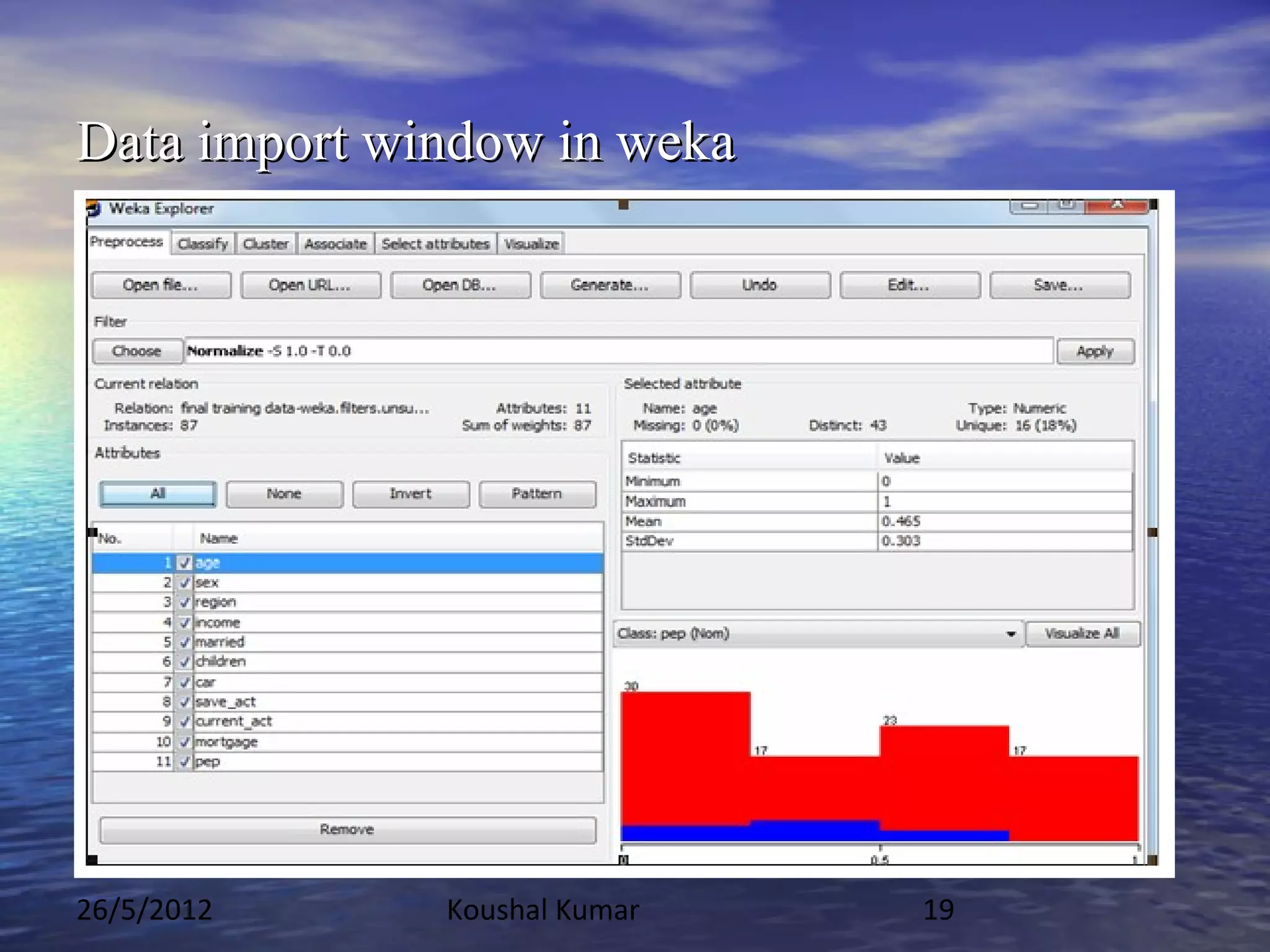
Data import window in weka


26/5/2012     Koushal Kumar   19
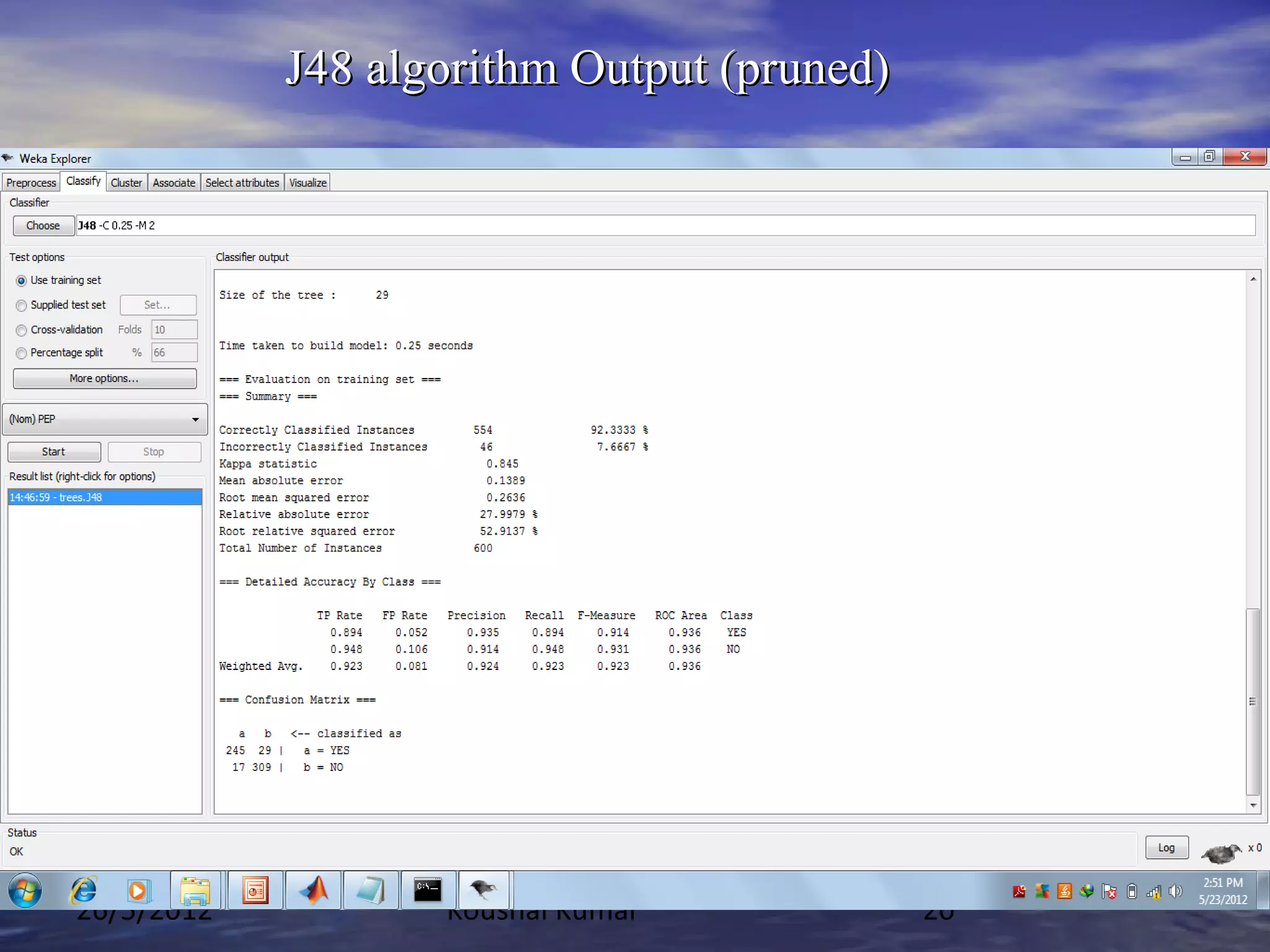
J48 algorithm Output (pruned)


26/5/2012          Koushal Kumar            20
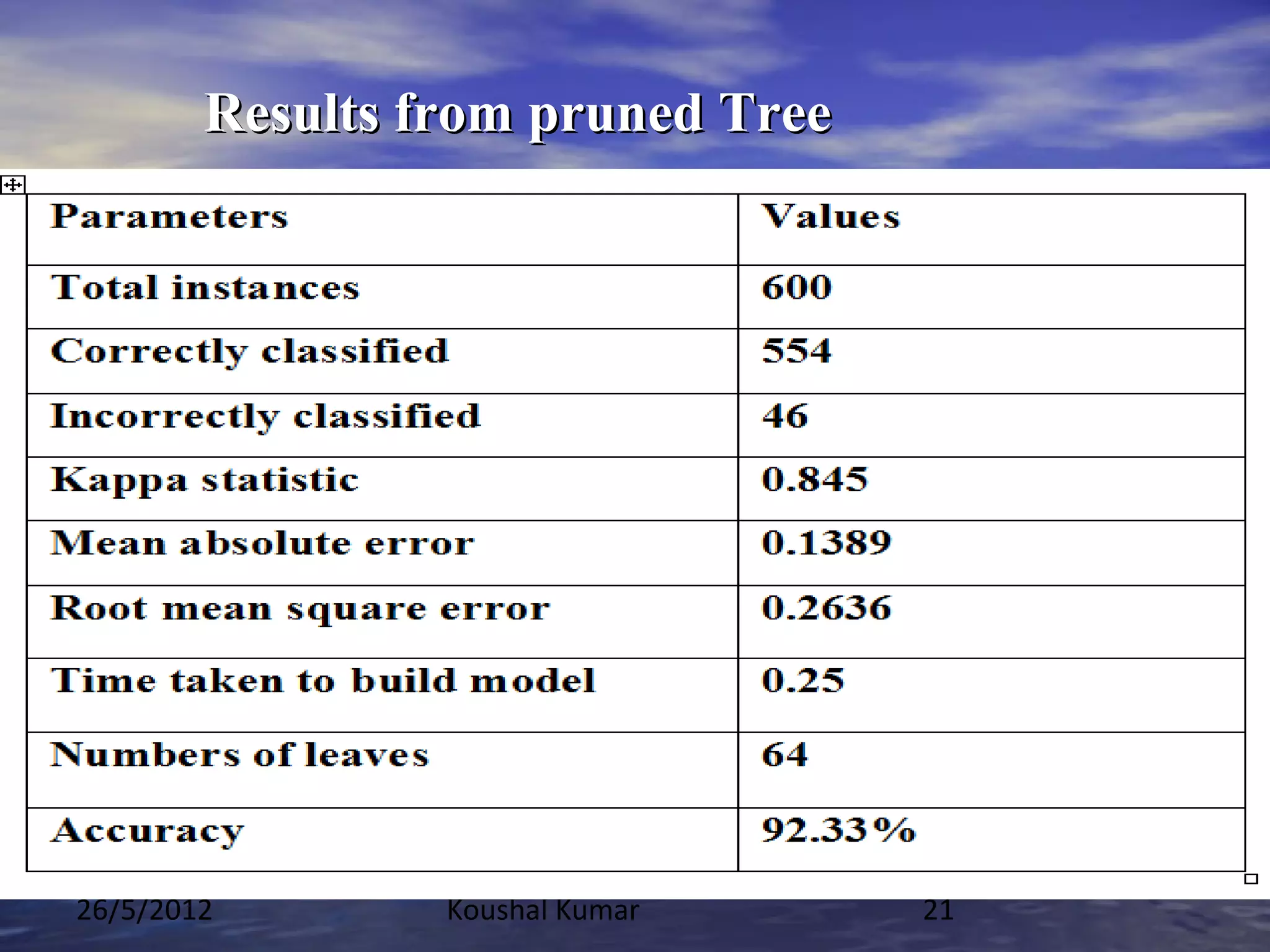
Results from pruned Tree


26/5/2012        Koushal Kumar     21
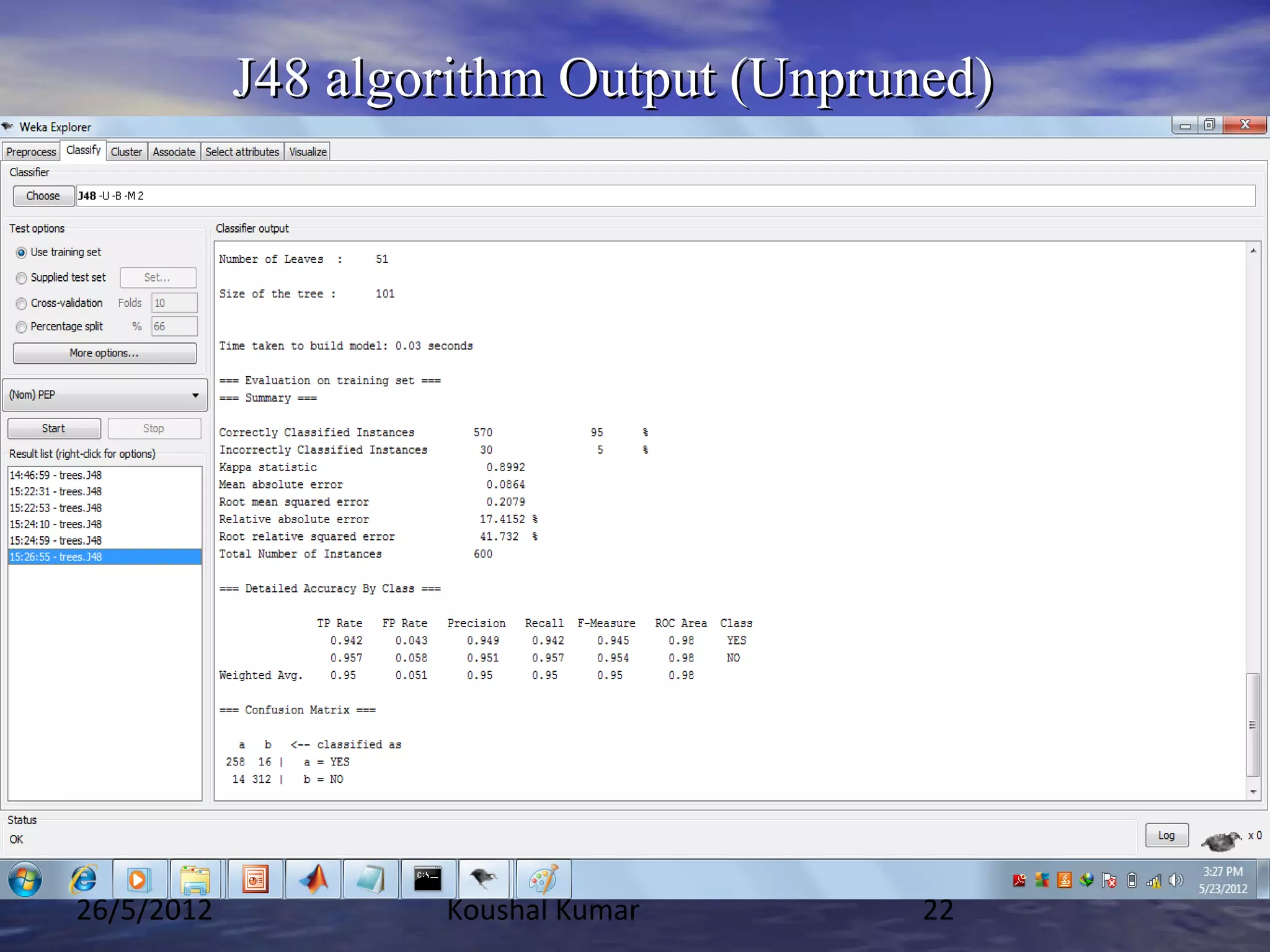
J48 algorithm Output (Unpruned)


26/5/2012           Koushal Kumar       22
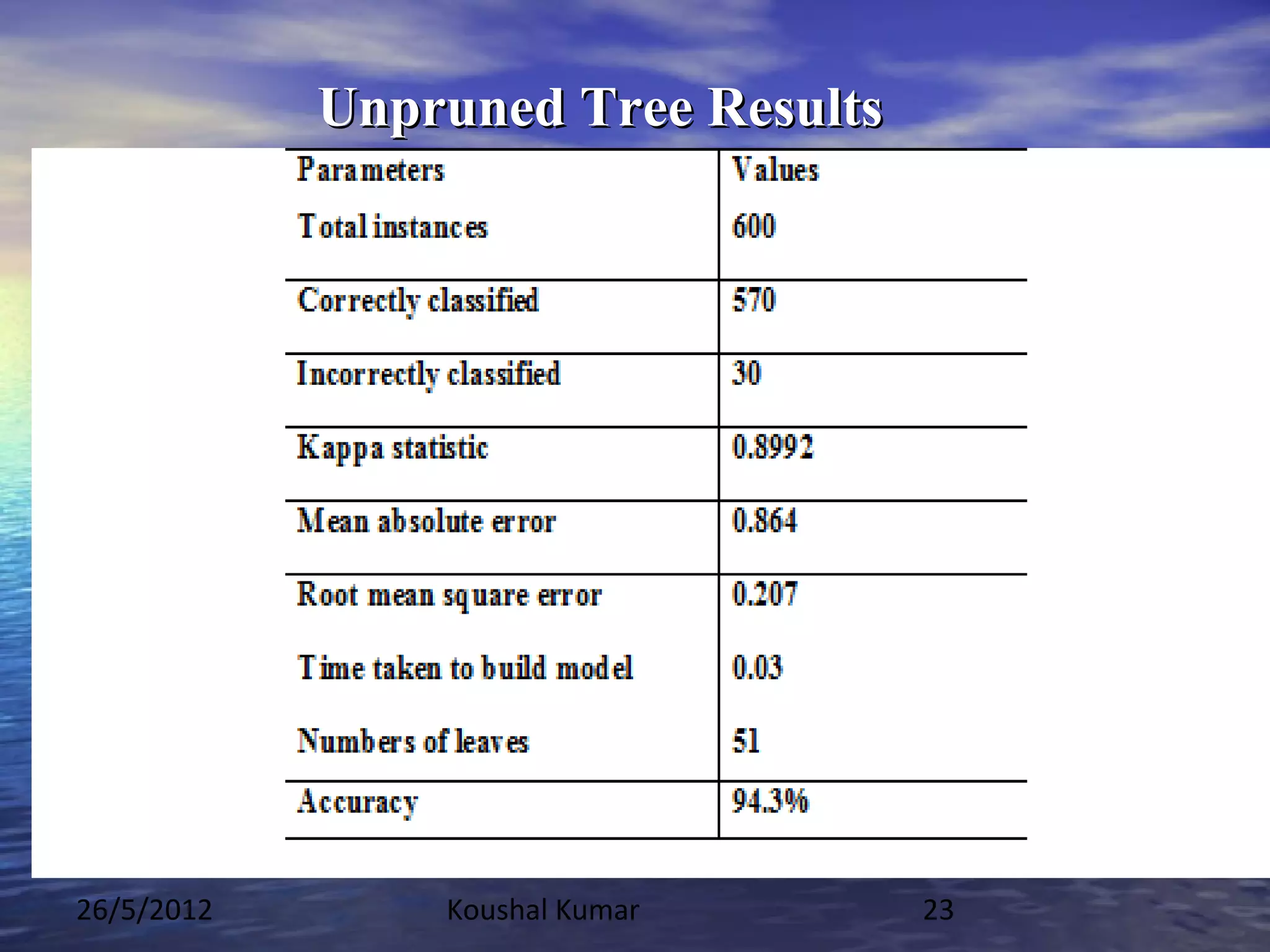
Unpruned Tree Results


26/5/2012       Koushal Kumar       23
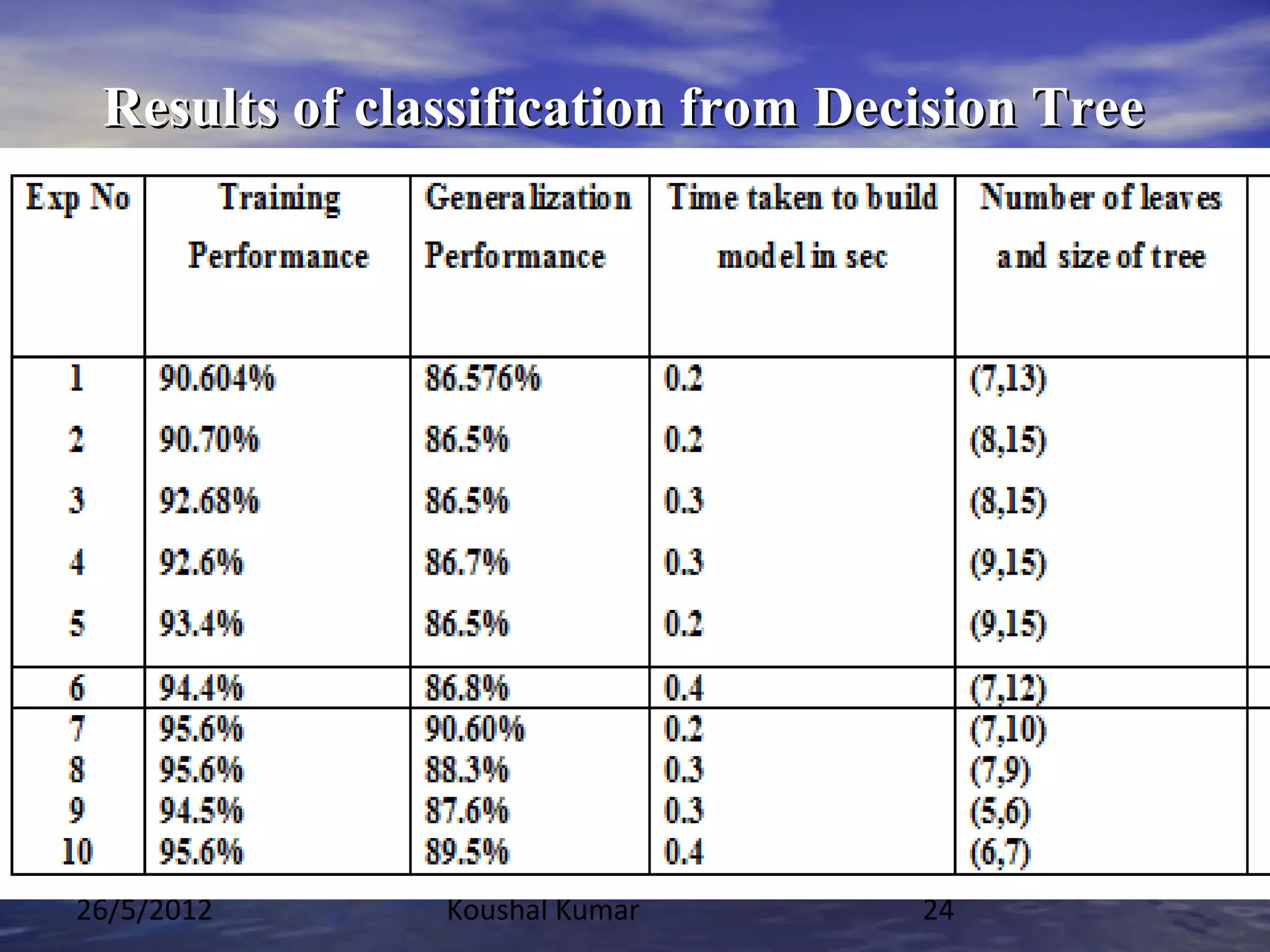
Results of classification from Decision Tree


26/5/2012      Koushal Kumar       24
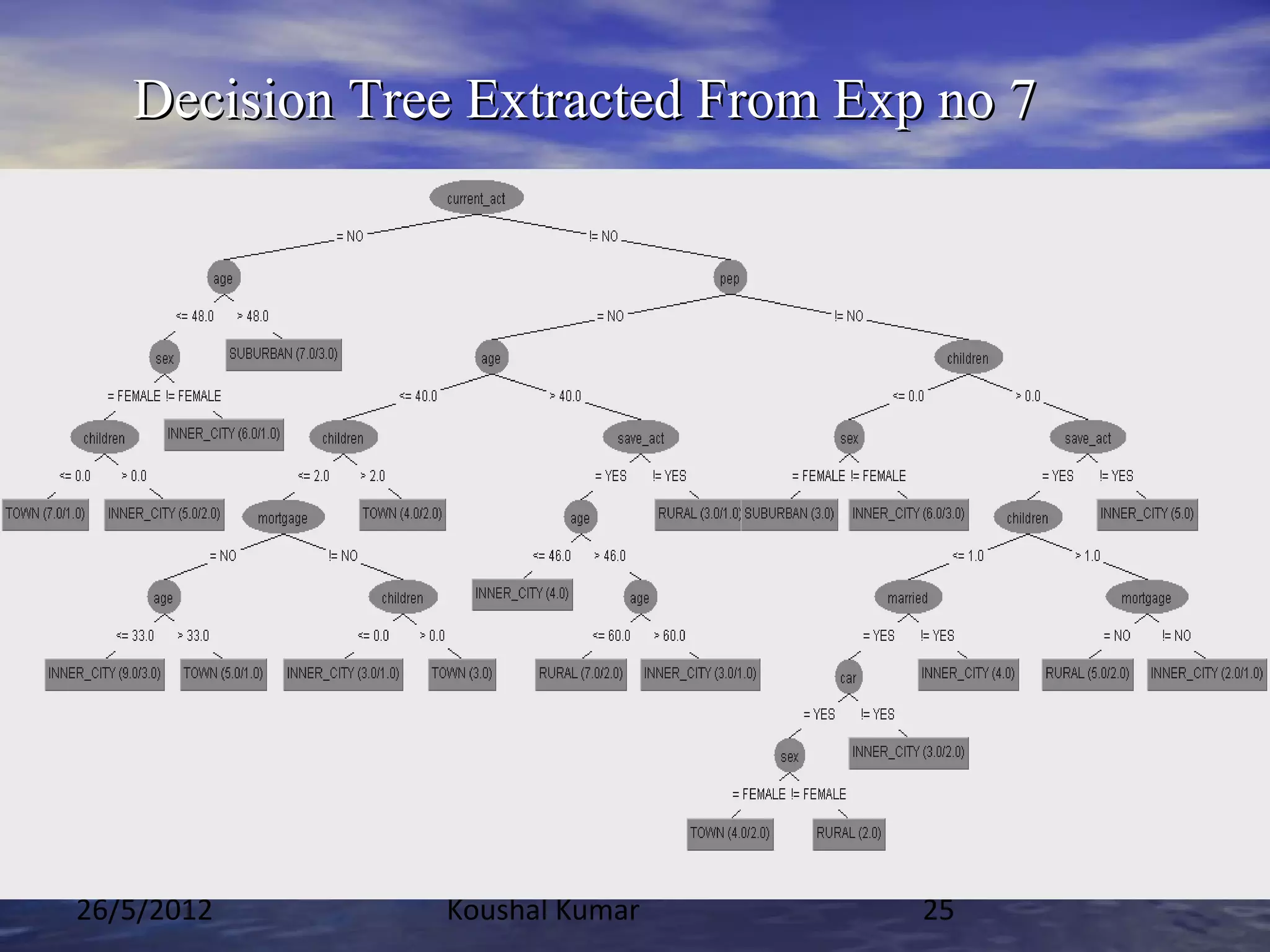
Decision Tree Extracted From Exp no 7


26/5/2012      Koushal Kumar       25
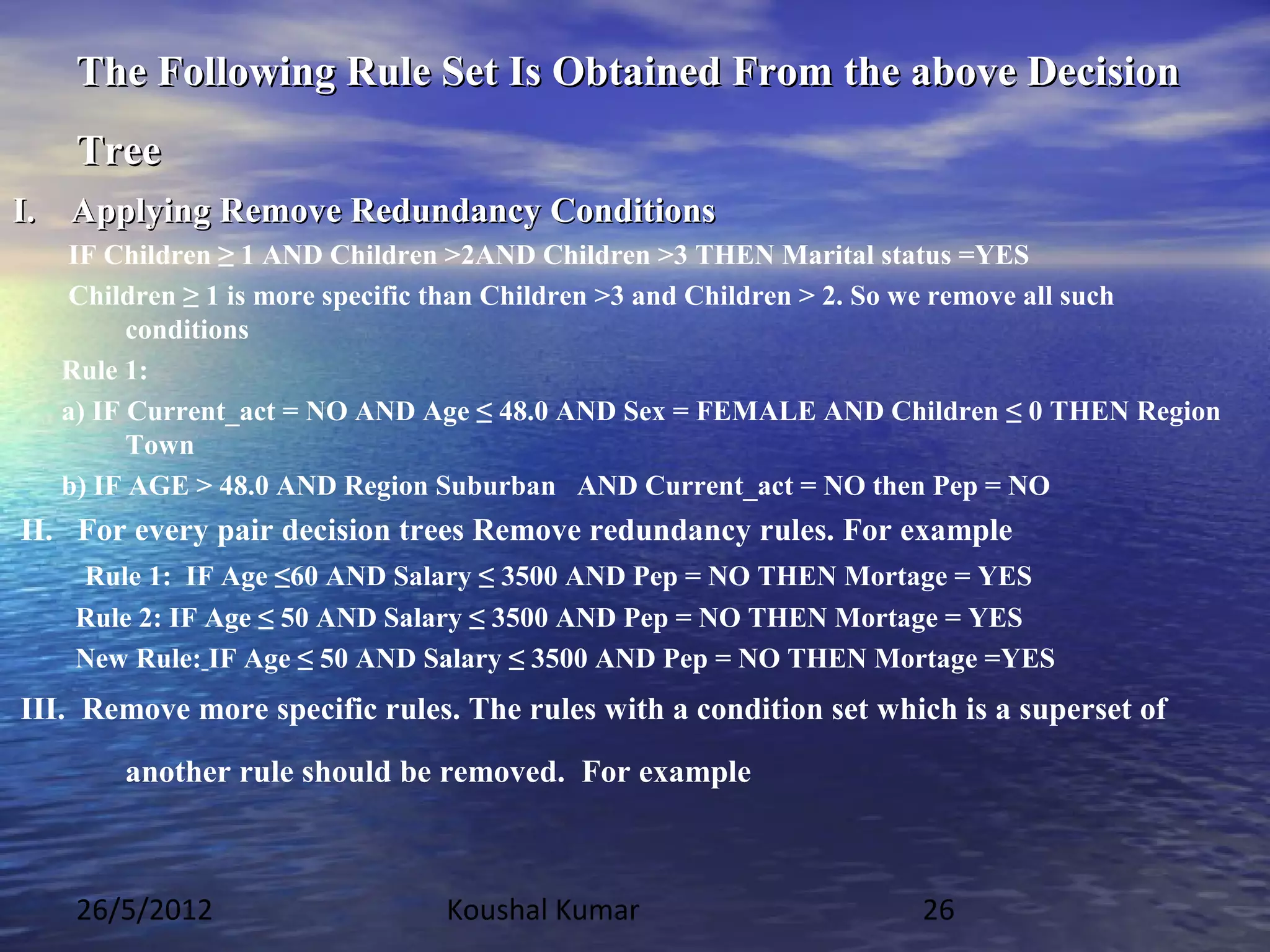
The Following Rule Set Is Obtained From the above Decision
    Tree
I. Applying Remove Redundancy Conditions
   IF Children ≥ 1 AND Children >2AND Children >3 THEN Marital status =YES
   Children ≥ 1 is more specific than Children >3 and Children > 2. So we remove all such
         conditions
   Rule 1:
   a) IF Current_act = NO AND Age ≤ 48.0 AND Sex = FEMALE AND Children ≤ 0 THEN Region
         Town
   b) IF AGE > 48.0 AND Region Suburban AND Current_act = NO then Pep = NO
II. For every pair decision trees Remove redundancy rules. For example
    Rule 1: IF Age ≤60 AND Salary ≤ 3500 AND Pep = NO THEN Mortage = YES
    Rule 2: IF Age ≤ 50 AND Salary ≤ 3500 AND Pep = NO THEN Mortage = YES
    New Rule: IF Age ≤ 50 AND Salary ≤ 3500 AND Pep = NO THEN Mortage =YES
III. Remove more specific rules. The rules with a condition set which is a superset of
       another rule should be removed. For example


    26/5/2012                  Koushal Kumar                       26
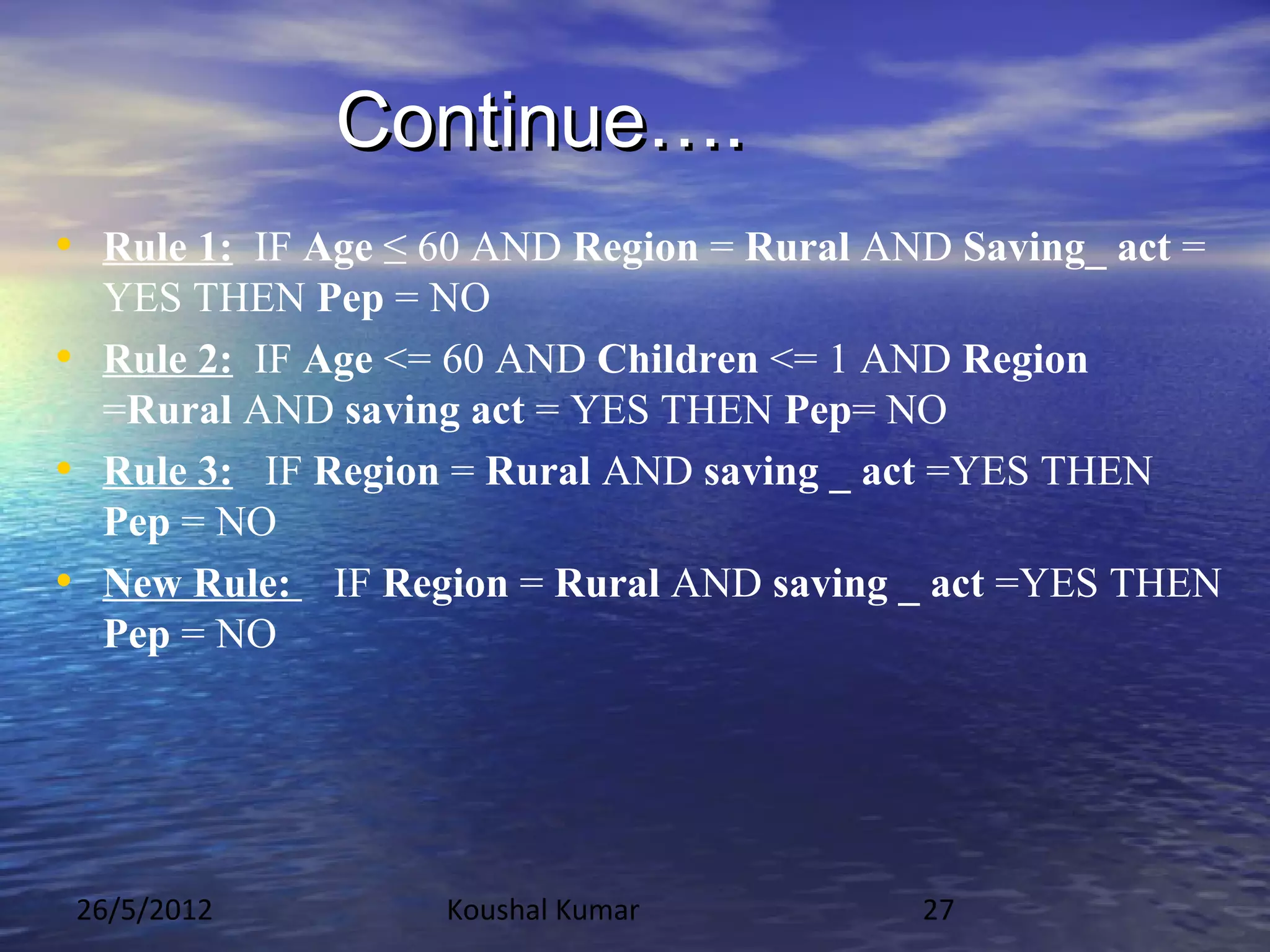
Continue….
• Rule 1: IF Age ≤ 60 AND Region = Rural AND Saving_ act =
     YES THEN Pep = NO
•    Rule 2: IF Age <= 60 AND Children <= 1 AND Region
     =Rural AND saving act = YES THEN Pep= NO
•    Rule 3: IF Region = Rural AND saving _ act =YES THEN
     Pep = NO
•    New Rule: IF Region = Rural AND saving _ act =YES THEN
     Pep = NO


    26/5/2012        Koushal Kumar          27
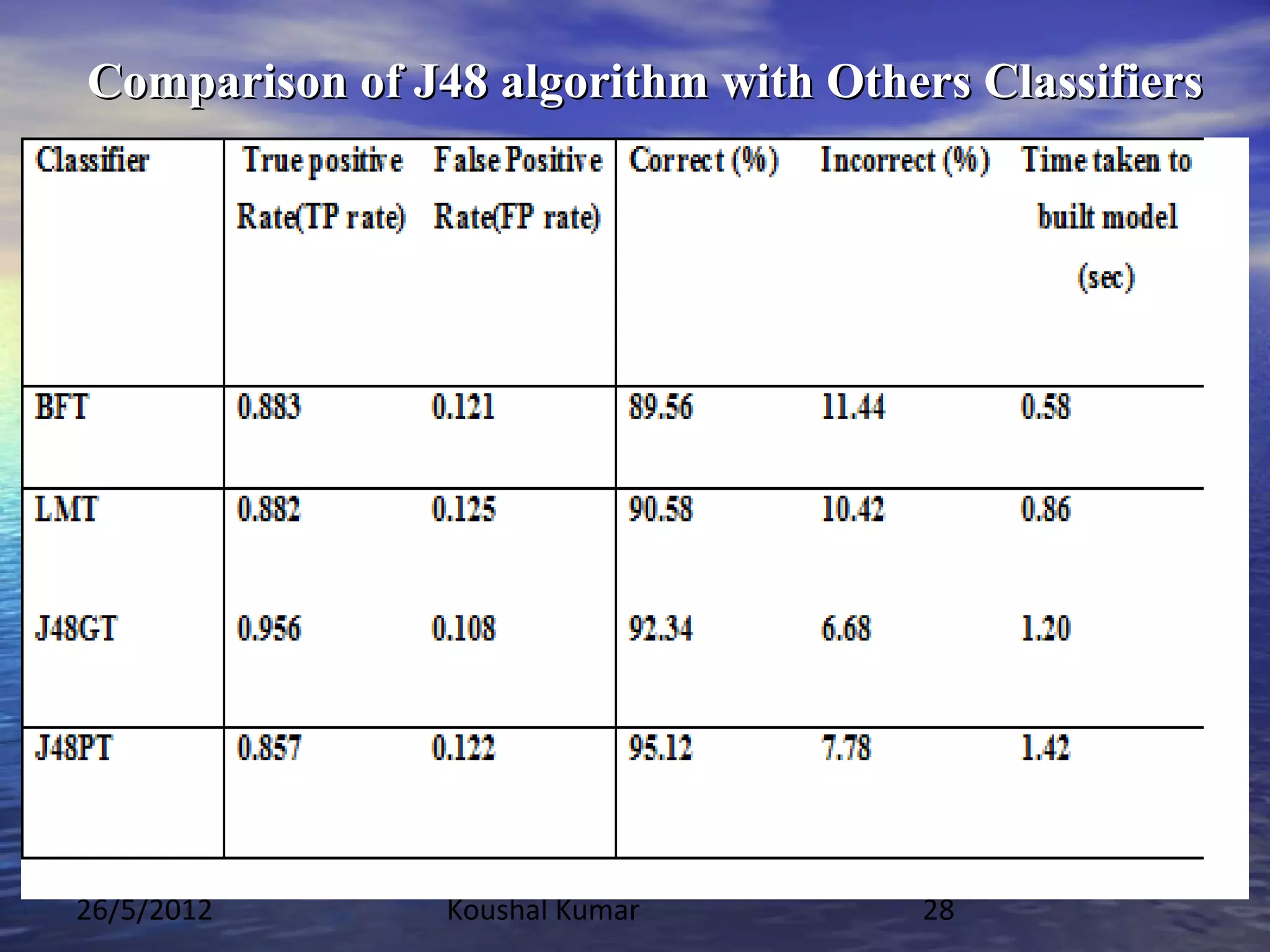
Comparison of J48 algorithm with Others Classifiers


26/5/2012       Koushal Kumar         28
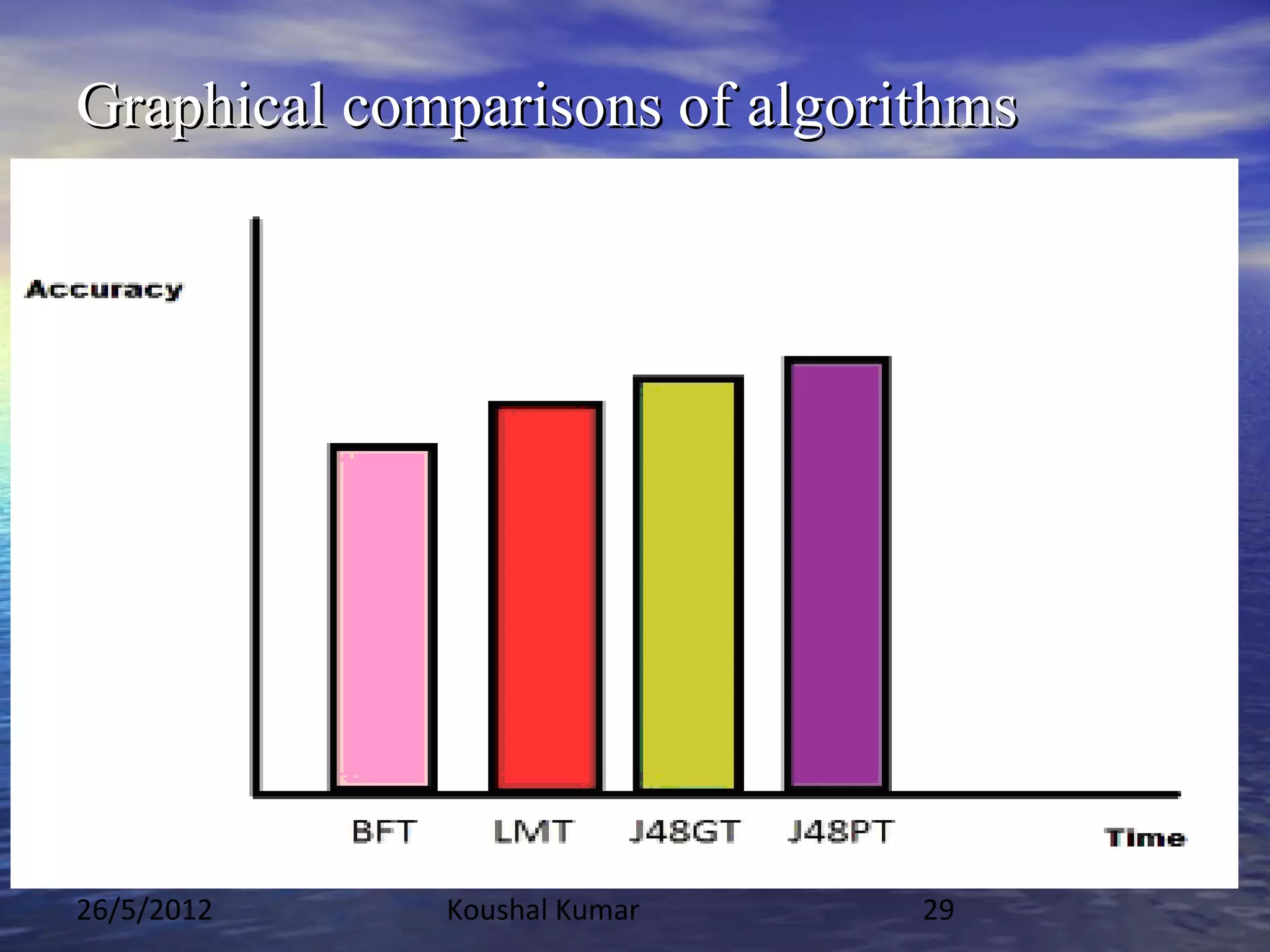
Graphical comparisons of algorithms


26/5/2012    Koushal Kumar     29
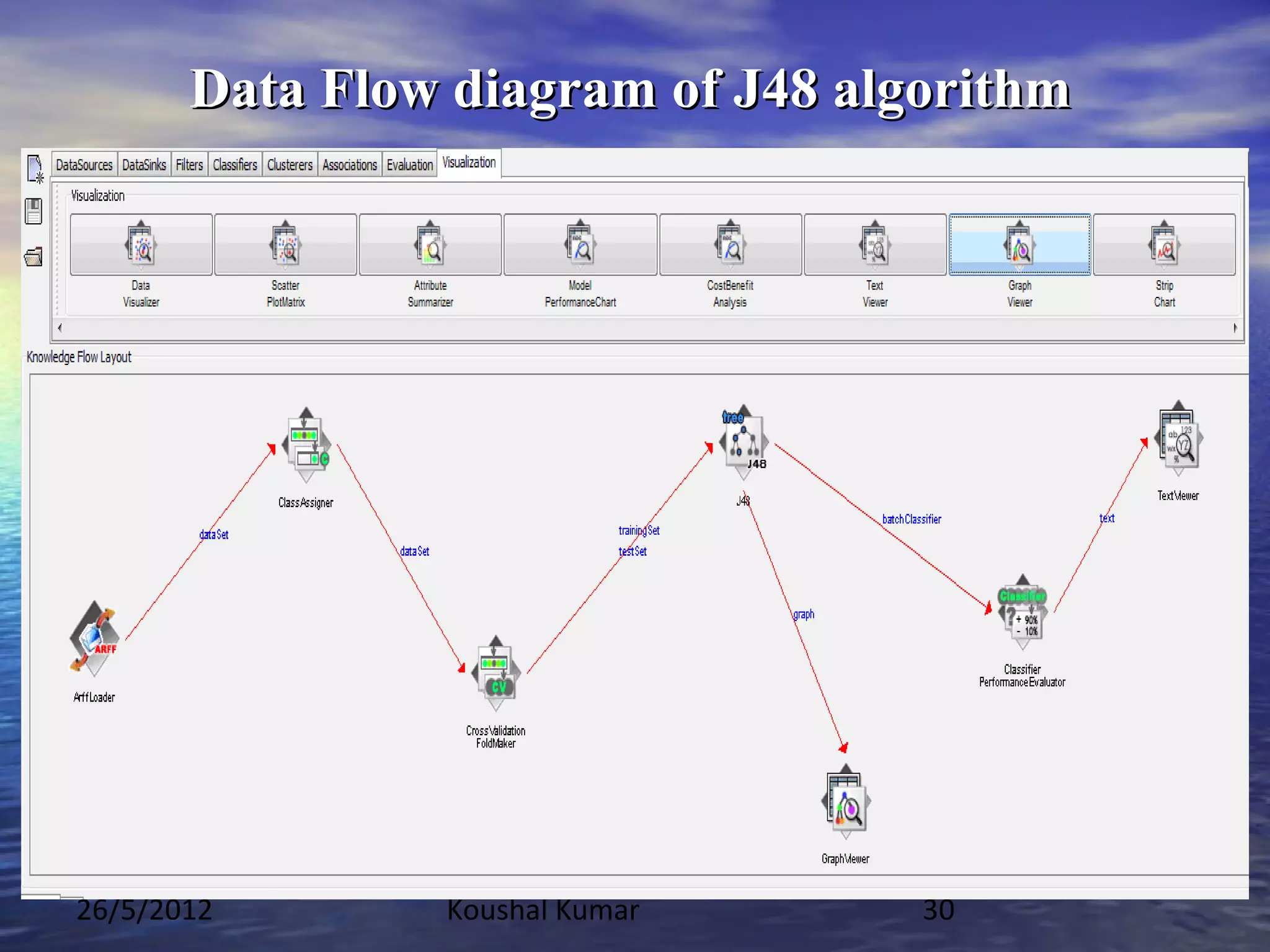
Data Flow diagram of J48 algorithm


26/5/2012       Koushal Kumar      30
Paper Published

• “Extracting Explanation From Artificial Neural Networks” is
  published in International Journal of Computer Science and
  Information Technologies.
• “Advanced Applications of Neural Networks and Artificial
  Intelligence: A Review” has been selected in International journal of
  information technologies and computer science and it will published
  on May June volume of journal.
• Seminar: Published Research paper on “Symbolic Rules Extraction
  From Trained Neural Networks” in two days UGC Sponsored
  National Seminar on Social Implications of Artificial Intelligence
  organized in KMV College in Jalandhar.


26/5/2012               Koushal Kumar                  31
References
• Olcay Boz AT & T Labs”Converting a trained neural network
    to a decision tree DecText-Decision Tree Extractor.
•   J.T Yao Dept of computer sci university of Regina “Knowledge
    extracted from Trained neural networks whats next?
•   Simon Haykin ”Neural networks a Comprehensive foundation”
    Pearson education(second edition).
•   R. Davis, B.G. Buchanan, and E. Shortcliff, “Production Rules
    as a
•   Representation for a Knowledge Based Consultation Progra”,
•   Artificial Intelligence, 1977, vol. 8(1), pp.15-45.
•   Knowledge Extraction from the Neural ‘Black Box’ in
    Ecological Monitoring Journal of Industrial and Systems
    Engineering Vol. 3, No. 1, pp 38-55 Spring 2009
26/5/2012             Koushal Kumar              32

Symbolic Rules Extraction From Trained Neural Networks

  • 1.
    Symbolic Rules Extraction FromTrained Neural Networks Koushal Kumar M .Tech CSE Mob: +918968939621 26/5/2012 Koushal Kumar 1
  • 2.
    What are ArtificialNeural Networks? • Artificial Neural Networks are powerful computational systems consisting of many simple processing elements connected together to perform tasks analogously to biological brains. • They are massively parallel, which makes them efficient, robust, fault tolerant and noise tolerant • They can learn from training data and generalize to new situations. 26/5/2012 Koushal Kumar 2
  • 3.
    The limitation ofNeural Network The major criticism against Neural Network is that decision given by neural networks is difficult to understand by a human being. Reasons for this are Knowledge in Neural Networks are stored as real values parameters (weights and bias) of networks Neural Networks are unable to explain its internal processing how they come to particular decision This behavior makes Neural Networks Black Box in Nature 26/5/2012 Koushal Kumar 3
  • 4.
    Continue.. 26/5/2012 Koushal Kumar 4
  • 5.
    Rules extraction FromNeural Networks. So to overcome the Black Box nature of Neural Networks we need to extract rules from Neural Networks so that the user can gain a better understanding of the decision process. following types of rules can be extracted from neural networks I) M OF N types rules II) Fuzzy rules 26/5/2012 Koushal Kumar 5
  • 6.
    continue.. III) IFTHEN RULES IV) Decision Rules V) First order logic rules From all above types of rules IF THEN RULES and Decision rules are easy to understand then others kind of rules. 26/5/2012 Koushal Kumar 6
  • 7.
    J48 Algorithm forextracting decision trees • J48 is an algorithm used to generate a decision tree. • Developed by quinlan and most widely used decision tree induction algorithm. • It is based upon greedy search approach i.e select the best attribute and never looks back to reconsider early choices. • It select the best attribute according to its entropy value. • More preference will be given to that attribute which has more value of entropy. 26/5/2012 Koushal Kumar 7
  • 8.
  • 9.
  • 10.
    MATLAB Simulator • Matlab stands for matrix laboratory. • It integrate computation, visualization, and programming in an easy-to-use environment. • MATLAB is a package that has been purpose- designed to make computations easy, fast and reliable. • Matlab can be used in math and computation, algorithm development, simulation purposes. • MATLAB is a powerful system that can plot graphs and perform a large variety of calculations with numbers. 26/5/2012 Koushal Kumar 10
  • 11.
    Weka simulator • WEKAis abbreviation of Waikato Environment for Knowledge Analysis. • Weka is open source simulator with machine learning algorithms. • The Weka workbench contains a collection of visualization tools and algorithms for data analysis and predictive modelling. 26/5/2012 Koushal Kumar 11
  • 12.
    Training data setand its Histogram 26/5/2012 Koushal Kumar 12
  • 13.
    Histogram of inputtarget values 26/5/2012 Koushal Kumar 13
  • 14.
    Histogram of testingset as Inputs 26/5/2012 Koushal Kumar 14
  • 15.
    Histogram of testingset as Target values 26/5/2012 Koushal Kumar 15
  • 16.
    Neural networks Trainingwith BPA 26/5/2012 Koushal Kumar 16
  • 17.
    Best Training Performancecurve 26/5/2012 Koushal Kumar 17
  • 18.
    Gradient Performance CurveAfter Training & Testing 26/5/2012 Koushal Kumar 18
  • 19.
    Data import windowin weka 26/5/2012 Koushal Kumar 19
  • 20.
    J48 algorithm Output(pruned) 26/5/2012 Koushal Kumar 20
  • 21.
    Results from prunedTree 26/5/2012 Koushal Kumar 21
  • 22.
    J48 algorithm Output(Unpruned) 26/5/2012 Koushal Kumar 22
  • 23.
  • 24.
    Results of classificationfrom Decision Tree 26/5/2012 Koushal Kumar 24
  • 25.
    Decision Tree ExtractedFrom Exp no 7 26/5/2012 Koushal Kumar 25
  • 26.
    The Following RuleSet Is Obtained From the above Decision Tree I. Applying Remove Redundancy Conditions IF Children ≥ 1 AND Children >2AND Children >3 THEN Marital status =YES Children ≥ 1 is more specific than Children >3 and Children > 2. So we remove all such conditions Rule 1: a) IF Current_act = NO AND Age ≤ 48.0 AND Sex = FEMALE AND Children ≤ 0 THEN Region Town b) IF AGE > 48.0 AND Region Suburban AND Current_act = NO then Pep = NO II. For every pair decision trees Remove redundancy rules. For example Rule 1: IF Age ≤60 AND Salary ≤ 3500 AND Pep = NO THEN Mortage = YES Rule 2: IF Age ≤ 50 AND Salary ≤ 3500 AND Pep = NO THEN Mortage = YES New Rule: IF Age ≤ 50 AND Salary ≤ 3500 AND Pep = NO THEN Mortage =YES III. Remove more specific rules. The rules with a condition set which is a superset of another rule should be removed. For example 26/5/2012 Koushal Kumar 26
  • 27.
    Continue…. • Rule 1:IF Age ≤ 60 AND Region = Rural AND Saving_ act = YES THEN Pep = NO • Rule 2: IF Age <= 60 AND Children <= 1 AND Region =Rural AND saving act = YES THEN Pep= NO • Rule 3: IF Region = Rural AND saving _ act =YES THEN Pep = NO • New Rule: IF Region = Rural AND saving _ act =YES THEN Pep = NO 26/5/2012 Koushal Kumar 27
  • 28.
    Comparison of J48algorithm with Others Classifiers 26/5/2012 Koushal Kumar 28
  • 29.
    Graphical comparisons ofalgorithms 26/5/2012 Koushal Kumar 29
  • 30.
    Data Flow diagramof J48 algorithm 26/5/2012 Koushal Kumar 30
  • 31.
    Paper Published • “ExtractingExplanation From Artificial Neural Networks” is published in International Journal of Computer Science and Information Technologies. • “Advanced Applications of Neural Networks and Artificial Intelligence: A Review” has been selected in International journal of information technologies and computer science and it will published on May June volume of journal. • Seminar: Published Research paper on “Symbolic Rules Extraction From Trained Neural Networks” in two days UGC Sponsored National Seminar on Social Implications of Artificial Intelligence organized in KMV College in Jalandhar. 26/5/2012 Koushal Kumar 31
  • 32.
    References • Olcay BozAT & T Labs”Converting a trained neural network to a decision tree DecText-Decision Tree Extractor. • J.T Yao Dept of computer sci university of Regina “Knowledge extracted from Trained neural networks whats next? • Simon Haykin ”Neural networks a Comprehensive foundation” Pearson education(second edition). • R. Davis, B.G. Buchanan, and E. Shortcliff, “Production Rules as a • Representation for a Knowledge Based Consultation Progra”, • Artificial Intelligence, 1977, vol. 8(1), pp.15-45. • Knowledge Extraction from the Neural ‘Black Box’ in Ecological Monitoring Journal of Industrial and Systems Engineering Vol. 3, No. 1, pp 38-55 Spring 2009 26/5/2012 Koushal Kumar 32

Editor's Notes