


The Dimensions of
Biblical Language
2
¡Be Careful How You Approach the Runway!
3
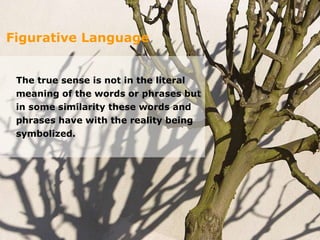
Figurative Language
The true sense is not in the literal
meaning of the words or phrases but
in some similarity these words and
phrases have with the reality being
symbolized.
4
The Experience of the Tadpole
The Hidden World
The Visible World
5
The Literal Interpretation seeks the
original meaning according to the intention
of the author.
literal
or figurative.
That Meaning May be Either
physical
or spiritual.
That Meaning May be Either
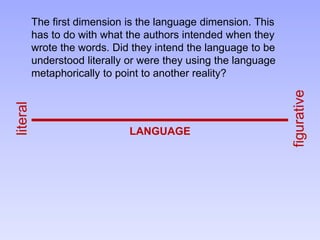
LANGUAGE
figurative
literalThe first dimension is the language dimension. This
has to do with what the authors intended when they
wrote the words. Did they intend the language to be
understood literally or were they using the language
metaphorically to point to another reality?
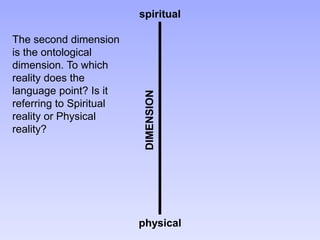
DIMENSION
spiritual
physical
The second dimension
is the ontological
dimension. To which
reality does the
language point? Is it
referring to Spiritual
reality or Physical
reality?
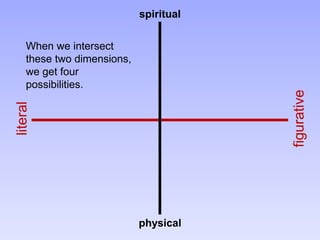
figurative
literal
spiritual
physical
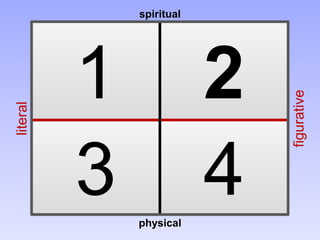
When we intersect
these two dimensions,
we get four
possibilities.
2
43
1
figurative
literal
spiritual
physical
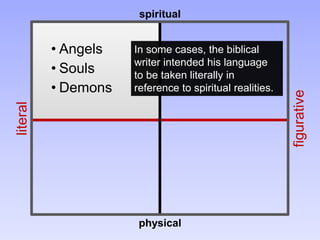
• Angels
• Souls
• Demons
figurative
literal
spiritual
physical
In some cases, the biblical
writer intended his language
to be taken literally in
reference to spiritual realities.
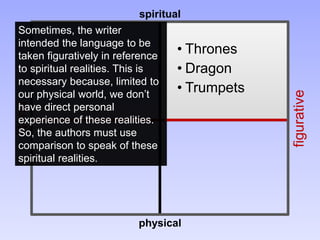
• Thrones
• Dragon
• Trumpets
figurative
literal
spiritual
physical
Sometimes, the writer
intended the language to be
taken figuratively in reference
to spiritual realities. This is
necessary because, limited to
our physical world, we don’t
have direct personal
experience of these realities.
So, the authors must use
comparison to speak of these
spiritual realities.
figurative
literal
spiritual
physical
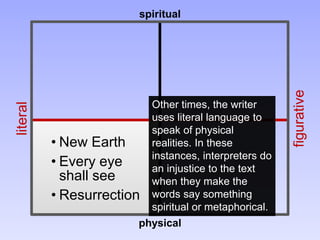
• New Earth
• Every eye
shall see
• Resurrection
Other times, the writer
uses literal language to
speak of physical
realities. In these
instances, interpreters do
an injustice to the text
when they make the
words say something
spiritual or metaphorical.
figurative
literal
spiritual
physical
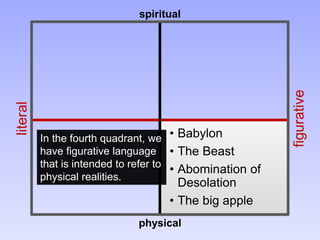
• Babylon
• The Beast
• Abomination of
Desolation
• The big apple
In the fourth quadrant, we
have figurative language
that is intended to refer to
physical realities.
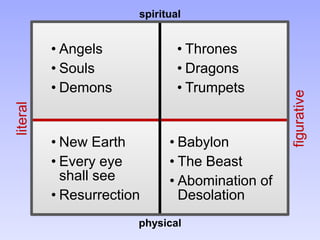
• Thrones
• Dragons
• Trumpets
• Angels
• Souls
• Demons
figurative
literal
spiritual
physical
• Babylon
• The Beast
• Abomination of
Desolation
• New Earth
• Every eye
shall see
• Resurrection
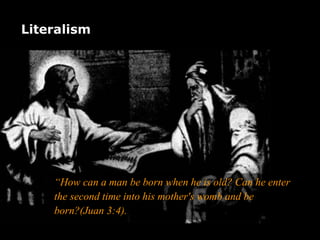
Literalism
Literalism occurs when the reader imposes a literal
(or physical) interpretation on language that was
originally intended to be taken figuratively.
“How can a man be born when he is old? Can he enter
the second time into his mother's womb and be
born?(Juan 3:4).
Literalism
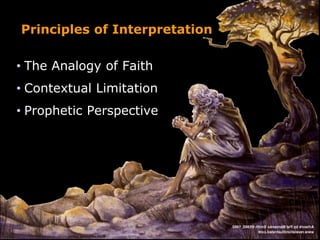
Principles of Interpretation
• The Analogy of Faith
• Contextual Limitation
• Prophetic Perspective
Analogy of Faith
“Each book proceeded from the same divine mind, so the
teaching of the Bible’s sixty-six books will be complementary
and self-consistent. If we cannot yet see this, the fault is in
us, not in Scripture. It is certain that Scripture nowhere
contradicts Scripture; rather, one passage explains another.
This sound principle of interpreting Scripture by Scripture is
sometimes called the analogy of Scripture or the analogy of
faith.”
J. I. Packer, Concise Theology: A Guide to Historic Christian Beliefs (Wheaton, Ill.:
Tyndale House, 1995).
Analogy of Faith
“If the Scriptures be what they claim to be, the word of God,
they are the work of one mind, and that mind divine. From
this it follows that Scripture cannot contradict Scripture. God
cannot teach in one place anything which is inconsistent with
what He teaches in another. Hence Scripture must explain
Scripture. If a passage admits of different interpretations,
that only can be the true one which agrees with what the
Bible teaches elsewhere on the same subject.”
Charles Hodge, vol. 1, Systematic Theology (Oak Harbor, WA: Logos Research
Systems, Inc., 1997), 187.
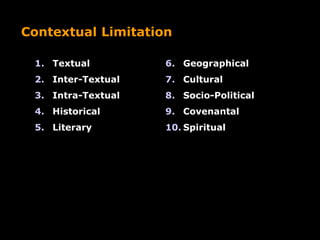
1. Textual
2. Inter-Textual
3. Intra-Textual
4. Historical
5. Literary
6. Geographical
7. Cultural
8. Socio-Political
9. Covenantal
10. Spiritual
Contextual Limitation
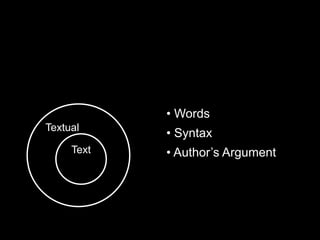
Text
Textual
Text
• Words
• Syntax
• Author’s Argument
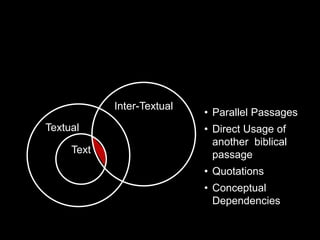
Textual
Text
Inter-Textual
• Parallel Passages
• Direct Usage of
another biblical
passage
• Quotations
• Conceptual
Dependencies
Textual
Text
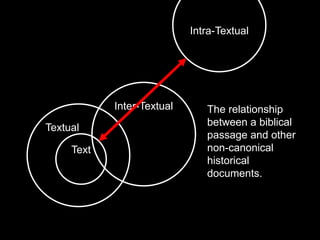
Inter-Textual
Intra-Textual
The relationship
between a biblical
passage and other
non-canonical
historical
documents.
Contextual Limitation
Application should be made at paragraph level, not word
level. Words have meaning only in context; clauses have
meaning only in context; sentences have meaning only in
context. The only inspired person involved in the interpretive
process is the original author. . . . We must abide by the
original author’s intent. Application must relate specifically to
the general intent of the whole writing, the specific literary
unit and paragraph level thought development.
Robert James Dr. Utley, You Can Understand the Bible! (Marshall, Texas: Bible Lessons
International, 1996), 5.

Symbolic Language

  • 1.
  • 2.
    2 ¡Be Careful HowYou Approach the Runway!
  • 3.
    3 Figurative Language The truesense is not in the literal meaning of the words or phrases but in some similarity these words and phrases have with the reality being symbolized.
  • 4.
    4 The Experience ofthe Tadpole The Hidden World The Visible World
  • 5.
  • 6.
    The Literal Interpretationseeks the original meaning according to the intention of the author.
  • 7.
  • 8.
  • 9.
    LANGUAGE figurative literalThe first dimensionis the language dimension. This has to do with what the authors intended when they wrote the words. Did they intend the language to be understood literally or were they using the language metaphorically to point to another reality?
  • 10.
    DIMENSION spiritual physical The second dimension isthe ontological dimension. To which reality does the language point? Is it referring to Spiritual reality or Physical reality?
  • 11.
    figurative literal spiritual physical When we intersect thesetwo dimensions, we get four possibilities.
  • 12.
  • 13.
    • Angels • Souls •Demons figurative literal spiritual physical In some cases, the biblical writer intended his language to be taken literally in reference to spiritual realities.
  • 14.
    • Thrones • Dragon •Trumpets figurative literal spiritual physical Sometimes, the writer intended the language to be taken figuratively in reference to spiritual realities. This is necessary because, limited to our physical world, we don’t have direct personal experience of these realities. So, the authors must use comparison to speak of these spiritual realities.
  • 15.
    figurative literal spiritual physical • New Earth •Every eye shall see • Resurrection Other times, the writer uses literal language to speak of physical realities. In these instances, interpreters do an injustice to the text when they make the words say something spiritual or metaphorical.
  • 16.
    figurative literal spiritual physical • Babylon • TheBeast • Abomination of Desolation • The big apple In the fourth quadrant, we have figurative language that is intended to refer to physical realities.
  • 17.
    • Thrones • Dragons •Trumpets • Angels • Souls • Demons figurative literal spiritual physical • Babylon • The Beast • Abomination of Desolation • New Earth • Every eye shall see • Resurrection
  • 18.
    Literalism Literalism occurs whenthe reader imposes a literal (or physical) interpretation on language that was originally intended to be taken figuratively.
  • 19.
    “How can aman be born when he is old? Can he enter the second time into his mother's womb and be born?(Juan 3:4). Literalism
  • 20.
    Principles of Interpretation •The Analogy of Faith • Contextual Limitation • Prophetic Perspective
  • 21.
    Analogy of Faith “Eachbook proceeded from the same divine mind, so the teaching of the Bible’s sixty-six books will be complementary and self-consistent. If we cannot yet see this, the fault is in us, not in Scripture. It is certain that Scripture nowhere contradicts Scripture; rather, one passage explains another. This sound principle of interpreting Scripture by Scripture is sometimes called the analogy of Scripture or the analogy of faith.” J. I. Packer, Concise Theology: A Guide to Historic Christian Beliefs (Wheaton, Ill.: Tyndale House, 1995).
  • 22.
    Analogy of Faith “Ifthe Scriptures be what they claim to be, the word of God, they are the work of one mind, and that mind divine. From this it follows that Scripture cannot contradict Scripture. God cannot teach in one place anything which is inconsistent with what He teaches in another. Hence Scripture must explain Scripture. If a passage admits of different interpretations, that only can be the true one which agrees with what the Bible teaches elsewhere on the same subject.” Charles Hodge, vol. 1, Systematic Theology (Oak Harbor, WA: Logos Research Systems, Inc., 1997), 187.
  • 23.
    1. Textual 2. Inter-Textual 3.Intra-Textual 4. Historical 5. Literary 6. Geographical 7. Cultural 8. Socio-Political 9. Covenantal 10. Spiritual Contextual Limitation
  • 24.
  • 25.
  • 26.
    Textual Text Inter-Textual • Parallel Passages •Direct Usage of another biblical passage • Quotations • Conceptual Dependencies
  • 27.
    Textual Text Inter-Textual Intra-Textual The relationship between abiblical passage and other non-canonical historical documents.
  • 28.
    Contextual Limitation Application shouldbe made at paragraph level, not word level. Words have meaning only in context; clauses have meaning only in context; sentences have meaning only in context. The only inspired person involved in the interpretive process is the original author. . . . We must abide by the original author’s intent. Application must relate specifically to the general intent of the whole writing, the specific literary unit and paragraph level thought development. Robert James Dr. Utley, You Can Understand the Bible! (Marshall, Texas: Bible Lessons International, 1996), 5.

Editor's Notes

  • #3 Just as a pilot must be careful how he approaches the runway, we must be careful how we approach the interpretation of the Book of Revelation.