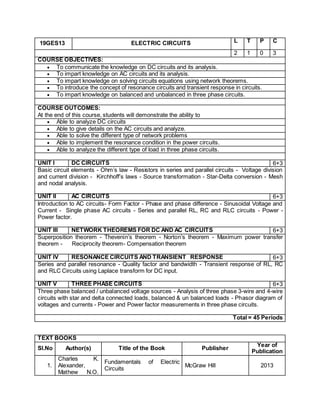
19GES13 ELECTRIC CIRCUITS L T P C
2 1 0 3
COURSE OBJECTIVES:
 To communicate the knowledge on DC circuits and its analysis.
 To impart knowledge on AC circuits and its analysis.
 To impart knowledge on solving circuits equations using network theorems.
 To introduce the concept of resonance circuits and transient response in circuits.
 To impart knowledge on balanced and unbalanced in three phase circuits.
COURSE OUTCOMES:
At the end of this course, students will demonstrate the ability to
 Able to analyze DC circuits
 Able to give details on the AC circuits and analyze.
 Able to solve the different type of network problems
 Able to implement the resonance condition in the power circuits.
 Able to analyze the different type of load in three phase circuits.
UNIT I DC CIRCUITS 6+3
Basic circuit elements - Ohm’s law - Resistors in series and parallel circuits - Voltage division
and current division - Kirchhoff’s laws - Source transformation - Star-Delta conversion - Mesh
and nodal analysis.
UNIT II AC CIRCUITS 6+3
Introduction to AC circuits- Form Factor - Phase and phase difference - Sinusoidal Voltage and
Current - Single phase AC circuits - Series and parallel RL, RC and RLC circuits - Power -
Power factor.
UNIT III NETWORK THEOREMS FOR DC AND AC CIRCUITS 6+3
Superposition theorem - Thevenin’s theorem - Norton’s theorem - Maximum power transfer
theorem - Reciprocity theorem- Compensation theorem
UNIT IV RESONANCE CIRCUITS AND TRANSIENT RESPONSE 6+3
Series and parallel resonance - Quality factor and bandwidth - Transient response of RL, RC
and RLC Circuits using Laplace transform for DC input.
UNIT V THREE PHASE CIRCUITS 6+3
Three phase balanced / unbalanced voltage sources - Analysis of three phase 3-wire and 4-wire
circuits with star and delta connected loads, balanced & un balanced loads - Phasor diagram of
voltages and currents - Power and Power factor measurements in three phase circuits.
Total = 45 Periods
TEXT BOOKS
Sl.No Author(s) Title of the Book Publisher
Year of
Publication
1.
Charles K.
Alexander,
Mathew N.O.
Fundamentals of Electric
Circuits
McGraw Hill 2013
Sadiku
2.
William H. Hayt
Jr, Jack E.
Kemmerly and
Steven M.
Durbin
Engineering Circuits Analysis
McGraw Hill publishers
New Delhi
2013
REFERENCE BOOKS:
Sl.No Author(s) Title of the Book Publisher
Year of
Publication
1. Jegatheesan, R Analysis of Electric Circuits McGraw Hill 2015
2.
Mahadevan, K.,
Chitra, C
Electric Circuits Analysis
Prentice-Hall of India
Pvt Ltd., New Delhi
2015
3.
Sudhakar A
and Shyam
Mohan SP
Circuits and Network
Analysis and Synthesis
McGraw Hill 2015
4.
M E Van
Valkenburg
Network Analysis
Prentice-Hall of India
Pvt Ltd, New Delhi
2015
5. Chakrabarti A
Circuits Theory (Analysis and
synthesis)
Dhanpath Rai & Sons,
New Delhi
2011

Syllabus

  • 1.
    19GES13 ELECTRIC CIRCUITSL T P C 2 1 0 3 COURSE OBJECTIVES:  To communicate the knowledge on DC circuits and its analysis.  To impart knowledge on AC circuits and its analysis.  To impart knowledge on solving circuits equations using network theorems.  To introduce the concept of resonance circuits and transient response in circuits.  To impart knowledge on balanced and unbalanced in three phase circuits. COURSE OUTCOMES: At the end of this course, students will demonstrate the ability to  Able to analyze DC circuits  Able to give details on the AC circuits and analyze.  Able to solve the different type of network problems  Able to implement the resonance condition in the power circuits.  Able to analyze the different type of load in three phase circuits. UNIT I DC CIRCUITS 6+3 Basic circuit elements - Ohm’s law - Resistors in series and parallel circuits - Voltage division and current division - Kirchhoff’s laws - Source transformation - Star-Delta conversion - Mesh and nodal analysis. UNIT II AC CIRCUITS 6+3 Introduction to AC circuits- Form Factor - Phase and phase difference - Sinusoidal Voltage and Current - Single phase AC circuits - Series and parallel RL, RC and RLC circuits - Power - Power factor. UNIT III NETWORK THEOREMS FOR DC AND AC CIRCUITS 6+3 Superposition theorem - Thevenin’s theorem - Norton’s theorem - Maximum power transfer theorem - Reciprocity theorem- Compensation theorem UNIT IV RESONANCE CIRCUITS AND TRANSIENT RESPONSE 6+3 Series and parallel resonance - Quality factor and bandwidth - Transient response of RL, RC and RLC Circuits using Laplace transform for DC input. UNIT V THREE PHASE CIRCUITS 6+3 Three phase balanced / unbalanced voltage sources - Analysis of three phase 3-wire and 4-wire circuits with star and delta connected loads, balanced & un balanced loads - Phasor diagram of voltages and currents - Power and Power factor measurements in three phase circuits. Total = 45 Periods TEXT BOOKS Sl.No Author(s) Title of the Book Publisher Year of Publication 1. Charles K. Alexander, Mathew N.O. Fundamentals of Electric Circuits McGraw Hill 2013
  • 2.
    Sadiku 2. William H. Hayt Jr,Jack E. Kemmerly and Steven M. Durbin Engineering Circuits Analysis McGraw Hill publishers New Delhi 2013 REFERENCE BOOKS: Sl.No Author(s) Title of the Book Publisher Year of Publication 1. Jegatheesan, R Analysis of Electric Circuits McGraw Hill 2015 2. Mahadevan, K., Chitra, C Electric Circuits Analysis Prentice-Hall of India Pvt Ltd., New Delhi 2015 3. Sudhakar A and Shyam Mohan SP Circuits and Network Analysis and Synthesis McGraw Hill 2015 4. M E Van Valkenburg Network Analysis Prentice-Hall of India Pvt Ltd, New Delhi 2015 5. Chakrabarti A Circuits Theory (Analysis and synthesis) Dhanpath Rai & Sons, New Delhi 2011