COURSE PLAN AND EVALUATION PLAN

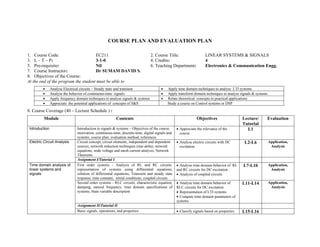
1. Course Code:                      EC211                                       2. Course Title:                   LINEAR SYSTEMS & SIGNALS
3. L – T – P:                        3-1-0                                       4. Credits:                        4
5. Pre-requisite:                    Nil                                         6. Teaching Department:            Electronics & Communication Engg.
7. Course Instructor:                Dr SUMAM DAVID S.
8. Objectives of the Course:
At the end of the program the student must be able to
         •      Analyse Electrical circuits – Steady state and transient               •   Apply time domain techniques to analyse LTI systems
         •      Analyse the behavior of continuous-time signals                        •   Apply transform domain techniques to analyse signals & systems
         •      Apply frequency domain techniques to analyse signals & systems         •   Relate theoretical concepts to practical applications
         •      Appreciate the potential applications of concepts of S&S                   Study a course on Control systems or DSP
8. Course Coverage (40 – Lecture Schedule ) :
          Module                                         Contents                                              Objectives                  Lecture/     Evaluation
                                                                                                                                           Tutorial
 Introduction                   Introduction to signals & systems – Objectives of the course,     • Appreciate the relevance of the          L1
                                motivation, continuous-time, discrete-time, digital signals and     course
                                systems, course plan, evaluation method, references
 Electric Circuit Analysis      Circuit concept, circuit elements, independent and dependent      • Analyse electric circuits with DC       L2-L6           Application,
                                sources, network reduction techniques (star-delta), network         excitation                                               Analysis
                                equations, node voltage and mesh current analysis, Network
                                Theorems
                                Assignment I/Tutorial I
 Time domain analysis of        First order systems - Analysis of RL and RC circuits,             • Analyse time domain behavior of RL     L7-L10           Application,
 linear systems and             representation of systems using differential equations,           and RC circuits for DC excitation                          Analysis
 signals                        solution of differential equations, Transient and steady state    • Analysis of coupled circuits
                                response, time constant, initial conditions, coupled circuits
                                Second order systems - RLC circuits, characteristic equation,     • Analyse time domain behavior of        L11-L14          Application,
                                damping, natural frequency, time domain specifications of         RLC circuits for DC excitation                             Analysis
                                systems, State variable description                               • Representation of LTI systems
                                                                                                  • Compute time domain parameters of
                                                                                                  systems
                                Assignment II/Tutorial II
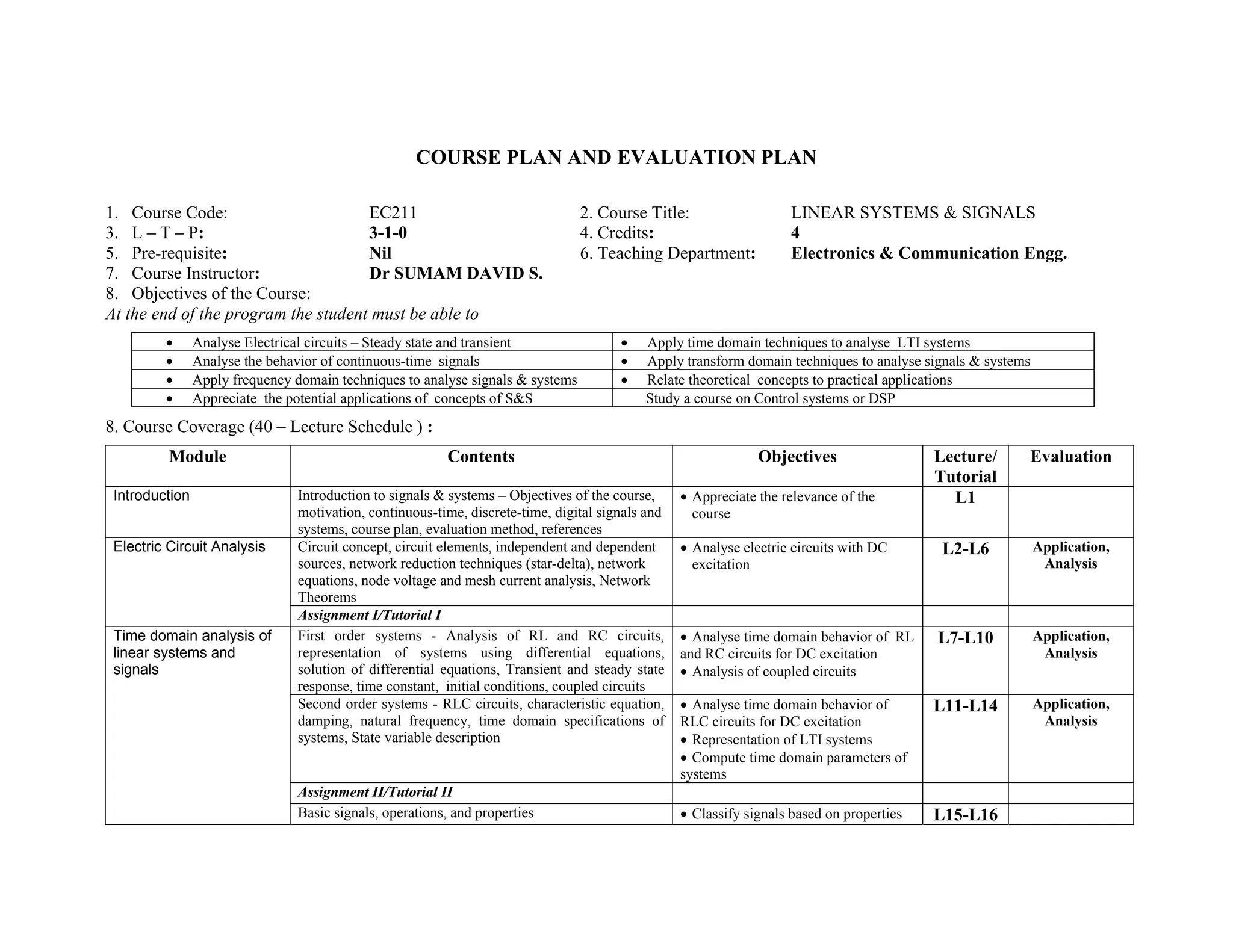
                                Basic signals, operations, and properties                         • Classify signals based on properties   L15-L16
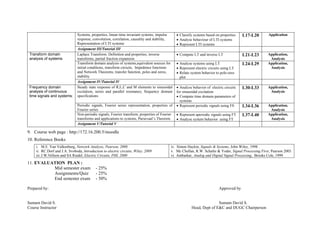
Systems, properties, linear-time invariant systems, impulse      • Classify systems based on properties    L17-L20       Application
                                response, convolution, correlation, causality and stability,     • Analyse behaviour of LTI systems
                                Representation of LTI systems                                    • Represent LTI systems
                                Assignment III/Tutorial III
 Transform domain               Laplace Transform: Definition and properties, inverse            • Compute LT and inverse LT               L21-L23       Application,
 analysis of systems            transforms, partial fraction expansion                                                                                    Analysis
                                Transform domain analysis of systems,equivalent sources for      • Analyse systems using LT                L24-L29       Application,
                                initial conditions, transform circuits, Impedence functions      • Represent electric circuits using LT                   Analysis
                                and Network Theorems, transfer function, poles and zeros,        • Relate system behavior to pole-zero
                                stability                                                          plot
                                Assignment IV/Tutorial IV
 Frequency domain               Steady state response of R,L,C and M elements to sinusoidal      • Analyse behavior of electric circuits   L30-L33       Application,
 analysis of continuous         excitation, series and parallel resonance, frequency domain      for sinusoidal excitation                                Analysis
 time signals and systems:      specifications                                                   • Compute time domain parameters of
                                                                                                   systems
                                Periodic signals, Fourier series representation, properties of   • Represent periodic signals using FS     L34-L36       Application,
                                Fourier series                                                                                                            Analysis
                                Non-periodic signals, Fourier transform, properties of Fourier   • Represent aperiodic signals using FT    L37-L40       Application,
                                transforms and applications to systems, Parsevaal’s Theorem.     • Analyse system behavior using FT                       Analysis
                                Assignment V/Tutorial V

9. Course web page : http://172.16.200.5/moodle
10. Reference Books
     i. M.E. Van Valkenburg, Network Analysis, Pearson, 2008                                 iv. Simon Haykin, Signals & Systems, John Wiley, 1998 .
     ii. RC.Dorf and J.A. Svoboda, Introduction to electric circuits, Wiley, 2009            v. Mc Chellan, R.W. Schafer & Yoder, Signal Processing First, Pearson 2003.
     iii. J.W.Nillson and SA Riedel, Electric Circuits, PHI, 2000                            vi. Ambarkar, Analog and Digital Signal Processing, Brooks Cole, 1999.
11. EVALUATION PLAN :
          Mid semester exam                 - 25%
          Assignments/Quiz                  - 25%
          End semester exam                 - 50%

Prepared by:                                                                                                                Approved by


Sumam David S.                                                                                                           Sumam David S.
Course Instructor                                                                                         Head, Dept of E&C and DUGC Chairperson

Assn2

  • 1.
    COURSE PLAN ANDEVALUATION PLAN 1. Course Code: EC211 2. Course Title: LINEAR SYSTEMS & SIGNALS 3. L – T – P: 3-1-0 4. Credits: 4 5. Pre-requisite: Nil 6. Teaching Department: Electronics & Communication Engg. 7. Course Instructor: Dr SUMAM DAVID S. 8. Objectives of the Course: At the end of the program the student must be able to • Analyse Electrical circuits – Steady state and transient • Apply time domain techniques to analyse LTI systems • Analyse the behavior of continuous-time signals • Apply transform domain techniques to analyse signals & systems • Apply frequency domain techniques to analyse signals & systems • Relate theoretical concepts to practical applications • Appreciate the potential applications of concepts of S&S Study a course on Control systems or DSP 8. Course Coverage (40 – Lecture Schedule ) : Module Contents Objectives Lecture/ Evaluation Tutorial Introduction Introduction to signals & systems – Objectives of the course, • Appreciate the relevance of the L1 motivation, continuous-time, discrete-time, digital signals and course systems, course plan, evaluation method, references Electric Circuit Analysis Circuit concept, circuit elements, independent and dependent • Analyse electric circuits with DC L2-L6 Application, sources, network reduction techniques (star-delta), network excitation Analysis equations, node voltage and mesh current analysis, Network Theorems Assignment I/Tutorial I Time domain analysis of First order systems - Analysis of RL and RC circuits, • Analyse time domain behavior of RL L7-L10 Application, linear systems and representation of systems using differential equations, and RC circuits for DC excitation Analysis signals solution of differential equations, Transient and steady state • Analysis of coupled circuits response, time constant, initial conditions, coupled circuits Second order systems - RLC circuits, characteristic equation, • Analyse time domain behavior of L11-L14 Application, damping, natural frequency, time domain specifications of RLC circuits for DC excitation Analysis systems, State variable description • Representation of LTI systems • Compute time domain parameters of systems Assignment II/Tutorial II Basic signals, operations, and properties • Classify signals based on properties L15-L16
  • 2.
    Systems, properties, linear-timeinvariant systems, impulse • Classify systems based on properties L17-L20 Application response, convolution, correlation, causality and stability, • Analyse behaviour of LTI systems Representation of LTI systems • Represent LTI systems Assignment III/Tutorial III Transform domain Laplace Transform: Definition and properties, inverse • Compute LT and inverse LT L21-L23 Application, analysis of systems transforms, partial fraction expansion Analysis Transform domain analysis of systems,equivalent sources for • Analyse systems using LT L24-L29 Application, initial conditions, transform circuits, Impedence functions • Represent electric circuits using LT Analysis and Network Theorems, transfer function, poles and zeros, • Relate system behavior to pole-zero stability plot Assignment IV/Tutorial IV Frequency domain Steady state response of R,L,C and M elements to sinusoidal • Analyse behavior of electric circuits L30-L33 Application, analysis of continuous excitation, series and parallel resonance, frequency domain for sinusoidal excitation Analysis time signals and systems: specifications • Compute time domain parameters of systems Periodic signals, Fourier series representation, properties of • Represent periodic signals using FS L34-L36 Application, Fourier series Analysis Non-periodic signals, Fourier transform, properties of Fourier • Represent aperiodic signals using FT L37-L40 Application, transforms and applications to systems, Parsevaal’s Theorem. • Analyse system behavior using FT Analysis Assignment V/Tutorial V 9. Course web page : http://172.16.200.5/moodle 10. Reference Books i. M.E. Van Valkenburg, Network Analysis, Pearson, 2008 iv. Simon Haykin, Signals & Systems, John Wiley, 1998 . ii. RC.Dorf and J.A. Svoboda, Introduction to electric circuits, Wiley, 2009 v. Mc Chellan, R.W. Schafer & Yoder, Signal Processing First, Pearson 2003. iii. J.W.Nillson and SA Riedel, Electric Circuits, PHI, 2000 vi. Ambarkar, Analog and Digital Signal Processing, Brooks Cole, 1999. 11. EVALUATION PLAN : Mid semester exam - 25% Assignments/Quiz - 25% End semester exam - 50% Prepared by: Approved by Sumam David S. Sumam David S. Course Instructor Head, Dept of E&C and DUGC Chairperson