

Internet Control and Law:
Network Neutrality
History and Future
          Corrs Chambers Westgarth
                          for CMCL
                    22 March 2012
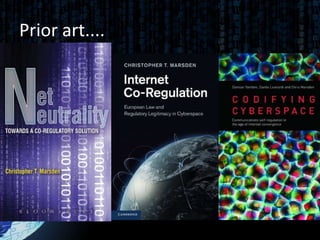
Prior art....
Author:
• Oxford Bibliography of Internet Law
  – Oxford UP, 2012
• Network Neutrality: A Research Guide
  – in 'Handbook Of Internet Research' (Elgar, 2012)
• Internet Co-regulation
  – Cambridge UP, 2011
• Net Neutrality: Towards a Co-regulatory
  Solution
  – Bloomsbury, 2010
In this talk
• I explain its past,
• explore the legislation and regulation of its
  present, and explain that
• economics and human rights will both play a
  part in its future.
Net Neutrality: European and
      Comparative Approaches
• Network neutrality growing policy controversy,
• 2 elements separated:
  – present net neutrality 'lite' debate and
  – the emerging net neutrality 'heavy'
  – concerned with fibre access networks in future.
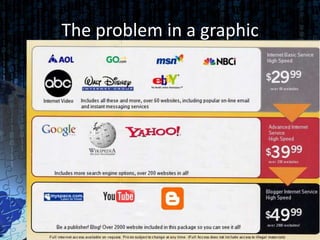
The problem in a graphic
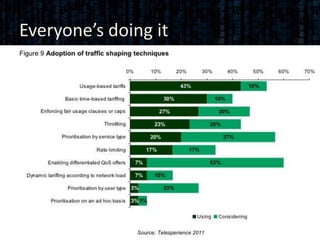
Everyone’s doing it
BEREC preliminary findings
• 9 March 2012
• “traffic management practices in Europe
• “blocking of VoIP and P2P traffic is common,
• “other practices vary widely.
• “in the process of validating, consolidating
  and categorising the data”
• intends to publish findings Q2 2012
     • http://erg.eu.int/doc/2012/TMI_press_release.pdf
“BEREC is very pleased with the high
    level of responses received.”
250 fixed and 150 mobile operators
• 25% claim “security and integrity” concerns
  – e.g. controlling “spam” traffic
• “application-agnostic” approach e.g. buffering
• OR “application-specific” techniques
  – throttle specific traffic, such as video streaming
• 1/3rd of fixed operators manage their networks
  – offer specialised services (e.g. telephony or TV)
  – alongside a best efforts) Internet access service.
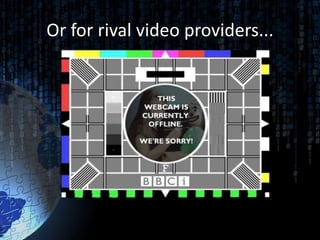
Or for rival video providers...
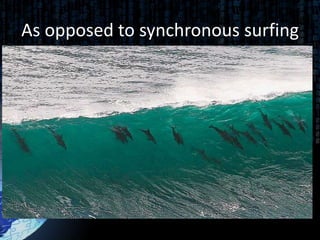
As opposed to synchronous surfing
Telcos never liked the Internet
• AT&T’s Jack Osterman reacting to
• Paul Baran’s 1964 concept of the Internet:
• ‘First it can’t possibly work, and if it did,
• damned if we are going to allow the
  creation of a competitor to ourselves.’
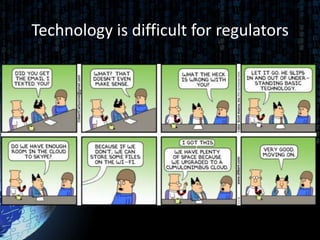
Technology is difficult for regulators
Net neutrality permanent
         feature of telecoms law
• It is a debate which
  – has existed since 1999
  – will grow in importance as
• Internet matures & service quality increases
• demand on the network for
  – more attractive fixed and
  – mobile/wireless services.
1999
•   Network Neutrality debate began in 1999
•   Mergers: cable TV and broadband companies
•   AT&T/MediaOne and AOL/TimeWarner
•   Lessig and Lemley FCC submission:
    – ‘The end of End-to-End’
• Before ‘Code and Other Laws…’
• Fear of closed duopoly model
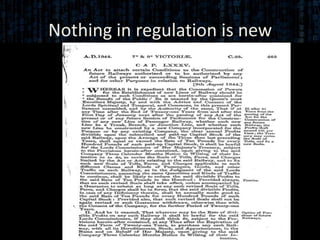
Nothing in regulation is new
SOME EARLIER HISTORY:
WHY WE HAVE REGULATION
Common Carriage not new
•   Began with obligations on inns/boats
•   Determined by public function of networks
•   Continued into modern networks
•   E.g. Railways and telegraphs
•   1844 Railway Regulation Act
    – Setting both emergency access (‘kill switch’)
    – AND Parliamentary trains
• FRAND end-to-end access at set cost
2000s Debate
• 2002-4 US ‘Title II’ telecoms competition
  removed by courts, Republican FCC
  – Brand X case, Triennial Review
• Lessig and Wu write to Congress 2002:
  – fear cable-TV business model
  – Wu coins term ‘net neutrality’ 2003
• FCC introduces 4 ‘Net Freedoms’ 2005
  – Not including enforcement of same!
  – Congress fails to legislate 2005-6
  – 2008 – Obama campaigns w.net neutrality
Telecoms law
• More than just competition law
• Are ISPs all engaged in similar practices?
  – All discriminating against innovative users
  – Blocking gamers and P2P file sharers
  – Are they all doing it for security reasons?
• Vertical integration and discrimination?
  – US Comcast (2008) and
  – Madison River (2005) cases
  – are easy FCC competition cases
Four types of market failure: legitimacy for
              regulators to act
1. Market power
  –   As in Comcast (2008) and Madison River (2005)
2. Lack of information/asymmetries
  –   Ofcom work on easier switch between ISPs
3. Quality of service
  –   Claim of P2P and gamers that they are blocked
4. Provision of public goods
  – Welfare loss through lack of innovation
  – Much more complex and far-sighted Lessigian view
2009 –11
              FCC,
            CRTC and
     European Commission
introduce vague broad principles
      of non-discrimination
             2012 devil lies in the detail…
Incidentally it’s not net neutrality...
• It’s ‘the open Internet’
• In both EC consultation and FCC Order
Facebook advert for neutrality
• $100billion business built in 6 years
  – 845million users
  – Not permitted in China/Iran/N.Korea
• Rupert Murdoch bought MySpace 2005
  – His revolutionary new idea: paywalls
• So who’s on the right side of history?
OPTIMISM
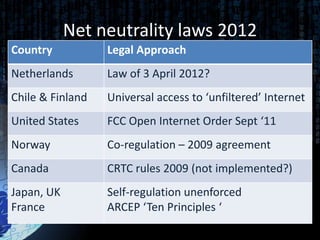
Net neutrality laws 2012
Country           Legal Approach
Netherlands       Law of 3 April 2012?
Chile & Finland   Universal access to ‘unfiltered’ Internet
United States     FCC Open Internet Order Sept ‘11
Norway            Co-regulation – 2009 agreement
Canada            CRTC rules 2009 (not implemented?)
Japan, UK         Self-regulation unenforced
France            ARCEP ‘Ten Principles ‘
US FCC Order 2011, challenge 2012
• FCC Report and Order (2010) Preserving the Open Internet,
   – 25 FCC Rcd 17905
• FCC Report and Order, In The Matter Of Preserving The Open
  Internet And Broadband Industry Practices,
   – GN Docket No. 09-191, WC Docket NO. 07-52, FCC 10-201 § 21-30
   – Published 22 Dec 2010, appeared Federal Register 23 Sept 2011
• In Re: FCC, In the Matter of Preserving the Open Internet,
  Report and Order, FCC 10-201, 76 Fed. Reg. 59192 (2011),
• Consolidation Order - Judicial Panel on Multidistrict Litigation,
      Oct. 6, 2011
   – http://commcns.org/sOFyyT
DIRECTIVE 2009/136/EC
New Articles 20 and 22, Recital 26:
• Consumer protection/citizen rights NOT SMP
      • http://eur-
        lex.europa.eu/LexUriServ/LexUriServ.do?uri=OJ:L:2009:337:0011:0
        036:EN:PDF
• Requirements to notify customers & NRAs
   – But will need civil society activists
   – To detect discrimination
   – To notify higher-end consumers of problems
• Added to interoperability requirements
• Article 5 Interconnection Directive
Article 22: Quality of service
1. Member States shall ensure that NRAs are
• able to require networks and/or services to publish
• comparable, adequate and up-to-date QoS information

2. NRAs may specify the QoS parameters to be measured
• content, form and manner of information published,
• including possible quality certification mechanisms,
• end-users...comparable reliable user-friendly information

3. In order to prevent the degradation of service,
• Member States ensure NRAs can set QoS requirements.
NRAs shall provide the Commission
1.   ... with a summary of the grounds for action,
2.   the envisaged requirements and
3.   the proposed course of action.
4.   This information shall be available to BEREC
The Commission may... make comments or
  recommendations...
     – NRAs shall take the utmost account of the Commission’s
       comments or recommendations when deciding on the
       requirements.
Declaration: Neutrality 2009/140EC
The Commission attaches high importance to preserving
  the open and neutral character of the Internet,
• taking full account of the will of the co-legislators
• now to enshrine net neutrality as a policy objective and
• regulatory principle to be promoted by NRAs
   – Article 8(4)(g) Framework Directive
• strengthening of related transparency requirements
   – USD Articles 20(1)(b) and 21(3)(c) and (d)
• safeguard NRA powers to prevent service degradation
• hindering or slowing down of traffic over public
  networks
   – USD Article 22(3)
Commission will monitor closely
• the implementation of provisions in the Member States,
• introducing a particular focus on how the ‘net freedoms’
  of European citizens are being safeguarded
   – in its annual Progress Report to Parliament and Council.
Commission will monitor the impact of market and
  technological developments on ‘net freedoms’
• reporting to Parliament and Council before end-2010
   – on whether additional guidance is required, and
• will invoke its existing competition law powers
   – to deal with anti-competitive practices that may emerge.
Kroes: BEREC given key role by EC
[1] EC is not leading in evidence gathering –for BEREC:
   – "At the end of 2011, I will publish the results, including any
     instances of blocking or throttling certain types of traffic."
[2] If that produces evidence of widespread
  infringement - only Madison River Skype blocking?
    – recommend setting EU guidance rules
       • "more stringent measures...[in] the form of guidance."
[3] "If this proves to be insufficient, I am ready to
  prohibit the blocking of lawful services or
  applications.”
• I think that means guidance 2012 - regulatory action
  2013, if ever.
BEREC response 2010
• EC (2010) consultation on the open Internet
  and net neutrality in Europe
     • http://ec.europa.eu/information_society/policy/ecom
       m/library/public_consult/net_neutrality/index_en.htm
• BoR (10) 42 BEREC Response at
  – http://www.erg.eu.int/doc/berec/bor_10_42.pdf
• “blocking of VoIP in mobile networks occurred
  – Austria, Croatia, Germany, Italy, the Netherlands,
    Portugal, Romania and Switzerland”
BoR (11) 40 Rev1
• Draft Work Programme for BEREC 2012
• NRAs’ regulatory remedies available
• to address potential discrimination issues,
  – link to the quality of service issue
  – possible IP interconnection market analysis in
    2012
BEREC overview situation of European
             markets
• BEREC investigation task from Commission
  – regarding switching issues and
  – traffic management practices
  – implemented by operators.
• thorough investigation request
  – dedicated task force, together with Commission
• results consolidated and published by
  February 2012?
Quality of Service requirements
• Regulatory Framework: competence for NRAs
  to set QoS minimum requirements.
• When should NRAs set minimum
  requirements and what should those be?
• Harmonised minimum QoS requirements
  – could avoid creating inefficiencies for operators,
  – costs ultimately paid by consumers.
2012 further guidelines for NRAs
Methods for measuring and assessing
  • network and application performance,
  • including by the end users themselves.
E.g. NRAs can promote or provide tools
  • end users control or monitor quality
  • include contractually agreed parameters
BEREC Deliverables:

1. Detailed guidelines on Transparency;
  1. (depending on outcome of the public consultation):
2. Guidelines on Quality of Service Requirements;
3. Completion of BEREC Reports on discriminatory
   issues;
4. Report on IP interconnection;
5. Inquiry results on traffic management practices.
Deadlines for BEREC 2012
• Results of inquiry on traffic management
  Q1/2012
• Discrimination report: public consultation
  Q2/2012, adoption Q3/2012;
• Transparency Q3/2012;
• Quality of Service guidelines Q3/ 2012;
• IP interconnection final report Q3/2012;
December 2011 documents
•   BEREC Christmas present!
•   Dense information documents:
•   BoR 53(11) Quality of Service
•   BoR 67(11) Transparency, at
    – erg.eu.int/documents/berec_docs/index_en.htm
Discrimination:
• Prioritisation implicitly is discrimination,
• number of aspects should be taken into
  account
• to evaluate negative consequences for
   – level of competition, innovation and end users’
     interests.
• 2011, economic analysis of potential and
  theoretical effects of discriminatory behaviour.
Key Policy Concerns
• Service available to consumers
   – What kind of QoS should consumers expect to get when they purchase
     ‘basic’ broadband Internet access?
   – Will consumers be able to access the applications that they want via
     the broadband and mobile Internet?
• Discrimination/monopoly rents
   – To what extent can network operators treat differently the traffic of
     particular content or application providers?
   – When can network operators charge for QoS on different terms to
     similarly situated providers?
Anti-NN behaviour addressed?
NRAs tackling anti-NN behaviour will depend on:
• Ability of complainant to prove discriminatory behaviour
    – poor customer service distinguished from discrimination?
• How the 2009 Framework is transposed
• Speed and effectiveness of NRA decision-making
• Notifying proposed measures (including non-SMP remedies)
    – which Commission may veto
In SMP markets,
• SMP analysis before non-SMP remedies can be applied?
IP interconnection
• current IP interconnection agreements
  – peering/transit,
  – which may affect net neutrality issues.
• analysis competition/technological
  developments
• in particular contribute to economic analysis.
European Data Protection Supervisor
           October 2011
• Concerned that traffic management would
  result in exposure of users’ personal data
  – Including IP addresses
• ‘Opinion on net neutrality, traffic management
  and protection of privacy and personal data’
  – http://www.edps.europa.eu/EDPSWEB/webdav/si
    te/mySite/shared/Documents/Consultation/Opini
    ons/2011/11-10-07_Net_neutrality_EN.pdf
Losing liberty?
•   ISPs important intermediary limited liability
•   Based on their wise monkeys role
•   Behavioural advertising – PHORM
•   Blocking and filtering
•   Throttling on non-transparent basis
•   Removes 2000/31/EC Art.12-14 exemption
•   Freedom of expression vital to democracy
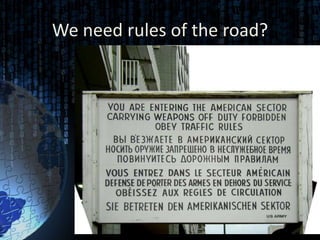
We need rules of the road?
Managed services FRAND
Fair
Reasonable and
Non-discriminatory
Access
• means Murdoch, Berlusconi and Disney
   – can’t cut exclusive deals to freeze out
     competitors
• Universal service must also be considered
• As well as Public Service must-carry
Questions?
cmars@essex.ac.uk
WWW.ESSEX.AC.UK/EXCCEL
@EXCCELESSEX

Sydney 22 March: EU neutrality

  • 1.
    Internet Control andLaw: Network Neutrality History and Future Corrs Chambers Westgarth for CMCL 22 March 2012
  • 2.
  • 3.
    Author: • Oxford Bibliographyof Internet Law – Oxford UP, 2012 • Network Neutrality: A Research Guide – in 'Handbook Of Internet Research' (Elgar, 2012) • Internet Co-regulation – Cambridge UP, 2011 • Net Neutrality: Towards a Co-regulatory Solution – Bloomsbury, 2010
  • 4.
    In this talk •I explain its past, • explore the legislation and regulation of its present, and explain that • economics and human rights will both play a part in its future.
  • 5.
    Net Neutrality: Europeanand Comparative Approaches • Network neutrality growing policy controversy, • 2 elements separated: – present net neutrality 'lite' debate and – the emerging net neutrality 'heavy' – concerned with fibre access networks in future.
  • 6.
    The problem ina graphic
  • 7.
  • 8.
    BEREC preliminary findings •9 March 2012 • “traffic management practices in Europe • “blocking of VoIP and P2P traffic is common, • “other practices vary widely. • “in the process of validating, consolidating and categorising the data” • intends to publish findings Q2 2012 • http://erg.eu.int/doc/2012/TMI_press_release.pdf
  • 9.
    “BEREC is verypleased with the high level of responses received.” 250 fixed and 150 mobile operators • 25% claim “security and integrity” concerns – e.g. controlling “spam” traffic • “application-agnostic” approach e.g. buffering • OR “application-specific” techniques – throttle specific traffic, such as video streaming • 1/3rd of fixed operators manage their networks – offer specialised services (e.g. telephony or TV) – alongside a best efforts) Internet access service.
  • 10.
    Or for rivalvideo providers...
  • 11.
    As opposed tosynchronous surfing
  • 12.
    Telcos never likedthe Internet • AT&T’s Jack Osterman reacting to • Paul Baran’s 1964 concept of the Internet: • ‘First it can’t possibly work, and if it did, • damned if we are going to allow the creation of a competitor to ourselves.’
  • 13.
  • 14.
    Net neutrality permanent feature of telecoms law • It is a debate which – has existed since 1999 – will grow in importance as • Internet matures & service quality increases • demand on the network for – more attractive fixed and – mobile/wireless services.
  • 15.
    1999 • Network Neutrality debate began in 1999 • Mergers: cable TV and broadband companies • AT&T/MediaOne and AOL/TimeWarner • Lessig and Lemley FCC submission: – ‘The end of End-to-End’ • Before ‘Code and Other Laws…’ • Fear of closed duopoly model
  • 16.
  • 17.
    SOME EARLIER HISTORY: WHYWE HAVE REGULATION
  • 18.
    Common Carriage notnew • Began with obligations on inns/boats • Determined by public function of networks • Continued into modern networks • E.g. Railways and telegraphs • 1844 Railway Regulation Act – Setting both emergency access (‘kill switch’) – AND Parliamentary trains • FRAND end-to-end access at set cost
  • 19.
    2000s Debate • 2002-4US ‘Title II’ telecoms competition removed by courts, Republican FCC – Brand X case, Triennial Review • Lessig and Wu write to Congress 2002: – fear cable-TV business model – Wu coins term ‘net neutrality’ 2003 • FCC introduces 4 ‘Net Freedoms’ 2005 – Not including enforcement of same! – Congress fails to legislate 2005-6 – 2008 – Obama campaigns w.net neutrality
  • 20.
    Telecoms law • Morethan just competition law • Are ISPs all engaged in similar practices? – All discriminating against innovative users – Blocking gamers and P2P file sharers – Are they all doing it for security reasons? • Vertical integration and discrimination? – US Comcast (2008) and – Madison River (2005) cases – are easy FCC competition cases
  • 21.
    Four types ofmarket failure: legitimacy for regulators to act 1. Market power – As in Comcast (2008) and Madison River (2005) 2. Lack of information/asymmetries – Ofcom work on easier switch between ISPs 3. Quality of service – Claim of P2P and gamers that they are blocked 4. Provision of public goods – Welfare loss through lack of innovation – Much more complex and far-sighted Lessigian view
  • 22.
    2009 –11 FCC, CRTC and European Commission introduce vague broad principles of non-discrimination 2012 devil lies in the detail…
  • 23.
    Incidentally it’s notnet neutrality... • It’s ‘the open Internet’ • In both EC consultation and FCC Order
  • 24.
    Facebook advert forneutrality • $100billion business built in 6 years – 845million users – Not permitted in China/Iran/N.Korea • Rupert Murdoch bought MySpace 2005 – His revolutionary new idea: paywalls • So who’s on the right side of history?
  • 25.
  • 26.
    Net neutrality laws2012 Country Legal Approach Netherlands Law of 3 April 2012? Chile & Finland Universal access to ‘unfiltered’ Internet United States FCC Open Internet Order Sept ‘11 Norway Co-regulation – 2009 agreement Canada CRTC rules 2009 (not implemented?) Japan, UK Self-regulation unenforced France ARCEP ‘Ten Principles ‘
  • 27.
    US FCC Order2011, challenge 2012 • FCC Report and Order (2010) Preserving the Open Internet, – 25 FCC Rcd 17905 • FCC Report and Order, In The Matter Of Preserving The Open Internet And Broadband Industry Practices, – GN Docket No. 09-191, WC Docket NO. 07-52, FCC 10-201 § 21-30 – Published 22 Dec 2010, appeared Federal Register 23 Sept 2011 • In Re: FCC, In the Matter of Preserving the Open Internet, Report and Order, FCC 10-201, 76 Fed. Reg. 59192 (2011), • Consolidation Order - Judicial Panel on Multidistrict Litigation, Oct. 6, 2011 – http://commcns.org/sOFyyT
  • 28.
    DIRECTIVE 2009/136/EC New Articles20 and 22, Recital 26: • Consumer protection/citizen rights NOT SMP • http://eur- lex.europa.eu/LexUriServ/LexUriServ.do?uri=OJ:L:2009:337:0011:0 036:EN:PDF • Requirements to notify customers & NRAs – But will need civil society activists – To detect discrimination – To notify higher-end consumers of problems • Added to interoperability requirements • Article 5 Interconnection Directive
  • 29.
    Article 22: Qualityof service 1. Member States shall ensure that NRAs are • able to require networks and/or services to publish • comparable, adequate and up-to-date QoS information 2. NRAs may specify the QoS parameters to be measured • content, form and manner of information published, • including possible quality certification mechanisms, • end-users...comparable reliable user-friendly information 3. In order to prevent the degradation of service, • Member States ensure NRAs can set QoS requirements.
  • 30.
    NRAs shall providethe Commission 1. ... with a summary of the grounds for action, 2. the envisaged requirements and 3. the proposed course of action. 4. This information shall be available to BEREC The Commission may... make comments or recommendations... – NRAs shall take the utmost account of the Commission’s comments or recommendations when deciding on the requirements.
  • 31.
    Declaration: Neutrality 2009/140EC TheCommission attaches high importance to preserving the open and neutral character of the Internet, • taking full account of the will of the co-legislators • now to enshrine net neutrality as a policy objective and • regulatory principle to be promoted by NRAs – Article 8(4)(g) Framework Directive • strengthening of related transparency requirements – USD Articles 20(1)(b) and 21(3)(c) and (d) • safeguard NRA powers to prevent service degradation • hindering or slowing down of traffic over public networks – USD Article 22(3)
  • 32.
    Commission will monitorclosely • the implementation of provisions in the Member States, • introducing a particular focus on how the ‘net freedoms’ of European citizens are being safeguarded – in its annual Progress Report to Parliament and Council. Commission will monitor the impact of market and technological developments on ‘net freedoms’ • reporting to Parliament and Council before end-2010 – on whether additional guidance is required, and • will invoke its existing competition law powers – to deal with anti-competitive practices that may emerge.
  • 33.
    Kroes: BEREC givenkey role by EC [1] EC is not leading in evidence gathering –for BEREC: – "At the end of 2011, I will publish the results, including any instances of blocking or throttling certain types of traffic." [2] If that produces evidence of widespread infringement - only Madison River Skype blocking? – recommend setting EU guidance rules • "more stringent measures...[in] the form of guidance." [3] "If this proves to be insufficient, I am ready to prohibit the blocking of lawful services or applications.” • I think that means guidance 2012 - regulatory action 2013, if ever.
  • 34.
    BEREC response 2010 •EC (2010) consultation on the open Internet and net neutrality in Europe • http://ec.europa.eu/information_society/policy/ecom m/library/public_consult/net_neutrality/index_en.htm • BoR (10) 42 BEREC Response at – http://www.erg.eu.int/doc/berec/bor_10_42.pdf • “blocking of VoIP in mobile networks occurred – Austria, Croatia, Germany, Italy, the Netherlands, Portugal, Romania and Switzerland”
  • 35.
    BoR (11) 40Rev1 • Draft Work Programme for BEREC 2012 • NRAs’ regulatory remedies available • to address potential discrimination issues, – link to the quality of service issue – possible IP interconnection market analysis in 2012
  • 36.
    BEREC overview situationof European markets • BEREC investigation task from Commission – regarding switching issues and – traffic management practices – implemented by operators. • thorough investigation request – dedicated task force, together with Commission • results consolidated and published by February 2012?
  • 37.
    Quality of Servicerequirements • Regulatory Framework: competence for NRAs to set QoS minimum requirements. • When should NRAs set minimum requirements and what should those be? • Harmonised minimum QoS requirements – could avoid creating inefficiencies for operators, – costs ultimately paid by consumers.
  • 38.
    2012 further guidelinesfor NRAs Methods for measuring and assessing • network and application performance, • including by the end users themselves. E.g. NRAs can promote or provide tools • end users control or monitor quality • include contractually agreed parameters
  • 39.
    BEREC Deliverables: 1. Detailedguidelines on Transparency; 1. (depending on outcome of the public consultation): 2. Guidelines on Quality of Service Requirements; 3. Completion of BEREC Reports on discriminatory issues; 4. Report on IP interconnection; 5. Inquiry results on traffic management practices.
  • 40.
    Deadlines for BEREC2012 • Results of inquiry on traffic management Q1/2012 • Discrimination report: public consultation Q2/2012, adoption Q3/2012; • Transparency Q3/2012; • Quality of Service guidelines Q3/ 2012; • IP interconnection final report Q3/2012;
  • 41.
    December 2011 documents • BEREC Christmas present! • Dense information documents: • BoR 53(11) Quality of Service • BoR 67(11) Transparency, at – erg.eu.int/documents/berec_docs/index_en.htm
  • 42.
    Discrimination: • Prioritisation implicitlyis discrimination, • number of aspects should be taken into account • to evaluate negative consequences for – level of competition, innovation and end users’ interests. • 2011, economic analysis of potential and theoretical effects of discriminatory behaviour.
  • 43.
    Key Policy Concerns •Service available to consumers – What kind of QoS should consumers expect to get when they purchase ‘basic’ broadband Internet access? – Will consumers be able to access the applications that they want via the broadband and mobile Internet? • Discrimination/monopoly rents – To what extent can network operators treat differently the traffic of particular content or application providers? – When can network operators charge for QoS on different terms to similarly situated providers?
  • 44.
    Anti-NN behaviour addressed? NRAstackling anti-NN behaviour will depend on: • Ability of complainant to prove discriminatory behaviour – poor customer service distinguished from discrimination? • How the 2009 Framework is transposed • Speed and effectiveness of NRA decision-making • Notifying proposed measures (including non-SMP remedies) – which Commission may veto In SMP markets, • SMP analysis before non-SMP remedies can be applied?
  • 45.
    IP interconnection • currentIP interconnection agreements – peering/transit, – which may affect net neutrality issues. • analysis competition/technological developments • in particular contribute to economic analysis.
  • 46.
    European Data ProtectionSupervisor October 2011 • Concerned that traffic management would result in exposure of users’ personal data – Including IP addresses • ‘Opinion on net neutrality, traffic management and protection of privacy and personal data’ – http://www.edps.europa.eu/EDPSWEB/webdav/si te/mySite/shared/Documents/Consultation/Opini ons/2011/11-10-07_Net_neutrality_EN.pdf
  • 47.
    Losing liberty? • ISPs important intermediary limited liability • Based on their wise monkeys role • Behavioural advertising – PHORM • Blocking and filtering • Throttling on non-transparent basis • Removes 2000/31/EC Art.12-14 exemption • Freedom of expression vital to democracy
  • 48.
    We need rulesof the road?
  • 49.
    Managed services FRAND Fair Reasonableand Non-discriminatory Access • means Murdoch, Berlusconi and Disney – can’t cut exclusive deals to freeze out competitors • Universal service must also be considered • As well as Public Service must-carry
  • 50.