
The open internet and net neutrality in Europe Christian Micas DG Information Society and Media European Commission
Disclaimer The views expressed in this presentation are the views from the speaker and do not necessarily reflect the views from the European Commission •••
The internet today Engine for  innovation  which owes much of its success to being  open and easily accessible Decoupling of services and networks  decreases barriers to entry for service and content providers Borderless provision of services, applications and content •••
Internet – the policy challenge Internet applications require increasing network capacity and quality of service. Access remains a bottleneck The public policy challenge is to foster  investment, innovation and competition  while preserving the  open and neutral  character of the internet •••
What is net neutrality No commonly agreed definition of net neutrality but it can be understood to mean: End-users should have the ability to access and distribute information or run applications and services of their choice •••
The issues Core issue is what is considered as reasonable  traffic management Blocking of VoIP services  such as Skype by mobile operators Throttling of traffic  during peak-time for particular packages – eg BBC iPlayer in the UK Additional charges  for particular internet services •••
New legislative framework Amendments were made to the Telecoms framework. Adopted in December 2009 Several changes are geared toward Net Neutrality-related issues Had to be transposed into national laws by May 2011 •••
The Commission Declaration In a declaration attached to the Telecoms framework which was adopted in November 2009, the European Commission noted its commitment to  « preserving the open and neutral character of the internet  taking full account of the will of the co-legislators now to enshrine net neutrality as a policy objective and regulatory principle to be promoted by national regulatory authorities » •••
New Policy Objective Article 8 (§4) (g) of the Framework Directive  NRAS should promote the interests of the citizens of the European Union by promoting the ability of end-users to access and distribute information or run applications and services of their choice •••
Communication by the Commission Adopted in April 2011 Extensive public consultation Joint summit organised together with the European Parliament •••
EU Policy Objectives  To promote effective competition To promote the interests of citizens To contribute to the development of the Internal market •••
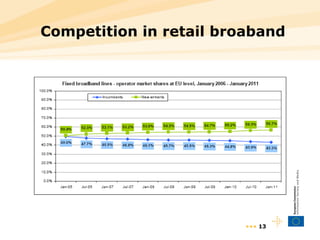
1. Promoting competition Access regulation based on the imposition of symmetrical and asymmetrical remedies Effective level of competition achieved in retail broadband markets •••
Competition in retail broaband •••
2. Promoting the interests of citizens Transparency Quality of service Consumer switching •••
a) Transparency Rules Contracts must include information on any procedures put in place by the provider to measure and shape traffic so as to avoid filling or overfilling of a network link NRAs also have powers to ask operators to publish information in a comparable manner •••
b) Minimum Quality of Service In order to prevent the degradation of service and the hindering or slowing down of traffic over networks, NRAs are able to set minimum quality of service requirements •••
Situation in Europe There have been issues in a few Member States with blocking of VoIP providers and throttling of certain bandwidth hungry applications but so far NRAs have been able to tackle such issues •••
Advertised v. Effective Speed Only 66% of EU households perceive that the effective speed of their connection meets the advertised speed (Eurobarometer, March 2011) The Commission has launched fieldwork measurement across the EU •••
c) Consumer Switching Contract conditions: right to withdraw Number portability in one day Operators must offer the possibility to subscribe to a contract with a maximum duration of 12 months. •••
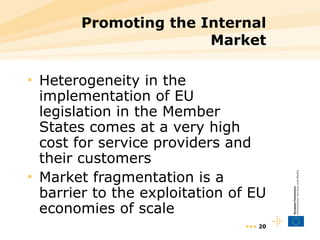
Promoting the Internal Market Heterogeneity in the implementation of EU legislation in the Member States comes at a very high cost for service providers and their customers Market fragmentation is a barrier to the exploitation of EU economies of scale •••
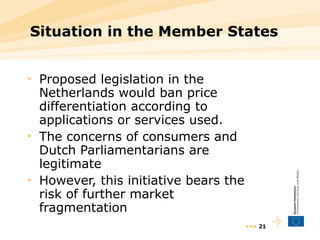
Situation in the Member States  Proposed legislation in the Netherlands would ban price differentiation according to applications or services used. The concerns of consumers and Dutch Parliamentarians are legitimate However, this initiative bears the risk of further market fragmentation •••
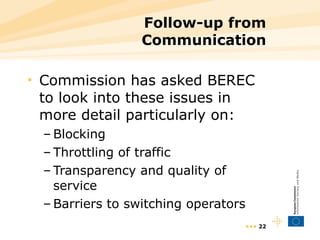
Follow-up from Communication Commission has asked BEREC to look into these issues in more detail particularly on: Blocking Throttling of traffic Transparency and quality of service Barriers to switching operators •••
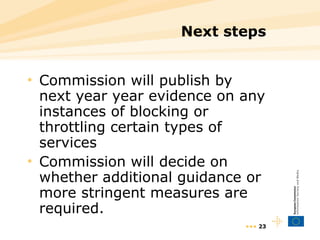
Next steps Commission will publish by next year year evidence on any instances of blocking or throttling certain types of services Commission will decide on whether additional guidance or more stringent measures are required. •••
Thank you very much for your attention! •••

Mr Micas Open Internet & Net Neutrality DigiWorld Summit 2011 IDATE

  • 1.
    Theopen internet and net neutrality in Europe Christian Micas DG Information Society and Media European Commission
  • 2.
    Disclaimer The viewsexpressed in this presentation are the views from the speaker and do not necessarily reflect the views from the European Commission •••
  • 3.
    The internet todayEngine for innovation which owes much of its success to being open and easily accessible Decoupling of services and networks decreases barriers to entry for service and content providers Borderless provision of services, applications and content •••
  • 4.
    Internet – thepolicy challenge Internet applications require increasing network capacity and quality of service. Access remains a bottleneck The public policy challenge is to foster investment, innovation and competition while preserving the open and neutral character of the internet •••
  • 5.
    What is netneutrality No commonly agreed definition of net neutrality but it can be understood to mean: End-users should have the ability to access and distribute information or run applications and services of their choice •••
  • 6.
    The issues Coreissue is what is considered as reasonable traffic management Blocking of VoIP services such as Skype by mobile operators Throttling of traffic during peak-time for particular packages – eg BBC iPlayer in the UK Additional charges for particular internet services •••
  • 7.
    New legislative frameworkAmendments were made to the Telecoms framework. Adopted in December 2009 Several changes are geared toward Net Neutrality-related issues Had to be transposed into national laws by May 2011 •••
  • 8.
    The Commission DeclarationIn a declaration attached to the Telecoms framework which was adopted in November 2009, the European Commission noted its commitment to « preserving the open and neutral character of the internet  taking full account of the will of the co-legislators now to enshrine net neutrality as a policy objective and regulatory principle to be promoted by national regulatory authorities » •••
  • 9.
    New Policy ObjectiveArticle 8 (§4) (g) of the Framework Directive NRAS should promote the interests of the citizens of the European Union by promoting the ability of end-users to access and distribute information or run applications and services of their choice •••
  • 10.
    Communication by theCommission Adopted in April 2011 Extensive public consultation Joint summit organised together with the European Parliament •••
  • 11.
    EU Policy Objectives To promote effective competition To promote the interests of citizens To contribute to the development of the Internal market •••
  • 12.
    1. Promoting competitionAccess regulation based on the imposition of symmetrical and asymmetrical remedies Effective level of competition achieved in retail broadband markets •••
  • 13.
    Competition in retailbroaband •••
  • 14.
    2. Promoting theinterests of citizens Transparency Quality of service Consumer switching •••
  • 15.
    a) Transparency RulesContracts must include information on any procedures put in place by the provider to measure and shape traffic so as to avoid filling or overfilling of a network link NRAs also have powers to ask operators to publish information in a comparable manner •••
  • 16.
    b) Minimum Qualityof Service In order to prevent the degradation of service and the hindering or slowing down of traffic over networks, NRAs are able to set minimum quality of service requirements •••
  • 17.
    Situation in EuropeThere have been issues in a few Member States with blocking of VoIP providers and throttling of certain bandwidth hungry applications but so far NRAs have been able to tackle such issues •••
  • 18.
    Advertised v. EffectiveSpeed Only 66% of EU households perceive that the effective speed of their connection meets the advertised speed (Eurobarometer, March 2011) The Commission has launched fieldwork measurement across the EU •••
  • 19.
    c) Consumer SwitchingContract conditions: right to withdraw Number portability in one day Operators must offer the possibility to subscribe to a contract with a maximum duration of 12 months. •••
  • 20.
    Promoting the InternalMarket Heterogeneity in the implementation of EU legislation in the Member States comes at a very high cost for service providers and their customers Market fragmentation is a barrier to the exploitation of EU economies of scale •••
  • 21.
    Situation in theMember States Proposed legislation in the Netherlands would ban price differentiation according to applications or services used. The concerns of consumers and Dutch Parliamentarians are legitimate However, this initiative bears the risk of further market fragmentation •••
  • 22.
    Follow-up from CommunicationCommission has asked BEREC to look into these issues in more detail particularly on: Blocking Throttling of traffic Transparency and quality of service Barriers to switching operators •••
  • 23.
    Next steps Commissionwill publish by next year year evidence on any instances of blocking or throttling certain types of services Commission will decide on whether additional guidance or more stringent measures are required. •••
  • 24.
    Thank you verymuch for your attention! •••