What Employers
Want Most and Get Least
from Grads
Barnaby Dorfman / PayScale.com
Kristen Hamilton / Koru
Tony Wagner / Expert-in-Residence, Harvard Innovation Lab
Zachary First / The Drucker Institute
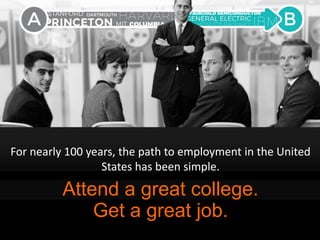
For nearly 100 years, the path to employment in the United
States has been simple.
Attend a great college.
Get a great job.
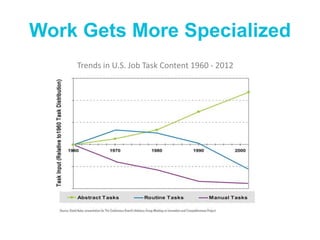
Work Gets More Specialized
Trends in U.S. Job Task Content 1960 - 2012
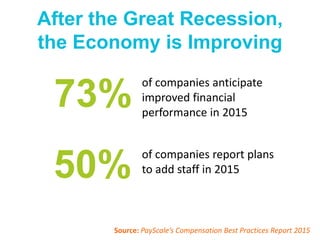
After the Great Recession,
the Economy is Improving
of companies anticipate
improved financial
performance in 2015
of companies report plans
to add staff in 2015
73%
50%
Source: PayScale’s Compensation Best Practices Report 2015
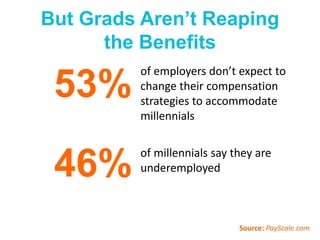
But Grads Aren’t Reaping
the Benefits
of employers don’t expect to
change their compensation
strategies to accommodate
millennials
of millennials say they are
underemployed
53%
46%
Source: PayScale.com
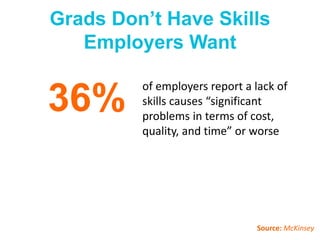
Grads Don’t Have Skills
Employers Want
of employers report a lack of
skills causes “significant
problems in terms of cost,
quality, and time” or worse
36%
Source: McKinsey
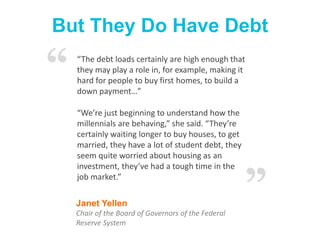
But They Do Have Debt
Janet Yellen
Chair of the Board of Governors of the Federal
Reserve System
“The debt loads certainly are high enough that
they may play a role in, for example, making it
hard for people to buy first homes, to build a
down payment…”
“We’re just beginning to understand how the
millennials are behaving,” she said. “They’re
certainly waiting longer to buy houses, to get
married, they have a lot of student debt, they
seem quite worried about housing as an
investment, they’ve had a tough time in the
job market.”
“
”
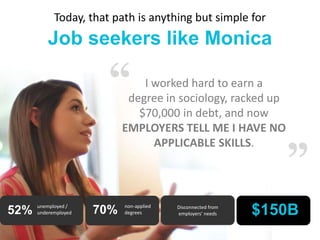
Today, that path is anything but simple for
Job seekers like Monica
I worked hard to earn a
degree in sociology, racked up
$70,000 in debt, and now
EMPLOYERS TELL ME I HAVE NO
APPLICABLE SKILLS.
Disconnected from
employers’ needs52% unemployed /
underemployed $150B70% non-applied
degrees
“
”
Talent managers like Laszlo
Laszlo Bock
Sr. VP of People Operations
Google
Today, that path is anything but simple for
G.P.A.’s ARE WORTHLESS
AS A CRITERIA FOR HIRING
[…] we found that they
don’t predict anything.
$60B250
resumes per job opening
53%
can’t find qualified
candidates
$8-12K
per employee hire
20-30%
are bad hires
“
”
Why Don’t Students Have
These Qualities?
In a world where knowledge has become a
free commodity…
The capacity to innovate – to solve problems
creatively or to bring new possibilities to life –
is the single most important competitive
advantage for individuals and organizations
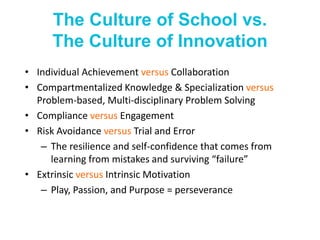
The Culture of School vs.
The Culture of Innovation
• Individual Achievement versus Collaboration
• Compartmentalized Knowledge & Specialization versus
Problem-based, Multi-disciplinary Problem Solving
• Compliance versus Engagement
• Risk Avoidance versus Trial and Error
– The resilience and self-confidence that comes from
learning from mistakes and surviving “failure”
• Extrinsic versus Intrinsic Motivation
– Play, Passion, and Purpose = perseverance
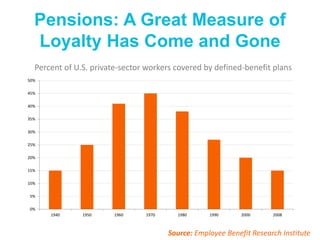
Pensions: A Great Measure of
Loyalty Has Come and Gone
0%
5%
10%
15%
20%
25%
30%
35%
40%
45%
50%
1940 1950 1960 1970 1980 1990 2000 2008
Percent of U.S. private-sector workers covered by defined-benefit plans
Source: Employee Benefit Research Institute
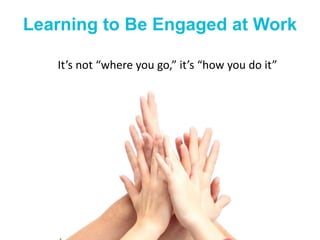
Learning to Be Engaged at Work
It’s not “where you go,” it’s “how you do it”
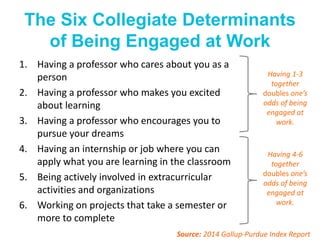
The Six Collegiate Determinants
of Being Engaged at Work
1. Having a professor who cares about you as a
person
2. Having a professor who makes you excited
about learning
3. Having a professor who encourages you to
pursue your dreams
4. Having an internship or job where you can
apply what you are learning in the classroom
5. Being actively involved in extracurricular
activities and organizations
6. Working on projects that take a semester or
more to complete
Having 1-3
together
doubles one’s
odds of being
engaged at
work.
Having 4-6
together
doubles one’s
odds of being
engaged at
work.
Source: 2014 Gallup-Purdue Index Report
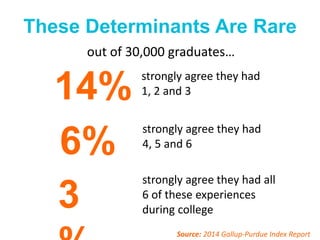
These Determinants Are Rare
strongly agree they had all
6 of these experiences
during college
strongly agree they had
4, 5 and 6
strongly agree they had
1, 2 and 314%
6%
3
out of 30,000 graduates…
Source: 2014 Gallup-Purdue Index Report
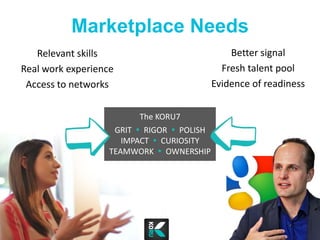
The KORU7
GRIT  RIGOR  POLISH
IMPACT  CURIOSITY
TEAMWORK  OWNERSHIP
Relevant skills
Real work experience
Access to networks
Better signal
Fresh talent pool
Evidence of readiness
Marketplace Needs

What Employers Want Most and Get Least from Grads

  • 1.
    What Employers Want Mostand Get Least from Grads Barnaby Dorfman / PayScale.com Kristen Hamilton / Koru Tony Wagner / Expert-in-Residence, Harvard Innovation Lab Zachary First / The Drucker Institute
  • 2.
    For nearly 100years, the path to employment in the United States has been simple. Attend a great college. Get a great job.
  • 3.
    Work Gets MoreSpecialized Trends in U.S. Job Task Content 1960 - 2012
  • 4.
    After the GreatRecession, the Economy is Improving of companies anticipate improved financial performance in 2015 of companies report plans to add staff in 2015 73% 50% Source: PayScale’s Compensation Best Practices Report 2015
  • 5.
    But Grads Aren’tReaping the Benefits of employers don’t expect to change their compensation strategies to accommodate millennials of millennials say they are underemployed 53% 46% Source: PayScale.com
  • 6.
    Grads Don’t HaveSkills Employers Want of employers report a lack of skills causes “significant problems in terms of cost, quality, and time” or worse 36% Source: McKinsey
  • 7.
    But They DoHave Debt Janet Yellen Chair of the Board of Governors of the Federal Reserve System “The debt loads certainly are high enough that they may play a role in, for example, making it hard for people to buy first homes, to build a down payment…” “We’re just beginning to understand how the millennials are behaving,” she said. “They’re certainly waiting longer to buy houses, to get married, they have a lot of student debt, they seem quite worried about housing as an investment, they’ve had a tough time in the job market.” “ ”
  • 8.
    Today, that pathis anything but simple for Job seekers like Monica I worked hard to earn a degree in sociology, racked up $70,000 in debt, and now EMPLOYERS TELL ME I HAVE NO APPLICABLE SKILLS. Disconnected from employers’ needs52% unemployed / underemployed $150B70% non-applied degrees “ ”
  • 9.
    Talent managers likeLaszlo Laszlo Bock Sr. VP of People Operations Google Today, that path is anything but simple for G.P.A.’s ARE WORTHLESS AS A CRITERIA FOR HIRING […] we found that they don’t predict anything. $60B250 resumes per job opening 53% can’t find qualified candidates $8-12K per employee hire 20-30% are bad hires “ ”
  • 10.
    Why Don’t StudentsHave These Qualities? In a world where knowledge has become a free commodity… The capacity to innovate – to solve problems creatively or to bring new possibilities to life – is the single most important competitive advantage for individuals and organizations
  • 11.
    The Culture ofSchool vs. The Culture of Innovation • Individual Achievement versus Collaboration • Compartmentalized Knowledge & Specialization versus Problem-based, Multi-disciplinary Problem Solving • Compliance versus Engagement • Risk Avoidance versus Trial and Error – The resilience and self-confidence that comes from learning from mistakes and surviving “failure” • Extrinsic versus Intrinsic Motivation – Play, Passion, and Purpose = perseverance
  • 12.
    Pensions: A GreatMeasure of Loyalty Has Come and Gone 0% 5% 10% 15% 20% 25% 30% 35% 40% 45% 50% 1940 1950 1960 1970 1980 1990 2000 2008 Percent of U.S. private-sector workers covered by defined-benefit plans Source: Employee Benefit Research Institute
  • 13.
    Learning to BeEngaged at Work It’s not “where you go,” it’s “how you do it”
  • 14.
    The Six CollegiateDeterminants of Being Engaged at Work 1. Having a professor who cares about you as a person 2. Having a professor who makes you excited about learning 3. Having a professor who encourages you to pursue your dreams 4. Having an internship or job where you can apply what you are learning in the classroom 5. Being actively involved in extracurricular activities and organizations 6. Working on projects that take a semester or more to complete Having 1-3 together doubles one’s odds of being engaged at work. Having 4-6 together doubles one’s odds of being engaged at work. Source: 2014 Gallup-Purdue Index Report
  • 15.
    These Determinants AreRare strongly agree they had all 6 of these experiences during college strongly agree they had 4, 5 and 6 strongly agree they had 1, 2 and 314% 6% 3 out of 30,000 graduates… Source: 2014 Gallup-Purdue Index Report
  • 16.
    The KORU7 GRIT RIGOR  POLISH IMPACT  CURIOSITY TEAMWORK  OWNERSHIP Relevant skills Real work experience Access to networks Better signal Fresh talent pool Evidence of readiness Marketplace Needs