The two greatest concerns of employers today are finding good workers
and training them. The difference between the skills needed on the job and
those possessed by applicants, sometimes called the skills-gap, is of real con-
cern to human resource managers and business owners looking to hire com-
petent employees. While employers would prefer to hire people who are
trained and ready to go to work, they are usually willing to provide the spe-
cialized, job-specific training necessary for those lacking such skills.
Most discussions concerning today’s workforce eventually turn to em-
ployability skills. Finding workers who have employability or job readiness
skills that help them fit into and remain in the work environment is a real
problem. Employers need reliable, responsible workers who can solve prob-
lems and who have the social skills and
attitudes to work together with other
workers. Creativity, once a trait
avoided by employers who used a
cookie cutter system, is now prized
among employers who are trying to
create the empowered, high-
performance workforce needed for com-
petitiveness in today’s marketplace.
Employees with these skills are in de-
mand and are considered valuable hu-
man capital assets to companies.
Employability skills are those basic
skills necessary for getting, keeping,
and doing well on a job. These are the
skills, attitudes and actions that en-
able workers to get along with their
fellow workers and supervisors and to
make sound, critical decisions. Unlike occupational or technical skills, em-
ployability skills are generic in nature rather than job specific and cut across
all industry types, business sizees, and job levels from the entry-level
worker to the senior-most position.
What specifically are those skills, attitudes and actions, i.e., employabil-
What Are Employability Skills?
A L A B A M A C O O P E R A T I V E E X T E N S I O N S Y S T E M
A Fact Sheet
AUTHOR INFORMATION:
Dr. Jacquelyn P. Robinson
Community Workforce
Development Specialist
State Headquarters
216 Extension Hall
Auburn University, AL
36849-5631
Telephone (334) 844-5353
FAX (334) 844-9022
jrobinso@aces.auburn.edu
Visit the Community Resource Development home page at www.aces.edu/department/crd/
September 15, 2000Volume 1, Issue 3
Job readiness skills
are clustered into
three skill sets: ba-
sic academic skills,
higher order think-
ing skills, personal
qualities
Employability skills
are those basic
skills necessary for
getting, keeping,
and doing well on a
job.
Employability skills
are teachable skills.
Highlights
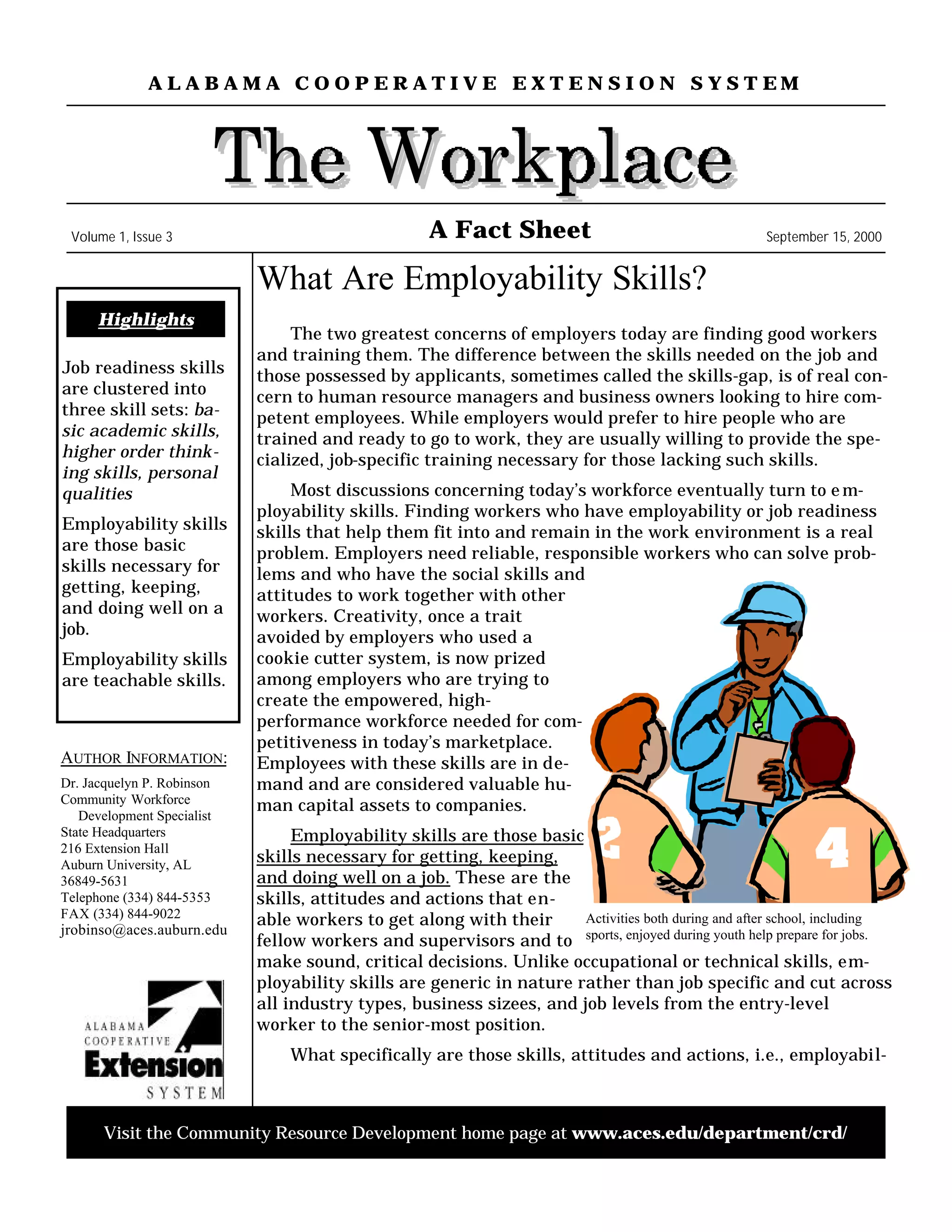
Activities both during and after school, including
sports, enjoyed during youth help prepare for jobs.
ity skills, necessary for getting, keeping, and
doing well on a job? Employability skills,
while categorized in many different ways, are
generally divided into three skill sets: (a) basic
academic skills, (b) higher-order thinking
skills and (c) personal qualities. The three
skill sets are typically broken down into more
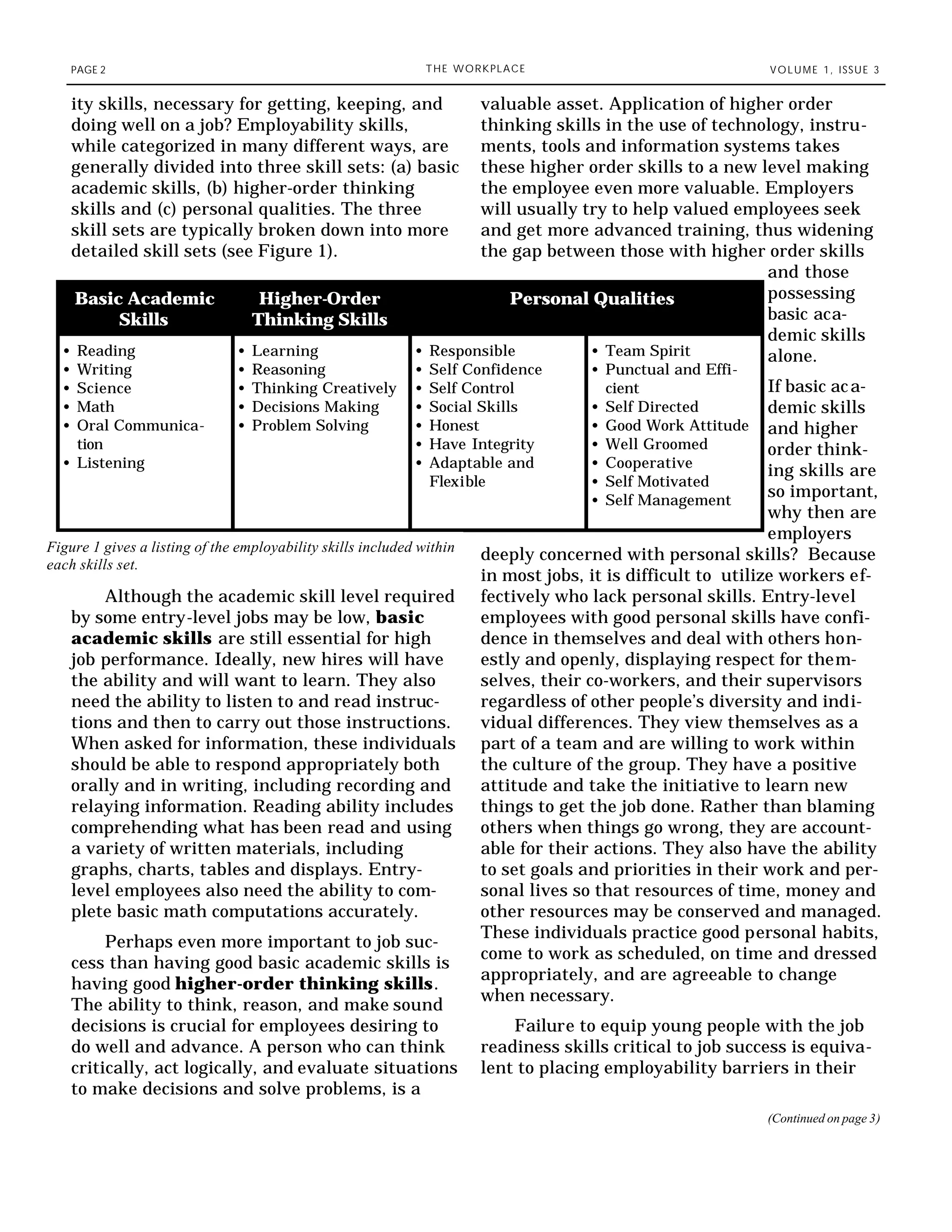
detailed skill sets (see Figure 1).
Although the academic skill level required
by some entry-level jobs may be low, basic
academic skills are still essential for high
job performance. Ideally, new hires will have
the ability and will want to learn. They also
need the ability to listen to and read instruc-
tions and then to carry out those instructions.
When asked for information, these individuals
should be able to respond appropriately both
orally and in writing, including recording and
relaying information. Reading ability includes
comprehending what has been read and using
a variety of written materials, including
graphs, charts, tables and displays. Entry-
level employees also need the ability to com-
plete basic math computations accurately.
Perhaps even more important to job suc-
cess than having good basic academic skills is
having good higher-order thinking skills.
The ability to think, reason, and make sound
decisions is crucial for employees desiring to
do well and advance. A person who can think
critically, act logically, and evaluate situations
to make decisions and solve problems, is a
valuable asset. Application of higher order
thinking skills in the use of technology, instru-
ments, tools and information systems takes
these higher order skills to a new level making
the employee even more valuable. Employers
will usually try to help valued employees seek
and get more advanced training, thus widening
the gap between those with higher order skills
and those
possessing
basic aca-
demic skills
alone.
If basic aca-
demic skills
and higher
order think-
ing skills are
so important,
why then are
employers
deeply concerned with personal skills? Because
in most jobs, it is difficult to utilize workers ef-
fectively who lack personal skills. Entry-level
employees with good personal skills have confi-
dence in themselves and deal with others hon-
estly and openly, displaying respect for them-
selves, their co-workers, and their supervisors
regardless of other people’s diversity and indi-
vidual differences. They view themselves as a
part of a team and are willing to work within
the culture of the group. They have a positive
attitude and take the initiative to learn new
things to get the job done. Rather than blaming
others when things go wrong, they are account-
able for their actions. They also have the ability
to set goals and priorities in their work and per-
sonal lives so that resources of time, money and
other resources may be conserved and managed.
These individuals practice good personal habits,
come to work as scheduled, on time and dressed
appropriately, and are agreeable to change
when necessary.
Failure to equip young people with the job
readiness skills critical to job success is equiva-
lent to placing employability barriers in their
(Continued on page 3)
PAGE 2 THE WORKPLACE VOLUME 1, ISSUE 3
Basic Academic
Skills
Higher-Order
Thinking Skills
• Reading
• Writing
• Science
• Math
• Oral Communica-
tion
• Listening
• Learning
• Reasoning
• Thinking Creatively
• Decisions Making
• Problem Solving
• Responsible
• Self Confidence
• Self Control
• Social Skills
• Honest
• Have Integrity
• Adaptable and
Flexible
• Team Spirit
• Punctual and Effi-
cient
• Self Directed
• Good Work Attitude
• Well Groomed
• Cooperative
• Self Motivated
• Self Management
• Personal Qualities
Figure 1 gives a listing of the employability skills included within
each skills set.
PAGE 3
THE WORKPLACE
VOLUME 1, ISSUE 3
7. Teach,
don’t tell.
Teachers and
trainers tend
to be most ef-
fective when
they assume
the role of
coach or facilitator.
It is often said that it is too late to teach val-
ues after a child has reached or completed high
school; that their personality is set and nothing
can change it. That is not true. It is, fortu-
nately, never too late. Change may be difficult,
but it can be done. Teaching of values should
begin in the home as a child, be continued
through development to adulthood, and rein-
forced as an adult. If good behavior is reinforced
and good role models are presented, people can
change for the better. Good habits can be ac-
quired. Employers, schools and parents should
remember that you get the behavior you reward
and model.
Dr. Jacquelyn P. Robinson
Community Workforce Development Specialist
Alabama Cooperative Extension System
path. Allowing students to graduate with
these deficiencies has far reaching implica-
tions. There are ways, however, these defi-
ciencies may be corrected. For example,
1. Employability skills are teachable skills
and may be taught in both school and em-
ployment settings. Goals and objectives for
teaching employability skills should be set.
Instruction should be designed to ensure
those goals and objectives are reached.
2. Parents need to be involved in goal setting
and modeling behavior for in-school youth.
3. Teach employability skills using a democ-
ratic approach so that students’ awareness
of values, attitudes, and worker responsi-
bilities is increased.
4. Supervisors, trainers and teachers should
set good examples of the desired behavior.
Students should have the opportunity to
observe the type of work place behavior
that is being required of them.
5. When possible, classrooms should replicate
the features of real work settings.
6. Set and communicate high expectations
and hold students responsible for their be-
havior.
Issued in furtherance of Cooperative Extension work in agriculture and home economics, Acts of May 8 and June 30, 1914, and other
related acts, in cooperation with the U.S. Department of Agriculture. The Alabama Cooperative Extension System (Alabama A&M
University and Auburn University) offers educational programs, materials, and equal opportunity employment to all people without
regard to race, color, national origin, religion, sex, age, veteran status, or disability.
References:
Needleman, E. C. (1995). Preparing Youth for Employable Futures. Washington, DC: National 4-H Council
Secretary’s Commission on Achieving Necessary Skills (no date). Skills and Tasks for Jobs. A SCANS Report for America
2000. Washington, DC: U.S. Department of Labor.
“The real problem is
finding workers who have
the employability skills or
job readiness skills . . .”

Employability

  • 1.
    The two greatestconcerns of employers today are finding good workers and training them. The difference between the skills needed on the job and those possessed by applicants, sometimes called the skills-gap, is of real con- cern to human resource managers and business owners looking to hire com- petent employees. While employers would prefer to hire people who are trained and ready to go to work, they are usually willing to provide the spe- cialized, job-specific training necessary for those lacking such skills. Most discussions concerning today’s workforce eventually turn to em- ployability skills. Finding workers who have employability or job readiness skills that help them fit into and remain in the work environment is a real problem. Employers need reliable, responsible workers who can solve prob- lems and who have the social skills and attitudes to work together with other workers. Creativity, once a trait avoided by employers who used a cookie cutter system, is now prized among employers who are trying to create the empowered, high- performance workforce needed for com- petitiveness in today’s marketplace. Employees with these skills are in de- mand and are considered valuable hu- man capital assets to companies. Employability skills are those basic skills necessary for getting, keeping, and doing well on a job. These are the skills, attitudes and actions that en- able workers to get along with their fellow workers and supervisors and to make sound, critical decisions. Unlike occupational or technical skills, em- ployability skills are generic in nature rather than job specific and cut across all industry types, business sizees, and job levels from the entry-level worker to the senior-most position. What specifically are those skills, attitudes and actions, i.e., employabil- What Are Employability Skills? A L A B A M A C O O P E R A T I V E E X T E N S I O N S Y S T E M A Fact Sheet AUTHOR INFORMATION: Dr. Jacquelyn P. Robinson Community Workforce Development Specialist State Headquarters 216 Extension Hall Auburn University, AL 36849-5631 Telephone (334) 844-5353 FAX (334) 844-9022 jrobinso@aces.auburn.edu Visit the Community Resource Development home page at www.aces.edu/department/crd/ September 15, 2000Volume 1, Issue 3 Job readiness skills are clustered into three skill sets: ba- sic academic skills, higher order think- ing skills, personal qualities Employability skills are those basic skills necessary for getting, keeping, and doing well on a job. Employability skills are teachable skills. Highlights Activities both during and after school, including sports, enjoyed during youth help prepare for jobs.
  • 2.
    ity skills, necessaryfor getting, keeping, and doing well on a job? Employability skills, while categorized in many different ways, are generally divided into three skill sets: (a) basic academic skills, (b) higher-order thinking skills and (c) personal qualities. The three skill sets are typically broken down into more detailed skill sets (see Figure 1). Although the academic skill level required by some entry-level jobs may be low, basic academic skills are still essential for high job performance. Ideally, new hires will have the ability and will want to learn. They also need the ability to listen to and read instruc- tions and then to carry out those instructions. When asked for information, these individuals should be able to respond appropriately both orally and in writing, including recording and relaying information. Reading ability includes comprehending what has been read and using a variety of written materials, including graphs, charts, tables and displays. Entry- level employees also need the ability to com- plete basic math computations accurately. Perhaps even more important to job suc- cess than having good basic academic skills is having good higher-order thinking skills. The ability to think, reason, and make sound decisions is crucial for employees desiring to do well and advance. A person who can think critically, act logically, and evaluate situations to make decisions and solve problems, is a valuable asset. Application of higher order thinking skills in the use of technology, instru- ments, tools and information systems takes these higher order skills to a new level making the employee even more valuable. Employers will usually try to help valued employees seek and get more advanced training, thus widening the gap between those with higher order skills and those possessing basic aca- demic skills alone. If basic aca- demic skills and higher order think- ing skills are so important, why then are employers deeply concerned with personal skills? Because in most jobs, it is difficult to utilize workers ef- fectively who lack personal skills. Entry-level employees with good personal skills have confi- dence in themselves and deal with others hon- estly and openly, displaying respect for them- selves, their co-workers, and their supervisors regardless of other people’s diversity and indi- vidual differences. They view themselves as a part of a team and are willing to work within the culture of the group. They have a positive attitude and take the initiative to learn new things to get the job done. Rather than blaming others when things go wrong, they are account- able for their actions. They also have the ability to set goals and priorities in their work and per- sonal lives so that resources of time, money and other resources may be conserved and managed. These individuals practice good personal habits, come to work as scheduled, on time and dressed appropriately, and are agreeable to change when necessary. Failure to equip young people with the job readiness skills critical to job success is equiva- lent to placing employability barriers in their (Continued on page 3) PAGE 2 THE WORKPLACE VOLUME 1, ISSUE 3 Basic Academic Skills Higher-Order Thinking Skills • Reading • Writing • Science • Math • Oral Communica- tion • Listening • Learning • Reasoning • Thinking Creatively • Decisions Making • Problem Solving • Responsible • Self Confidence • Self Control • Social Skills • Honest • Have Integrity • Adaptable and Flexible • Team Spirit • Punctual and Effi- cient • Self Directed • Good Work Attitude • Well Groomed • Cooperative • Self Motivated • Self Management • Personal Qualities Figure 1 gives a listing of the employability skills included within each skills set.
  • 3.
    PAGE 3 THE WORKPLACE VOLUME1, ISSUE 3 7. Teach, don’t tell. Teachers and trainers tend to be most ef- fective when they assume the role of coach or facilitator. It is often said that it is too late to teach val- ues after a child has reached or completed high school; that their personality is set and nothing can change it. That is not true. It is, fortu- nately, never too late. Change may be difficult, but it can be done. Teaching of values should begin in the home as a child, be continued through development to adulthood, and rein- forced as an adult. If good behavior is reinforced and good role models are presented, people can change for the better. Good habits can be ac- quired. Employers, schools and parents should remember that you get the behavior you reward and model. Dr. Jacquelyn P. Robinson Community Workforce Development Specialist Alabama Cooperative Extension System path. Allowing students to graduate with these deficiencies has far reaching implica- tions. There are ways, however, these defi- ciencies may be corrected. For example, 1. Employability skills are teachable skills and may be taught in both school and em- ployment settings. Goals and objectives for teaching employability skills should be set. Instruction should be designed to ensure those goals and objectives are reached. 2. Parents need to be involved in goal setting and modeling behavior for in-school youth. 3. Teach employability skills using a democ- ratic approach so that students’ awareness of values, attitudes, and worker responsi- bilities is increased. 4. Supervisors, trainers and teachers should set good examples of the desired behavior. Students should have the opportunity to observe the type of work place behavior that is being required of them. 5. When possible, classrooms should replicate the features of real work settings. 6. Set and communicate high expectations and hold students responsible for their be- havior. Issued in furtherance of Cooperative Extension work in agriculture and home economics, Acts of May 8 and June 30, 1914, and other related acts, in cooperation with the U.S. Department of Agriculture. The Alabama Cooperative Extension System (Alabama A&M University and Auburn University) offers educational programs, materials, and equal opportunity employment to all people without regard to race, color, national origin, religion, sex, age, veteran status, or disability. References: Needleman, E. C. (1995). Preparing Youth for Employable Futures. Washington, DC: National 4-H Council Secretary’s Commission on Achieving Necessary Skills (no date). Skills and Tasks for Jobs. A SCANS Report for America 2000. Washington, DC: U.S. Department of Labor. “The real problem is finding workers who have the employability skills or job readiness skills . . .”