© 2016 Ewing Marion Kauffman Foundation
Women’s
Entrepreneurship Research
Alex Krause
Program Officer in Research & Policy
June 22, 2016
Global Entrepreneurship Summit
www.kauffman.org
© 2016 Ewing Marion Kauffman Foundation
first things first
Women entrepreneurs: data
• Labor force participation
• Gender composition of entrepreneurs
• Rate of new entrepreneurs
Challenges for women in
entrepreneurship
• Financing
• Mentors
• Cognitive biases
• Family dynamics
What can we do?
• Public policy
• Entrepreneurship support organizations
• Look at the gig economy
• Societal shift
© 2016 Ewing Marion Kauffman Foundation
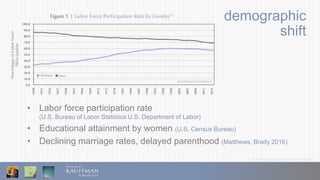
demographic
shift
• Labor force participation rate
(U.S. Bureau of Labor Statistics U.S. Department of Labor)
• Educational attainment by women (U.S. Census Bureau)
• Declining marriage rates, delayed parenthood (Matthews, Brady 2016)
© 2016 Ewing Marion Kauffman Foundation
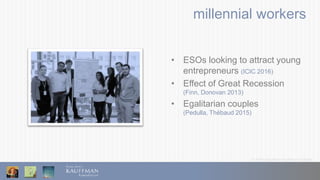
millennial workers
• ESOs looking to attract young
entrepreneurs (ICIC 2016)
• Effect of Great Recession
(Finn, Donovan 2013)
• Egalitarian couples
(Pedulla, Thébaud 2015)
© 2016 Ewing Marion Kauffman Foundation
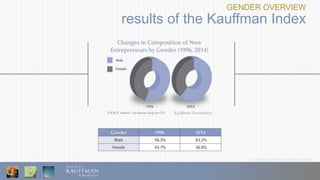
GENDER OVERVIEW
results of the Kauffman Index
© 2016 Ewing Marion Kauffman Foundation
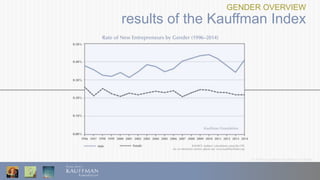
GENDER OVERVIEW
results of the Kauffman Index
© 2016 Ewing Marion Kauffman Foundation
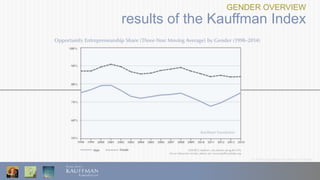
GENDER OVERVIEW
results of the Kauffman Index
© 2016 Ewing Marion Kauffman Foundation
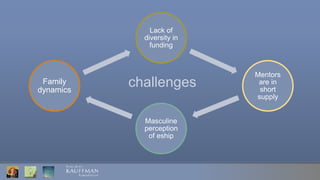
Lack of
diversity in
funding
Mentors
are in
short
supply
Masculine
perception
of eship
Family
dynamics
challenges
© 2016 Ewing Marion Kauffman Foundation
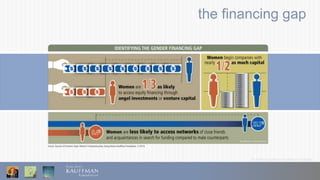
the financing gap
© 2016 Ewing Marion Kauffman Foundation
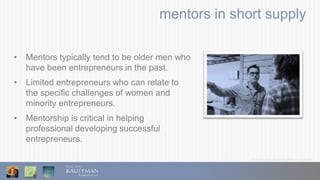
mentors in short supply
• Mentors typically tend to be older men who
have been entrepreneurs in the past.
• Limited entrepreneurs who can relate to
the specific challenges of women and
minority entrepreneurs.
• Mentorship is critical in helping
professional developing successful
entrepreneurs.
© 2016 Ewing Marion Kauffman Foundation
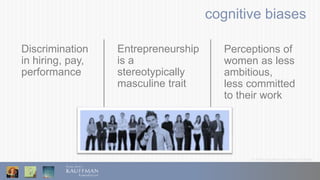
cognitive biases
Discrimination
in hiring, pay,
performance
Entrepreneurship
is a
stereotypically
masculine trait
Perceptions of
women as less
ambitious,
less committed
to their work
© 2016 Ewing Marion Kauffman Foundation
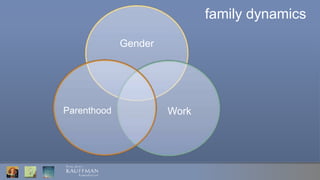
Gender
WorkParenthood
family dynamics
© 2016 Ewing Marion Kauffman Foundation
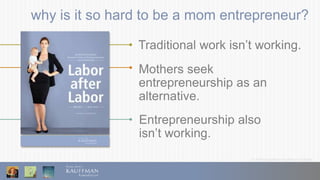
why is it so hard to be a mom entrepreneur?
Traditional work isn’t working.
Mothers seek
entrepreneurship as an
alternative.
Entrepreneurship also
isn’t working.
© 2016 Ewing Marion Kauffman Foundation
how can we address these challenges?
Public policy
Entrepreneurship support organizations
Advocacy
Future research
© 2016 Ewing Marion Kauffman Foundation
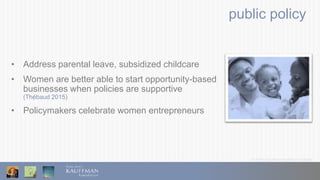
public policy
• Address parental leave, subsidized childcare
• Women are better able to start opportunity-based
businesses when policies are supportive
(Thébaud 2015)
• Policymakers celebrate women entrepreneurs
© 2016 Ewing Marion Kauffman Foundation
changing nature of work
• New platforms for work are rapidly
creating a new gig economy.
(Zysman, 2016)
• Many gig-workers must work multiple
jobs/have unreliable hours.
Challenges for these flexible workers are
similar to those of entrepreneurship.
© 2016 Ewing Marion Kauffman Foundation
entrepreneurship support organizations
• Provide family-friendly spaces
• Develop mentoring programs
• Counseling services to improve
family/spousal dynamics
• Celebrate women entrepreneurs
© 2016 Ewing Marion Kauffman Foundation
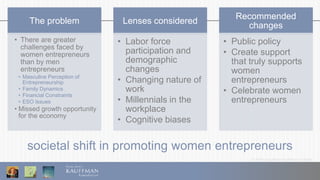
societal shift in promoting women entrepreneurs
The problem
• There are greater
challenges faced by
women entrepreneurs
than by men
entrepreneurs
• Masculine Perception of
Entrepreneurship
• Family Dynamics
• Financial Constraints
• ESO Issues
• Missed growth opportunity
for the economy
Lenses considered
• Labor force
participation and
demographic
changes
• Changing nature of
work
• Millennials in the
workplace
• Cognitive biases
Recommended
changes
• Public policy
• Create support
that truly supports
women
entrepreneurs
• Celebrate women
entrepreneurs
© 2016 Ewing Marion Kauffman Foundation
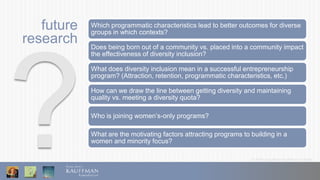
Which programmatic characteristics lead to better outcomes for diverse
groups in which contexts?
Does being born out of a community vs. placed into a community impact
the effectiveness of diversity inclusion?
What does diversity inclusion mean in a successful entrepreneurship
program? (Attraction, retention, programmatic characteristics, etc.)
How can we draw the line between getting diversity and maintaining
quality vs. meeting a diversity quota?
Who is joining women’s-only programs?
What are the motivating factors attracting programs to building in a
women and minority focus?
future
research
© 2016 Ewing Marion Kauffman Foundation
w w w. k a u ff m a n . o r g
© 2016 Ewing Marion Kauffman Foundation
#GES2016 | @AlexKrause | @EdSteidl
@KauffmanFDN | @Microsoft | @MicrosoftMIC
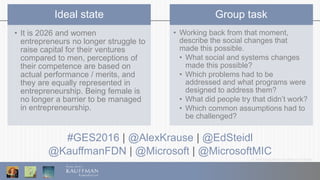
Ideal state
• It is 2026 and women
entrepreneurs no longer struggle to
raise capital for their ventures
compared to men, perceptions of
their competence are based on
actual performance / merits, and
they are equally represented in
entrepreneurship. Being female is
no longer a barrier to be managed
in entrepreneurship.
Group task
• Working back from that moment,
describe the social changes that
made this possible.
• What social and systems changes
made this possible?
• Which problems had to be
addressed and what programs were
designed to address them?
• What did people try that didn’t work?
• Which common assumptions had to
be challenged?