Saudi Arabia By Cecy Bateman  Grade 9 and  Mr. Nebel Eman Al-Ansari  World History I
Saudi Arabian History The Dynasty of Saudi Arabia was founded at the birth of 15 th  Century, only to be taken by the Ottomans in 1517 In the middle of the 18 th  Century, Abu I-Wahhab ( a religious leader) established Muwahhiduns, a sect that Saudi supported In 1865, a Civil War erupted, and the Saudi Arabian dynasty fell apart, and was divided between the Ottomans and different clans.
Saudi Arabian History cont. Oil was found in Dhahran in 1938, and oil explorations started in 1939.  With new money and publicity, King Ibn Saud was given the chance to fulfill his long awaited dream, and immediately began modernizing the country In 1940 to 1945, Saudi was listed as an Ally during the second world war Dhahran held a US airbase during this time.
Saudi Arabian History cont. In 1951, an agreement called the Aramco (Arabian American Oil Company) earned Saudi 50% of all earnings of oil In 1993, the US asked Saudi Arabia to pay the expenses for the Gulf War Saudi was having  severe economic problems, and the US owed 51 billion American dollars alone.
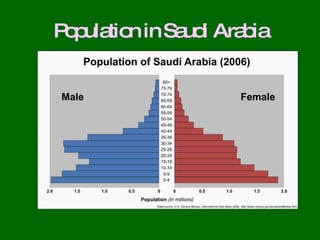
Demographics Many Saudis are ethnically Arabs. Saudi Arabia’s population today is expected  to be over 27 million including 5.5 million resident foreigners. In the past during 1960’s, most of the population were travelers. Because of rapid economic growth, more than 95% of the population are now settled.
Population in Saudi Arabia
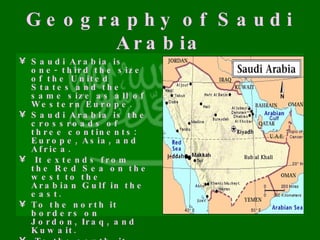
Geography of Saudi Arabia Saudi Arabia is one- third the size of the United States and the same size as all of Western Europe.  Saudi Arabia is the crossroads of three continents: Europe, Asia, and Africa. It extends from the Red Sea on the west to the Arabian Gulf in the east. To the north it borders on Jordon, Iraq, and Kuwait. To the south, it borders Yemen and Oman.
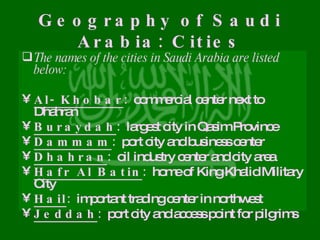
Geography of Saudi Arabia: Cities The names of the cities in Saudi Arabia are listed below: Al- Khobar :  commercial center next to Dhahran Buraydah :  largest city in Qasim Province Dammam :  port city and business center Dhahran :  oil industry center and city area   Hafr Al Batin :  home of King Khalid Military City   Hail :  important trading center in northwest Jeddah :  port city and access point for pilgrims
Geography of Saudi Arabia: Cities cont. Jubayl :  new industrial city on east coast Madinah :  holy city and funeral place of the Prophet Muhammad Makkah :   holiest city of Islam, where Muslims pray Riyadh :  capital of Kingdom of Saudi Arabia Tabuk :  large city near Jordan border Taif :  summer capital and mountain resort Yanbu :  new oil shipping terminal and trade city Abha :  largest city in Asir Province
Saudi Arabian Government Saudi’s Capital is Riyadh The legal system in Saudi is based on the Sharia’s Law They use Executive, Legislative, and Judicial Branches  Saudi is a monarchy (hereditary rule) that is led by King Abdullah Bin Abdul Aziz, who is the guardian of the two Holy Mosques and also the head of state. He is assisted by Prince Sultan Bin Abdul Aziz
Saudi Arabian Culture Saudi Arabia is a culturally diverse country Different nationalities live in this country such as Egyptians, Syrians, Lebanese, Sudanese, Pakistanis, Indians, etc. Men and Women dressed in cultural and religious dress. Women are forced to cover their head and bodies. Men were not supposed to talk to women or make an eye contact with them. It was severely restricted.  The dress of the Saudi men consisted of the thobe, a white gown, the agal, a black ring that holds the scarf, and the ghutra, a red and white, square- shaped scarf that covers the head. Women are not allowed to drive or ride bicycles on public roads
Human Rights in Saudi Arabia People in this Kingdom have no religious freedom. They have no right to change the government. The government strictly punishes those who abuse and beat other people. The kingdom have strict limitations on worker rights. Saudi women face strict discrimination in many aspects of their lives, including education, employment, and the justice system. Women are forbidden to testify in criminal events. Woman have to cover their bodies by wearing a black cloak, if they refuse, they would face a severe punishment. Women had no right to drive cars on public roads.
Saudi Arabian Holidays Saudi Arabia’s National Day is On September 23 Saudi Arabia practices and participates in Islamic Holidays. Eid al-Adha  (or “Feast of the Sacrifice”) During Eid al-Adha, Muslims give food, money, and help to the poor and needy. For the first three days after Ramadan, (Eid al-Fitr), Muslims feast and Celebrate the closure of another Month of Fasting.
Saudi Arabia and the Quran Most of Saudis population are Sunni Muslims who represent the branch of Islam that accepted the caliphate of Abu Bakr. The fifth pillar of Islam is the Hajj, or pilgrimage to Mecca, which is a city in Saudi Arabia. Muslims go there to pray for at least once in their lives. Muslims in Saudi Arabia follow the rules in the Sharia and the Quran that guides them in their religion lives. Most Saudis also follow the five pillars of Islam which is the most important part in the Muslim world. Most Saudis are religious and always stick to the rules included in the Sharia and in the Quran. As we read before, Saudi Arabia’s legal system is based on the Sharia.
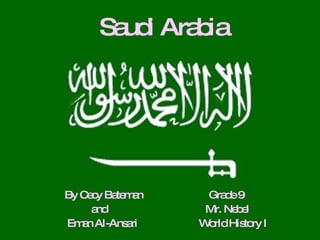
Saudi Arabia and the Quran cont. The color of Saudi Arabia’s flag is green and it has a large, white Arabic script translated as “There is no god but God; Muhammad is the Messenger of God.” This writing script came from the first pillar of the five pillars of Islam. It was the declaration of faith.

Saudi Arabia

  • 1.
    Saudi Arabia ByCecy Bateman Grade 9 and Mr. Nebel Eman Al-Ansari World History I
  • 2.
    Saudi Arabian HistoryThe Dynasty of Saudi Arabia was founded at the birth of 15 th Century, only to be taken by the Ottomans in 1517 In the middle of the 18 th Century, Abu I-Wahhab ( a religious leader) established Muwahhiduns, a sect that Saudi supported In 1865, a Civil War erupted, and the Saudi Arabian dynasty fell apart, and was divided between the Ottomans and different clans.
  • 3.
    Saudi Arabian Historycont. Oil was found in Dhahran in 1938, and oil explorations started in 1939. With new money and publicity, King Ibn Saud was given the chance to fulfill his long awaited dream, and immediately began modernizing the country In 1940 to 1945, Saudi was listed as an Ally during the second world war Dhahran held a US airbase during this time.
  • 4.
    Saudi Arabian Historycont. In 1951, an agreement called the Aramco (Arabian American Oil Company) earned Saudi 50% of all earnings of oil In 1993, the US asked Saudi Arabia to pay the expenses for the Gulf War Saudi was having severe economic problems, and the US owed 51 billion American dollars alone.
  • 5.
    Demographics Many Saudisare ethnically Arabs. Saudi Arabia’s population today is expected to be over 27 million including 5.5 million resident foreigners. In the past during 1960’s, most of the population were travelers. Because of rapid economic growth, more than 95% of the population are now settled.
  • 6.
  • 7.
    Geography of SaudiArabia Saudi Arabia is one- third the size of the United States and the same size as all of Western Europe. Saudi Arabia is the crossroads of three continents: Europe, Asia, and Africa. It extends from the Red Sea on the west to the Arabian Gulf in the east. To the north it borders on Jordon, Iraq, and Kuwait. To the south, it borders Yemen and Oman.
  • 8.
    Geography of SaudiArabia: Cities The names of the cities in Saudi Arabia are listed below: Al- Khobar : commercial center next to Dhahran Buraydah : largest city in Qasim Province Dammam : port city and business center Dhahran : oil industry center and city area Hafr Al Batin : home of King Khalid Military City Hail : important trading center in northwest Jeddah : port city and access point for pilgrims
  • 9.
    Geography of SaudiArabia: Cities cont. Jubayl : new industrial city on east coast Madinah : holy city and funeral place of the Prophet Muhammad Makkah : holiest city of Islam, where Muslims pray Riyadh : capital of Kingdom of Saudi Arabia Tabuk : large city near Jordan border Taif : summer capital and mountain resort Yanbu : new oil shipping terminal and trade city Abha : largest city in Asir Province
  • 10.
    Saudi Arabian GovernmentSaudi’s Capital is Riyadh The legal system in Saudi is based on the Sharia’s Law They use Executive, Legislative, and Judicial Branches Saudi is a monarchy (hereditary rule) that is led by King Abdullah Bin Abdul Aziz, who is the guardian of the two Holy Mosques and also the head of state. He is assisted by Prince Sultan Bin Abdul Aziz
  • 11.
    Saudi Arabian CultureSaudi Arabia is a culturally diverse country Different nationalities live in this country such as Egyptians, Syrians, Lebanese, Sudanese, Pakistanis, Indians, etc. Men and Women dressed in cultural and religious dress. Women are forced to cover their head and bodies. Men were not supposed to talk to women or make an eye contact with them. It was severely restricted. The dress of the Saudi men consisted of the thobe, a white gown, the agal, a black ring that holds the scarf, and the ghutra, a red and white, square- shaped scarf that covers the head. Women are not allowed to drive or ride bicycles on public roads
  • 12.
    Human Rights inSaudi Arabia People in this Kingdom have no religious freedom. They have no right to change the government. The government strictly punishes those who abuse and beat other people. The kingdom have strict limitations on worker rights. Saudi women face strict discrimination in many aspects of their lives, including education, employment, and the justice system. Women are forbidden to testify in criminal events. Woman have to cover their bodies by wearing a black cloak, if they refuse, they would face a severe punishment. Women had no right to drive cars on public roads.
  • 13.
    Saudi Arabian HolidaysSaudi Arabia’s National Day is On September 23 Saudi Arabia practices and participates in Islamic Holidays. Eid al-Adha (or “Feast of the Sacrifice”) During Eid al-Adha, Muslims give food, money, and help to the poor and needy. For the first three days after Ramadan, (Eid al-Fitr), Muslims feast and Celebrate the closure of another Month of Fasting.
  • 14.
    Saudi Arabia andthe Quran Most of Saudis population are Sunni Muslims who represent the branch of Islam that accepted the caliphate of Abu Bakr. The fifth pillar of Islam is the Hajj, or pilgrimage to Mecca, which is a city in Saudi Arabia. Muslims go there to pray for at least once in their lives. Muslims in Saudi Arabia follow the rules in the Sharia and the Quran that guides them in their religion lives. Most Saudis also follow the five pillars of Islam which is the most important part in the Muslim world. Most Saudis are religious and always stick to the rules included in the Sharia and in the Quran. As we read before, Saudi Arabia’s legal system is based on the Sharia.
  • 15.
    Saudi Arabia andthe Quran cont. The color of Saudi Arabia’s flag is green and it has a large, white Arabic script translated as “There is no god but God; Muhammad is the Messenger of God.” This writing script came from the first pillar of the five pillars of Islam. It was the declaration of faith.